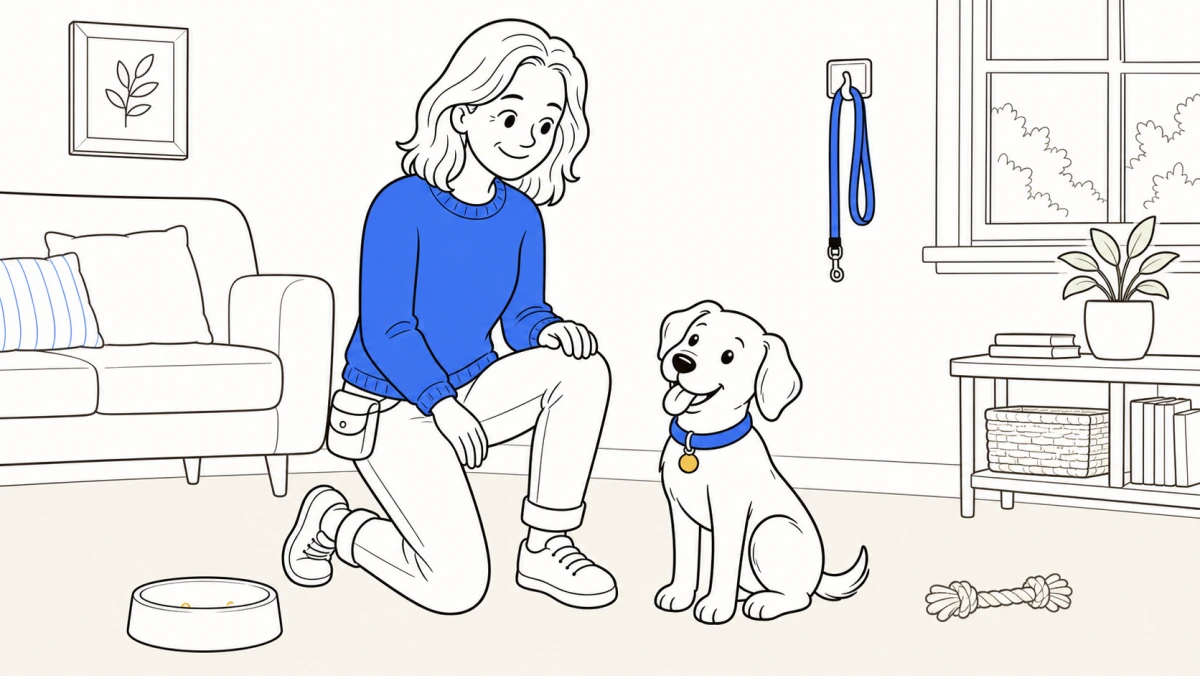
A puppy training schedule for the first week isn’t really a list of commands — it’s a daily rhythm of sleep, potty, food, and play, with a couple of two-minute training moments folded in. Get the rhythm right and most of the “training” takes care of itself. Here’s what a realistic first week actually looks like.
If you’re reading this the week your puppy came home — or the night before pickup, already wondering how you’ll fit “training” around work — here’s the relief: you don’t need a curriculum yet. Most “puppy training schedules” online are really schedules by age, mapping out weeks 8 through 16. In your first seven days, the useful plan is smaller and calmer than that. It’s the shape of the day: when your puppy sleeps, when they go out, when they eat, and where a tiny bit of training fits without taking over the rest of your day.
What should a puppy’s first-week schedule actually include?
Four things, repeated: sleep, potty breaks, food, and play — with two or three two-minute training moments tucked inside the play. In week one you’re building a rhythm, not teaching a syllabus. The commands can wait a few days; the routine can’t, because everything else — house-training, calmer evenings, a puppy who can settle — hangs off it.
That order matters. A puppy runs on a simple loop all day: wake, pee, eat or play for a short burst, then crash for a nap. The loop repeats every couple of hours. The American Kennel Club’s own daily-routine guidance is built around exactly this cycle, and notes that a predictable routine is one of the best ways to head off behavior problems before they start (AKC). Your job in week one is to protect that loop, not pack it.
What does a realistic first-week daily routine look like?
Like the same short cycle on repeat: outside to potty, a little food or play, a two-minute training moment if there’s room, then a nap — roughly every two to three hours. The clock doesn’t matter and the times below are only an example; puppies don’t read clocks, and you’ll train whenever you’re home. What matters is the sequence and the spacing; the hour is yours to set.
| Point in the day (example — shift to your hours) | What’s happening |
|---|---|
| First thing | Straight outside to potty — puppies need to go the moment they wake |
| After the first potty | Breakfast (meal 1 of about four), then back out to potty within 10–15 minutes |
| Mid-morning | Short play + one two-minute training moment (charge the marker, name game), then a nap |
| Midday | Potty, meal 2, gentle handling or a new-sound introduction, nap |
| Afternoon | Potty, meal 3, short play + a two-minute session, a longer nap |
| Late afternoon | Potty, meal 4, calm play — winding down rather than revving up |
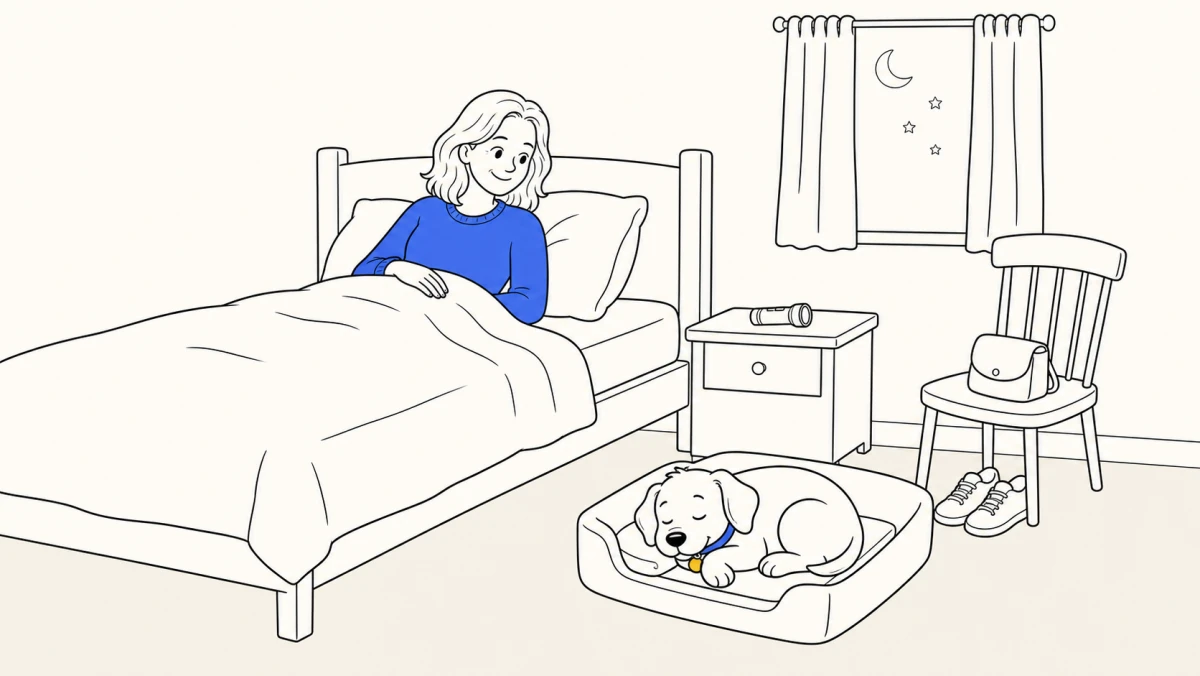
| End of day | Last potty, then settle in the crate near you |
| Overnight | Expect at least one potty trip — an 8-week-old can’t hold it all night |
Those four meals aren’t arbitrary: at 8–12 weeks the AKC’s feeding guidance puts a puppy on about four small meals a day, dropping to three by around 3–6 months (AKC). Space them across the loop rather than one big bowl.
Notice what’s missing: long training blocks. In week one, “training” is a handful of two-minute moments riding on top of a routine that’s mostly sleep and potty trips. Everything below is just the reasoning behind each piece of that loop.
How much sleep does a puppy need in its first week?
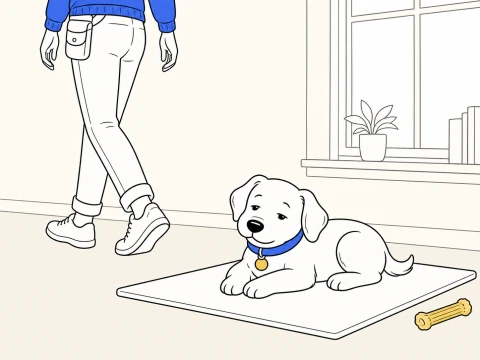
Far more than most new owners expect — around 18 to 20 hours a day at 8 weeks old, in naps scattered across the whole day and night (AKC). Protecting those naps is the single most underrated job of week one, because an overtired puppy doesn’t wind down — it winds up. And when it’s time to wind down for the night, capping the day with settling and sleep is its own small skill.
The American Kennel Club puts a young puppy’s sleep at roughly 18–20 hours a day, with individual naps running anywhere from 30 minutes to two hours (Jan Reisen, AKC). Skip them and you get what the r/puppy101 community has names for: the “witching hour,” or, less kindly, “demon time” — the late-day stretch where a tired puppy turns into a biting, zooming tornado. It reads like bad behavior; it’s usually just exhaustion. As the AKC notes plainly, “too much stimulation and exhaustion can lead to unfortunate behavior.” So the move is to schedule the nap that heads the meltdown off before it starts. (More on that pattern in why does my puppy go crazy at 6pm?)
How often should you take a new puppy out to potty?
In week one, roughly every couple of hours during the day — plus right after every wake-up, meal, drink, and play session — and at least once overnight. A rough rule of thumb from the AKC: a puppy can hold its bladder about one hour for each month of age, so an 8-week-old (two months) tops out around two hours between trips.
That “one hour per month of age” guideline (AKC) applies to daytime hours only. Overnight is a different story: an 8-week-old simply can’t last the night yet, so plan for at least one middle-of-the-night trip and treat it as plumbing, not a setback. Take your puppy to the same spot each time, and the instant they finish, reward it — a click or a bright “yes” and a treat, right there. Never punish an accident: as the AKC’s Mara Bovsun puts it, scolding after the fact “isn’t going to do much,” while praising the right thing “works best.” Accidents in week one are a given; clean them up without a fuss and move on. The full house-training method — the schedule math, confinement, and nighttime accidents — is in how do you potty train a puppy?; this week is about starting the rhythm, not perfecting it.
How much training should you actually do in the first week?
Almost none, by the standards of a training plan — and that’s correct. Two or three sessions of about two to three minutes each, spread across the day, is plenty for an 8-to-12-week-old puppy; their focus doesn’t stretch much further than that (The Training of Dogs). Week one’s training is really just three small things: teaching the marker, the name, and maybe a first sit.
Short and often beats long and rare — puppies this age are commonly recommended two-to-three-minute sessions rather than one long drill, because attention at 8–12 weeks is measured in a couple of minutes (The Training of Dogs). That’s the same short-and-spaced principle in how long should puppy training sessions be?. What actually fits in week one:
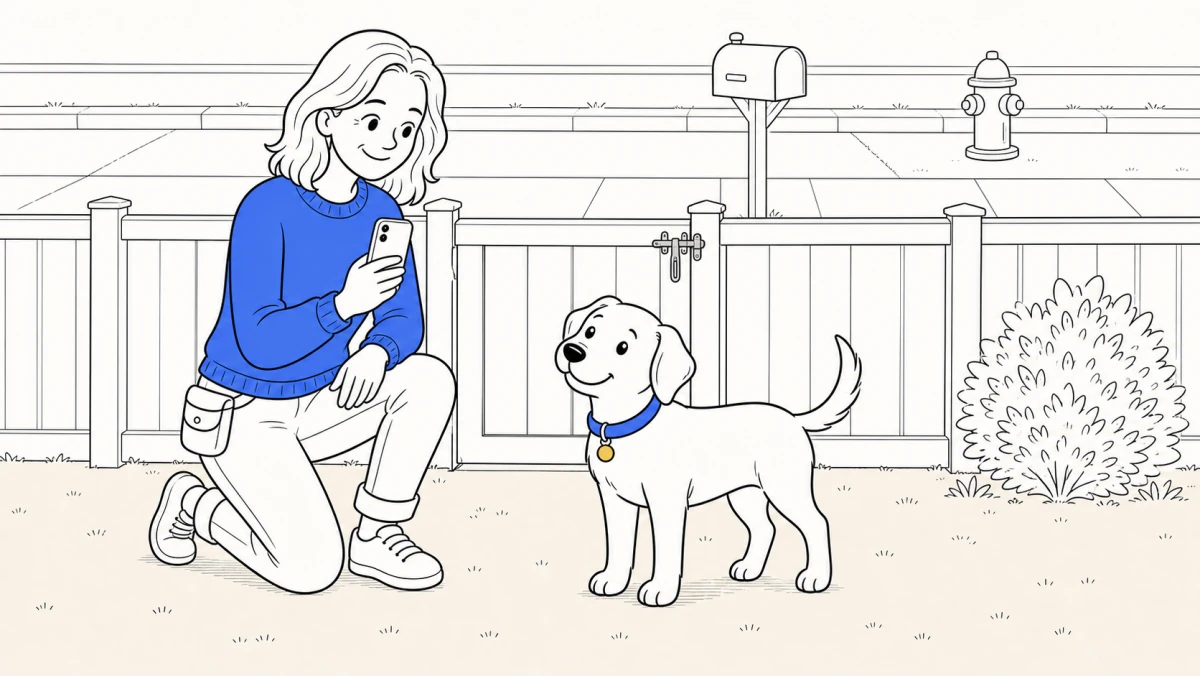
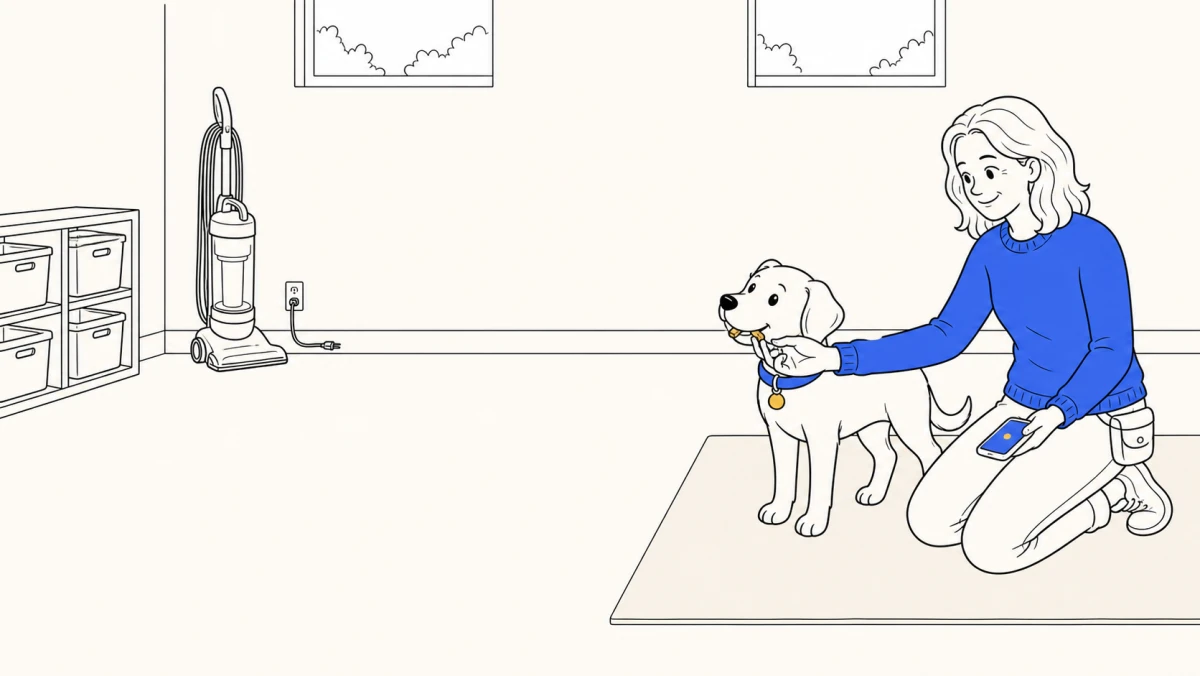
- Charge the marker. Click, then treat, a handful of times, until your puppy’s head snaps to you at the sound — the “charging” step Karen Pryor describes as a few Pavlovian click-treat pairings, not the hundreds an old lab tradition once demanded (Pryor, clickertraining.com). AVSAB’s 2021 guidance names either a clicker or a verbal “yes” as an equally valid marker (AVSAB, 2021), so use whichever you’ll keep to. Walkthrough: clicker training on day one.
- Play the name game. Say the name once, brightly; the moment your puppy looks, mark it and pay. See how to teach a puppy its name.
- Maybe a first sit — if an easy moment for it comes up. There’s no rule you have to get there in seven days: how to teach a puppy to sit.
None of this needs an app. A marker, a handful of treats, and two spare minutes will do it. Where a coach like ClickerPup is meant to help is next: choosing which two-minute session fits your puppy today, and reading how it went, instead of handing you the same generic week-8 checklist every other Labrador gets.
How does the schedule change after the first week?
Less than the schedule-by-age charts suggest — at least at first. Week two looks a lot like week one: the same sleep-potty-food-play loop, just with slightly longer awake windows and one or two more skills folded in as the early ones stick. The real week-by-week change isn’t the daily shape; it’s socialization and adding cues.
Most “puppy training schedule by age” guides do map the 8-to-16-week stretch into phases — the AKC’s own puppy training timeline runs from the socialization window through the obedience milestones of the months that follow (AKC). That’s genuinely useful later. In the first two weeks, though, the honest version is simpler. Keep the routine, stretch sessions from two minutes toward three or four as your puppy matures (The Training of Dogs), and start gentle, positive socialization now rather than waiting. AVSAB’s position is that socialization should begin before the vaccination series is finished — as early as 7–8 weeks — because behavior problems, not infection, are the leading cause of death in dogs under three (AVSAB, 2008). In practice that means calm exposure to new sounds, surfaces, and people at home this week, built up gradually. For the deeper evidence — including why the “window” gets quoted more rigidly than the research supports — see the puppy socialization window. When you’re ready to add real cues, the first five puppy commands is the natural next step up from here.
When is it more than a rough first week?
A rough night or two, accidents, mouthing, and a clingy or overwhelmed puppy are all normal week-one territory — not signs you’re doing it wrong, and not something a stricter schedule fixes. A few specific things do warrant a same-week call to a vet or a certified behavior professional rather than a wait-and-see: the red flags below, which are about health and safety, not the ordinary chaos of a new puppy settling in.
Get help sooner rather than later if you see a stiff, frozen body paired with growling or snapping that keeps escalating, or physical signs — vomiting, real lethargy, refusing to eat at all — that point to something medical rather than behavioral. Genuine panic when left alone (not the normal settling fuss of the first nights) is separation distress, which needs a professional’s eyes, not more time shut in a crate. AVSAB is clear that only reward-based methods should be used, with no evidence aversive tools work better in any context (AVSAB, 2021). So decline anyone who suggests a shock or prong collar for a puppy this age. For the fuller line between normal and not, see is my puppy normal, or should I get help?, and find a certified professional through the IAABC (iaabc.org).
The bottom line
Your puppy’s first week runs on a rhythm. Protect the naps, keep the potty trips frequent, feed on a schedule, and let “training” be two or three tiny, happy moments a day. Do that and you’re not behind — you’ve built the thing every command later depends on. The syllabus can start next week. This week, the schedule that works is mostly sleep, potty, food, play, and a puppy who’s learning that being near you is the best part of the day. The teaching can wait. When you’re ready for it, the hard part won’t be the clicker — it’ll be knowing which two-minute session fits your dog today, and whether it landed. That’s the one part we’re building ClickerPup to take off your plate.