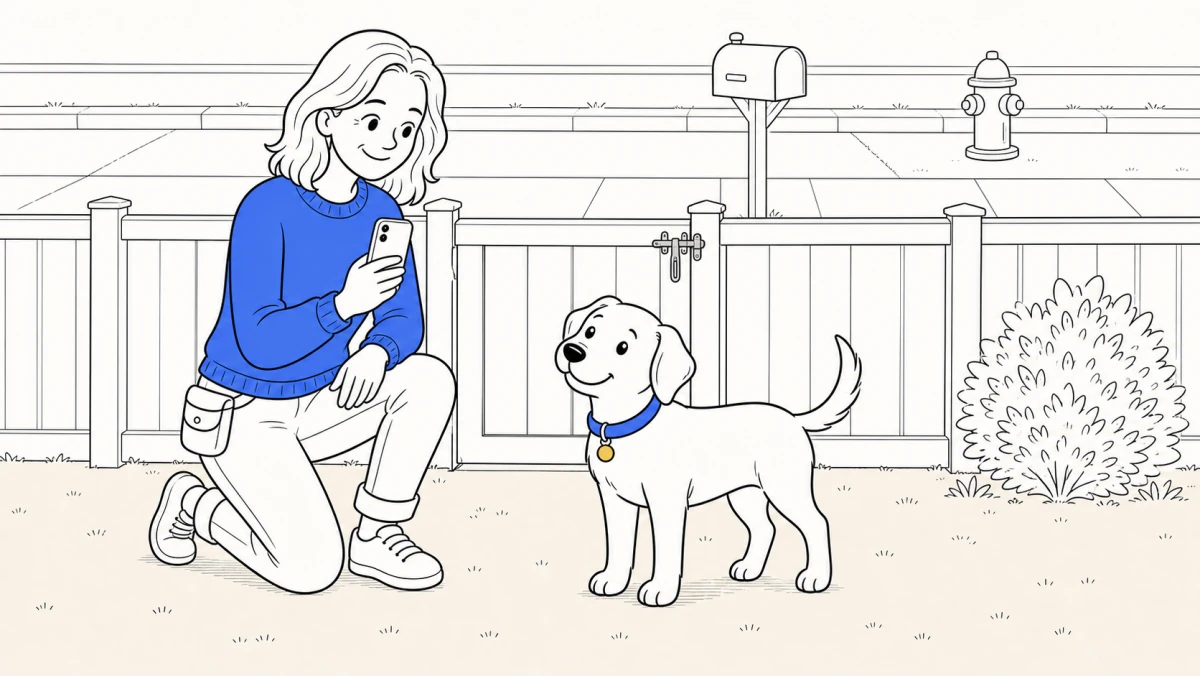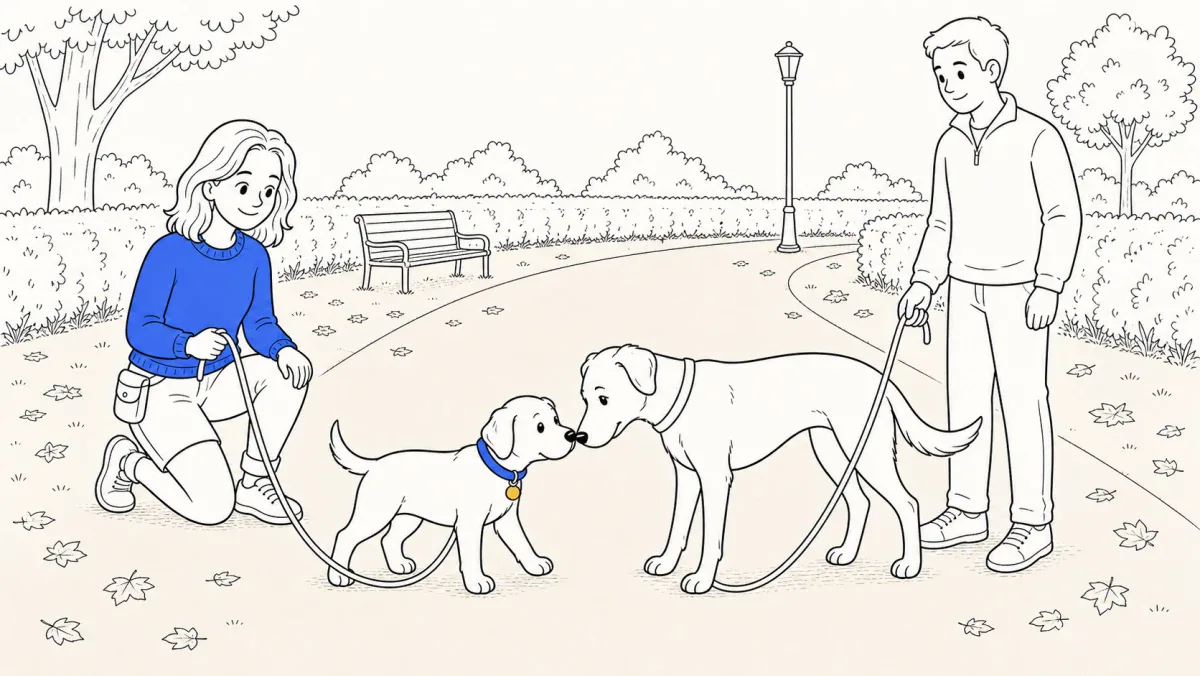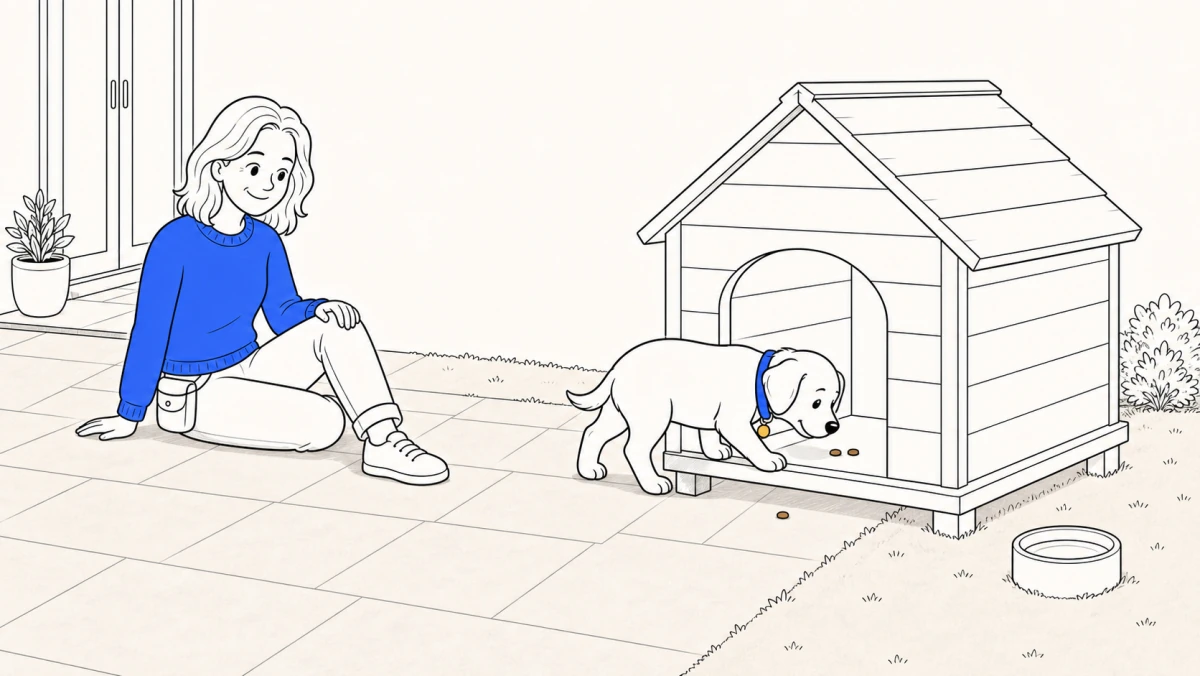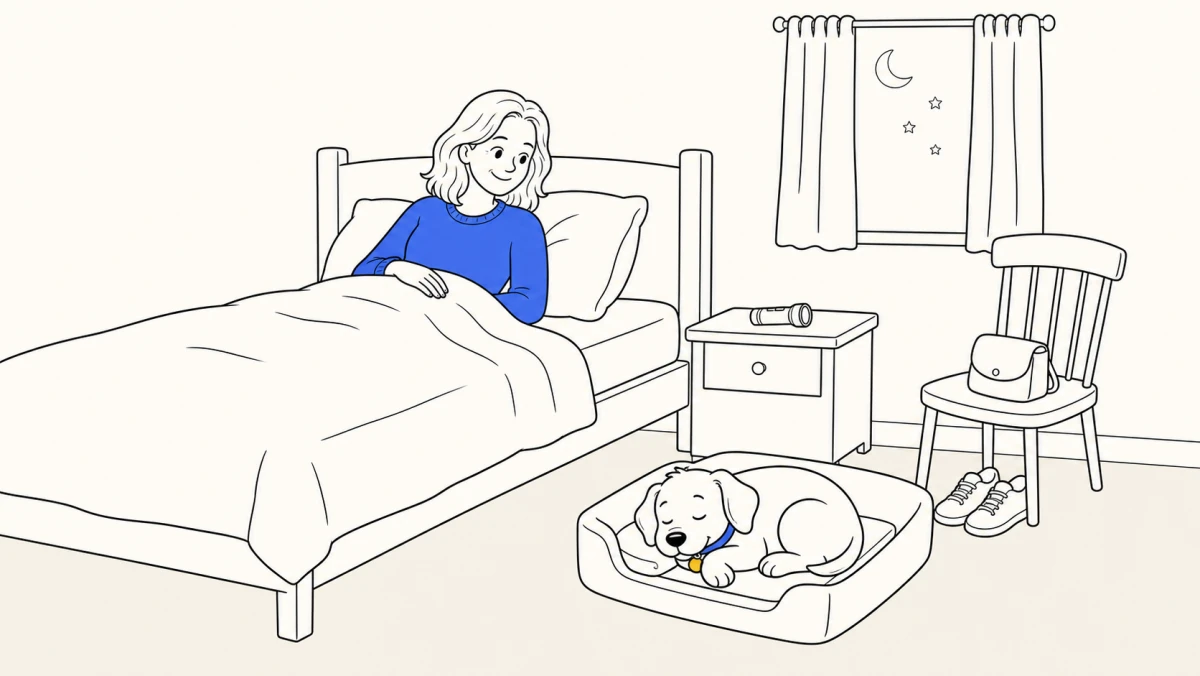
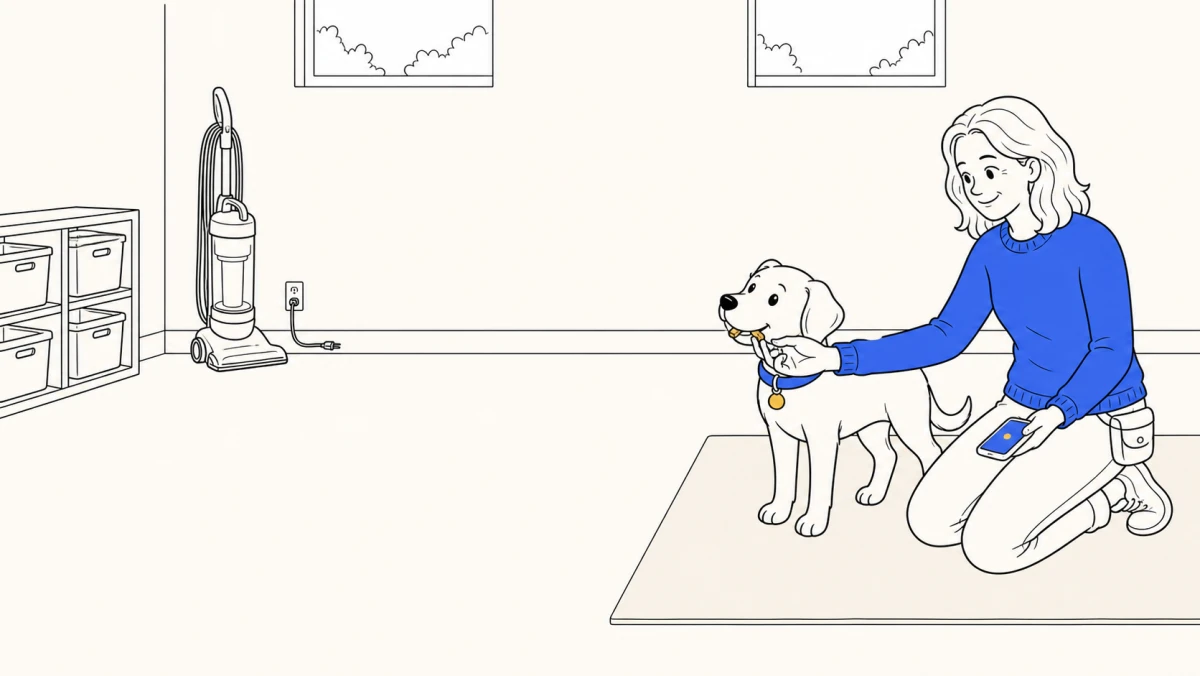
A puppy socialization checklist for 8–16 weeks works better as eight categories than as a hundred boxes: surfaces, sounds, people who look and move differently, handling, other animals, traffic and travel, short stretches alone, and vet handling. Run each one only for as long as your puppy keeps taking food and keeps choosing to move toward the thing. That criterion, not a count, is what decides whether an exposure helps.
If you’re watching the weeks tick toward sixteen and feeling quietly certain you’re already behind, the count was never the thing to be behind on. A checklist can tally exposures. It can’t record what actually decides whether one helps or backfires: how your puppy felt while it was happening. The American Veterinary Society of Animal Behavior (AVSAB) puts that limit in the same sentence as the instruction, and its 2021 statement files badly run exposure in the same list as choke chains and shock collars.
What should a puppy be exposed to between 8 and 16 weeks?
Eight categories, each standing for a class of thing your puppy will meet for the rest of their life: surfaces and spaces, sounds, people who look and move differently, handling, other animals, traffic and travel, being briefly alone, and the vet.
Six of the eight are AVSAB’s, not ours. Their 2008 position statement asks for handling from birth so a puppy learns “to accept manipulation of all body parts,” “a variety of surfaces, tunnels, steps, chutes,” as many car trips as possible, and — easy to overlook — scheduled time to “play alone with their favorite toys” or “take naps in safe places such as crates or puppy pens,” which AVSAB says “may help to prevent problems of over attachment to the owners.”
Sounds and vet handling aren’t in that statement. Sounds are here because a 2022 systematic review of canine socialization (McEvoy et al., Animals) reports one category where early exposure to a stimulus correlated with later fear of it — noise (Blackwell, Bradshaw and Casey, 2013) — a pattern the review attributes to bad early experiences rather than to exposure as such, which is exactly why the sound row is run at a volume your puppy keeps eating through. Vet handling is here because AAHA’s developmental checks include how a dog behaves in an exam room, and that is a thing you can practice before it matters.
The instruction the rest hangs off is a single sentence. During the first three months, AVSAB says, puppies “should be exposed to as many new people, animals, stimuli and environments as can be achieved safely and without causing overstimulation manifested as excessive fear, withdrawal or avoidance behavior.” The first half is what gets printed on checklists. The second half is what decides the outcome, and the right-hand column below is that half, applied.
| Category | Examples to work through | How to run it so it counts |
|---|---|---|
| Surfaces and spaces | Grass, gravel, tile, wood, a metal drain cover, a wobbly doormat, stairs, a car ramp, a new room, a dark hallway | Let your puppy choose to step on it. Put the food at the near edge so approaching is their idea. |
| Sounds | Vacuum, hairdryer, blender, doorbell, traffic, a dropped pan, rain on a window | Start far enough away, or quiet enough, that your puppy keeps eating. Volume control matters more here than anywhere else on the list. |
| People who look and move differently | Hats, hoods, beards, sunglasses, high-visibility vests, umbrellas, walking sticks, wheelchairs, uniforms, a running child at a distance | People ignore the puppy and let the puppy approach. No crowding, no reaching over the head, no passing them around. |
| Handling | Ears, paws, mouth, tail, a collar hold, a brush, nail clippers touched but not used, being lifted, being toweled off | One body part, two or three seconds, food, stop. Do it while your puppy is already sleepy. |
| Other animals | One calm vaccinated adult dog, a settled cat behind a barrier, horses or livestock at a distance, birds | Known, healthy, calm animals only, introduced one at a time. AVSAB says to avoid “dog parks or other areas that are not sanitized and/or are highly trafficked by dogs of unknown vaccination or disease status.” |
| Traffic and travel | Car rides, bikes, strollers, scooters, a bus going past, a grocery-store parking lot seen from the car | Short and boring, and not always to the vet. Drive somewhere pleasant and come home again. |
| Being briefly alone | Thirty seconds behind a baby gate with a stuffed food toy, working up to a nap in a pen while you’re in the next room | Go while they’re still settled and come back before they get worried. Build up a few seconds at a time. |
| Vet handling | A ride to the parking lot and home, a weigh-in and out again, a treat on the scale, the sound of clippers | Ask your clinic whether you can bring your puppy in for a weigh-in where nothing medical happens. |
A note on the dates: AVSAB puts the primary window at “the first three months of life,” so eight-to-sixteen weeks isn’t a research boundary — it’s the part of the window you actually own, plus the weeks just after it. Why the twelve-week cutoff gets quoted far more precisely than the data supports is covered in what the research actually says about the socialization window.
Eight categories, sixteen weeks, and no requirement to finish. A puppy who has met four surfaces calmly is in better shape than one who has met forty badly.
Which socialization categories can you do before your puppy is fully vaccinated?
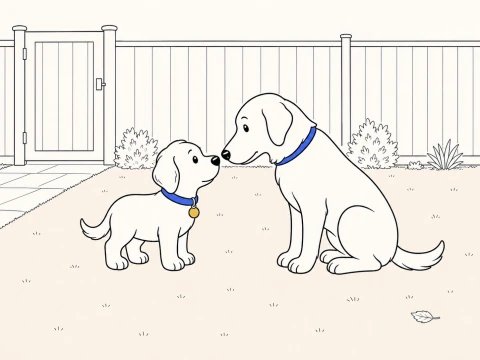
Most of them, in a modified form, and the decision is your vet’s rather than ours. Five of the eight never leave the house — handling, sounds, surfaces at home, brief alone-time, and visitors — so they’re available immediately. The other three are the ones that need your vet’s read on your area: other animals, traffic and travel, and vet handling.
Waiting has a cost of its own, which is why both bodies push early. AVSAB’s position is “that it should be the standard of care for puppies to receive such socialization before they are fully vaccinated.” The American Animal Hospital Association (AAHA) puts the tradeoff in a line: “The risks attendant with missing social exposure far exceed any disease risk,” with “no medical reason to delay puppy and kitten classes or social exposure until the vaccination series is completed as long as exposure to sick animals is prohibited, basic hygiene is practiced, and diets are high quality.”
The practical move, and Ian Dunbar’s original one, is to bring the world to the puppy rather than the puppy to the world: “Capitalize on the time your pup needs to be confined indoors by inviting people to your home.” That matters most for the people category, which is usually the one owners worry about and is one of the five you can run at home.
What we won’t do is tell you which shots your puppy needs or when. That’s a clinical decision, it depends on your puppy and where you live, and your vet has the final word on where it’s safe to take them. Ask at the next appointment; they’ll have a view, and it beats ours. The ground rules that come with going out early — clean ground, no dog parks, no dogs of unknown vaccination status — are set out in the socialization window article.
How do you fit socialization into ten minutes a day?
Attach it to things you’re already doing, and run one category a day rather than a session. Most of a good socialization week isn’t outings at all — it’s noticing that the garbage truck is a sound, the front step is a surface, and the mail carrier is a person.
Nothing in the sources below prescribes a schedule, so the shape here is ours rather than anyone’s protocol:
- Pick one category — surfaces, sounds, people, handling, other animals, traffic and travel, alone-time, or the vet. Just one.
- Do two or three short repetitions, spread across the day, rather than one long push. Ninety seconds is plenty, and the same stop condition applies: end it when your puppy stops eating or stops moving toward the thing. It’s the same reason puppy training sessions work better short.
- Piggyback. Carry your puppy to the door when a delivery arrives. Sit on the front step for two minutes while traffic goes past. Do paws while they’re already dozing.
- Do one familiar thing for every new thing. A repeat of something your puppy already found easy isn’t a wasted rep — it’s the one that builds the expectation that new things go fine.
- On a bad day, stay in. Two minutes of ear-and-paw handling while your puppy is dozing is a complete day’s socialization.
The “being briefly alone” row quietly needs the most runway, and it overlaps with getting your puppy to settle and sleep. For where all of this sits in a day alongside sleep, potty trips, and meals, there’s a first-week puppy training schedule; the supplies-and-settling side is in the new-puppy checklist for your first week.
How do you tell if socialization is working or backfiring?
Watch three things: whether your puppy still takes food, whether they move toward the thing or away from it, and how quickly they go back to normal afterward. All three are drawn from how the 2015 AAHA Canine and Feline Behavior Management Guidelines tell veterinary teams to separate normal development from problematic development.
AAHA’s table pairs the two directly:
| Normal development (AAHA) | Problematic development (AAHA) |
|---|---|
| “Approaches unfamiliar people” | “Will not approach/actively avoids unfamiliar people” |
| “Approaches and/or plays with other friendly and/or solicitous animals” | “Doesn’t interact or play with other solicitous animals, avoids them or responds aggressively to their solicitations for play” |
| “Not fearful of most noises and recovers quickly from exposure to loud noises” | “Fearful of many noises and does not immediately recover from exposure to loud noises” |
| “Takes treats and explores exam room” | “Doesn’t take treats, hides, freezes, or panics in the exam room” |
Cell text quoted from AAHA (2015), Table 4, which AAHA adapts from Overall’s Manual of Clinical Behavioral Medicine for Dogs and Cats; the column labels are AAHA’s own categories. Four of its five rows shown.
AAHA’s right-hand column isn’t a stop-for-today signal. It’s AAHA’s problematic-development list, and anything sitting in it routes to a vet or a veterinary behaviorist rather than to another repetition.
The harder problem is the quieter signals, and AAHA names that too: “Clients easily recognize trembling, shaking, and high-pitched vocalization as signs of distress but may not recognize less overt signs.” The rest of their list is where the quieter ones sit — the ones you’ll otherwise walk straight past:
| What you’ll see | AAHA’s wording |
|---|---|
| Licking lips or nose with no food around | “Lip licking” / “Nose licking” |
| Yawning when your puppy isn’t tired | “Yawning” |
| Going completely still | “Immobility, ‘freezing,’ profoundly decreased activity” |
| Pacing, or suddenly can’t settle | “Pacing, profoundly increased activity” |
| Eyes flicking around the environment | “moving eyes and/or head across the environment to continually monitor all activity” |
| Won’t look at you, or stares past you | “Inability to meet a direct gaze” / “Staring at some middle distance” |
| Turns their head or body away from whoever’s approaching | “Body language of social disengagement (i.e., turning head or body away from signaler)” |
| Head or neck dropped, ears down, body low | “Lowering of head or neck” / “Ears lowered” / “Body posture lower than normal” |
| One front paw lifted and held | “Lifting paw in an intentional movement” |
AVSAB’s 2021 statement, describing dogs trained with aversive methods, reaches for much the same vocabulary: “tense body, lower body posture, lip licking, tail lowering, lifting front leg, panting, yawning, and yelping.”
One caution before you start diagnosing. A single yawn near a nap is a yawn, and a lip lick near a sandwich is a lip lick. You’re looking for several at once, in a context that explains them, in a puppy who was fine ten seconds earlier.
What do you do the second your puppy looks worried?
Make it easier before you do anything else, and if that doesn’t land within a few seconds, end the session and go home.
Here’s the one rule that decides whether this is an adjustment or a phone call. It’s ours, built on the guidance below, and it holds everywhere else on this page: within a session, if making it easier brings your puppy back — eating again, looking again, moving forward again — you’ve found the setting that works and the session continues there. Across sessions, if the same thing needs more help than it did last week — more distance, lower volume, or a shorter go — or no amount of help brings your puppy back at all, stop running that exposure and get it looked at.
AVSAB’s 2021 position puts a floor under the first half: “The learner must always feel safe and have the ability to ‘opt out’ of training sessions.” Backing off isn’t indulgence, and it isn’t a lost rep. A puppy who turns away from the person in the high-visibility vest has told you the distance is wrong; the fix is to move, not to coax.
The mechanism is in AAHA’s own definitions. Desensitization works by exposing an animal “to a worrisome stimulus at a level below that which will trigger the response,” and counterconditioning pairs that stimulus “with something that the dog or cat likes and wants.” Every good exposure in the category table is those two things at once: far enough away that nothing frightening happens, close enough to notice, with food arriving while your puppy looks.
Can socializing a puppy the wrong way make things worse?
Yes — and the mechanism has a name. Pushing a worried puppy through an exposure instead of easing it stops being socialization and becomes flooding, which the veterinary guidance treats as actively harmful rather than merely unhelpful.
What is flooding, and why is it never recommended?
Flooding is exposure at a level that triggers the fear response instead of staying under it. AAHA defines it as “prolonged exposure to the worrisome stimulus at a level that causes the anxious, aggressive, or fearful response in the hope that simply by presenting the stimulus continuously, the undesirable behavior will stop.” Their verdict runs to four words: “Flooding is never recommended.”
The reason is that it does the opposite of what it looks like it’s doing. In a distressed animal, AAHA says flooding “actually sensitizes the patient to the stimulus and worsens it by causing shutdown or collapse,” and repeated inescapable unpleasant experiences can produce learned helplessness, in which an animal ceases “offering any behaviors because they learn they have no control over outcomes.” A puppy who has gone quiet and still in the middle of a busy street market may not be coping. They may have stopped trying.
Applied to a checklist, the guidance is blunter still: “Continuing to expose fearful puppies in the guise of ‘socializing them’ instead sensitizes them.” AAHA calls the outcome by its name — overexposure making a fearful dog worse is “creating a behavioral emergency.”
AVSAB’s 2021 statement makes the same point from the training side. Listing the techniques a good trainer avoids, it names “pain (choke chains, prong collars, or electronic shock collars),” intimidation, physical correction — and, in the same list, “flooding (‘exposure’).” The scare quotes are theirs.
What does the field evidence say?
The field evidence supports socializing early and is specific about how to run it, with caveats it insists on itself. A 2022 narrative systematic review of canine socialization in Animals (McEvoy et al.) collects it, and one of its findings needs reporting carefully.
The most misread result in this literature is one the review has itself corrected. What it now concludes is that “mere simple introductions, i.e., exposures to unfamiliar dogs in a public park, may actually have more deleterious effects” on later behavior and on a dog’s ability to cope with stress “when compared to more controlled, structured introductions during events like puppy classes.” That is a finding about structure, not about timing.
The evidence underneath it is Wormald and colleagues (2016), who surveyed owners of 783 pet dogs about their puppies’ early public exposure. The review reports “actually no protective advantage of earlier or more frequent public exposure on the development of aggression as adults,” and that “every week an owner waited to expose their puppy to public areas, the more reduced the odds were” that the puppy would show aggression toward unfamiliar dogs as an adult. Read alone that looks like an argument for waiting. It isn’t — the review’s own conclusion is that unstructured park introductions, not early introductions, are what carry the risk. The review issued a published correction in 2023 revising how it had originally described this study, so anything written about it before then may say the opposite.
Blackwell, Bradshaw and Casey (2013), working from 3,897 postal surveys plus 383 structured interviews, found early exposure to particular noises was associated with fear of those noises in adulthood — a result the review reads as being about bad early experiences rather than about exposure itself, and the reason the sound row is run at a volume your puppy keeps eating through. The review’s general lesson: “aversive experiences with noises or other dogs may contribute to adverse reactions to these stimuli in later life, highlighting the need for positive interactions with potentially aversive stimuli in early life.”
Two caveats, both the review’s own. These are questionnaire studies, so they identify “correlations and not causations.” And none of it argues for staying home — the weight of the review runs hard the other way. Tiira and Lohi (2015) found, in a survey of 3,264 dogs, that fearful dogs had fewer socialization experiences; Hakanen and colleagues (2020), across 13,700 dogs, found those showing frequent non-social fear had had less socialization as puppies; Puurunen and colleagues (2020) found the same for fear of other dogs and of strangers; and Casey and colleagues (2014) found puppy-class attendance was associated with reduced risk of aggression toward unfamiliar people. Choose who your puppy meets, and from how far away.
How many people should a puppy meet before 12 weeks?
A 2022 systematic review of canine socialization (McEvoy et al., Animals) names no target count anywhere across the 29 studies it assessed, and the figure people usually cite has an author rather than a study behind it. It’s Ian Dunbar’s: “As a rule of thumb, your puppy needs to meet at least a hundred people before he is three months old.”
He calls it a rule of thumb himself, on his own site, and it’s a reasonable one — it pushes owners toward variety at the age when variety is cheapest. But it isn’t a research finding. The review screened 1,036 identified papers down to the 29 that passed its quality assessment, and across those 29 it names no target count at all; what it asks for instead is that “puppies should not be overwhelmed” during the socialization period, with the intensity of stimulation adjusted to the puppy’s stage of development. (Twelve weeks isn’t a hard edge either, which is the window article’s subject.)
So aim for variety over volume: a handful of people who look and sound genuinely different from each other, met calmly, beats a crowd of near-identical ones met in a blur. One hundred is a fine ambition to have and a terrible thing to feel behind on.
How do you know your puppy’s socialization is on track?
You’ll know from the trend: the same thing, at the same distance, recovered from faster this week than last. That answers the question actually sitting under the checklist, which is usually less “have I done enough?” than “is any of this working?”
Which means the only record worth keeping has three fields. What it was, how close or loud it was, and how your puppy was thirty seconds after it ended — “garbage truck, across the street, back to sniffing in ten seconds.”
Recovery earns the third slot because it’s the one thing AAHA writes into its normal-development wording as a rate rather than a state — “recovers quickly from exposure to loud noises” — which is what gives you a direction of travel instead of a snapshot. It also doubles as an early-warning system, which is the log’s real job: a gap that widens week over week is the earliest signal you will get, and it is the one the rule above acts on.
If you’ve started a puppy log before and abandoned it by day four, you’re in normal company, and this isn’t that. Eight lines a week in your phone’s notes app is the whole commitment.
How do you socialize a puppy who’s already past 16 weeks?
The same eight categories, with four adjustments — and no, it isn’t too late. AVSAB’s position is that owners of puppies past the first three months “are strongly encouraged to continue to socialize their puppies to as many people, pets, and locations as is practical,” which is encouragement to keep going rather than a promise that the timing made no difference. What the research does and doesn’t settle about a late start belongs to the window article; this is what to do about it.
- Fewer categories, more repetitions. Pick the three your dog’s actual life needs — usually people, traffic, and handling — and do those properly.
- Start further away than you think you need to. A later start often means a puppy who already has opinions, and opinions need more distance.
- Expect each item to take longer. That’s ordinary at this age, and it isn’t evidence you’ve failed.
- Don’t compress. Cramming to catch up is the exact route to the sensitization described earlier, so a slower plan is the one that avoids going backwards.
When is a fearful reaction a reason to get help rather than more practice?
When your puppy is beginning to withdraw from interactions, or showing outright fear instead of warming up. One more, and it’s the rule from earlier restated because this is where it gets used: when the same thing needs more help week over week — more distance, lower volume, a shorter go — or no amount of help brings your puppy back.
The first two aren’t our thresholds — they’re AAHA’s, and stated firmly: “Clients should be advised that any dog either beginning to withdraw from interactions or exhibiting outright fear should not have more exposure unless recommended by their veterinarian. If the behavior is extreme, a veterinary behavior specialist should be consulted.” AVSAB’s socialization statement ends on the same note: “owners of puppies displaying fear should seek veterinary guidance.”
Move on this sooner than you would for most puppy problems. Most of them tolerate a wait-and-see week; this one doesn’t, because the window you’re working inside is time-limited and AAHA is direct that “patients do not outgrow pathologic fear.”
Our guide to what’s normal and when to get help covers where the line sits generally. For this specifically, in this order:
- Your vet first. AVSAB’s owner-facing line is exactly that: “owners of puppies displaying fear should seek veterinary guidance.” A vet visit also rules out pain, which is worth excluding before anything is called behavioral.
- Then a certified behavior consultant. AVSAB’s 2021 statement, answering how a veterinarian should choose a training referral, says trainers with involvement in organizations such as the International Association of Animal Behavior Consultants (iaabc.org) “should be recommended whenever possible.” IAABC’s own standards of practice say the organization “strongly opposes the intentional use of aversive stimuli and requires members to refrain from using shock in training or behavior modification.”
- Then the specialist tier. Where a trainer can’t move a behavior, AVSAB sends them on to “a veterinarian, board-certified veterinary behaviorist, or certified applied animal behaviorist” — which is the level to ask for if the first two rounds don’t shift it.
- Decline aversives at any tier. If anyone proposes a shock, prong, or choke collar for a frightened puppy, find someone else: AVSAB names all three among the tools a reward-based trainer avoids, in the same list as flooding.
Where does clicker training fit into a socialization checklist?
Clicker training sits underneath the checklist, doing the paying. Socialization isn’t a trainable skill — there’s no cue, no criteria to raise, nothing to put on a fluency ladder — and it’s worth saying plainly that ClickerPup doesn’t ship it as a training track. It’s a companion habit that runs alongside training, which is why it’s a checklist and not a lesson plan.
What is trainable is the mechanic the whole page rests on: marking the exact half-second your puppy chooses to look at the strange thing rather than away from it, and paying that choice before the moment passes. AVSAB names “a clicker or verbal marker to mark the behavior” among the ordinary tools of reward-based training, and a marker exists because getting food to a dog inside half a second is otherwise very hard. If the idea is new, what clicker training is and whether it works is the overview, and charging the clicker is the short setup that makes the sound mean anything.
The bottom line
Eight categories, a few calm repetitions of each, and one rule that outranks the others: the exposure ends when your puppy stops taking food or stops moving toward the thing, not when the list says it’s finished. Pick tomorrow’s category now, decide where you’ll stand, and put the treats in your pocket before you leave the house.
ClickerPup doesn’t coach socialization — no app should pretend a checklist is a curriculum. What we’re building it to coach is the mechanic underneath: the marker, the timing, and paying the choice you want repeated, in two-minute sessions that take how the last one went into account. The clicker itself stays free, with a plain reminder before anything ever charges.
Claim my early spot and we’ll bring you in as we open up.