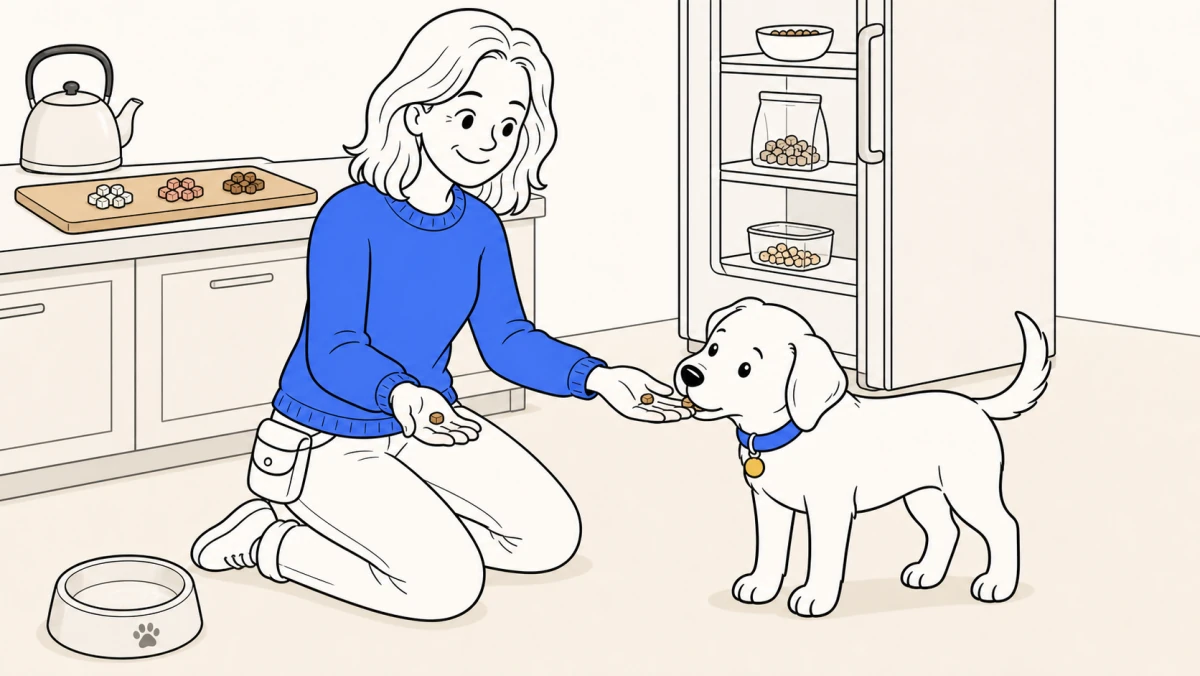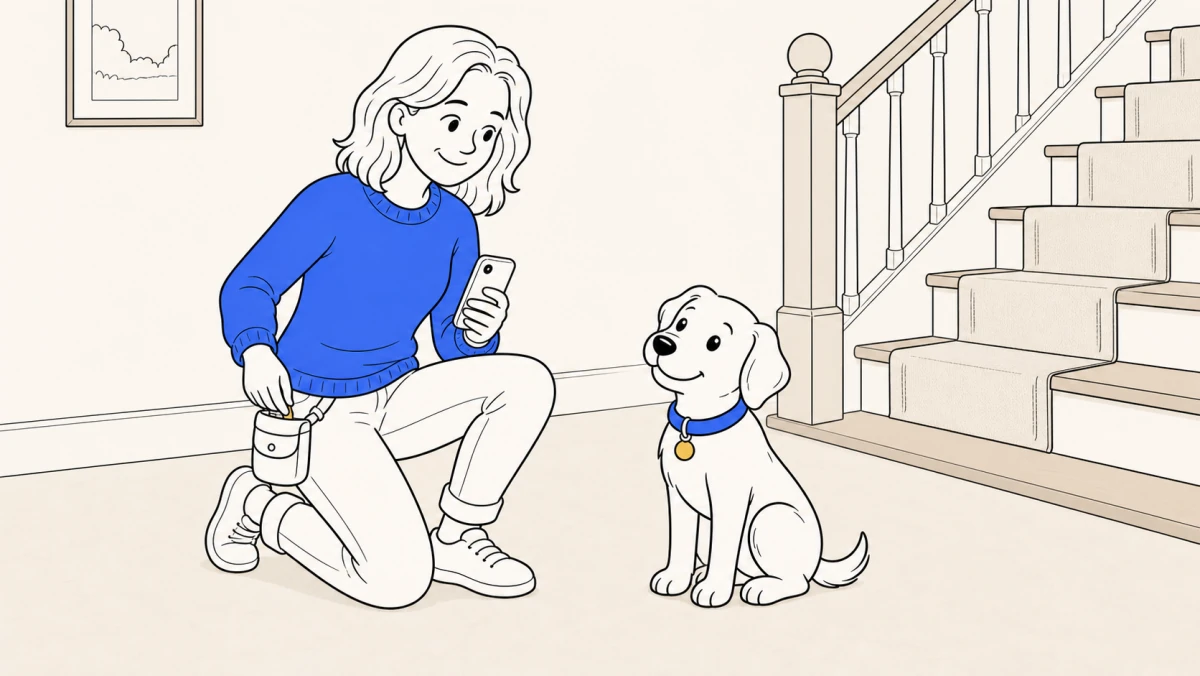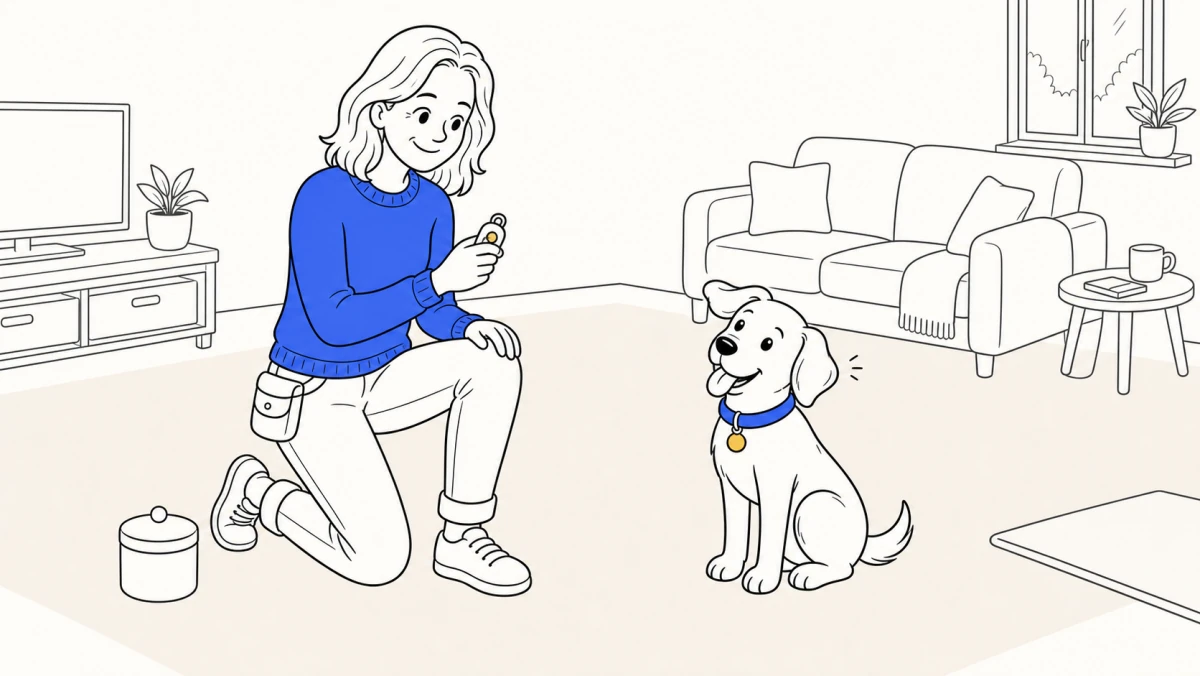
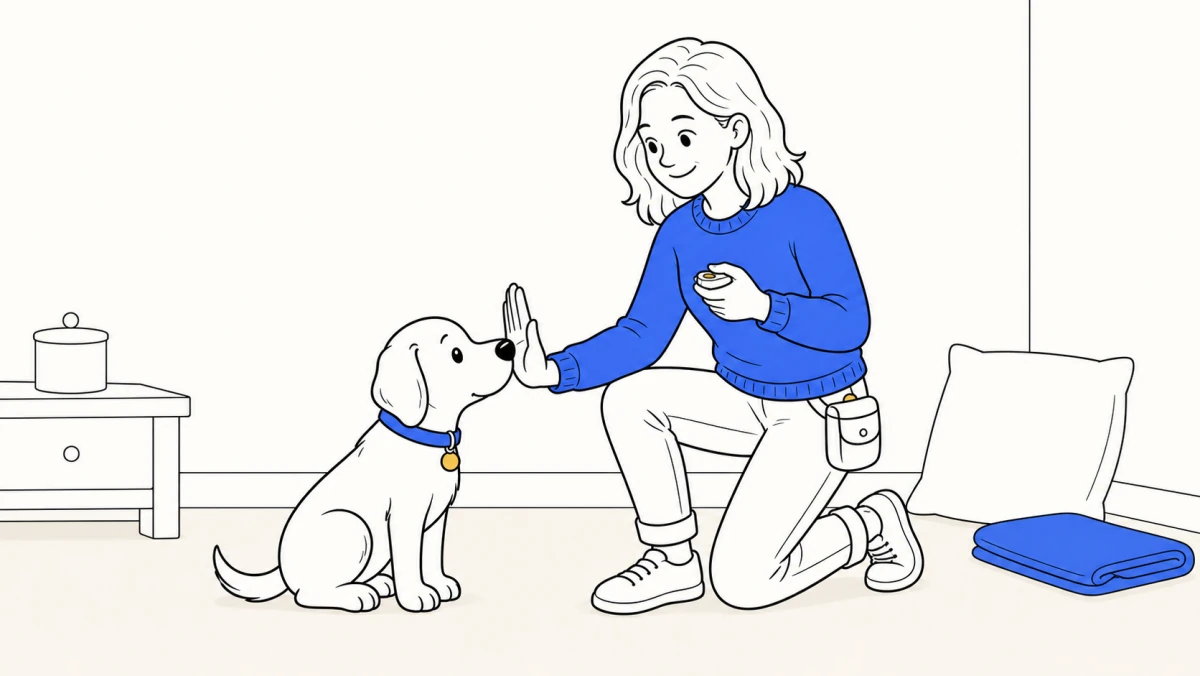
Day one of clicker training has two jobs: charge the clicker — click, then treat, a handful of times, then a quick test to check your puppy perks up at the sound — then teach a hand target — puppy touches their nose to your open palm. One short session each. Most puppies get a first win the same day.
If you’re picking up a clicker for the first time, the worry underneath it is usually the same: what if I mess up the timing and teach the wrong thing? Worth knowing before you start — Karen Pryor’s own troubleshooting rule for stuck beginners is blunt: “if you are not making progress with a particular behavior, you are probably clicking too late.” That’s it. Not a broken dog, not a broken method — a fixable half-second, and this page exists to help you land it.
What does the click actually do?
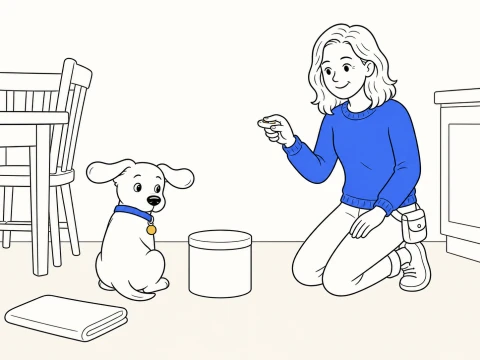
A clicker is a bookmark. It marks the exact instant your puppy did the thing you liked, and it promises a treat is coming. The click doesn’t teach; the reward teaches. The click just tells your puppy precisely which half-second earned it.
That precision matters more than it sounds. In a PhD study at the University of Waikato, dogs learning a new behavior succeeded about 60% of the time when the reward came immediately — but only about 25% when it arrived just one second late. When an immediate marker bridged that one-second gap, about 40% still learned. A beginner’s hands are never as fast as a beginner’s puppy; the marker buys back the timing you don’t have yet.
Now the honest part, which most clicker articles skip: the clicker itself is not magic. Gilchrist et al. (2021) split dogs into three groups — clicker plus food, a spoken word (“chee”) plus food, and food alone — and all three learned, with no clicker advantage. AVSAB’s humane-training guidance says “a clicker or verbal marker.” So if you’d rather say a crisp “yes!” than carry a plastic box, that’s a legitimate equal — charge it exactly the same way. What is load-bearing: good timing, and a real treat after every mark.
Step 1: How do I charge a clicker?
“Charging” just means teaching your puppy that the click predicts food. It’s the five-minute foundation everything else sits on.
- Get a quiet room and a small pot of pea-sized, soft treats (soft, so there’s no crunching intermission).
- Click, then immediately give a treat. Your puppy doesn’t have to do anything — this isn’t a test, it’s an introduction.
- Repeat a handful of times — Karen Pryor’s own instruction is “two or three” — then move to the test below. Click, treat. Click, treat.
- Run the charge test: wait until your puppy isn’t staring at you, click once, and keep your hands still. If they perk up and look for the treat — charged. If not, do a few more pairs and test again.
If you’ve read that charging takes 200 repetitions, relax: Karen Pryor called that number “a useless leftover of a laboratory procedure.” Her own instruction is brief — two or three pairings, then test. The honest caveat is that the exact count is genuinely debated beyond that — applied studies have used anywhere from about 20 to 100 pairings — so if your puppy needs more than a handful before the test comes back bright, that’s normal too. The test is what tells you you’re done, not any specific tally.
One rule from day one, forever: every click gets a treat. Cimarelli et al. (2020) found that partially rewarding clicks didn’t make dogs learn any faster — and it was linked to a more pessimistic mood state. If your thumb slips and you click by accident, pay up anyway. The click is a promise.
What if my puppy is scared of the clicker?
Muffle the clicker in your pocket or behind your back, use a softer-model clicker, or switch to a verbal “yes” — then charge your gentler marker the same way. Nothing is lost. Some puppies startle at the sharp sound — common enough that it fills whole forum threads — and it doesn’t mean clicker training is off the table; it just means your puppy is one of the ones who does better with a softer marker.
Step 2: How do I teach the hand target, my puppy’s first trick?
“Touch” — puppy boops their nose to your open palm — is the classic first skill because it’s nearly impossible to fail, it’s done in one short session, and it later becomes the backbone of recall. Here’s the whole thing:
- Hide a treat in one hand behind your back.
- Present your other hand — open palm, flat and still — a couple of inches from your puppy’s nose.
- Most puppies lean in to investigate. The instant the nose touches your palm: click.
- Treat from the other hand. Then move your palm to a new spot and offer it again.
- Do 5–8 touches, about two minutes, and stop while your puppy is still keen.
The click-point is everything: click at the moment of contact — not while they approach, not after the head pulls back. Clicking late is the single most common beginner error, and it’s the difference between teaching “touch the palm” and teaching “wander off afterward.”
What if the hand target isn’t working?
| Problem | Fix |
|---|---|
| Puppy bites the hand instead of nosing it | Click only nose contact; present the palm flat and briefly; calmly withdraw if teeth arrive; lower the excitement |
| Puppy won’t approach the hand | Rub a treat on your palm, click the sniff, then fade the scent over a few reps |
| You keep clicking late | Click at contact, not after — decide before you present the palm |
| Puppy loses interest in the hovering hand | Present-and-remove; keep it a quick game, not a standoff |
And if your puppy just isn’t showing a light-bulb moment — that’s normal too. Very young puppies often don’t have a visible “aha” for a while even when the training is working. Persist; don’t switch methods after one quiet session.
Worth knowing where “normal” ends: mouthing your hand during this game is ordinary teething, not aggression. That’s different from a stiff, frozen body, growling, guarding over food or toys, or a bite that breaks skin from a dog older than about six months — those deserve a professional, not a training tweak. Here’s a fuller guide to what’s normal and when to get help.
How long should day-one training sessions be?
Short sessions are the whole culture of this method: a couple of minutes at a time, a few times a day, always stopping on a win. For an 8–12-week-old puppy, around two minutes is plenty — practitioner guidance converges on roughly one to five minutes across puppyhood. There is no schedule to fall behind on, and “one short session” is always the unit — whenever it happens to fit your day.
Two practical notes on treats: keep them pea-sized and soft, and count them out of the day’s food rather than on top of it — common veterinary guidance caps all treats around 10% of daily calories. And a puppy who refuses food isn’t being stubborn; they’re too excited, too full, or too tired. Make it easier, or try again later.
What has my puppy actually learned on day one?
By the end of one day you have a charged marker, a puppy who’s earned a first win, and — usually within a session or two — the real magic moment: your puppy starts offering the touch, choosing the game before you ask. That’s not a party trick. That’s a dog who has learned that trying things makes good stuff happen, and it’s the exact foundation the next months of training — their name, sit, settle, recall — get built on. Not bad for two short sessions.
Where to go next: the first five commands worth teaching is the map for the weeks after day one. And if you want to know what “trained” actually means before you start — because “he does it in the kitchen” and “he does it at the park” are not the same dog — that’s what trained to reliable means.
If turning tomorrow’s skill into its own short, right-sized session — one that adapts to how today’s charge-and-target actually went — sounds useful, that’s exactly the gap we’re building ClickerPup to fill.