
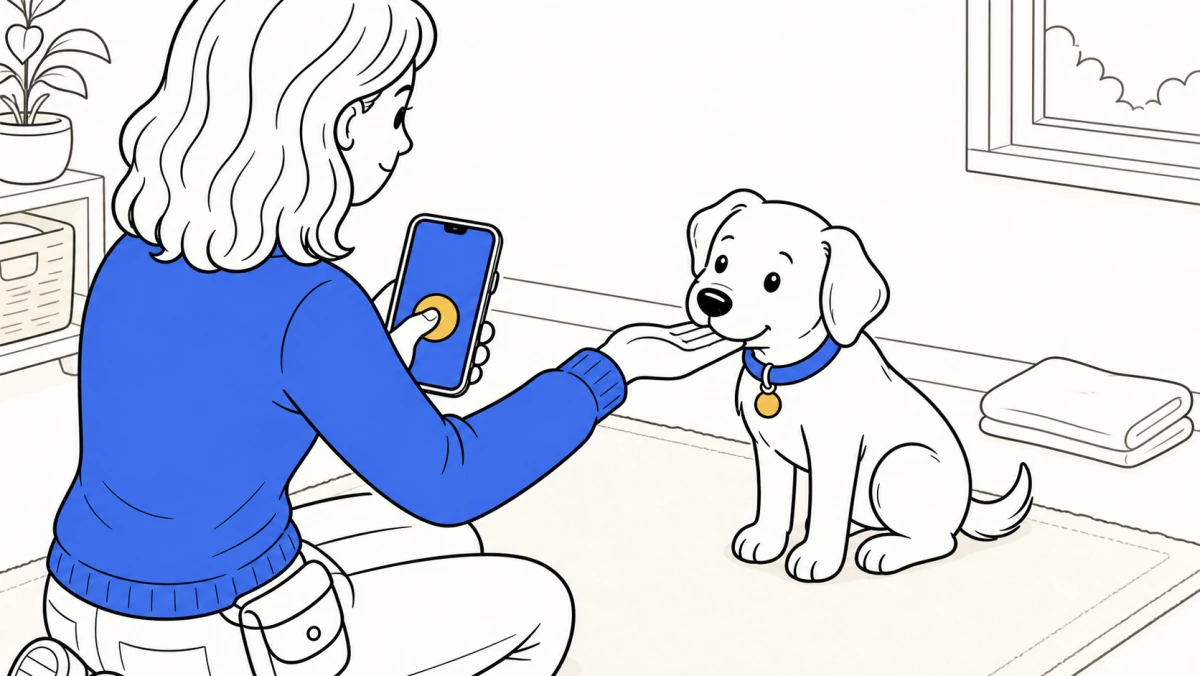
ClickerPup trains your puppy with clicker training — the reward-based marker method — measured against a published standard instead of a lesson list. Your phone becomes a real clicker. Every session ends with three taps about how it went. And the next session changes because of them, until each skill is Reliable: 4 of 5, two sessions running, at the level you rated.
If you’ve tried a training app before, you already know the pitch — and you know how it went. They all say they personalize, and they all hand you the same lessons. So this page isn’t a pitch. It’s the method with its working shown: what happens in the first five minutes, what the app measures, the exact moment it will call a skill trained, and what its AI is — and isn’t — allowed to do. And every claim is specific enough to check for yourself the day you first open the app. That’s deliberate.
Why do training apps keep giving you the same lessons?
Because almost every training app measures the wrong thing: your progress through its content, not your dog’s behavior. Lessons completed, streaks, badges — the dog is not in the data. And an app that doesn’t measure the dog can’t adapt to the dog, so “personalized” quietly collapses into the same track as every other puppy of your breed and age.
We checked. In July 2026 we swept the listings and claims of ten of the best-known puppy training apps — five of them we also review openly, prices and billing traps included. Every one claims personalized training. In every case but one, “personalized” demonstrably means an onboarding quiz that routes you onto a fixed track by breed and age. And not one of the ten publishes a definition of what “trained” means. A finished lesson isn’t a trained dog — but a lesson list has no way of knowing the difference.
Kneeling on the floor with a handful of treats, you only ever have two questions: Is this working for my dog? and When is she actually trained? Everything on this page exists to answer those two questions with measurements instead of vibes.
What happens in the first session?
The first session — charging the clicker, then your first skill — is about five minutes, and it ends with your puppy doing something on purpose. That moment is the entire method in miniature.
First you charge the clicker: click, then treat, a handful of times, until the sound alone makes your puppy look up for food. Karen Pryor — who brought clicker training to the world — put it at two or three pairings, then a test: one click, hands still. That’s the part that matters, and it’s why the app doesn’t count reps at all. It asks what your dog did, because an uncharged clicker is only a noise, and ClickerPup never starts training with a noise.
Then you teach the hand target — “Touch,” the skill most puppies land in a single session. Hold out your palm; the instant a curious nose touches it, click, then treat. And then the thing happens that this method is built on: your puppy looks at your hand, thinks, and pushes their nose into it again — to make you click. Nobody lured them. Nobody pushed them. They chose to do it, and you taught them.
Pryor documented this decades ago: once a dog understands the click, it will start offering the behavior spontaneously, trying to get you to click. That first offered touch is training changing direction — a puppy working out what earns the reward and doing it on purpose. Everything else on this page is engineering to keep that moment coming, session after session. (Here’s that first session, step by step.)
When will the app say a skill is trained?
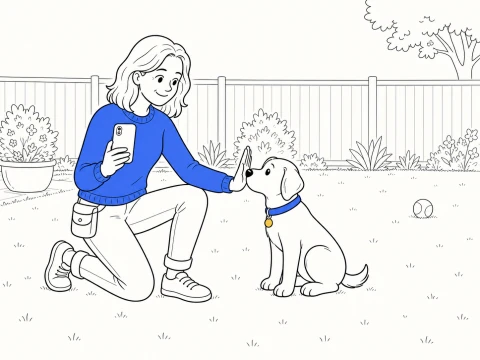
When the skill passes a published bar — not when you finish the lessons about it. Every skill in ClickerPup moves through four stages, shown plainly in the app: First try → Practicing → Most times → Reliable. And Reliable has a definition you can read: 4 of 5, two sessions running, at the level you rated. The engine underneath is stricter than it sounds: only sessions your dog actually found easy — you rated it easy, or your dog got it first try — count toward the bar. Two mediocre sessions can never mint a Reliable.
Reliable also doesn’t transfer for free. Every owner knows the dog who “knows sit” in the kitchen and loses it completely at the park. So the app raises exactly one thing at a time — a new room, the yard, a mild distraction — and the bar resets at each step: Reliable must be re-earned at every new level of difficulty.
Trainers call the destination fluency — when a skill actually works: first ask, most places, no lure in your hand. Behavior science named that concept decades ago; Karen Pryor’s own academy teaches it. What ClickerPup adds is measurement: a consumer app that trains toward fluency against a published bar, measured on your own dog. Measured, not guessed. That is the whole method in one line — we call it the Puppy Fluency Method — and the rest of this page is how it works in practice.
One honest limit, stated plainly: Reliable is computed from your own logged sessions. Nobody independent has watched your dog, and if you rate sessions generously, you’ll mint an easier Reliable. That’s why the bar is published and every plan change shows its math — the standard keeps you honest with yourself; it doesn’t police you. If you want an outside judge, AKC’s S.T.A.R. Puppy and Canine Good Citizen are real, respected tests, and a dog trained to Reliable is being prepared for exactly that kind of test.
How does the plan actually adapt to my dog?
Every session ends with three taps: how it felt (easy / okay / hard), how your dog responded (first try / a few attempts / needed help), and the session’s clicks, already logged as you marked. That’s the whole ask. What happens next is the part none of the ten apps we checked could show us: the why.
A deterministic engine — the same code on your phone and on our servers, so it works offline and never disagrees with itself — reads your two ratings (the app logs every click, but it’s how the session went for your dog that drives the plan) and picks the next session from a fixed decision ladder:
- Two hard sessions in a row? One step easier.
- One rough session? Same skill, a touch easier. A rough session is data, not failure.
- A previously Reliable skill wobbled? A quick refresher goes back into the plan.
- Away for a couple of days? The next session eases back onto familiar ground. No guilt, nothing lost.
- Easy, first try? Your dog moves up.
“Up” never means the same drill again, just louder. Within each stage, every skill climbs named micro-steps that raise exactly one criterion at a time — for Touch: first touches → a new spot each time → heights and sides → on the word “touch.” One-criterion-at-a-time is the classic “splitting” principle from Karen Pryor’s shaping lineage, written into the curriculum so it never depends on your guesswork.
And the app shows its work. Close a session and the next card names what you logged and exactly what it changed:
“You marked it easy, first try — so tomorrow Luna moves up: Touch — a new spot each time.”
(“Tomorrow” means your next session, whenever that is. We follow the dog, not a calendar.) That receipt is the difference between personalization you’re promised and adaptation you can see. The next session changes because of what your dog did in the last one — and it tells you why. ClickerPup is in pre-launch; if that’s the loop you wished your last app had, the waitlist is open.
Is this based on real science, or is that just a badge?
It’s load-bearing. Each part of the method exists because of a specific, checkable finding — and where the evidence is thin, we say so instead of rounding up.
- Why a marker at all? Timing. In a University of Waikato study, dogs learning a new behavior succeeded about 60% of the time when the reward arrived immediately — and only about 25% when it came just one second late. An immediate marker bridging that gap brought success back to about 40% (Browne, 2015). A beginner’s hands are slower than a beginner’s puppy; the click buys back the timing you don’t have yet. That’s why the clicker is this product’s core instrument, not a sound effect.
- Why reward-based only? The evidence goes one way. AVSAB’s 2021 position recommends reward-based methods for all dog training and states there is no evidence aversive methods work better. In a study of 92 companion dogs, the aversive-trained group showed over 13 times more lip-licking, about 8 times more yawning, and a real rise in cortisol compared with reward-trained dogs (Vieira de Castro et al., 2020). ClickerPup’s AI coach declines aversive-tool questions outright, every time.
- Why don’t we claim the clicker is “faster”? Because for everyday cues, it isn’t. The handful of controlled studies to date find no reliable advantage for the clicker device over a well-timed “yes” or well-timed food on simple cues (Gilchrist et al., 2021; Dorey & Cox, 2018) — the timing, the consistency, and the always-paid reward do the work. Where a marker genuinely earns its keep is complex, precise behavior (Lazarowski et al., 2025). So the app engineers the mechanics the studies say matter — timing, rate, one-criterion steps — and treats a verbal “yes” as a full equal, not a compromise.
That honesty is a feature of the method, not a disclaimer on it. A plan built on “the clicker is magic” would be easy to market and wrong; a plan built on timing, reward, and measured steps is what the evidence actually supports. The full picture — including where popular claims outrun the science — is on our science page: What is clicker training, and why does it work?
What’s a real clicker doing inside my phone?
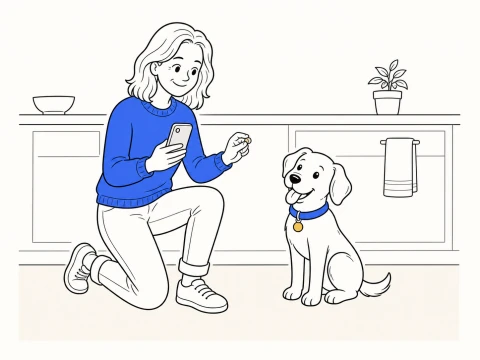
The engineering the marker deserves. A physical box clicker makes two sounds — a crisp click as the button goes down, a softer clack as it springs back — and that double transient is what a charged marker sounds like to a dog. ClickerPup reproduces both. The sound plays from four pre-armed audio voices rotated in turn, so rapid presses never queue behind a busy player, with a target of under 50 milliseconds from tap to click. It fires even with the iPhone ringer switched to silent, works over Bluetooth, and if audio ever fails it falls back to a haptic pulse and a visual flash — the marker never silently does nothing mid-session.
It also deletes the most repeated real-world clicker complaint owners actually make: juggling. Clicker in one hand, treats in the other, leash somewhere, phone somewhere else. When your phone is the clicker, one object leaves the pile.
Three marker variants are first-class: standard, soft (for noise-sensitive puppies), and verbal — no sound at all; you say “yes,” and a haptic tap keeps your timing honest. That last one is not a workaround. AVSAB names a clicker or verbal marker as equals, the controlled studies found no clear winner between them, and some puppies genuinely startle at a click. The method is the marker, not the plastic.
And the clicker is free forever. No subscription required — not at launch, not after.
What does the AI actually do — and what is it blocked from doing?
The AI makes zero training decisions. What to train, when to advance, when to ease off — those calls are made by the deterministic engine above, running a curriculum authored in Karen Pryor’s shaping lineage against IAABC and AVSAB positive-reinforcement standards, and scored through a 20-scenario content review before any of it reaches an owner. The AI writes the warm explanation around a decision already made. (“Coach” here always means the AI system. No human is watching your dog through the app, and we will never imply one is.)
It’s machine-blocked from improvising, too. Every AI-written note passes an output gate that rejects anything shaped like invented training steps; if a note fails the gate, the app falls back to pre-written copy. The steps you see always come from the reviewed curriculum — coaching never silently degrades into freestyling. Ask about a prong collar, an e-collar, or “showing the dog who’s alpha,” and the coach declines plainly and warmly, every time: everything here is reward-based, and the aversive route has welfare costs with no evidence of better results.
It also knows where an app should stop. The coach works from what you tell it — the worries you flag at onboarding, the notes you leave after sessions — and when what you describe sounds like persistent fear or aggression, panic when left alone, or a cluster of physical symptoms, it doesn’t coach through it. It points you to your vet or a certified behavior professional via iaabc.org, without guilt, because seeking help is good ownership. (Our guide to what’s normal and when to get help draws the same line.) One precision that matters: ClickerPup’s content is aligned with and gated against published IAABC and AVSAB standards — it is not certified or endorsed by IAABC. No app is. When your dog needs a certified professional, this app’s job is to send you to one.
What do you actually get?
A dog who listens — reached in sessions that fit real life, from an app that treats you like an adult.
- Sessions are two minutes by default, five at the hard cap, and they stop on a win — because drilling a tired puppy teaches the wrong lesson. (Why short sessions win.)
- Eight foundational skills in a prerequisite spine — Touch, Name, Sit, Settle, Leave it, Down, Recall, and Loose-leash walking — each unlocking when the skills it depends on are Reliable. Recall doesn’t open until Name and Touch are Reliable, because a recall built on a shaky name is a recall that fails at the park. Four opt-in tricks ride alongside for pure confidence and fun.
- A plan that starts where your dog is. Onboarding asks what your puppy already sort-of knows; a half-known skill starts partway up its ladder, not from scratch. Breed is context, never destiny — we train your dog, not your breed.
- Progress that names what you built. Milestones say you taught them that. Consistency is a kind rolling count of your active days — never a streak that resets to zero to shame you. Miss a few days and the plan simply eases back a step onto familiar ground. There is no “behind.”
- Billing that respects the person paying. The clicker is free forever. You get a reminder before anything charges. Canceling takes about 30 seconds in your Apple account settings. The category has a billing-trap problem; we’re building the opposite, in writing.
Four questions to ask any training app — including this one
You shouldn’t have to take a methodology page’s word for anything. The next time an app says “personalized,” ask it four questions:
- Does it measure the dog, or you? Is “progress” your dog’s behavior — or your lesson count?
- Can you read its definition of “trained”? Ours is published above: 4 of 5, two sessions running, at the level you rated — re-earned at every new level of difficulty.
- Can it show you why today’s plan changed? Not “our AI adapts” — a receipt that names what your dog did and exactly what changed because of it.
- Is its coaching allowed to freestyle? Or is the advice provably constrained to a stated, reviewed, reward-based method?
That’s the bar we hold ourselves to, and it’s checkable from the outside. Any app that can honestly answer all four is training the way we mean it — and your puppy will be better off wherever you land.
What we don’t claim
- We are not a trainer’s eyes. No live professional watches your dog through ClickerPup. And for dog-dog socialization — which genuinely requires other puppies in a room — a good in-person puppy class is the right tool; the app is designed to sit alongside one, not replace it.
- We didn’t invent any of this. Marker training is Karen Pryor’s lineage and the reward-based consensus of AVSAB and IAABC. Fluency is behavior science’s word, not ours. What ClickerPup adds is the instrumentation: an engineered marker, a measured loop, a published standard, and a coach that can’t freestyle.
- There is no “trained by day 84.” The plan follows your dog, never a calendar. What we promise is a direction, a definition of done, and a receipt for every step — not a date.