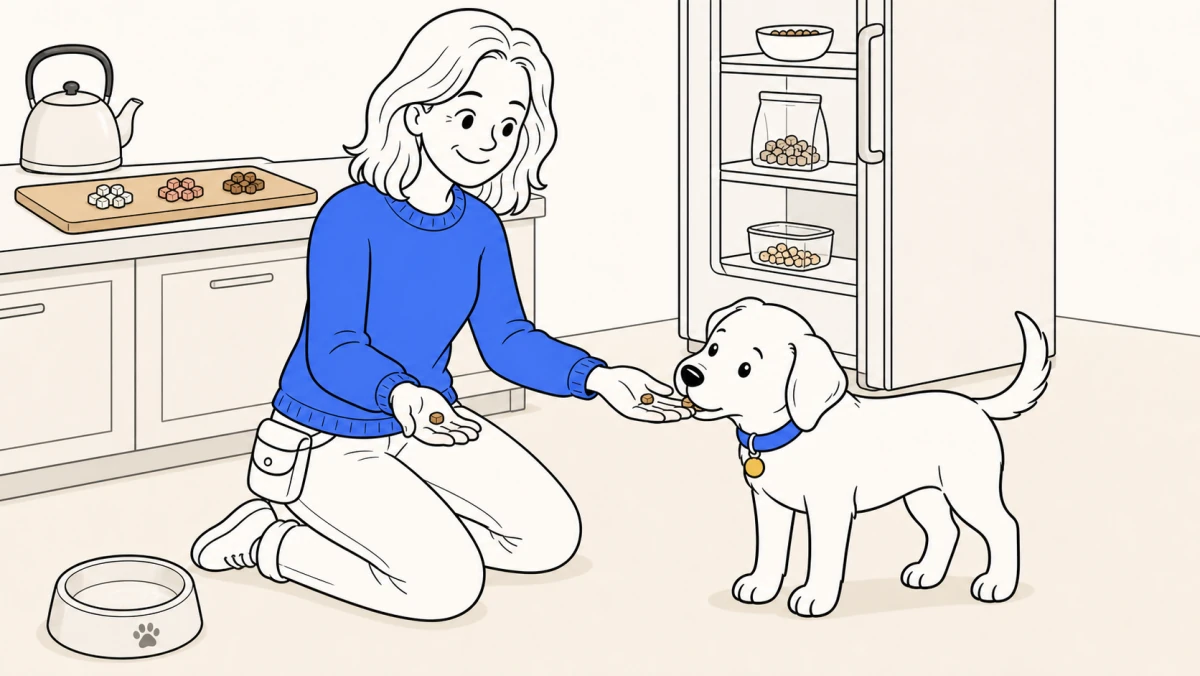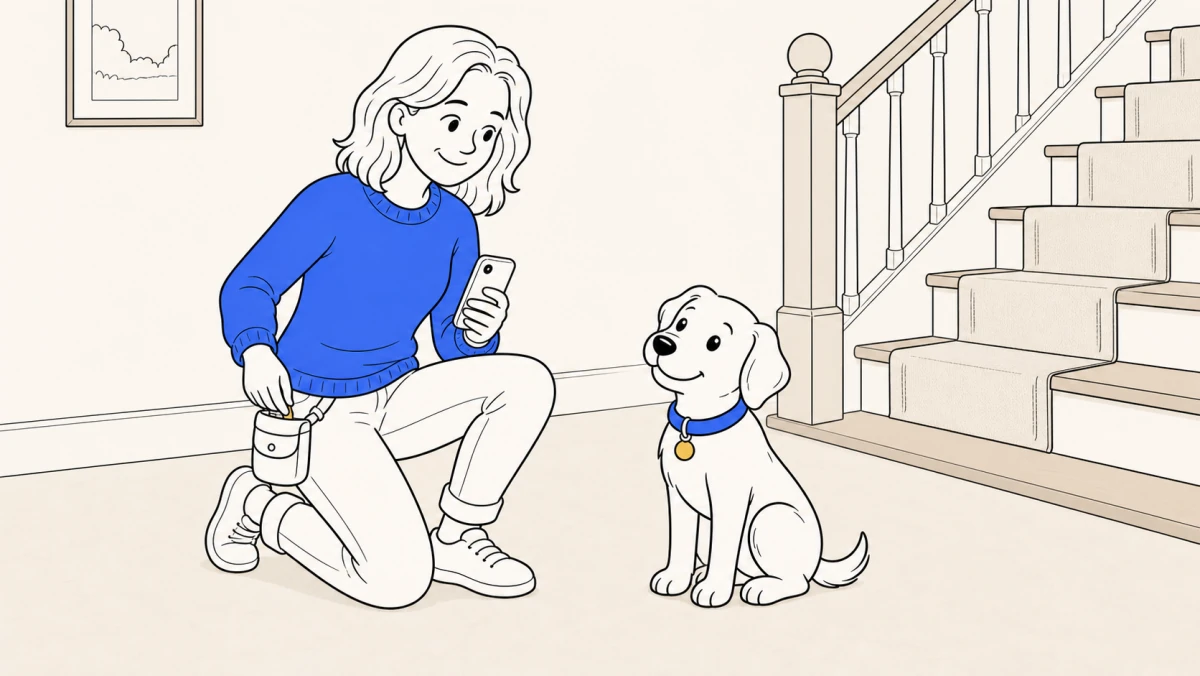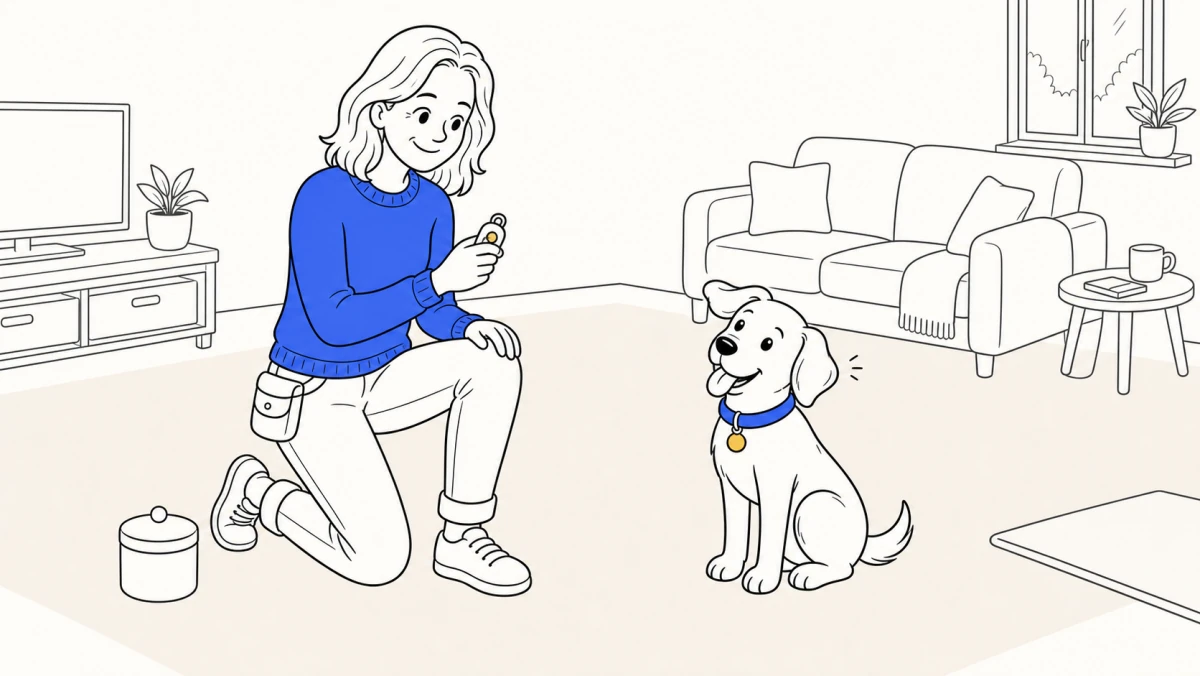
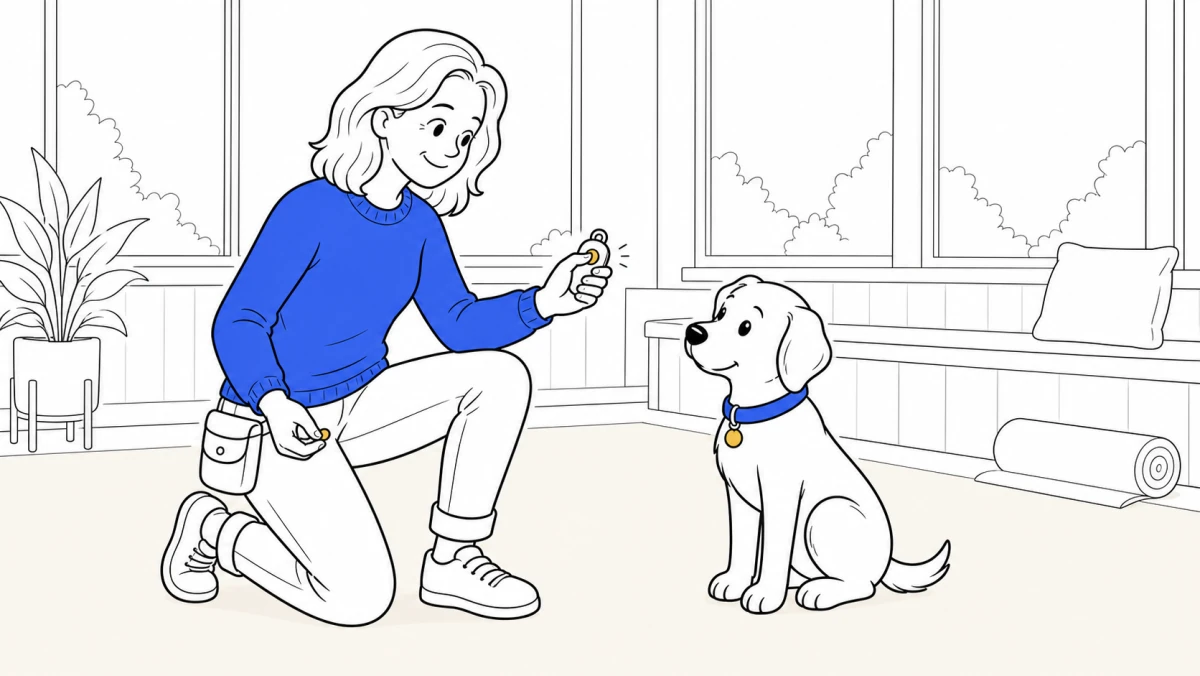
Clicker training is a reward-based method: the moment your puppy does something right, you mark it with a click, then pay that click with a treat. It works because the marker hands your puppy clear, precisely timed information about which action earned the reward, and because the reward, not punishment, is what drives the learning. The click doesn’t teach. It aims.
Maybe you clicked through from our homepage to check whether the method behind the app actually holds up. Maybe you typed “what is clicker training” one-handed while a puppy gnawed your sleeve. This page is for both of you: what clicker training is, why it works, how good the evidence really is, and the spots where the popular version gets ahead of it. Karen Pryor’s classic explainer covers the what well. This one covers the why, including where the research backs the familiar claims and where it doesn’t.
What is clicker training, exactly?
Clicker training is teaching with a marker: a distinct sound that means “yes — that, right there — a treat is coming.” The click is a bookmark. By itself it teaches nothing; its whole job is to tell your puppy precisely which half-second earned the treat that follows, so nothing is left to guesswork.
It rests on plain behavior science — the same operant-conditioning principles B.F. Skinner described. The click becomes a conditioned reinforcer: a sound your puppy learns to care about because it reliably predicts food. That’s why you “charge” it first, pairing click-then-treat a handful of times until the sound alone makes your puppy look for a treat. After that, you click the moment the behavior happens and pay every single click.
Karen Pryor, who popularized the clicker in dog training after years as a marine-mammal trainer, boils the whole method down to three moves: get the behavior, mark it, reinforce it. Everything else is refinement. So the method has three moving parts: a charged sound, good timing, and a reward that always arrives. Get those right and the plastic box becomes optional.
Why does clicker training work?
Clicker training works because it solves the animal’s hardest problem: figuring out which of the dozens of things it was just doing actually earned the reward. A precisely timed marker answers that question in a way a treat handed a moment later can’t. From your dog’s point of view, a well-timed click is pure information: this, right here, is what earned the treat.
Underneath it are two kinds of learning, stacked. When you first pair the click with food, your puppy forms an automatic association (click means food), the reflexive kind of learning psychologists call classical conditioning. The moment your puppy starts offering a behavior on purpose to make you click, it has crossed into operant conditioning: acting deliberately to produce a result. That shift, from reflex to purpose, is the engine of the whole thing. An operant learner experiments, remembers what worked, and comes back for more. The first time your puppy stops waiting to be lured and instead offers something to make you click, you can almost see the penny drop. Clicker trainers call it the moment “the light bulb goes on.”
Timing is where the marker earns its keep. In a University of Waikato PhD study, about 60% of dogs learned a new behavior when the reward came immediately, but only about 25% did when it arrived a second late — and about 40% still learned when an immediate marker bridged that one-second gap (Browne, 2015). A beginner’s hands are never as fast as a beginner’s puppy. The marker buys back the timing you don’t have yet.
Does clicker training actually work? What the evidence says
Yes, with one caveat that matters. As reward-based marker training, clicker training is effective, and it is what the veterinary-behavior field recommends: the American Veterinary Society of Animal Behavior (AVSAB) advises reward-based methods for all dog training, and says there is no evidence aversive methods work better (AVSAB, 2021).
The device itself is not magic. Most clicker marketing glides straight past that, though Karen Pryor says exactly the same on her own site (“there is no magic in the clicker”). The controlled studies bear it out. Gilchrist, Gunter, Anderson and Wynne, a team at Arizona State University, split dogs into three groups: a clicker plus food, a spoken word plus food, and food alone. Across three experiments no method reliably beat the others, and in one, food alone even held a sit longer than the spoken-word group (Gilchrist et al., 2021). A 2018 PeerJ review by Dorey and Cox reaches the same conclusion: among the few studies that have compared a clicker against a control, none has shown the device itself to improve on a well-timed reward.
So is a clicker ever genuinely faster? For simple, single cues, no. That changes as behaviors get harder. In a 2025 study, dogs learned a demanding, multi-step scent-detection task either with a marker or with the reward alone. On the early, simpler steps the two groups were level. On the hardest step, the marker group reached the standard in roughly half the trials (about 36 versus 68), and when the food was later withdrawn, those dogs kept working while the reward-only group fell away (Lazarowski et al., 2025). The researchers put it plainly: a marker’s edge shows up “when training complex and nuanced behaviors requiring precise timing,” not on “sit.” That is exactly where clicker training’s reputation for helping dogs “learn quickly,” in Karen Pryor’s words, has always been earned. Put the studies together and the lesson is steady: what does the work is the reward, the timing, and the consistency. The clicker is simply a dependable way to deliver all three.
Is a clicker better than a word, or just treats?
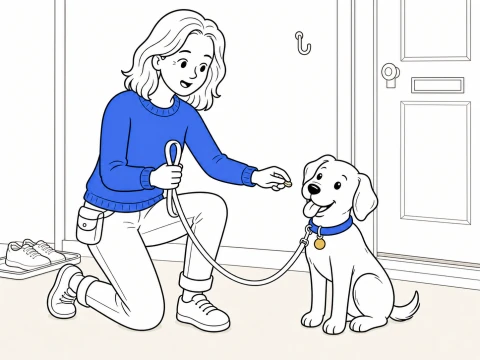
Not for everyday cues, and that’s genuinely freeing. A clicker’s one real advantage is a sharp, identical sound your puppy hears nowhere else, which makes precise timing easy for a beginner. But AVSAB names “a clicker or verbal marker” as equals, and the three-group study above found no clear winner between a click, a spoken word, and food alone (Gilchrist et al., 2021). You don’t need a special gadget to train with a marker at all. It doesn’t even have to be a sound: a thumbs-up or a small light works for a deaf dog, on exactly the same principle.
This is the one place we would add a nuance to the Karen Pryor house line. Her organization steers beginners toward the clicker and away from words like “good” or “yes,” on the reasoning that a human voice wavers and a puppy can lose a single word in the daily stream of chatter — though it grants that a verbal marker works fine in practiced hands. That is a fair worry for a competition trainer chasing split-second timing. For an owner on the living-room floor, though, a steady “yes” is a legitimate equal, and reaching for it because your hands are full of treats and leash is not cutting a corner. It is the same method carried by a different sound. Each option is good at something slightly different:
| Tool | What it’s good at | The catch |
|---|---|---|
| Clicker | A sharp, identical sound every time — hard to blur, easy for a puppy to pick out | One more object to juggle with treats and a leash; a few puppies startle at the sound |
| Verbal “yes” | Always with you, both hands free, can’t be dropped or forgotten | Your voice varies, so you have to keep the marker crisp and consistent |
| Treat alone | Simple; no marker to charge | Handed even a second late, it can accidentally reward the wrong moment |
So pick one marker, charge it, and stay consistent. That “clicker learns faster” line you may have read holds for complex, precise behaviors, less so for the everyday cues you will teach most, so go with the marker you will actually keep up.
Why is clicker training kinder than punishment, and just as effective?
Because you get the same results without the fallout. The case against punishment-based training isn’t only ethical, though the welfare gap is stark. It’s also practical, and it’s the reason reward-based methods are now the professional standard.
Start with welfare. In a controlled study of 92 companion dogs, those trained with aversive methods (leash corrections, shouting, “alpha” rolls) showed far more stress signals than reward-trained dogs: over 13 times more lip-licking and about 8 times more yawning, plus a real rise in cortisol, while the reward group showed almost none (Vieira de Castro et al., 2020). Those are physiological stress signals, measured on the dogs themselves.
And the trade-off you might expect, kinder but slower, does not appear. When researchers pitted dogs trained with electronic shock collars against dogs trained purely on rewards, the reward-trained group was at least as obedient and quicker to sit, and the authors concluded the shock collar was “unnecessary” (China et al., 2020). AVSAB is blunt: there is no evidence aversive methods are more effective in any context (AVSAB, 2021). Pryor explains the mechanism well. Punishment tends to suppress one behavior and throw up another, and because it usually lands after the event, with nothing marking the exact moment, the dog often reads it as random. A marker and a reward carry clearer information, delivered at the instant the dog can connect it to what it did.
Can you clicker train any animal?
Yes, and the reason that matters to you is what it proves. The exact three steps you’ll use on your puppy were first worked out by dolphin trainers, who had no way to physically force a dolphin to do anything and so had to teach entirely through a marker and a reward. As Karen Pryor’s organization documents, the same method now runs cooperative veterinary care at Disney’s Animal Kingdom, where elephants and macaws present body parts for examination on cue, and it’s the method Guide Dogs for the Blind uses to raise its dogs. It’s even been adapted for people: surgeons and athletes learn precise physical movements through a marker system called TAGteach.
The same handful of principles work on a leopard, a guide dog, and a surgeon because they describe how learning itself works: clear information, and consequences worth repeating. There is no special knack to master here. You mark the right moment, and you pay it.
How do you clicker train a puppy?
You clicker train a puppy by charging the clicker, then marking and paying the exact instant they do the thing you want, and raising the difficulty a step at a time. You do not need any experience to start, and the method is forgiving: a mistimed click here and there won’t undo your progress. It comes down to six moves, and the first is the one everything else rests on:
- Charge the clicker. Click, then treat, a handful of times, then test with one click and still hands to see if the sound alone makes your puppy look for food. If you’ve read that this takes 200 repetitions, relax — Karen Pryor dismissed that kind of long, mechanical charging routine as “a useless leftover of a laboratory procedure,” and her own instruction is brief: two or three pairings, then test. Read your dog, not a counter. (Here’s the very first session, start to finish.)
- Mark the instant, pay every click. Click at the behavior, not after it. And treat every click while your puppy is learning — the click is a promise, so keep it even if your thumb slips.
- Raise one criterion at a time. Distance, duration, and distraction are three separate difficulties; add them one by one. Pushing all three at once is the classic reason training stalls.
- Keep the rate up. Aim for something like 10 to 15 clicks and treats a minute (Chamberland); a bored puppy is usually an under-paid one.
- Keep sessions short. A couple of minutes, a few times a day, always stopping on a win. Here’s how long puppy training sessions should be.
- Add the cue, then fade the lure. Once the behavior is reliable, attach the word (“sit”), and stop luring with food in your hand so your puppy isn’t waiting to see a treat first. Naming it any earlier just teaches your puppy to tune out a word it doesn’t understand yet, so let the behavior come first and the label second.
That’s the shape of it: six moves you’ll reuse for every new behavior you teach, and the backbone of how to train a puppy generally.
Do you have to click and treat forever?
No. The clicker and the treats are training wheels, and you take them off once your puppy can ride. Once a behavior is learned and on cue, you can stop clicking it and let real life do the paying: your dog sits at the door, the door opens for the walk (Karen Pryor’s own example). You save the clicker for the next new thing you teach. Two worries fall away here, too. Your dog won’t get fat, because training treats are pea-sized and can come out of the daily food allowance. And a dog who “isn’t food-motivated” usually just needs a better paycheck: a thrown ball or ten seconds of tug is a perfectly good thing to mark and pay with. The marker is the constant. What you pay with can be anything your dog will actually work for.
What can you teach a puppy with a clicker, and what can’t you?
You can teach anything you can capture (mark a behavior your puppy already offers) or shape (build it in small steps): sit, hand target, leave it, drop it, stay, down, recall, and every trick from spin to shake. These are the clicker-shaped skills — clear, repeatable behaviors with a moment you can mark. The same marker-and-reward habit also underpins gentler fixes for everyday nuisances, like teaching an alternative to mouthing and puppy biting.
What a clicker doesn’t do is just as important to know. It can’t shape a management problem: house-training is a matter of schedule and supervision, not a behavior you click (see how to potty train a puppy), and the same goes for crate settling and overnight sleep. And it can’t fix a fear or a genuine behavior problem — that is a different job for a different professional, covered below. A clicker is a superb tool for building skills, and that is all it sets out to be.
Why does clicker training sometimes “not work”?
Almost always, it comes down to mechanics. Every common failure has a specific, fixable cause:
| What went wrong | The fix |
|---|---|
| You keep clicking late | Click at the moment of the behavior — Pryor’s own rule is that if you’re not making progress, you’re probably clicking too late |
| The marker seems to “stop working” | Check you’re still treating every click; clicking without paying quietly erodes the marker’s meaning |
| Progress stalls suddenly | You likely raised too many criteria at once — go back to one at a time |
| Your dog “ignores” a cue it knew yesterday | Not defiance — usually the cue isn’t solid in this room, or the reward isn’t worth it here; Pryor’s fix is to re-teach the cue in the new setting, not to insist |
| You can’t juggle clicker, treats, and leash | The single most common real-world complaint — switch to a verbal “yes” and free up a hand |
| No visible “light-bulb” moment yet | Normal, especially in very young puppies; persist a session or two before changing anything |
If it feels like it isn’t working, the answer is rarely “this dog can’t learn.” It’s a half-second of timing or a dropped treat: small, mechanical, and completely fixable.
When is clicker training not the answer?
When the problem is fear or aggression, not a missing skill. Clicker training is built for teaching a puppy what to do; it is not treatment for a dog who is frightened, reactive, guarding food or toys with a stiff, frozen body, or showing real aggression, and it isn’t the tool for separation panic. Those deserve a certified professional — a veterinary behaviorist (a vet board-certified by the American College of Veterinary Behaviorists) or an IAABC-certified behavior consultant (iaabc.org), not a training tweak. If you’re unsure where normal puppy behavior ends, here’s a fuller guide to what’s normal and when to get help.
A clicker handles the everyday building blocks beautifully. The rare serious stuff belongs with someone who can see your dog in person.
For that everyday stuff, none of this needs a subscription to start. A clicker (or your own “yes”) and a pocket of pea-sized treats is the whole kit, and it stays free forever. So make the next step a small one: pick a single behavior and run one two-minute session today, starting with your puppy’s first clicker session. (If you’re weighing your options, we also rate the best puppy training apps.) Where a coach comes in is the part an article can’t reach: turning “raise one criterion at a time” into the right session for the puppy on your floor, and adjusting it to how the last one went. That’s the gap we’re building ClickerPup to fill — our full method for training a puppy to reliable.