
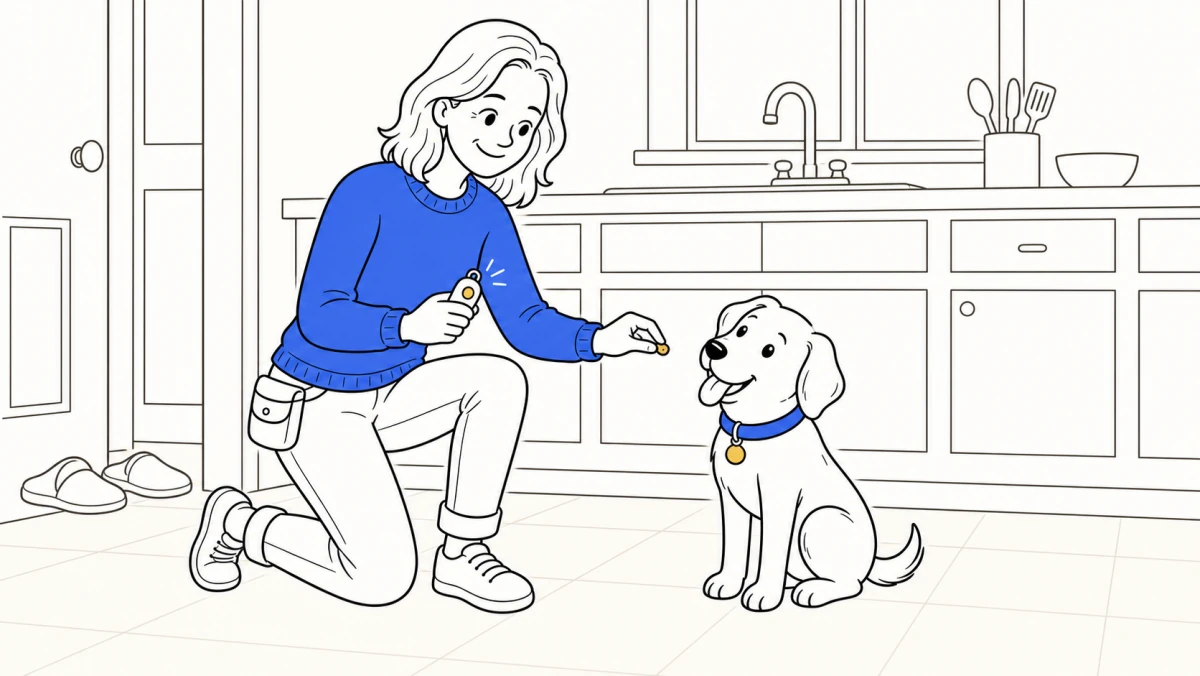
If you’re on the floor with a bouncing, bitey puppy — determined for about four minutes before it all unravels — start here. To train a puppy, reward the behavior you want the instant it happens: mark the exact moment (with a clicker or a short word), pay it with a treat, and keep sessions to a few minutes. Teach one small skill at a time, socialize gently and early, and manage — don’t punish — everything else. That’s the whole method. The rest of this guide is how, and where to go deep on each piece.
How do you start training a puppy?
Start with one easy win on day one, not a grand plan. Charge your marker first — click, then treat, a handful of times, then a quick test to check your puppy’s ears perk at the sound — then teach a hand target: your puppy touches their nose to your open palm, you mark it, and treat. One short session each. Most puppies get their first “oh, I did that!” the same day, and honestly, so do you. Here’s the full day-one walkthrough.
What’s the best puppy training method — and why clicker training?
The best method is reward-based training, and it isn’t close. The American Veterinary Society of Animal Behavior (AVSAB) recommends reward-based methods only, and warns that aversive methods — leash-jerks, “alpha” rolls, shock collars — harm both welfare and your relationship with your dog. The evidence backs the welfare point: in a 2020 study of 92 dogs (Vieira de Castro et al.), those trained with aversive methods showed more stress behaviors and larger cortisol (stress-hormone) rises than reward-trained dogs. Starting young helps too — a survey of over 1,000 dogs (Dinwoodie et al., 2021) found those trained by six months had lower odds of aggression, destructiveness, and excessive barking as adults.
Inside reward-based training, the fastest way to teach is to mark the moment. A marker — a clicker or a short word like “yes” — tells your puppy the precise instant they got it right, and a treat follows. That is what “clicker training” is. A 2025 study of dogs learning a precise detection task (Lazarowski et al.) found the marker-trained group learned it in far fewer trials and kept performing it even after the treat stopped, compared with dogs given the treat alone — the marker’s edge showing up most as the behavior got precise and complex. Turning that marked moment into a behavior your puppy performs reliably, every time, is the whole goal — it’s how ClickerPup turns a marked behavior into a reliable, trained response.
Do you need an actual clicker (and is it safe)?
You don’t strictly need a plastic clicker — for the simplest cues, controlled studies find no clear winner between a clicker and a well-timed word (Gilchrist et al., 2021) — but we recommend one for a single reason: timing. The click is a distinct, always-identical sound your puppy hears nowhere else, which makes it easy for a beginner to mark the exact right instant (the thing new trainers most often get wrong). Trainer Karen Pryor’s guidance is to “charge” it first, then use it — and to ignore the old lab myth that you need 200 repetitions.
One honest caveat: a clicker is a sudden, sharp sound, and a few sound-sensitive puppies find it startling. If yours flinches, don’t push it — click softly from a pocket or behind your back, or simply switch to a verbal marker. AVSAB explicitly okays “a clicker or verbal marker,” so a nervous puppy costs you nothing. Whichever you choose, keep it consistent and always follow the mark with the reward while your puppy is learning — the click is a promise. (Comparing training apps to help with all this? Here’s our honest rundown.)
How long should puppy training sessions be?
Short — much shorter than most people expect. A puppy’s focus is measured in a couple of minutes, not twenty, so a few tiny sessions spread across the day beat one long slog, and you should always stop while your puppy is still winning. Here’s how long, exactly, and why.
What should you teach a puppy first?
Start with the skills that make daily life easier, in roughly this order:
- Their name — a look up at you when you say it.
- A hand target (“touch”) — nose to your open palm; the easiest first win.
- Sit — the default “what do I do now?” behavior.
- Settle — the off-switch that turns a wired, over-tired puppy calm again.
Save “leave it” and recall (“come”) for once those basics click — then work through the five core commands in order. Each is one small skill, taught in those short sessions, marked and rewarded. And if the daily “witching hour” zoomies are your nemesis, settle is the answer.
How do you stop biting and other problem behaviors?
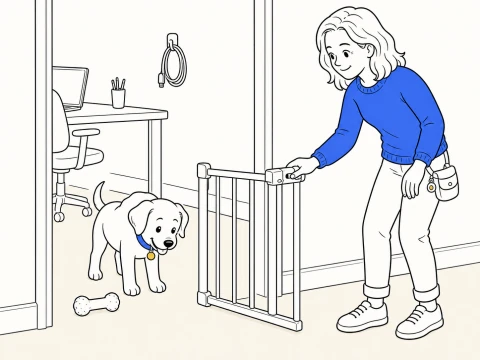
Puppy biting, jumping, and mouthing are normal development, not defiance — and you fix them by teaching what to do instead, never by punishing. For biting, the reward-based approach is to reward a soft mouth and teeth-off-skin, redirect onto a toy, and calmly end the game when teeth land. Here’s the full no-punishment method. The same reward-the-alternative approach runs through the other big ones — how to stop a puppy jumping up and why your puppy barks, and how to stop it. The same logic covers most “problem” behaviors: manage the situation, reward the alternative, and let the clicker skills give your puppy a better option than the one driving you up the wall.
What about potty training, crate training, and sleep?
These are mostly management, not clicker skills — and they matter enormously in the first weeks. Potty training comes down to routine, supervision, and rewarding the right spot; crate training and sleep are about building a cozy, safe den and going slow. Start with how to potty train a puppy. Fair warning: ClickerPup coaches the clicker skills, not potty or crate training — but the reward-based, go-at-your-puppy’s-pace mindset is exactly the same.
When should you socialize a puppy?
Early — this is the most time-sensitive thing on the list. The sensitive window for accepting new people, dogs, sounds, and surfaces runs from roughly 3 to 12–14 weeks, and AVSAB urges starting before the vaccine course is finished (as early as 7 to 8 weeks), because behavior problems — not infection — are the leading cause of death in dogs under three years old. Keep every experience gentle and positive, always below your puppy’s fear threshold. Here’s what the research actually says, fears and all.
What does a puppy training timeline look like?
There’s no rigid schedule, but a few rough markers help. Trainer Ian Dunbar’s well-known guidance is to introduce your puppy to 100 or more different people before 12 weeks, and to build a soft, gentle mouth (bite inhibition) before about 18 weeks. Past that, the order matters less than the habit: short, daily, reward-based sessions. And the payoff is real — in a study of nearly 1,000 puppies (Brand et al., 2024), those whose owners took early puppy classes (before 16 weeks) turned out far less likely to fall back on harsh methods later, which usually means a calmer dog and a happier house.
When is it not just training — and time to get help?
Most puppy chaos is normal. But a few things are not a training project: real aggression (not puppy mouthing), intense fear that doesn’t ease with gentle exposure, or genuine panic when left alone. If you see those, don’t try to train through them — loop in your vet or a certified behavior professional (IAABC-certified consultants at iaabc.org are a good place to start — their standards require members to refrain from using shock in training or behavior modification). Here’s what’s normal versus a red flag. Reaching out early is the strong move, not the failing one.
The bottom line
Training a puppy isn’t about drilling commands — it’s about rewarding the behavior you want, one short session at a time, and starting while your puppy’s brain is wide open. Pick your marker, charge it, socialize gently, manage the rest, and let each small win build the next.
That last part — knowing which small win to work on next, and adjusting when a session flops — is exactly the gap we’re building ClickerPup to fill: a coach that plans the next two-minute session around the dog on your floor, then adapts to how it actually went. It won’t potty-train or crate-train your dog; it coaches the clicker skills, honestly.