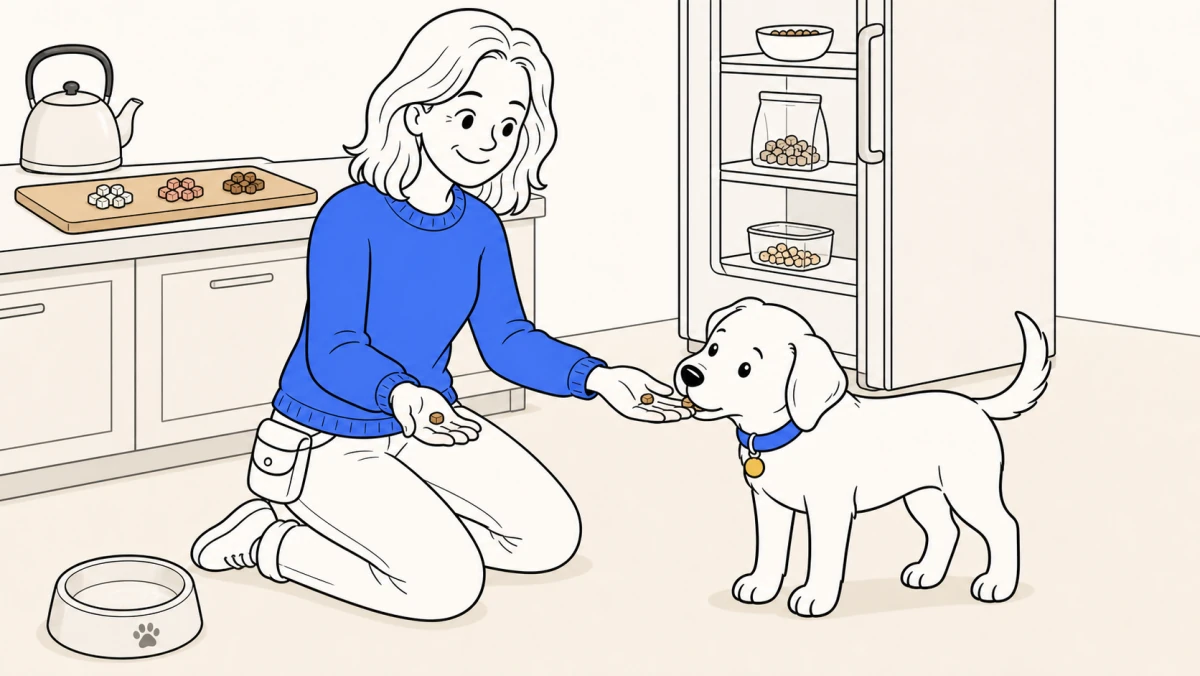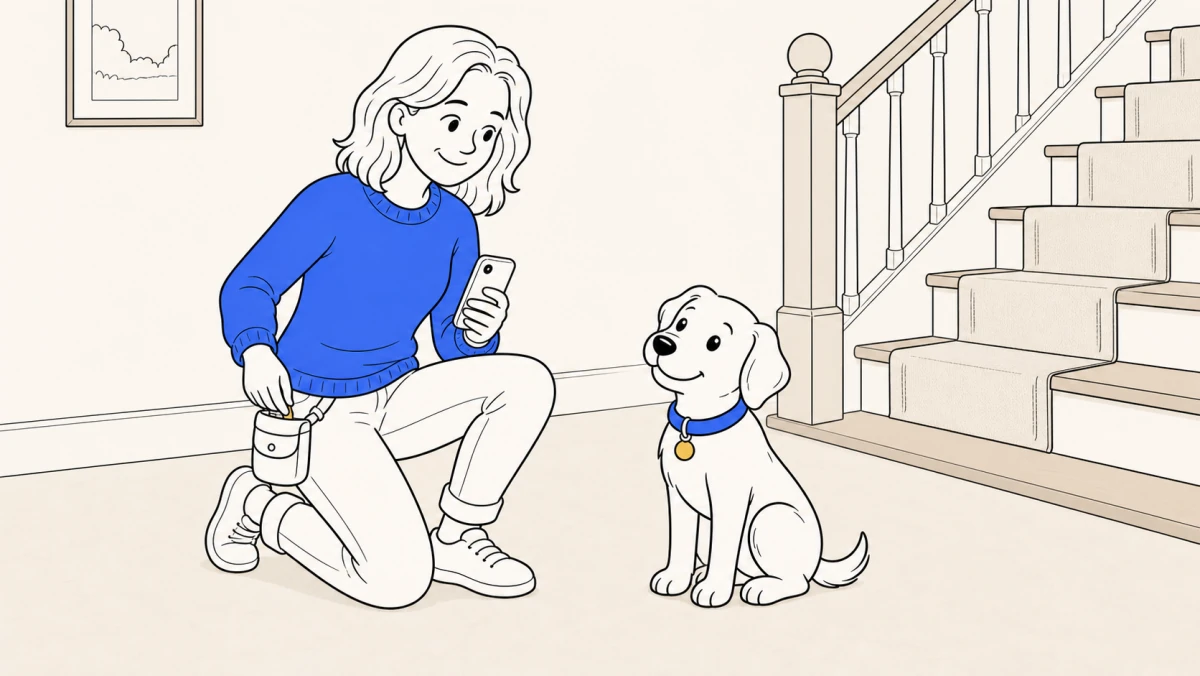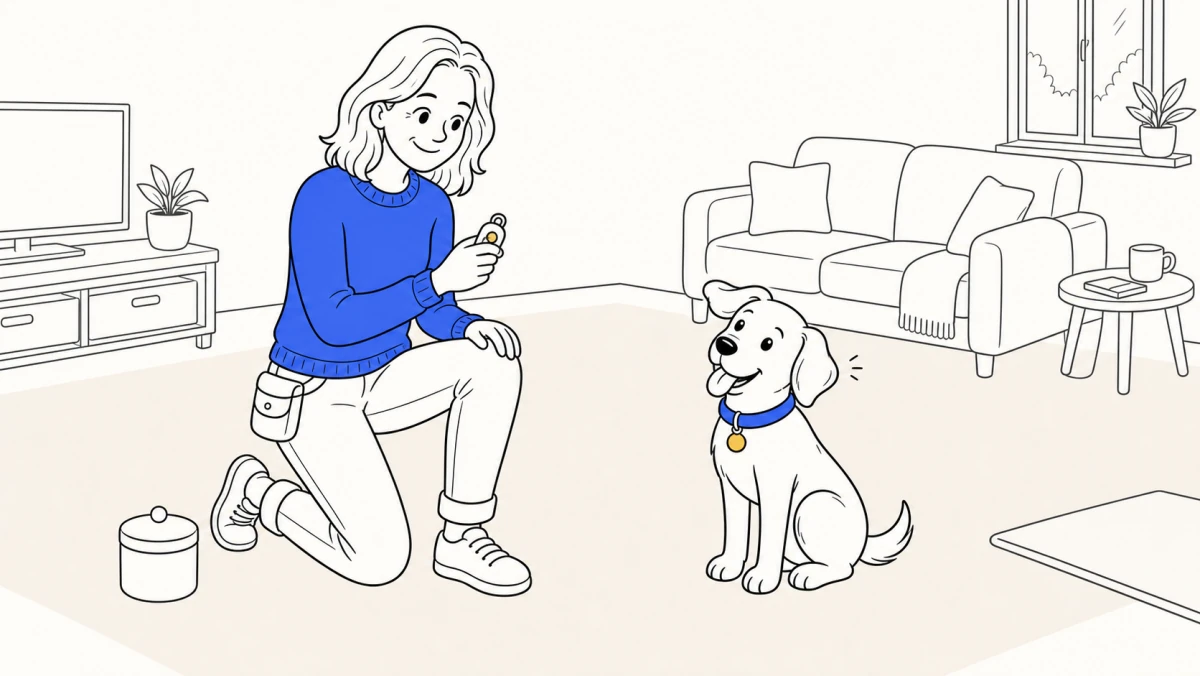
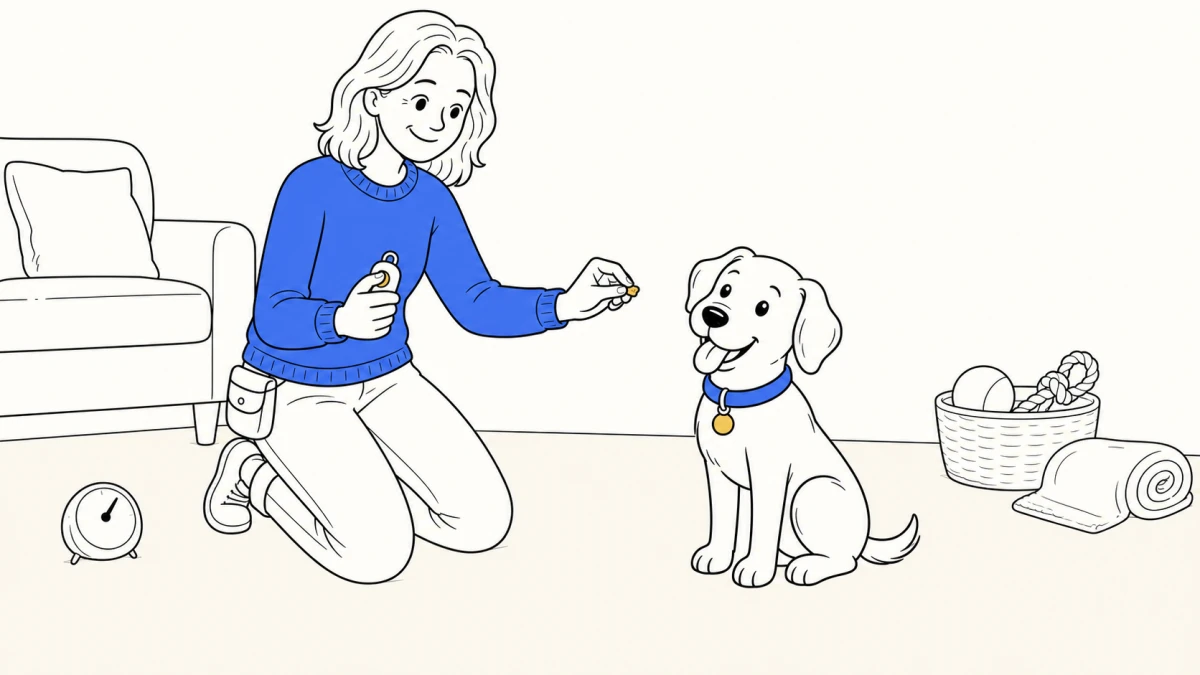
Keep them short: about two to five minutes, a few times a day. The research on dogs points the same way every time — short, spaced sessions that end while your puppy is still winning beat one long drill. A great session can be ninety seconds. Quality and timing matter far more than length.
The short version
If you take one thing from this page, take this: build a daily habit, not a daily grind. A tiny session your puppy enjoys and finishes on a good note teaches more than a long one that fizzles into frustration. If your puppy checked out after ninety seconds and you never got past step one, that’s not you falling behind — that’s a normal, useful session. You do not need to “get through” a list.
How long is a puppy training session, really?
Roughly one to five minutes, depending on your puppy’s age — treat the table below as friendly defaults, not rules. Younger puppies have shorter fuses, so start smaller and grow as they do.
| Puppy age | A good session | Reps to aim for |
|---|---|---|
| 8–10 weeks | 1–2 minutes | 3–5 |
| 10–12 weeks | 2–3 minutes | 3–6 |
| 12–16 weeks | up to 5 minutes | 3–8 |
The timer is the least important part. A ninety-second session where your puppy nails three easy reps beats a five-minute one that drags. Let their attention set the length, not the clock.
Why do short, spaced sessions beat long, frequent ones?
Because spacing practice out — rather than cramming it into one long block — helps a dog’s memory hold on to what it just learned, and that pattern shows up again and again in the research. In a controlled study of 44 laboratory Beagles, dogs trained in a single session did better than dogs trained in three sessions back-to-back, and dogs trained once or twice a week actually learned in fewer sessions than dogs drilled every day (Demant et al., 2011). A separate study of 18 Beagles found the nine dogs trained once a week learned the task in significantly fewer sessions than the nine trained five times a week (Meyer & Ladewig, 2008).
The bigger pattern comes from decades of human learning research: spreading practice across separate sessions helps memory hold on far better than cramming (Cepeda et al., 2006). Your puppy’s brain is no exception. Little and often, with rest in between, is how skills stick.
Is “two minutes” a hard rule for every puppy?
No — treat it as a guideline, not gospel. “Two minutes is scientifically optimal” is too strong a claim; the evidence supports short, non-crammed practice, but it does not pin down an exact perfect length for a home puppy. Here is the honest part most advice skips.
Were the studies done on puppies like mine?
Not exactly. Those famous studies used kenneled lab Beagles, not puppies on your floor. The trainer Patricia McConnell points out that “fewer sessions to learn” hid the fact that the once-a-week dogs took far more calendar days to get there — as many as 29 versus as few as 8. So “train less often” is not a clean law of nature; it is a nudge toward not over-drilling.
Are there exceptions to short-and-spaced?
Yes, a narrow one. For specialized working dogs on a hard scent task, one study found condensed training schedules improved how fast dogs learned the task (Smith et al., 2025) — the opposite of the pattern above. For a pet puppy learning the basics, though, short and spaced is the safe default. Keep it small, keep it spaced, and don’t treat any single number as gospel.
How do you run one good short training session?
A simple recipe you can lean on every time:
- Pick one skill. Not a checklist — one small thing.
- Do 3–8 clean reps. Fewer for anything brand new.
- Stop early. End after about three clean successes, two confused misses, or the first sign your puppy has checked out.
- Finish on a win. Resist “just one more.” The best moment to stop is right after a good one.
- Wind down. Close with calm praise, a little play, or a nap. Rest is when learning gets filed away.
If your puppy misses twice in a row, that is information, not failure — make the step easier and try again another time.
When is my puppy ready for the next step?
Length isn’t the only thing to keep small. So is difficulty. A good rule of thumb: move on only when your puppy gets it right about four times out of five, across two separate sessions — ideally on different days. Success today and success tomorrow is much more convincing than ten reps in a row right now.
When you do make things harder, raise just one thing at a time. Pick a single dial to turn:
- Duration — hold the position a little longer.
- Distance — take one step further away.
- Distraction — add a mild one, not a big one.
- Context — try a different spot.
Turning two dials at once (further away and with the doorbell going) is the fastest way to set your puppy up to fail. One change per session keeps the wins coming.
Does my puppy know a skill everywhere, or just where we practiced?
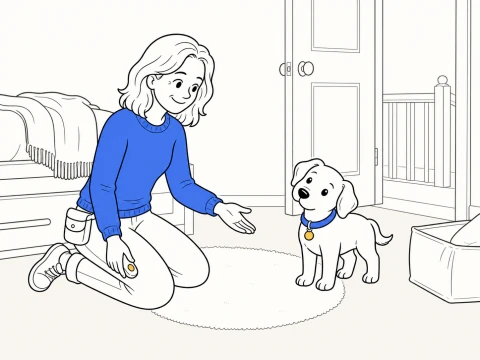
Only where you practiced, at first. Dogs don’t automatically carry a skill from one place to the next — they can look like they’ve completely forgotten “sit” the moment the setting changes, even in a room right next door. That surprises a lot of new owners, but it’s not stubbornness and it’s not a step backward. It’s normal.
Once a skill is solid in one easy spot, treat a “different room” as a genuine new level and drop your expectations a notch when you get there. Change one thing — same cue, new place — and let your puppy re-earn it in the new setting. Do that in a few different rooms and it starts to stick for real.
How do I know if a session has gone on too long?
Watch for wandering, grabbing at treats or hands, or reps getting sloppier — your puppy will tell you before you need a timer:
- Wandering off, sniffing, or getting the zoomies mid-session.
- Grabbing at treats or hands instead of thinking.
- Getting slower, sloppier, or bitier than they were a minute ago.
None of these mean your puppy is stubborn or that you are doing it wrong. They mean the tank is empty. Stop, celebrate what went well, and come back later with a fresh, tiny session.
The bottom line
Short beats long. Spaced beats crammed. Ending happy beats ending “finished.” A puppy who learns in two-minute bursts a few times a day, and quits while they are still winning, will get there — often faster than one who is drilled until everyone is fed up.
“There” is worth defining, because it’s the part most training advice leaves vague: a cue your dog answers first time, in a distracting place, without a treat in sight. That’s what trained to reliable means, and it’s the difference between a dog who has seen a skill and one who owns it. If you’re deciding which skills to spend these short sessions on, the first five commands worth teaching is the running order we’d use.
If your puppy’s behavior ever feels less like “distracted” and more like real fear, or something suddenly changes about their health or mood, that’s a different conversation — worth a call to your vet for a sudden health or mood change, or a certified behavior professional for fear or aggression that isn’t fading (IAABC-certified behavior consultants, at iaabc.org). Here’s a fuller guide to what’s normal and when to get help.
If sizing today’s session and knowing when to stop is the part you’d rather not guess at, that’s exactly what we’re building ClickerPup to handle: it plans one short session at a time and adapts to how it actually went.