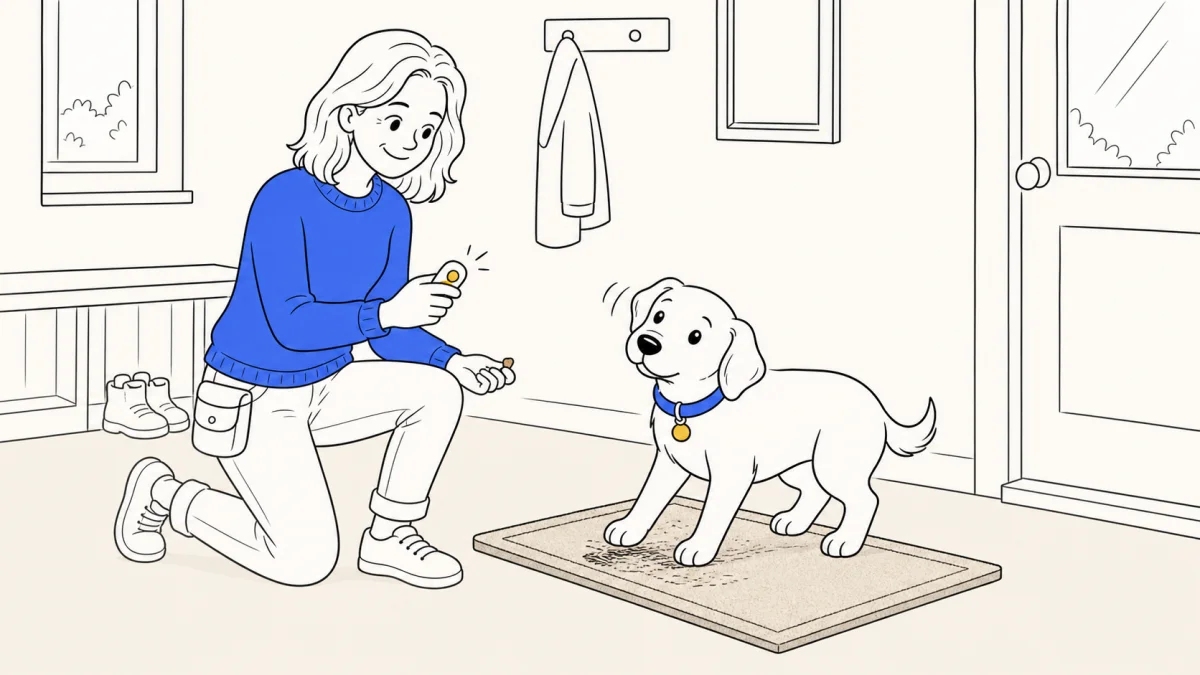
Say your puppy’s name once in a bright voice, click (or say “yes”) the instant their head turns toward you, then treat. Never repeat the name when they ignore it, and never pair it with a scold — the name should predict good things, not background noise or trouble.
If you’ve already said their name three times across the room and watched them keep sniffing the rug — determination draining into “he won’t listen” — you’re usually one fix away: say it once, mark the turn, and stop poisoning the word with nagging. Here’s the exact method, the failure modes, and how name response becomes the foundation for recall.
How do you teach a puppy its name, step by step?
Capture the head-turn: say the name once, mark the look, treat, then wait for them to glance away and repeat. That is the whole skill — the “name game” the AKC, Best Friends, and Guide Dogs for the Blind all teach.
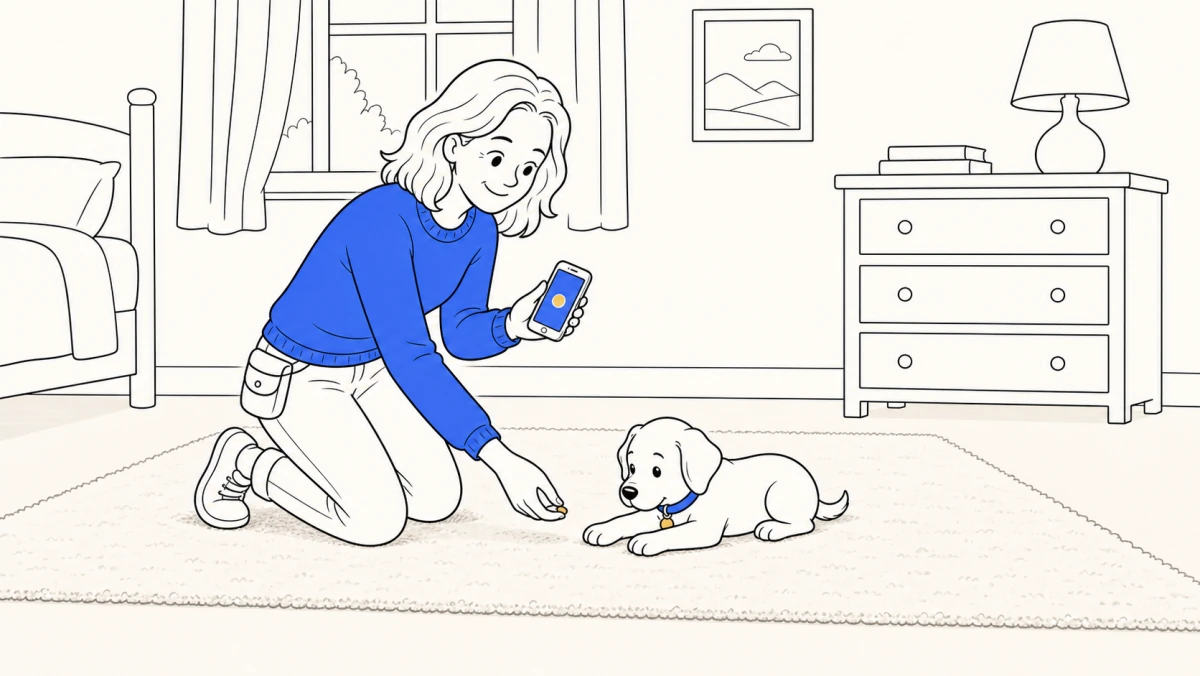
- Charge a clicker (or pick a crisp verbal marker like “yes”) and pocket pea-sized soft treats. Start in a quiet room with few distractions.
- Wait until your puppy is mildly occupied — sniffing the floor, not staring at you.
- Say their name once, bright and happy.
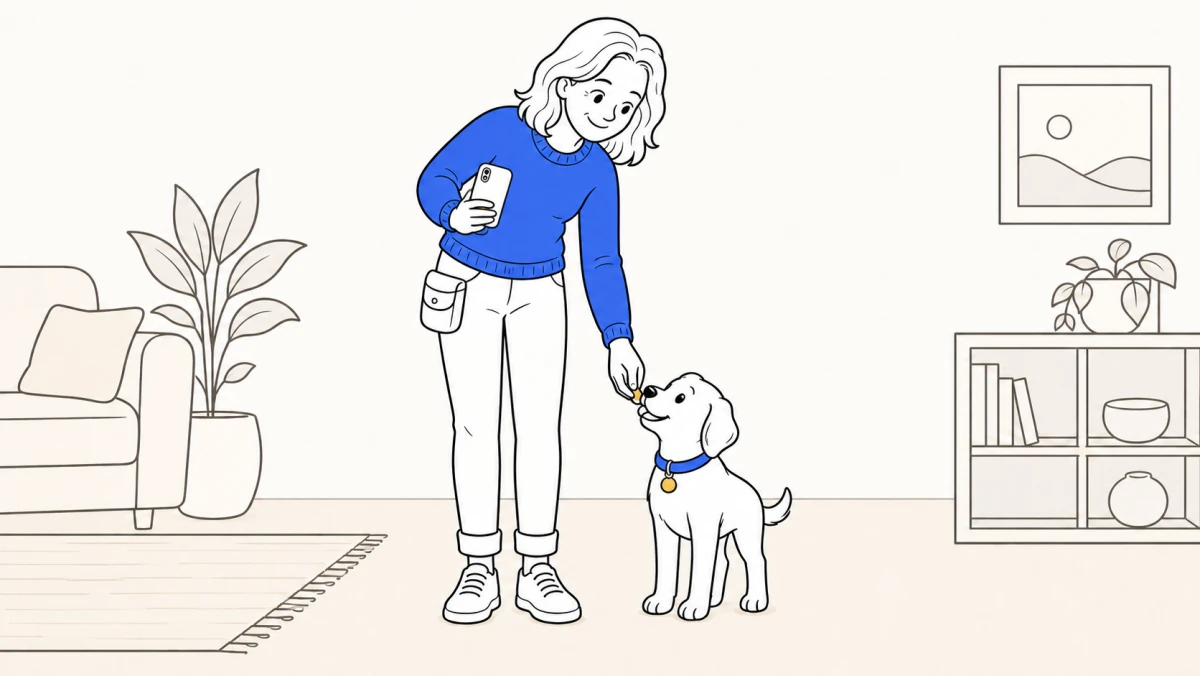
- The instant the head turns toward you — click (or “yes”) — then deliver the treat.
- Let them look away naturally. Repeat for five to eight easy reps, about two minutes, and stop while they’re still keen.
This matches AVSAB’s position that only reward-based methods should be used: a marker plus a treat, not a yank or a shout.
How do you get name response working outside the kitchen?
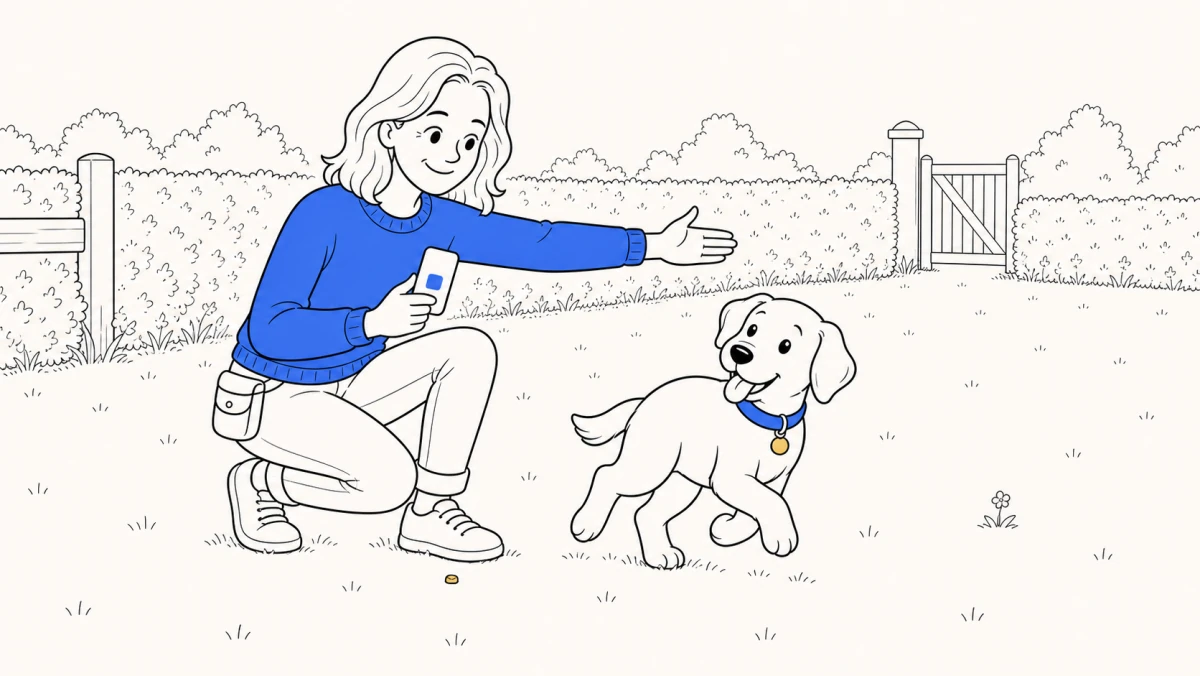
Change one thing at a time — distance, then a mildly busier spot, then outdoors on a leash — and re-earn four out of five turns at each step. That is generalization, not a brand-new skill.
ClickerPup runs name response on a four-phase fluency ladder — first try, practising, most times, reliable — scored as four out of five turns:
- Acquisition (first try): quiet room
- Proficiency (practising): mild distraction, name said once
- Generalization (most times): a new place after changing only one variable
- Maintenance (reliable): woven into daily life so the name stays a happy word
Best Friends uses the same quiet → distraction → distance shape. Guide Dogs for the Blind pairs the name with food in many places first, then tests when the puppy is calmly doing their own thing — and if there is no reaction, goes back to easier pairings instead of scolding.
What’s the exact moment to click when teaching name response?
Click the instant the head turns toward you — not after they wander over, and not once you’ve already said the name a second time. That half-second is the whole point of a marker.
Timing is not a nicety. Marker timing is the active ingredient in any cue — name included. In Browne’s 2015 University of Waikato PhD research on delayed reinforcement (not a name-training study), dogs succeeded about 60% of the time when the reward came immediately, but only about 25% when it arrived one second late. A marker that bridges that gap still helped learning land.
Your hands will never be as fast as your puppy; the click buys back the precision you don’t have yet. Guide Dogs for the Blind frames the same goal in plain language: the name should mean something wonderful is coming, so the pup focuses on you instead of worrying that something bad is.
Why won’t my puppy respond to its name?
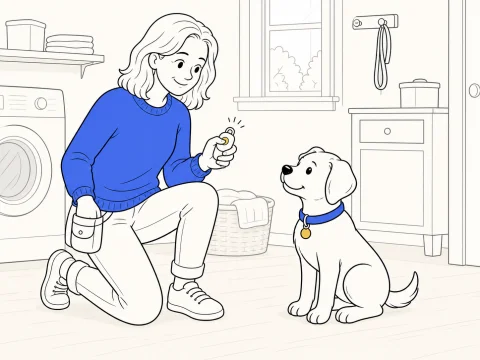
The name was usually repeated into background noise, paired with unpleasant moments, or asked when your puppy was already over threshold — too wired or scared to think. Fix the pairing and the criteria — not the puppy’s “stubbornness.”
Say it once. If there is no turn, make a soft attention sound (a kissy noise works) to prompt the look, click that, and treat — never a second “Bella, Bella.” That kissy prompt is standard force-free practice when a single name call misses: prompt the look without teaching the name means “ignore me until the third shout.” Then make the next rep easier: quieter room, closer distance, better treat. Do not spend the name while they are mid-chew or already wired — cue when their head is free to turn, or you teach “ignore this word.”
If your partner or parents yell the name across the room to stop chewing, that is the same poison — one bright say and a payoff from everyone, or the word fades. The AKC and Dogs Trust both warn that repeating the name — or pairing it with corrections — teaches the dog to tune it out. If you still get zero head-turns in a quiet room after a clean short set, ask your vet to rule out hearing or ear pain before you drill harder.
| What you see | Likely cause | Fix |
|---|---|---|
| Ignores the third “Bella!” | Name repeated when ignored | One say + kissy prompt; never stack the name |
| Flinches or leaves the room | Name poisoned by scolds / nail-trim captures | Rebuild: name only predicts treats, play, meals |
| Works in the kitchen, blank in the yard | Criteria jumped too fast | Quieter spot, closer distance, better treat; re-earn 4/5 |
| Partner yells the name all day | Household inconsistency | Align everyone: one bright say, pay the turn, no name-as-scold |
| Only answers one person | Competing handlers or a noisy room | Train in a quieter pocket; get the whole house on the same one-say rule |
| Two puppies both spin round | Same-room name confusion | Train separately first; pay only the named dog |
How long does it take a puppy to learn its name?
In a quiet room, ClickerPup’s acquisition bar is four head-turns out of five within a few two-minute sessions. Reliable name response in busier rooms or outdoors usually takes longer — that is generalization, not a failed first week.
Treat acquisition and real life as different jobs. Raise one variable at a time — a step of distance, then a busier spot, then a new doorway — and re-earn four out of five at each rung before you expect a solid outdoor check-in. That is the same fluency ladder as name response outside the kitchen.
Can you change a puppy’s or dog’s name?
Yes. Teach the new name the same way — bright tone, mark the head-turn, pay — and keep the old name out of scolds. Both the AKC and Best Friends Animal Society treat a name change as ordinary positive-association work, not a confusion crisis.
Rescue and rehome situations use this constantly. Pick a short, easy-to-call name that does not sound like your other cues (Best Friends’ naming tip), then run the same capture loop until the new word wins four out of five turns. You do not need to “erase” the old name first — you just stop paying it and stop using it as a correction.
Should you say your puppy’s name before every command?
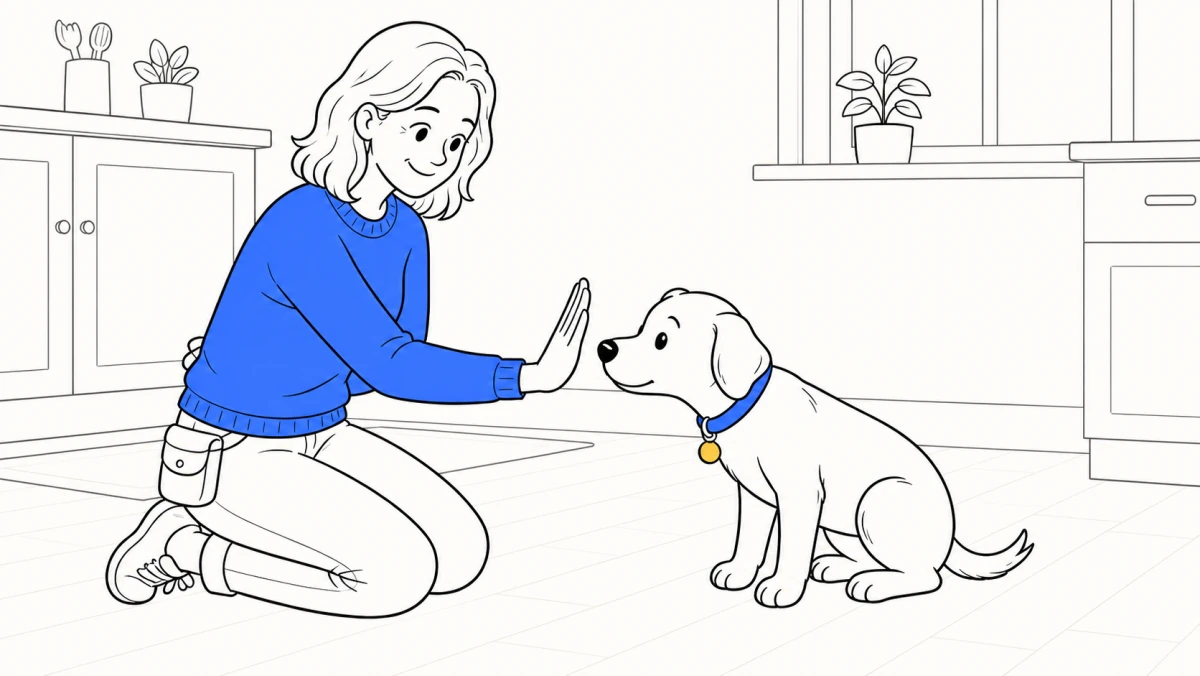
No. The AKC advises against stacking the name before every sit, stay, or down. The name is an attention tap; the cue is separate. Say the name when you want eyes, then ask for the behavior.
That distinction is why name response sits early in ClickerPup’s skill order, right beside a hand target: together they become the substrate for teaching a puppy to come later. If you want the marker charged before you start these reps, the same day-one walkthrough covers the charge test in about five minutes.
What age can you teach a puppy its name?
As early as the week they come home — often around 8 weeks. Name response uses a bright word, a marker, and a treat, so a young puppy can start right away in short sessions.
You do not need a class or a collar. Keep sessions to about two minutes and five to eight reps, then stop while your puppy is still winning — the same short-session pattern covered in how long puppy training sessions should be. An 8-week first session can be three easy turns on the kitchen rug: say once, click the look, treat, reset. For where name sits among the first skills owners actually search for, see the basic puppy commands hub.
When is “ignoring their name” actually something else?
A puppy who blanks you in a busy park is usually over threshold — too wired or scared to think — so drop criteria, get closer, and pay better. What isn’t a training tweak: freezing, flinching, growling, or shutting down when they hear their name after it has been used as a scold, or a sudden collapse of response paired with fear or pain signs.
Those deserve a certified behavior consultant’s eyes (IAABC-certified consultants at iaabc.org), not another louder call — here’s what’s normal and when to get help.
First session today: quiet room, name once, click the head-turn, treat, five to eight easy reps, stop while they’re keen. Tomorrow, make only one thing harder.
Name response is one short skill with a clear click-point, four failure modes you can actually fix, and a hard rule that keeps the word happy. If you want a coach that runs those name games to a 4/5 bar and catches the nagging trap before it poisons the cue, join the waitlist. That is the gap we’re building ClickerPup to fill.