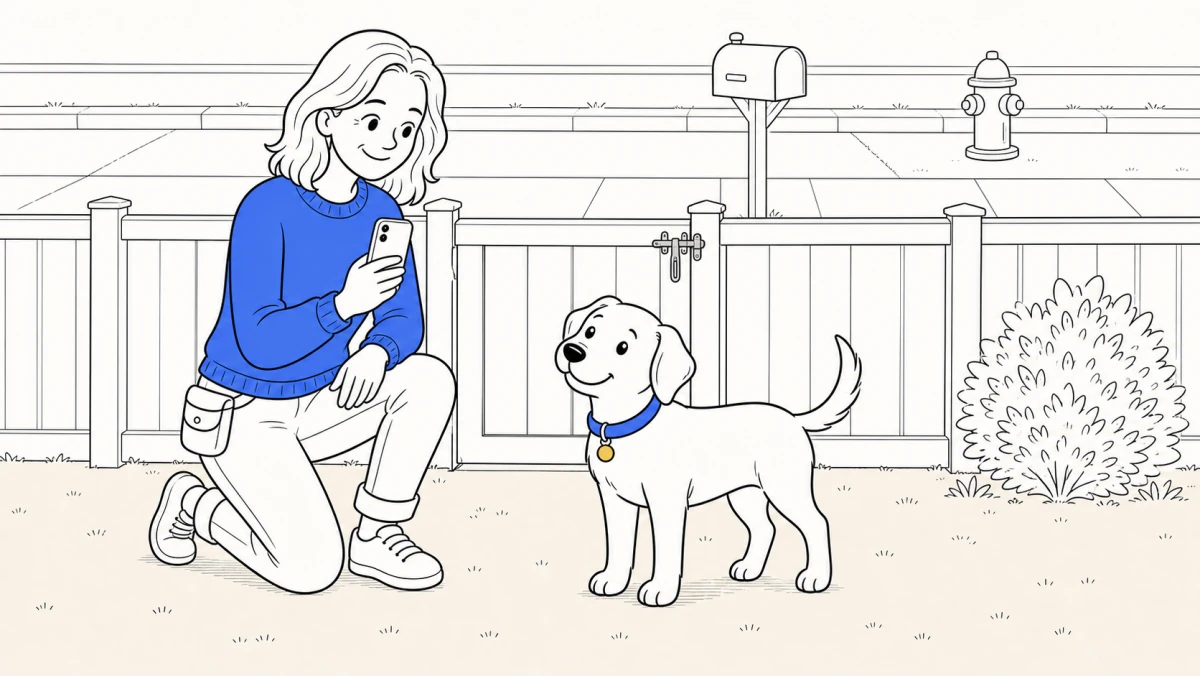
There isn’t one date, because outside isn’t one place: your own enclosed yard, a carried trip down the block, a vaccinated friend’s living room and a public dog park are four different risks, and the veterinary bodies that write this guidance answer them separately. Your vet sets your puppy’s dates. What follows is what those bodies actually publish about each place.
If you are counting weeks on a vaccination card while two threads tell you opposite things — one that your puppy’s feet must not touch the ground until the series is done, another that you are already burning the only weeks that matter — you haven’t been slow off the mark. You’ve found a real conflict, and the veterinary literature names it out loud rather than pretending it away. One thing to be plain about first: this page is not a veterinary source, and nothing here is a vaccination schedule. It’s a map of where the published guidance lands, so the ten minutes you get with the person who does decide go further.
Where can a puppy go before they’re fully vaccinated?
Seven different places, with seven different answers. Ordered from least to most contact with ground you don’t control:
| Where | The ground | Where the guidance lands |
|---|---|---|
| Carried — arms, sling, or stroller | None your puppy touches | Named as a routine tool, not a workaround (Herron & Stull) |
| Your own enclosed yard | Yours, if no unknown dogs use it | Permitted, with conditions attached (Dogs Trust, UK) |
| A well-run indoor puppy class | Cleaned and disinfected, where the class does it | Actively recommended, with a published entry bar (AVSAB; AVMA review) |
| A known, vaccinated dog’s home | A household you can ask about | Named as a common source of safe playmates (AVMA review) |
| Sidewalk and hard surfaces | Public, but not grass | US guidance says choose the location, not the date; UK advice differs (Herron & Stull; AVMA review) |
| Grass in a public park | Public, dog traffic unknown | Named as a surface to avoid (AVMA review) |
| A dog park | Public, heavily used by dogs of unknown status | Explicitly to be avoided (AVSAB; AVMA review) |
That table is not a green light for any row of it — it is the shape of the published guidance. Which rows your puppy can do, and when, is a conversation with the vet who knows what is circulating where you live.
How long after a puppy’s last vaccination can they go outside?
For walking on public ground, the clearest published figure comes from Dogs Trust, a UK charity: a puppy “can typically go on their first walk one to two weeks after they have completed their primary vaccination course.” Two things about that. It is one organization’s published guidance rather than your puppy’s date — your vet sets that, because the length of the series and the local disease picture are both things only they can see. And it answers one kind of outside. Most kinds open earlier.
Why isn’t there one date every puppy can go outside?
Because the finish line moves. Protection from the puppy series depends on when a puppy’s inherited maternal antibodies fade, which is not the same week for every puppy — and on how much disease is circulating where you live, which is not the same in every place. AAHA’s 2022 Canine Vaccination Guidelines note that maternal antibodies against parvovirus “decline exponentially over time and may persist for 13–15 wk or possibly longer,” which is why the series continues “until greater than 16 wk old” — and why “18–20 wk old is preferred particularly in areas of high CPV risk.”
That last clause is the whole problem in miniature: the endpoint is keyed to local disease pressure. AAHA also states that the document “is intended as a guideline only, not an AAHA standard of care,” and that “veterinarians must base their decisions on the best available scientific evidence in conjunction with their own knowledge and experience.” A web page cannot know the parvovirus history of your zip code. Your vet can.
Can a puppy catch parvo from the sidewalk?
The risk lives in ground and objects other dogs have contaminated, not in outdoor air or the act of leaving the house. AAHA’s guidelines are specific: “risk of infection is most likely from virus particles shed by other domestic dogs,” and “the virus is relatively stable in the environment.” That is why the same body of guidance can wave a puppy into an indoor class at seven or eight weeks, a week after their first shot, and still keep them off the grass at a park two months later — the hazard is contaminated ground and unknown dogs, not the outdoors as a category. The AVMA’s Animal Welfare Division draws the same line in a 2024 literature review, which the division publishes as information and states is not official AVMA policy: avoid “contact with dogs of unknown temperament, health or vaccination status or surfaces that may harbor disease vectors such as grass on public parks.”
Not everything follows that map. Leptospirosis needs no other dog at all — Dogs Trust flags standing water and fox urine as routes for it, and it isn’t only a British problem: AAHA’s own guidelines put the risk in ordinary places, noting that “Risk factors for leptospirosis include dogs spending any time outdoors (including urban, suburban, and rural environments), exposure to rodents, and time in kennels or dog daycares.” And the guidance is not unanimous on how hard to avoid public ground. Herron and Stull are noticeably softer than AVSAB and the AVMA review: “Locations where dog traffic is either high or unknown should be treated with caution, but not necessarily avoided.” They are answering different questions — AVSAB and the AVMA review name a class of place to stay out of; Herron and Stull describe how to move through the places you can’t.
Is it safe to just wait until my puppy is fully vaccinated?
Waiting isn’t the neutral option it looks like. It trades one risk for a second one, and the second is documented by veterinary bodies too.
The American Veterinary Society of Animal Behavior’s position statement on puppy socialization opens with “The primary and most important time for puppy socialization is the first three months of life,” and states that AVSAB “believes that it should be the standard of care for puppies to receive such socialization before they are fully vaccinated.” Its stated reason is blunt: “Behavioral issues, not infectious diseases, are the number one cause of death for dogs under three years of age.”
Meghan E. Herron, DVM, DACVB, and Jason Stull, VMD, MPVM, PhD, DACVPM — a board-certified veterinary behaviorist and a board-certified veterinary preventive-medicine specialist, in an undated continuing-education paper hosted by The Ohio State University College of Veterinary Medicine — spell out what the cautious route costs. Where early contact outside the home is avoided, “puppies do not gain essential social feedback until they are fully protected between 16-20 weeks of age – an age that is far past the window of time when socialization will have a positive impact.” Their framing is not go anywhere: “The key is finding a balance that takes BOTH risks into consideration, weighs them against the benefits, and provides an individualized plan for each puppy.” Worth knowing, since this page leans on both: Stull is also a listed contributing reviewer on the AAHA guidelines quoted above, so those two sources are not fully independent of each other.
What happens if a puppy isn’t socialized in time?
Two national datasets put the cost in the same place. Boyd and colleagues searched VetCompass records from primary-care practices in England and found dogs under three “at a proportionately high risk of death due to UBs (33.7%) compared with other specific causes of death (eg gastrointestinal issues: 14.5%)” — UBs being undesirable behaviors, with “Aggression was the most prevalent UB overall” (Animal Welfare, 2018). Yu and colleagues ran the equivalent search on VetCompass Australia: “29.7% of the 4341 dogs that died at three years of age or under had deaths ascribed to at least one UB,” aggression again the most commonly reported (Animals, 2021). Yu’s team notes their figure is “likely to have underestimated the national scale of canine euthanasia due to UB,” because dogs surrendered and euthanized at shelters are not in the data.
Be exact about what those numbers are. Both are shares of deaths, not shares of dogs: of young dogs who died and had a cause recorded, that is the proportion where behavior was the reason. Both studies set out to estimate proportional mortality and its risk factors from clinical records, which is a different question from whether earlier outings change anything. And AVSAB puts a superscript on the sentence before its own death claim — relinquishment to shelters, cited to Miller et al. (1996) — and none on the death claim itself. What the two studies do give you is a measured floor under the half of this tradeoff that usually arrives with no number at all. Why the socialization window exists, and why the famous 12-week figure gets quoted far more precisely than the evidence supports, is answered separately in what the research actually says about the socialization window.
Can a puppy get parvo at puppy class?
One study has measured it, and it is the one the guidance rests on. Stepita, Bain and Kass gathered records from 21 clinics across four US cities plus 24 trainers (Journal of the American Animal Hospital Association, 2013): “In total, 279 puppies attended socialization classes and none were suspected of or diagnosed with CPV infection,” and “vaccinated puppies attending socialization classes were at no greater risk of CPV infection than vaccinated puppies that did not attend those classes.”
The comparison arm is what gives that meaning, and it usually gets dropped. Reporting the study, dvm360’s journal scan sets out the clinic arm: 1,012 puppies, of whom 48 attended classes, 876 did not, and 88 had unknown class history — and “CPV infection was diagnosed in 14 dogs that did not attend socialization classes and was not diagnosed in any of the dogs that did.” The second arm was 231 puppies enrolled through trainers, in classes whose enrollees were predominantly under 20 weeks old; the 48 and the 231 together are where the 279 comes from.
Now the fence, which matters as much as the finding, and which is bigger than the headline suggests. The vet-confirmed comparison rests on 48 class-attending puppies against a background rate of roughly 14 in 876 — a rate low enough that you would expect about one case in a group of 48 even if class made no difference at all. Zero out of 48 is consistent with no added risk; it is not a demonstration of it. The other 231 puppies are trainers reporting no suspected cases, which is a softer signal than a veterinary diagnosis. Every puppy in the clinic arm had been vaccinated by a veterinarian at least once, and the trainer arm required at least one parvovirus vaccine before the first class — so none of this speaks to a puppy who has had no vaccines yet. It is an observational survey, not a controlled trial. And dvm360 reports the authors’ own caution, which is the one most relevant to you: the population “was not a random sample” and the results are “not generalizable to all geographic areas.”
Can a puppy go in the backyard before they are fully vaccinated?
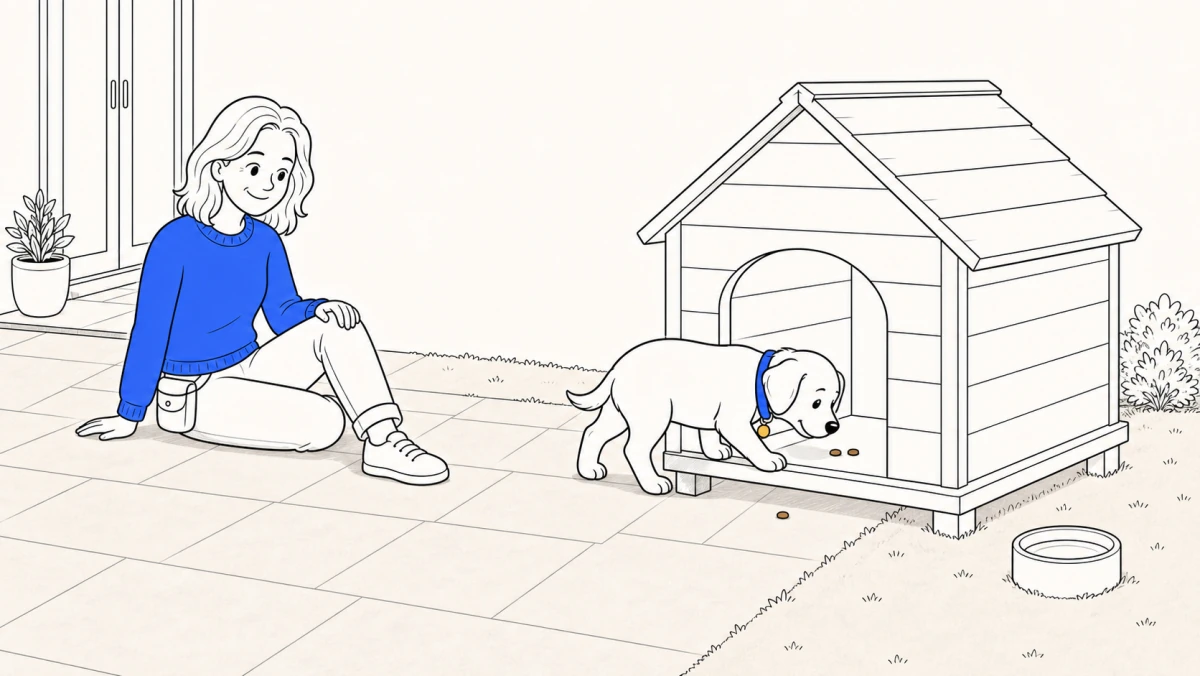
Yes in the clearest published guidance there is, which is British, and it comes with conditions. Dogs Trust says a puppy “can also walk outside in the garden after their first vaccination, provided that it is enclosed and not used by other dogs with unknown vaccination status.” Across the AVSAB statement, the AVMA’s welfare review and the 2022 AAHA guidelines, none of the US documents gives a yard rule at all — the closest is the AVMA review’s line that early outdoor activity “should be limited to areas that are not used by unvaccinated animals.” So whether your yard counts, and from when, is a question for your vet rather than a web page.
The same Dogs Trust page adds a condition that has nothing to do with other dogs: keep a puppy “away from ponds and stagnant water due to the leptospirosis risk,” and “be careful in gardens frequently visited by foxes, as it can also be spread in their urine.” A shared yard, a front lawn other dogs use, or a space you inherited without knowing its history is a different proposition from a fenced yard only your household’s dogs have used. While you’re out there, the same puppy-proofing pass you did indoors is worth repeating on the yard.
Where can a puppy go potty before they’re fully vaccinated?
The nearest thing to an answer in the published guidance is the enclosed-yard row above, with its conditions attached — and this is the reason that row matters more than any other, because a puppy in weeks 8 to 16 needs it many times a day, not once.
If you don’t have a yard — an apartment, a shared stoop, a strip of communal grass — that is a real constraint and a genuine vet conversation, because it depends on what’s circulating locally and on what your particular building has out front. The routine itself doesn’t change either way: how to potty train a puppy covers the timing and the marking, and those work on a balcony or a patch of turf as well as they work on grass.
Can you carry a puppy outside before their vaccinations are finished?
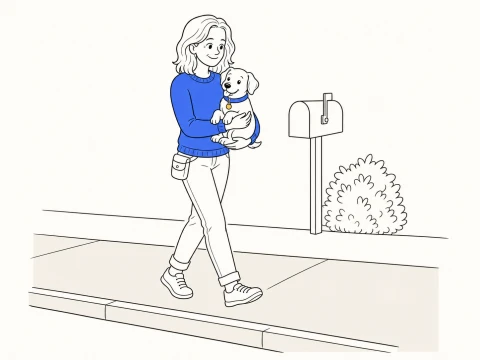
Yes, and it is the option that buys the most for the least. Carrying keeps your puppy off shared ground while leaving everything they actually need to meet — traffic, bicycles, umbrellas, hats, sirens, strangers — completely available.
Herron and Stull describe it as a routine tool rather than a workaround: puppies “can be carried or strollered when getting from one place to the other if the available walking paths are frequently trafficked by other dogs,” and “strollers or slings are also an option if contact with the ground is deemed too risky.” Dogs Trust puts the same option more strictly, and the strictness is worth hearing: “You can take your puppy out in a carrier or a secure pram during this time to introduce them to the outside world. But, they should not be allowed to walk on the ground.”
One thing carrying doesn’t solve: the ground travels indoors on people. Herron and Stull tell owners to ask visitors about “recent dog exposure and visits to areas where traffic may be high for dogs with unknown health status (i.e. dog shelters, dog parks),” note that “it may be best for them to change clothes/shoes before visiting with a new puppy,” and ask that everyone wash or disinfect their hands “before and after interacting with a new puppy.” A puppy watching a garbage truck from your arms is doing the actual work of socialization — but the shoes that walked through the park still come in the front door.
Can a puppy meet other dogs before the course is finished?
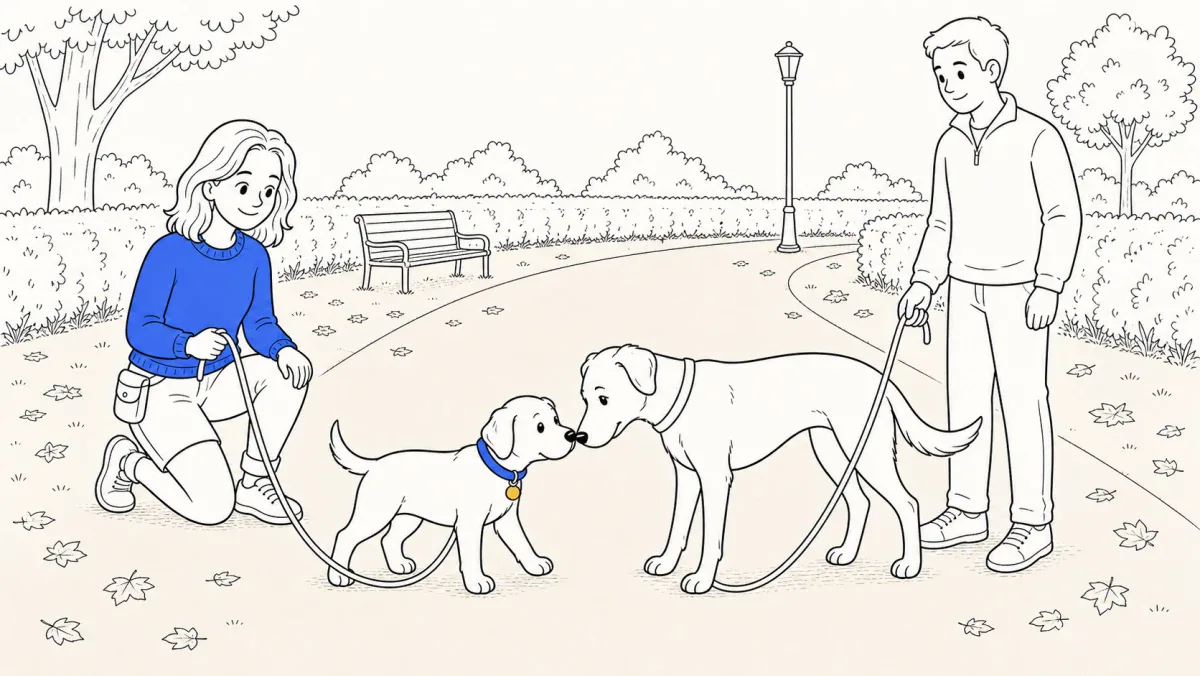
Known, healthy, fully vaccinated dogs — yes, and it is specifically recommended. Unknown dogs — no. The AVMA review’s phrasing is the whole rule in one line: “Prior to full vaccination a common source of well-vaccinated playmates includes socialization classes and friend’s pets.” Dogs Trust lands in the same place from the other side of the Atlantic: “Your puppy can interact with your other dogs, or a friend’s dogs coming to the house, provided these dogs are fully up to date with their vaccines.”
Herron and Stull add a second screen, and it is behavioral rather than medical. “The best play pal for a new puppy is a mature adult who is known to be friendly and eager to play with other dogs, but also one that does not tolerate excessive mouthing or jumping.” An occasional bark or air snap when your puppy plays too rough is, in their words, appropriate; “any aggression beyond that, however, is not appropriate,” and if the adult dog is avoiding your puppy, growling, or playing too rough, “remove the puppy from the situation immediately.” On the medical side: “Double check that any dog interacting with a new puppy is healthy and current on vaccines and ecto/endo parasite prevention to minimize risk for the puppy.” That is a question you ask the owner, out loud, before the door opens.
When can a puppy go to a dog park?
Not during the puppy series, and the guidance here is blunt. AVSAB’s statement says visits to dog parks “or other areas that are not sanitized and/or are highly trafficked by dogs of unknown vaccination or disease status should be avoided.” The AVMA review names the same place for the same reason: owners “should avoid areas with high likelihood of unvaccinated dogs such as dog parks and grassy areas that dogs frequent.”
There is a second reason, and it survives long after the medical one expires. Herron and Stull build their advice on choosing a play partner around known, screened, temperament-checked dogs, because at this age a bad match is durable: in their words, “A bad experience at this sensitive age can have long lasting negative effects.” Once your dog is cleared for public spaces, a dog park is still a hard first venue for a young dog — a controlled introduction beats a crowd of strangers whichever week you do it.
Can a puppy start puppy classes before the vaccine course is finished?
That is what the classes are designed for, and the entry bar is published rather than guessed. AVSAB’s position statement says that “in general, puppies can start puppy socialization classes as early as 7-8 weeks of age,” and that “puppies should receive a minimum of one set of vaccines at least 7 days prior to the first class and a first deworming.” The same statement adds the condition that is easiest to skip past: “Each puppy should have up-to-date vaccinations and be disease and parasite free before entering the class.” Herron and Stull add that a puppy should “be given a clean bill of health by a veterinarian” before starting. That is a class’s entry requirement, not your puppy’s plan; whether and when your puppy meets it is your vet’s call.
Vetting the class is the part you can do without anyone’s permission. The AVMA review says a class should be “held indoors” and started “as close to 8 weeks of age as possible if there is a well-run class in the area.” Herron and Stull say classes “should be researched ahead of time to ensure proper health screening of all dogs entering the facility, as well as proper disinfection practices,” and that they “should be reserved for puppies under 4 months of age” — an upper bound worth checking, because a class with adolescent dogs in it is a different room. A class that can’t tell you its vaccination requirement and its cleaning routine has answered the question.
Is puppy class actually worth it?
Probably, though the evidence is softer than it first looks. Duxbury and colleagues surveyed the owners of 248 adult dogs adopted as puppies from a humane society and reported higher retention in the home among the dogs that had attended that shelter’s own puppy socialization classes, concluding that vets may recommend “enrolling 7- to 12-week-old puppies in early learning and socialization classes” (JAVMA, 2003). Read that as an association in a questionnaire survey rather than a measured effect of class — higher retention also tracked with being female, being handled frequently as a puppy, and sleeping near the owner’s bed, which is a lot of things happening in the same households. And the AVMA review adds the small print that applies to every class: “class attendance alone is not sufficient.” The class is where the owner learns the exercises; the exercises happen at home.
Why is UK puppy-walking advice stricter than US advice?
For walks on public ground the two national traditions genuinely differ, and averaging them loses the information. Dogs Trust sets a date-shaped bar — the first-walk figure at the top of this page — and adds that “A puppy should not be walked outside if they have only had a single vaccination.” That line is about walking off your property; the same page treats the enclosed garden separately, which is how it can say both things without contradicting itself.
The AVMA review starts from the opposite assumption for leash work: “Note that this phase of training requires that owners walk puppies before the puppy is fully vaccinated. Hence, it’s important for owners to choose locations carefully.” Both agree on carrying and on the enclosed yard; they part company on walking on public ground before the course is done. Disease prevalence and vaccine schedules differ by country and region, which is why neither tradition transfers cleanly and why a local vet outranks both.
What should you ask your vet about going outside?
Four questions turn a vague “is it safe yet” into an answer you can act on, and none of them is a question a website could answer for you:
- How much parvovirus are you seeing locally this season, and does that change what you’d advise for us? This is the variable AAHA’s own guidelines move on.
- Does my yard count? Describe it honestly — fenced or open, shared or not, what else walks through it, whether there’s standing water.
- Would you sign off on a puppy class now, and what would you want done first? Bring the class’s published entry requirements with you.
- At what point would you be comfortable with sidewalks, and what would you still avoid after that? The second half of that question is the one people forget.
Write the answers down. You’re going to be asked for them by a class, a walker, or a relative with opinions.
What should a puppy’s first trip outside look like?
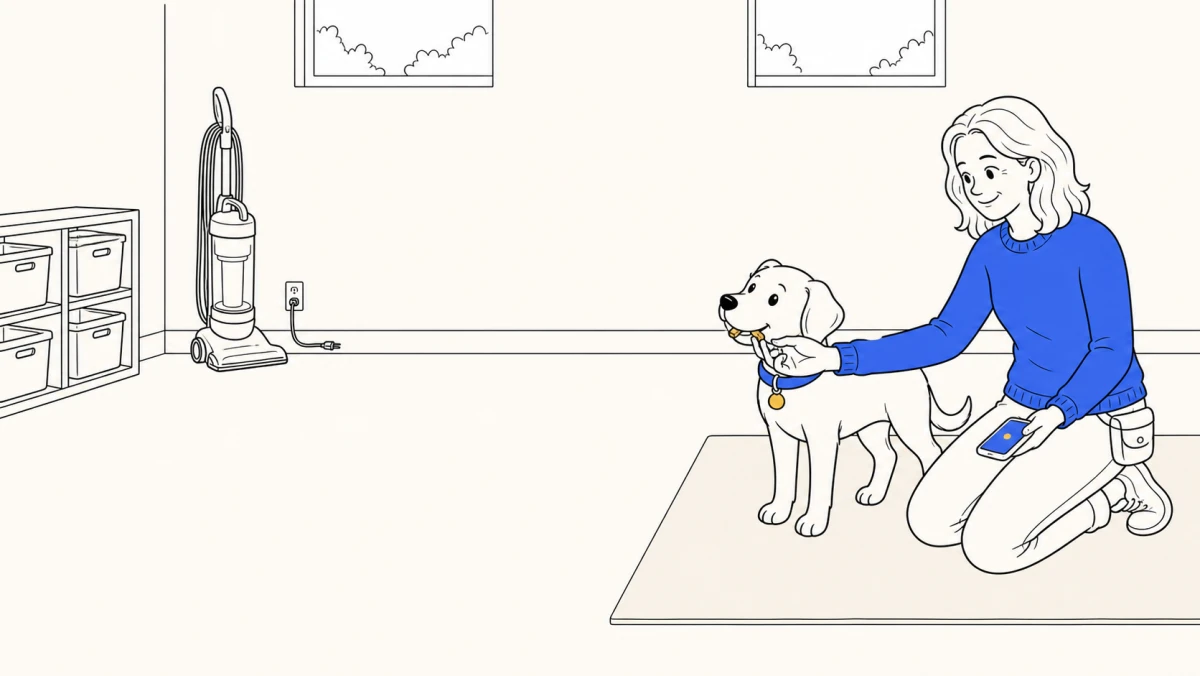
Short, boring, and at a distance your puppy chooses. Exposure isn’t the goal; a puppy who stays comfortable while exposed is the goal — the AVMA review says owners should “allow animals to withdraw when anxious but provide praise and treats as needed to encourage the animal to remain in a comfortable and relaxed or playful state.” The fuller version of getting that balance right lives in the socialization window article. What belongs here is what you do with your hands.
Concretely: pick a spot where the interesting thing is far enough off that your puppy can watch it without going still — the far corner of a parking lot, a bench across from a bus stop. Stand there. Don’t walk toward anything. When a bus goes past and your puppy looks at it and then looks back at you, that look-back is the thing you pay, and you pay it the instant it happens. Three or four of those and you’re done: five minutes, probably less. Turn around while your puppy is still craning to see more, not once they’ve had enough. The trip that ends early is the one that makes the next one easy.
What you never pay for is the flinch, or being dragged closer. If marking that exact instant is new, what clicker training is and whether it works covers the mechanism and how to charge a clicker is the five-minute setup.
The leash is a separate skill that starts indoors long before any of this, and leash training a puppy picks it up from there.
When should you call the vet instead of training through it?
Immediately, for anything with a medical shape to it. Vaccination dates, whether a booster has taken, titer testing, how much parvovirus or distemper is circulating where you live, and any puppy who seems unwell are vet questions, and they stay vet questions no matter how confident a web page sounds. If your puppy is vomiting, has diarrhea, goes off food, or turns lethargic after an outing, stop reading and call your vet.
The behavioral line is separate and just as firm. AVSAB’s statement puts it in one sentence: “owners of puppies displaying fear should seek veterinary guidance.” A puppy who startles at a bus and shakes it off in a minute is normal. A puppy who freezes, won’t take food they normally love, or is more frightened by outings after several weeks of gentle ones is telling you the exposure isn’t working, and more of it is the wrong answer. What is normal and when to get help covers where that line sits. A certified behavior consultant is the right next call: IAABC-certified consultants (iaabc.org) work to standards that name positive reinforcement as “the primary training strategy” and state that “The IAABC strongly opposes the intentional use of aversive stimuli and requires members to refrain from using shock in training or behavior modification.”
The bottom line
The question isn’t when, it’s where. Carried trips and your own enclosed yard are where the published guidance is most permissive. A well-run indoor class is where it’s most specific — and the one setting where the disease cost has been measured at all. Public grass and dog parks are where it’s most restrictive. Everything else is a date, and the dates belong to your vet, who knows what’s circulating where you live. The rest of the first week is in the new-puppy checklist.
ClickerPup won’t help with any of that. It doesn’t track vaccinations, it doesn’t schedule socialization, and it will never tell you your puppy is cleared to go somewhere — that’s your vet’s call, and we’re not a veterinary source.
What we are building it for is the other half of the outing: the training that happens whether you meant it to or not. Deciding what to mark when a bicycle goes past, paying the look-back instead of the flinch, and ending the trip while your puppy is still curious are ordinary clicker skills, and they’re hard to run well when you’re also the one holding the leash and worrying. That judgment is what the app is being built to make with you, one two-minute session at a time. It isn’t launched yet — the clicker stays free forever, and there’s a plain reminder before anything ever charges.
Claim my early spot and we’ll bring you in as we open up.