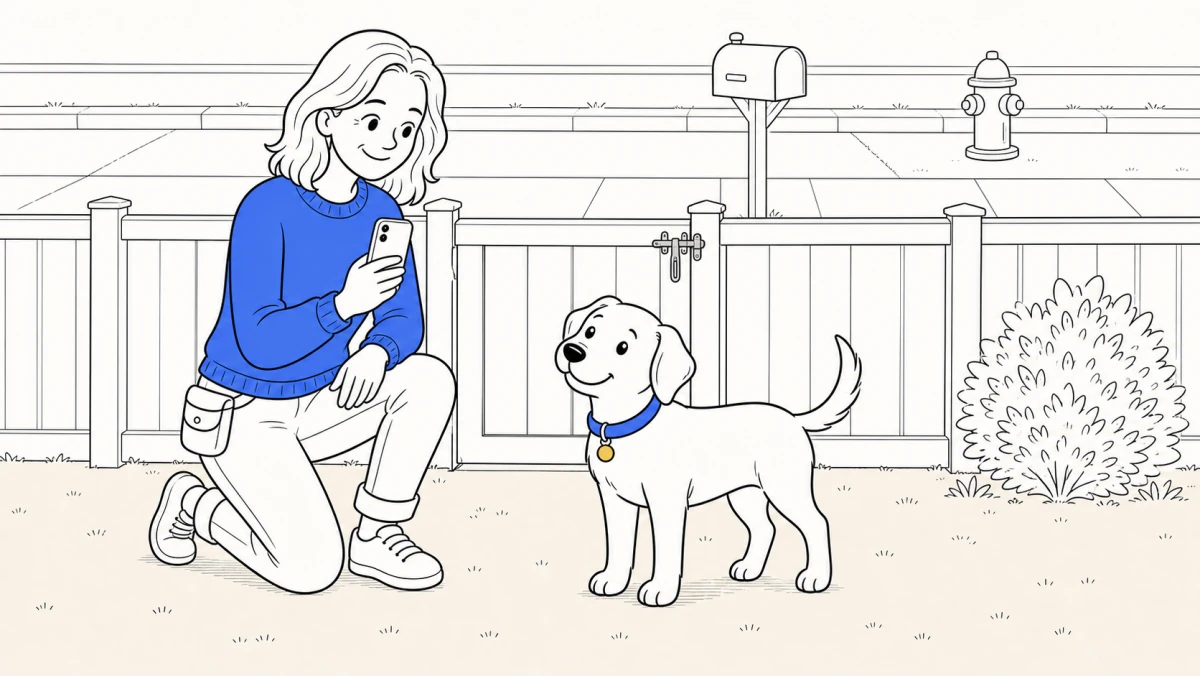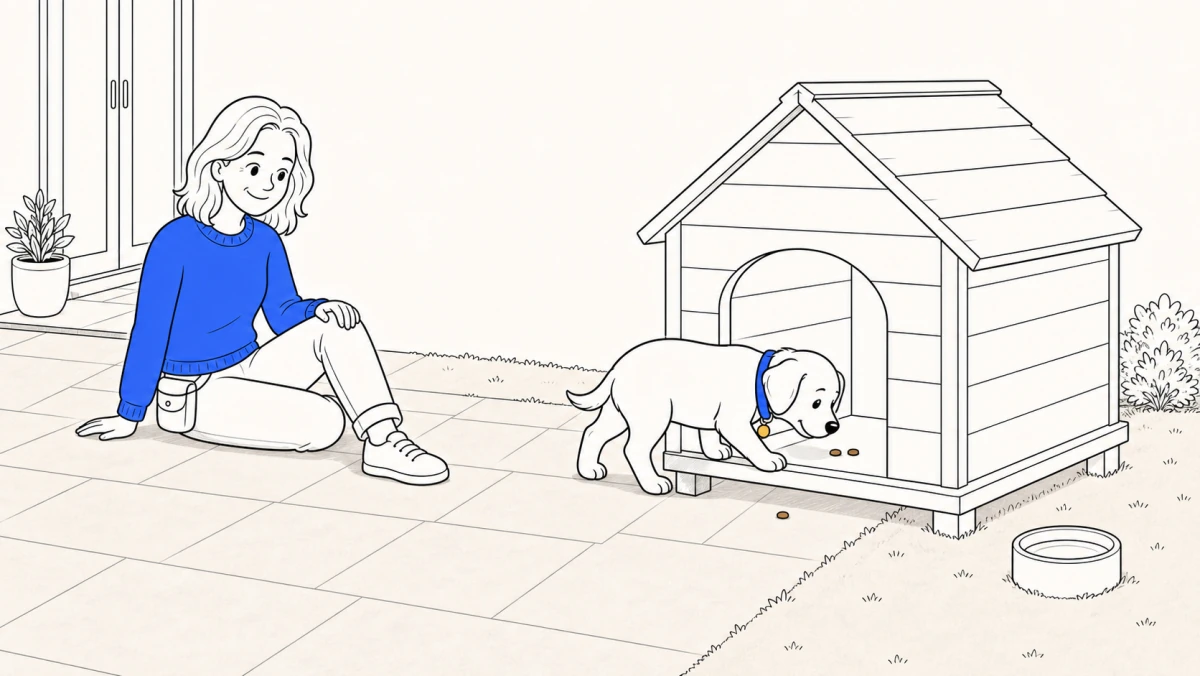
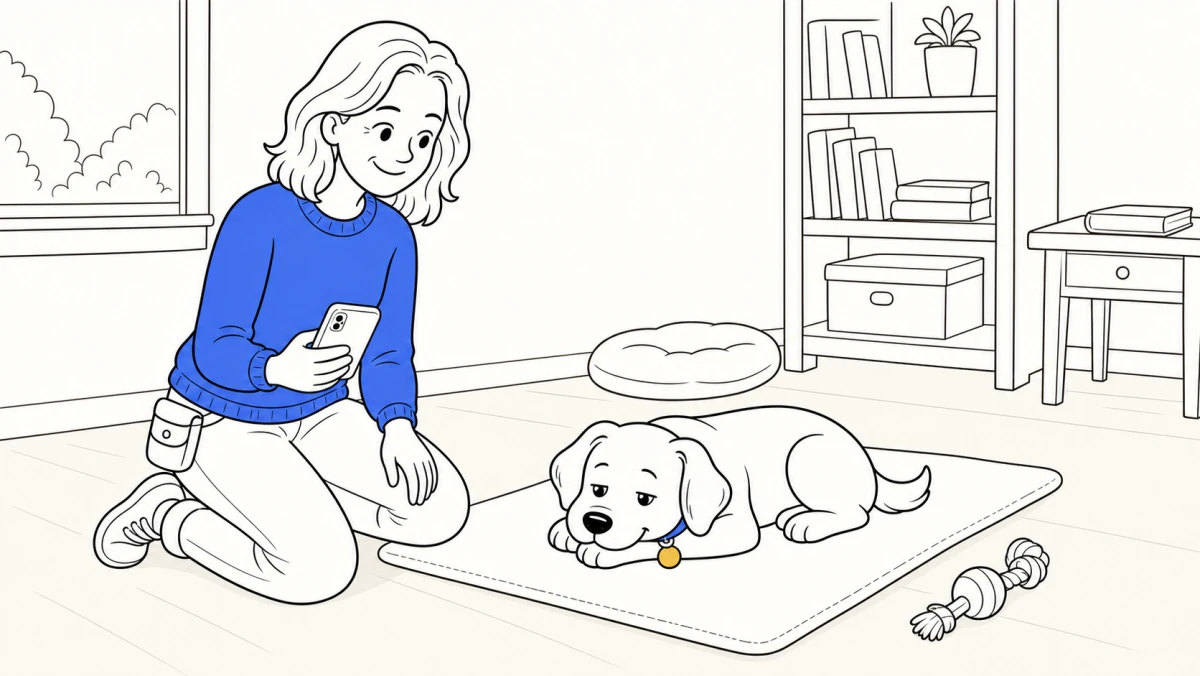
Getting a puppy to settle and sleep is two jobs, not one — and mixing them up is why it feels impossible. Settle is a skill you teach: your puppy learns that calm is a place they can go. Sleeping through the night is mostly management: a bladder that’s still growing, a crate near you, and a boring bedtime routine. Teach the first, and the second gets much easier.
If you searched this at 2am on a few hours’ sleep — the “please help before I cry myself to sleep again” kind of tired that big puppy forums like r/puppy101 are full of — start here: almost nothing about a puppy who won’t settle or sleep means something is wrong with your dog, or with you. Most of it is a small bladder, a big new world, and a wind-down skill your puppy hasn’t learned yet. If this is genuinely your first few days, the wider new-puppy checklist sets the scene; this guide is the deep dive on the settle-and-sleep part. Here’s how to teach the skill, set up the nights, and tell the normal rough patch from the rare real problem.
How do you teach a puppy to settle?
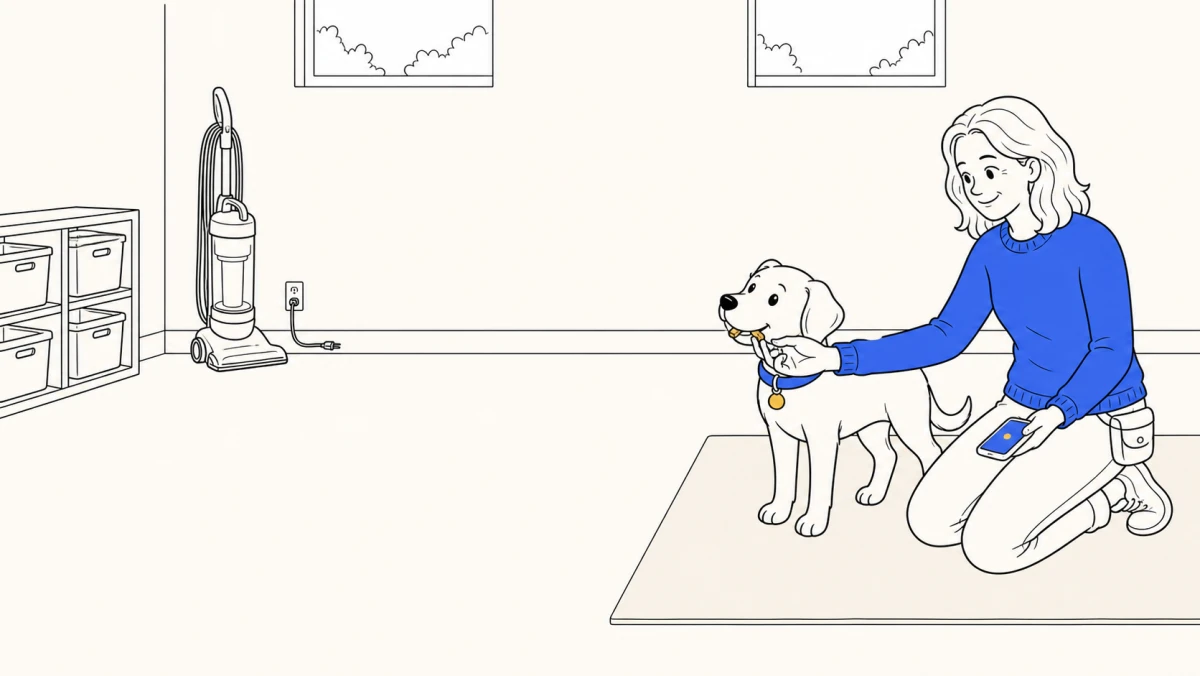
Settle is a trained off-switch: your puppy learns to relax on a mat and stay calm, on cue. The key is that you’re rewarding a state — a genuinely relaxed body — not a position you force. You capture calm and pay for it, and calm becomes something your puppy offers instead of bouncing off the walls. Capturing — a marker-training move Karen Pryor popularized — just means marking a good thing your puppy does on their own, rather than luring them into position.
You’ll need your marker — a clicker or a simple “yes” — already meaning “that earned a treat.” Both are legitimate; the AVSAB’s humane-training guidance explicitly names “a clicker or verbal marker” as equal tools, so use whichever you can handle without dropping the treats. (New to the marker? Start with charging the clicker and your first day of clicker training.) Then:
- Put a mat or folded blanket down. Any interest in it — a sniff, a paw on it — gets a marker and a treat, delivered on the mat. The mat is about to become the place where calm pays.
- Reward progressively calmer choices. Standing on it, then sitting, then lying down, then a soft, loose body. The click-point keeps moving toward calm — you’re shaping a mood, not a trick.
- Deliver treats slowly and low, between the front paws. Fast, high, exciting treats create an excited puppy — the exact opposite of the job. Slow and low keeps the volume down.
- Skip the cue word at first. Capture the calm, name it later — a cue attached to a puppy who isn’t actually relaxed yet just names the wrong thing.
- Keep it to two or three quiet minutes, and stop while your puppy is still relaxed. Settle is a wind-down, not a drill.
The thing that separates real settle from a stiff “down” is the body: click the sigh, the hip that rolls to one side, the head that goes down — not a tense sphinx watching your treat hand. Once the mat reliably means calm, build it outward in small steps: holding for 20–30 seconds, then while you take one step away and back, then in a slightly busier room, and finally during normal household bustle with a chew to make it their own idea. That last stage — calm on cue while life happens around them — is the version that underwrites both quiet houses and easier nights.
If turning that into a short, right-sized session — one that adapts to how your puppy’s day actually went — sounds better than winging it, that’s the gap we’re building ClickerPup to fill. But you can start with a blanket and a handful of treats today.
Why won’t my puppy settle down?
Usually because they’re overtired, not under-exercised — and that flips the fix on its head. Puppies sleep 18 to 20 hours a day, and the AKC is blunt about what happens when they don’t: “Too much stimulation and exhaustion can lead to unfortunate behavior.” An overtired puppy doesn’t wind down like a tired adult. They wind up — more biting, more zooming, no brakes.
So two boring levers do most of the work: protect daytime naps, and start your settle routine before the usual boil-over point, not during it. And there’s one important escape hatch — if your puppy is already past the point of settling, that isn’t a training moment. That’s a nap. An overtired puppy needs sleep, not another rep, and more play just pours fuel on the fire. If the chaos reliably peaks in the early evening, that has its own name and its own plan: the puppy witching hour.
When will my puppy sleep through the night?
Most puppies can’t physically sleep through the night until their bladder catches up — often somewhere around four to six months. It isn’t a discipline problem or a training failure; it’s anatomy. The AKC’s rule of thumb, from their puppy potty-training timeline, is simple: “Take the age of your puppy in months and add one, and that is the maximum number of hours that your puppy should be able to comfortably hold it between potty breaks.”
Run the math and the early weeks stop feeling like your fault:
| Puppy age | Roughly how long it can hold overnight | What to expect |
|---|---|---|
| 8 weeks (2 months) | ~3 hours | One, sometimes two, night potty trips |
| 3 months | ~4 hours | Often still one night trip |
| 4–5 months | ~5–6 hours | Starting to make it through |
| 6 months and up | 6–7+ hours | Usually sleeps through |
Two honest caveats on that table. Puppies can usually hold it a little longer asleep and still than the daytime number suggests, so the overnight stretch often beats the strict “age plus one.” But every puppy is different, and the AKC’s own sleep guidance puts it plainly: “Just like human babies, puppies sometimes are not yet ready to sleep through the night,” and yours “may need a potty break during the night.” A 2am trip outside at eight weeks isn’t a step backward. It’s plumbing.
How do you get a puppy to sleep through the night?
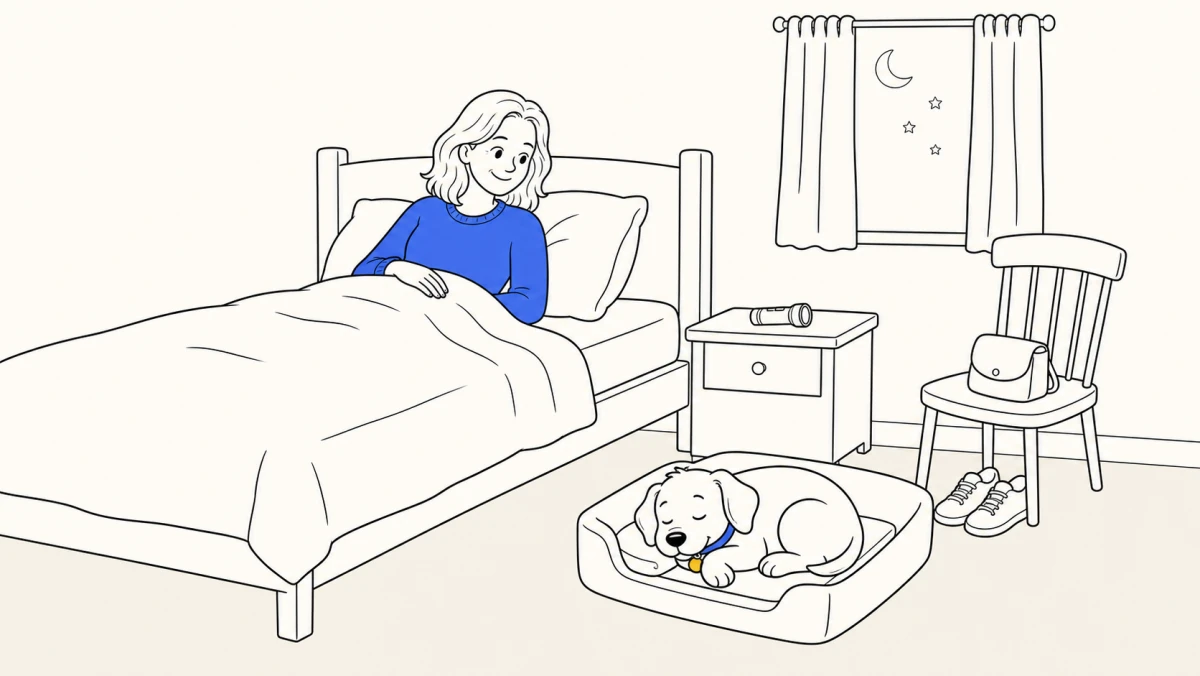
Set the night up so that sleeping is the easy option — most of “getting” a puppy to sleep is removing the reasons they can’t. Four things do the heavy lifting, and none of them are buyable:
- Put the crate or bed near you at first. The AKC’s reasoning is practical: “Keeping the crate in or near your bedroom lets you hear a whimper or a whine if your puppy needs to go out during the night.” Earshot distance means a small need doesn’t have to escalate into a full-blown cry before anyone notices. You can move it further away later; a panicked first week is much harder to undo.
- Run the same boring bedtime routine every night. The PDSA lays out a simple order: evening meal, then out to potty, then “time for a final play,” then the last potty trip right before bed, then into the crate or bed with a favorite chew. Predictable and dull is exactly what you want — nothing about bedtime should be exciting.
- Make the last potty trip the actual last thing. Straight from outside to the crate, no detour into play. And be ready for one genuine potty trip in the small hours early on — quiet, boring, functional, straight back to bed.
- Keep it calm and dim. A warm, comfortable bed — the PDSA notes a soft, bulky item like a teddy can give a puppy sleeping alone something to snuggle — and a quiet room tell an overtired nervous system it’s finally allowed to switch off.
This is management, not a trick — and it’s worth being straight about that, because plenty of apps and gadgets will happily sell you the idea that they can do it for you. They can’t. A bladder grows on its own schedule and a routine is something you run, not something you download.
What should you do when your puppy cries at night?
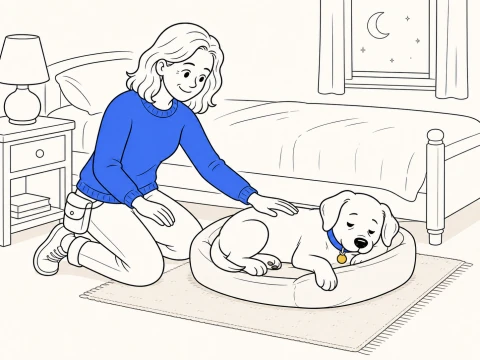
In the first nights, treat crying as normal distress, not protest to ignore — and comfort is the right call. Your puppy has, as the PDSA puts it, “spent their whole life up until now sleeping in a pile of their littermates,” right next to their mother — so suddenly having no one there at night is a real shock. That’s not manipulation. That’s a baby animal alone for the first time.
Crucially, the old “just let them cry it out” advice can backfire. The PDSA is direct that leaving a puppy to cry “could actually be having the opposite effect to what you want and making them more anxious.” So respond — but keep it low-key: settle them gently back down, “just enough to make them feel comforted,” without fuss, chatter, or a midnight play session that teaches crying summons the fun. If it’s been a few hours, a silent potty trip (out, done, back to bed, no engagement) covers the real need without turning night into party time.
One distinction worth making early: night crying is distress at being alone, and it fades as the settle skill grows. Barking that’s spreading into the daytime — at the doorbell, out of the window, at you for attention — is a different behavior with a different fix, and it’s covered in why puppies bark and how to stop it. Treating the second like the first is why some puppies get quieter at night and louder everywhere else.
The daytime skill helps here too. A puppy who’s learning to settle on a mat — and who’s had a few tiny, happy experiences of being calm and alone — walks into the night with a head start. The RSPCA’s advice on building that independence is to “very gradually increase the time that you leave your dog alone so that it’s never a frightening experience,” starting with as little as a few seconds and “never” pushing to the point of distress. Calm-when-alone is a skill you grow in daylight, a few seconds at a time, and the nights borrow from it.
When is a sleepless puppy a reason to get help?
A few rough nights are normal; a handful of patterns are not, and they need different help than a better bedtime routine. Get eyes on your puppy — a vet’s or a certified professional’s — if you see:
- Genuine panic when left alone, not just settling fuss — nonstop distress, drooling, destruction, or a puppy who hurts themselves trying to get out. That points toward separation anxiety, which is behavior modification with a professional, not something to sleep-train through. An IAABC-certified behavior consultant (iaabc.org) is the right call.
- Crying alongside physical signs — straining to pee, vomiting, real lethargy, or not eating — which reads as medical, not behavioral. That’s a vet call, not a training tweak.
- A settled sleeper who suddenly isn’t. A sharp change in a puppy who was doing fine deserves a vet’s look first, because pain and illness often show up as behavior.
None of that is the common case — the common case is a normal puppy with a small bladder having a hard week. But knowing the line matters, and here’s a fuller guide to what’s normal and when to get help. The honest rule: settling and sleep are things you teach and manage; panic, pain, and sudden change are things you get help with.
The honest short version
Settle and sleep are two jobs. Settle is a skill — mark and reward calm on a mat, shape toward a genuinely loose body, keep sessions short, and build it into real life a step at a time. Sleep is mostly management — a crate near you, a boring bedtime routine, a last potty trip, and patience with a bladder that needs four to six months to catch up. Do the first and the second gets easier. Expect a night trip early, read a rough night as a rough night rather than a verdict, and save the worry for genuine panic, pain, or a sudden change.
Here’s the honest bit most puppy apps won’t tell you: ClickerPup doesn’t get your puppy to sleep through the night. That’s a growing bladder and a bedtime routine — management no app can shortcut, so we’re not going to pretend otherwise.
What ClickerPup does coach is the trainable half: settle — the calm off-switch you just read how to build — along with sit, leave-it, and the marker foundation underneath them, two honest minutes at a time. It checks whether the puppy on your floor actually got a skill before moving on, the clicker’s free forever, and there’s a plain reminder before anything ever charges.
Claim my early spot and we’ll bring you in as we open up — with the force-free foundations ready from day one.