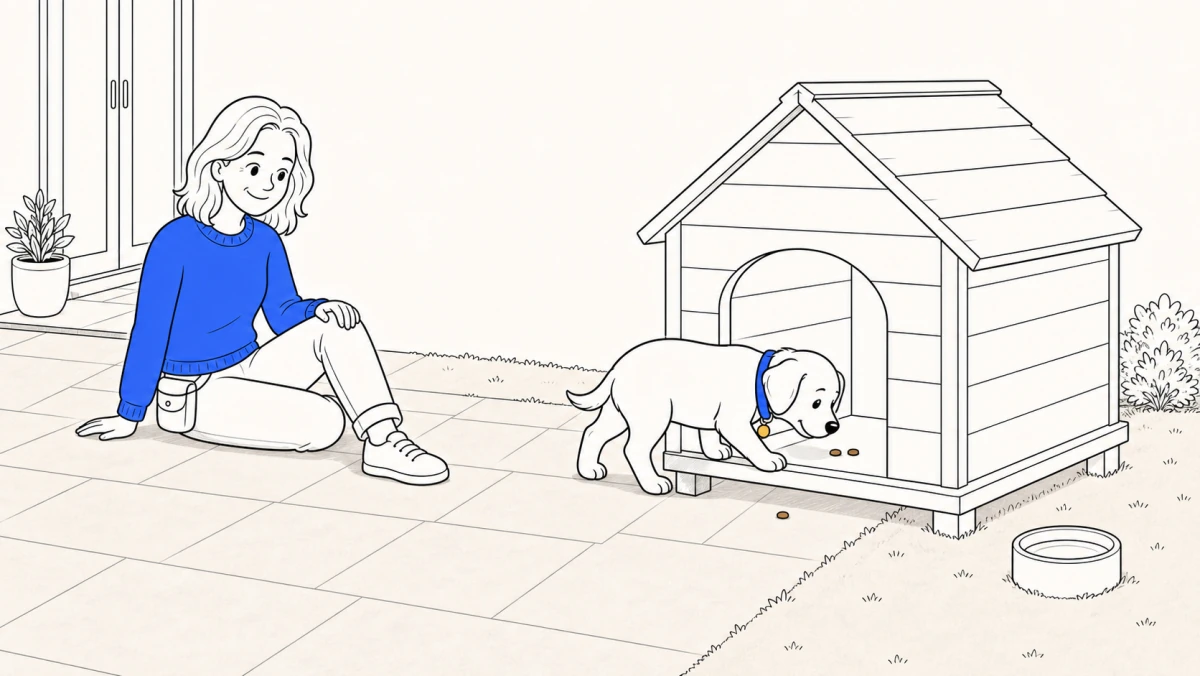
You kennel train a dog in stages: treats near the kennel with the door open, meals eaten inside it, the door shut for seconds and then minutes while you sit there, and only after all that, time alone. Kennel training and crate training are the same job — most guides use the two words interchangeably, and “kennel up” is the usual cue.
If you’re here because your dog screams the moment the latch clicks — or because one person told you crating is cruel and the next told you it’s essential — both of those are live questions with real answers. Below is the method every major welfare organization publishes, the four places they don’t line up — on hours, on how long it takes, on whether to ignore crying, and on whether you can crate a dog while you work — and the point where this stops being a training problem.
Everything below is sourced to guidance we read end to end for this piece — the American Kennel Club, Humane World for Animals, PAWS, the Animal Humane Society, Best Friends Animal Society, the RSPCA, the ASPCA and Cornell’s veterinary canine health center — plus the regulators and the IAABC’s practice standards, all listed at the foot. Where they disagree, we say so rather than picking quietly.
One thing worth having before the rest: if your dog panics rather than protests — drooling, frantic escape attempts, injuries to teeth or paws — none of the training below applies, and the section on when kennel distress means stop and get help is the one to read first.
Is kennel training the same as crate training?
Yes, in almost every case. “Kennel” and “crate” are two words for the same indoor box, and the standard cue for going into it is “kennel up.” The RSPCA lists the aliases in a single breath: the dog crate is “also referred to as a dog cage, playpen, puppy pen or indoor kennel.”
The cue is near-universal too: PAWS and the Animal Humane Society both teach “kennel up,” and Best Friends Animal Society offers “kennel up,” “crate,” “or something else you prefer.”
Two other things also get called a kennel, and neither is this: an outdoor run attached to a house, and a boarding kennel you pay to leave your dog in while you travel. Everything below is about the indoor box.
How do you kennel train a dog, step by step?
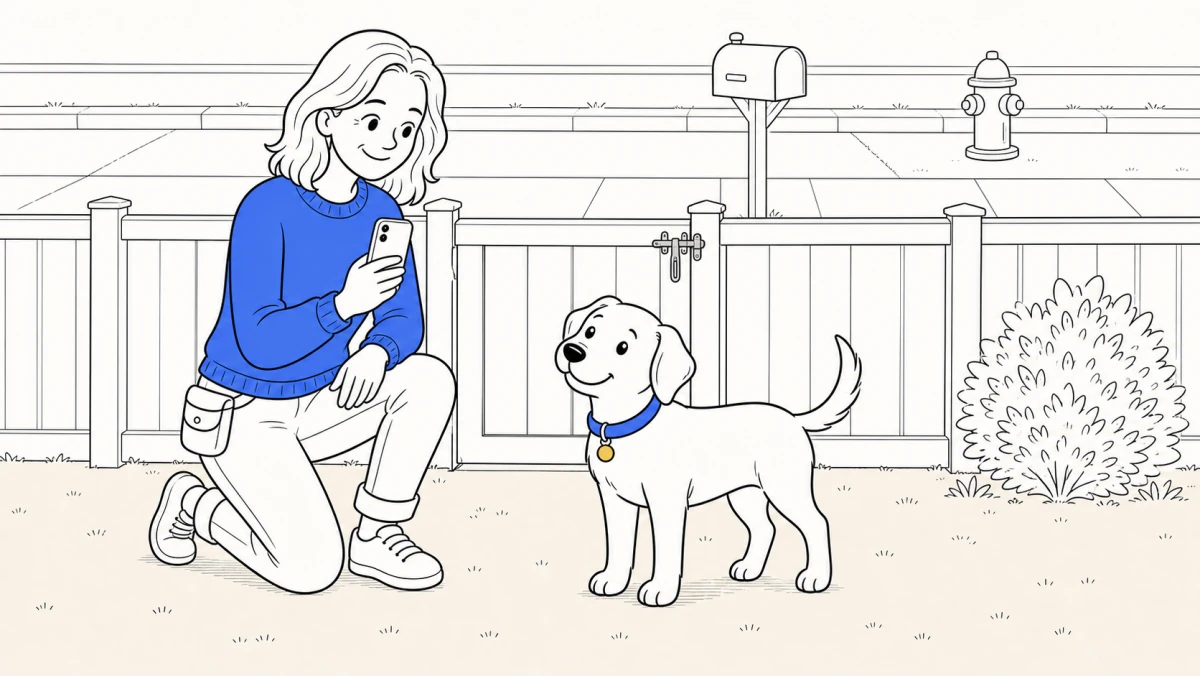
Four stages, and one rule governs all of them: the kennel predicts good things, and you never move faster than your dog is comfortable. Humane World for Animals states both constants plainly — “The crate should always be associated with something pleasant, and training should take place in a series of small steps. Don’t go too fast.”
- Let them explore it with the door open. Humane World’s version: “Encourage your dog to enter the crate by dropping some small food treats nearby, then just inside the door, and finally, all the way inside the crate.” PAWS adds the line that matters most here — “If he refuses to go all the way in at first, that’s okay – don’t force him to enter.”
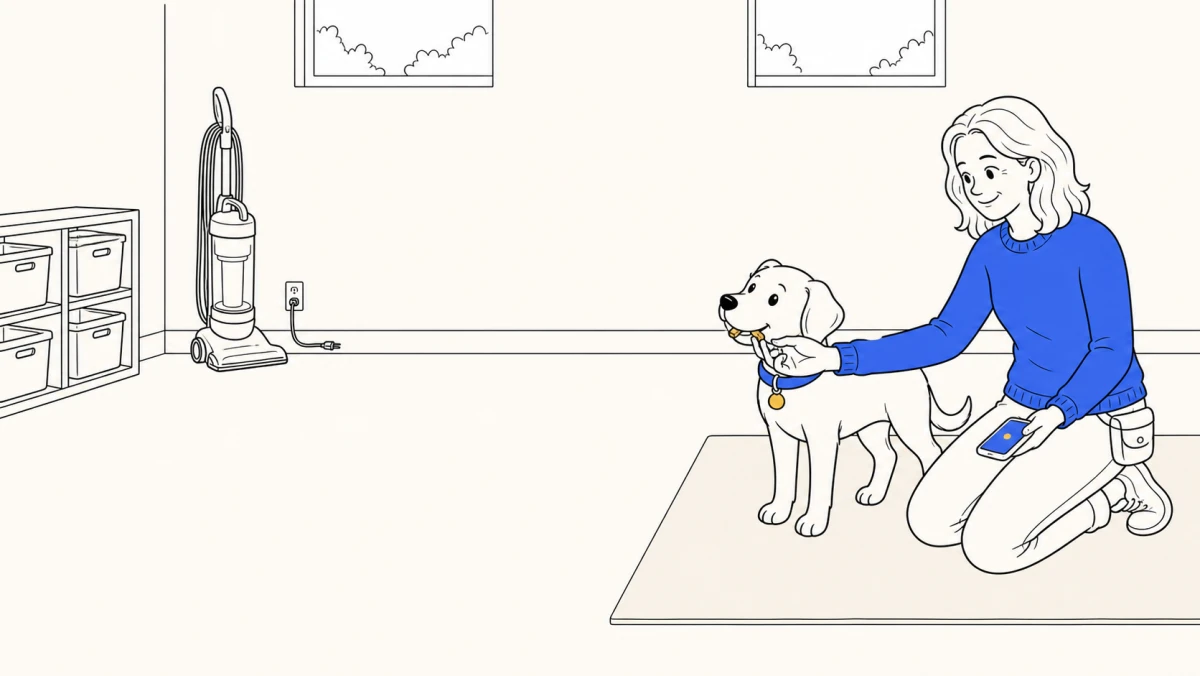
- Feed meals inside it. Start the bowl as far in as your dog will happily go and move it back a little each meal. Once they’ll stand inside to eat, close the door while they eat — Humane World builds this to “staying in the crate for 10 minutes or so after eating.”
- Close the door while you’re still there. Sit beside the kennel for five to ten minutes, step into another room for a few, come back, release. Humane World’s milestone for the end of this stage is specific: your dog stays quietly for “about 30 minutes with you mostly out of sight.”
- Only then, leave the house. Short absences first, with something to chew. Keep crating them for odd short spells while you’re home too — Humane World’s reason being “so they don’t associate crating with being left alone.”
Sessions grow with the stage, so don’t judge stage one by stage four: the RSPCA’s “Keep sessions short (about three minutes)” tip belongs to that first treat-throwing stage, while stage three builds to thirty minutes out of sight. Several short sessions a day beat one long one — and if a step falls apart, you went too fast, so go back one and repeat it. Stage one is genuinely three minutes: fix the door open, drop a few pieces of dinner just inside, walk away. If it falls apart the same way every time, and your dog is panicking rather than complaining, stop and read when kennel distress means stop and get help instead.
Where should the kennel go?
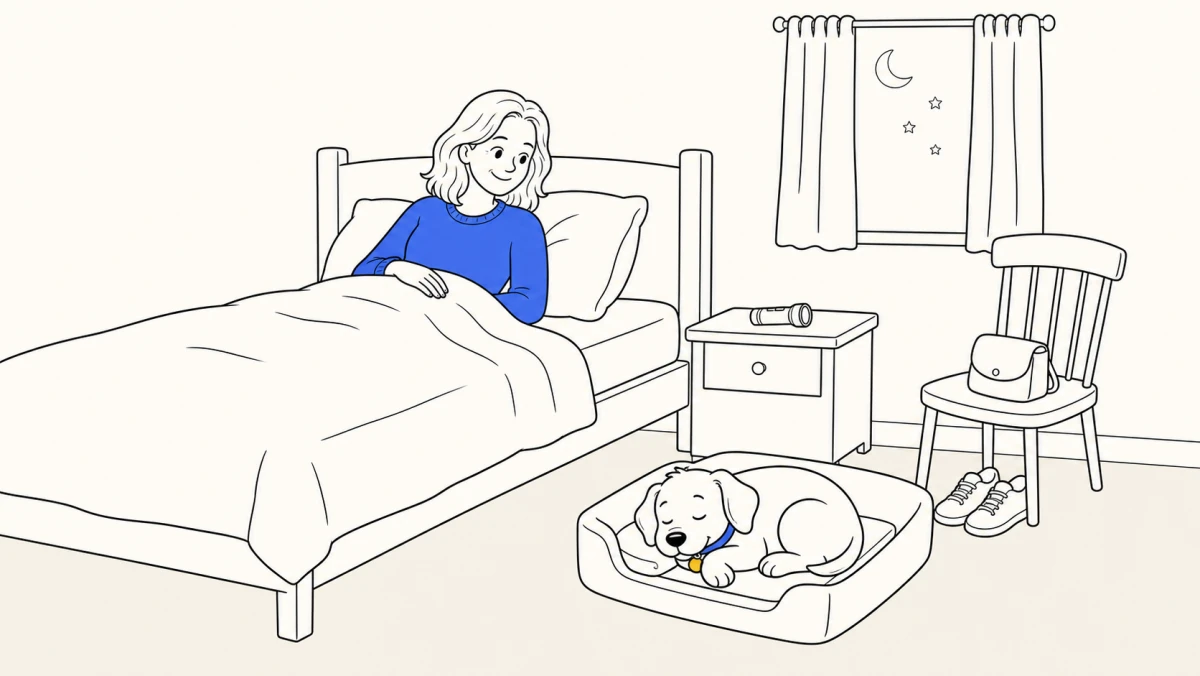
Where the family already is by day, and next to your bed at night. A kennel is not a place to be sent away to, and both of those placements exist to make that obvious to your dog.
Humane World’s reason for the bedroom is practical: young dogs “often need to go outside to eliminate during the night, and you’ll want to be able to hear your puppy when they whine to be let outside.” Older dogs “should also initially be kept nearby so they don’t associate the crate with social isolation” — the isolation, note, rather than the confinement, being the part that does the damage. You can move it once nights have gone boring. The rest of that job is getting a puppy to settle and sleep through the night, which asks more of you than the kennel alone can deliver.
When should you add the “kennel up” cue?
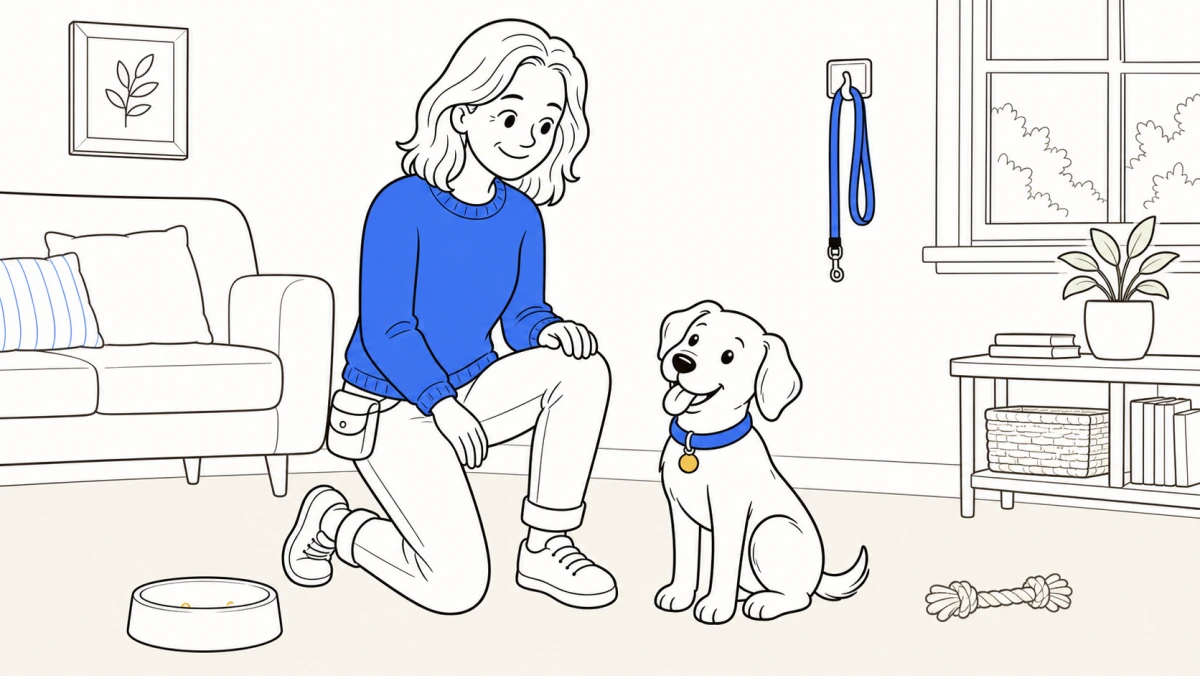
After the behavior is already happening, not before. You mark and pay your dog for going in of their own accord until they are doing it reliably, and only then attach a word to it. Get that ordering backwards and the word arrives before there is any behavior to attach it to, which is how a dog ends up knowing the phrase and ignoring it.
Best Friends Animal Society spells out the sequence, clicker and all: “Anytime they move toward it or place even a nose inside, mark and reward (click the clicker and then give them the high-value treat),” raising the bar as you go — nose, then head, then a leg, then the whole dog. Only at that point does the word arrive: “When you hit this stage you are going to name the behavior — i.e., add a cue like ‘kennel up,’ ‘crate,’ or something else you prefer that would only be used for this.”
Best Friends also names the discipline that keeps the cue worth something: “If the dog does not go in, wait several seconds and offer the cue again. If the dog still does not go in, then go back a step. It’s important not to continue saying the cue to them as it will lose meaning.”
That’s ordinary marker training applied to a box. If the mark-then-pay mechanic is new, here’s what clicker training is and whether it works — a phone or a clear “yes” does the same job as the plastic clicker.
How long can a dog stay in a kennel?
Two to six hours, depending on which organization you ask. For a five-month-old puppy the published limits run from two-to-three hours (Best Friends Animal Society) to six (the Animal Humane Society, and Humane World for Animals’ own FAQ), and the ASPCA’s own six-hour figure is an outer limit from its destructive-chewing guidance rather than a target. Here is what each one published as of July 2026, when we read them, so you can see the spread instead of one figure lifted out of it.
| Source | What it publishes |
|---|---|
| Best Friends Animal Society | “Puppies should not be left in a crate for more than two to three hours” |
| RSPCA | Trained adult dogs are “normally quite happy to be left for about three hours” |
| Humane World for Animals (main text) | “Puppies under 6 months of age shouldn’t stay in a crate for more than three or four hours at a time” |
| Humane World for Animals (FAQ, same page) | Adult dogs “shouldn’t be left in a crate for more than 4-5 hours during the day”; puppies “shouldn’t be crated for longer than their age in months plus one hour” |
| PAWS | Under six months, “more than three or four hours at a time”; any dog left alone, “not be left alone in the crate for more than four to five hours at a time during the day” |
| Animal Humane Society | “Use your puppy’s age in months plus one to determine the number of hours he can be crated” |
| ASPCA | Do not crate “for lengthy periods of time (more than six hours)” |
| American Kennel Club | No figure given; its trainer’s version is “You don’t want to go out to dinner for six hours” |
Take a five-month-old puppy through that table and you get two-to-three hours from Best Friends, three or four from Humane World’s main text, and six — age in months plus one — from the Animal Humane Society and from Humane World’s own FAQ further down the same page. One organization contradicting itself on a single page is the sharpest version of the problem, and the whole table has a milder case of it.
One caveat, because it cuts against us: PAWS is not an independent voice here. Its footer credits the text to “Dumb Friends League and Humane Society of the United States,” which is why it reads almost word for word like Humane World’s. Its row is not independent evidence; it is Humane World’s protocol under another name.
Can you leave a dog in a kennel while you’re at work?
Not a young one, and the sources split on whether a trained adult can manage it. This is the question the hour limits are really about, so it’s worth seeing both answers rather than the one that suits your schedule.
The RSPCA’s position is a flat no: “It’s never acceptable to shut your dog in the crate all day while you go to work.” Best Friends allows for it with conditions — “No dog, young or old, should be living in a crate most of the time,” but “with time and practice, your dog can work up to being crated while you are at work or another outing,” built in small increments and stocked with enrichment. Its morning rule is worth keeping either way: get the dog out first thing, and if they’ll be crated later in the day, “make sure they first have a break from it.”
If your dog comes apart when you leave rather than settling once you’ve gone, stop here and read when kennel distress means stop and get help — that is a different problem and a longer day will not fix it. For a dog who simply isn’t there yet, the Animal Humane Society’s answer is to stop using the kennel for that job entirely and use “a small bathroom, kitchen, gated-off area of a room, or an ex-pen” instead — with the crate inside it, door removed. Humane World’s list of the other fixes is short and unromantic: change your schedule, hire a sitter, or use daycare.
Why do the published limits disagree?
Because those seven published figures — the AKC declines to give one — are answering three different questions, and only one of them is about the bladder. That’s how the same five-month-old dog draws two hours from one organization and six from another.
- Bladder numbers. “Age in months plus one” is a house-training rule wearing a crate-training hat. PAWS attaches it explicitly to plumbing — puppies under six months “can’t control their bladders and bowels for longer periods” — the same arithmetic behind potty training a puppy.
- Company numbers. The RSPCA’s three hours isn’t about a bladder at all, but about how long a settled adult dog is content to be shut away. Best Friends folds both together: forcing a puppy “to break their instinctive aversion to soiling their sleeping area can lead to serious house-training difficulties,” and “because they are still developing, puppies have even more need for social interaction than adult dogs.”
- Outer limits. The ASPCA’s six hours appears in its guidance on destructive chewing as a ceiling on using confinement to stop the chewing — a line not to cross, not a target to approach.
One more thing before you pick a number off that table: those eight rows come from seven pages, we read every one of them end to end, and not one cites a study for its figure. These are judgments from organizations with a lot of practical experience, which is not nothing — but they aren’t measurements, and treating any one as the limit gives it more weight than its own authors do. So take the lowest figure that fits your dog, treat it as a ceiling rather than a target, and remember that every one of these numbers assumes the rest of the day is spent out of the kennel.
Is kennel training cruel?
Not in itself, on the mainstream view — but the disagreement is real, it comes from regulators and scientists rather than from forums, and nearly all of it is about duration rather than about the box.
Every crate-training guide quoted on this page treats a kennel as a legitimate tool with conditions attached: introduced gradually, never as a punishment, never as a substitute for company, and — wherever they give a number at all — never past a published hour limit. Cornell’s Riney Canine Health Center puts the strongest case for it, noting that acclimating a dog to a crate “can be life-saving in some scenarios” — evacuation, hospitalization, recovery from surgery.
The dissent isn’t fringe, either. The European Food Safety Authority records that “there are examples of national provisions establishing that dogs cannot be permanently crated/boxed (e.g. in Sweden and Finland)” — and Sweden’s version goes further than that summary suggests. Its rule sits in its Board of Agriculture’s regulations, SJVFS 2020:8, which state that dogs and cats may not be kept tied up and that their freedom of movement may not be restricted, outside a short list of temporary exceptions. The agency’s guidance for its own inspectors is blunter about the household version: they check that no cages are being used to house dogs or cats, and are encouraged to explain the burförbud — the cage ban — to owners. On the household version it is unusually direct: “Man kan låta hunden få använda en bur som en sovplats, men man får då aldrig stänga dörren till buren” — a dog may be allowed to use a crate as a sleeping place, but the door must then never be closed on it. (Both documents are in Swedish; the translation and the summaries are ours, and both were current when we checked them in July 2026.) None of this is law in the United States, where crating is lawful and ordinary — but it does mean “everyone crates” describes one country’s norm, not a settled consensus.
Be careful what you take from the science in either direction. EFSA’s judgment that “a permanent stay in these enclosures impairs welfare of dogs” is a finding, not an opinion — but it was reached about commercial breeding establishments, where confinement is permanent.
The wider literature EFSA reviews is about kennels and runs rather than living rooms: it reports that studies of enclosures from one to eight square meters “all had similar results, concluding that the dogs were mainly inactive when confined.” None of that answers whether four hours in a kitchen is fine. Nothing published does, yet — which is why the hour figures above are judgments, not measurements.
Which leaves an uncomfortable position rather than a tidy one. A kennel a dog walks into voluntarily, for a couple of hours, with something to chew, is a different object from a kennel a dog spends most of its life in. Every source here — including the ones that restrict it — is really arguing about which of the two you’ve got.
How long does kennel training take?
Days to weeks to reach the first real milestone, and considerably longer to reach a dog who’s genuinely relaxed in there. Humane World and the Animal Humane Society both say days to weeks; the AKC’s article says at least six months. Those two answers look like a contradiction and are not — they are timing different finish lines.
Humane World says “Crate training can take days or weeks, depending on your dog’s age, temperament and past experiences,” and the Animal Humane Society says it “can be accomplished in several days, or may take several weeks.” But look at what those estimates are pinned to: Humane World’s third stage ends at “about 30 minutes with you mostly out of sight,” and that is the thing it says “may take several days or weeks.”
The AKC’s article sets a very different expectation and pins it to nothing in particular: “Prepare yourself for at least six months of crate training.” It doesn’t put that figure in the mouth of Anna Flayton, the senior dog trainer at PUPS Pet Club in Chicago it interviews throughout, though it does credit her with the reasoning — there will be ups and downs because dogs aren’t linear learners, but success will come.
So: weeks to finish the protocol, months to a dog you’d call easy about it. Both are honest; they measure different things, which is the same trap that makes any claim about a “trained” dog hard to check unless someone says what the bar is.
How do you kennel train an adult or rescue dog?
The same four stages, at a slower pace, with one extra job at the front: finding out what a kennel already means to this dog. A puppy arrives with no opinion. An adult usually has one.
Cornell’s Riney Canine Health Center names this case directly — a crate is worth considering “when adopting a puppy or an adult dog whose behaviors they do not yet know” — and adds the caveat the puppy-shaped guides skip: “not all dogs are easily acclimated to a crate, and they require systematic positive reinforcement training (set at their own pace).”
Humane World, PAWS and the Animal Humane Society all list a dog’s past experiences as a variable in how long this takes, then say nothing about what to do when those experiences were bad. Nothing we could find fills that gap, so what follows is our own conservative reading, not anyone’s published protocol: door removed or fixed open for days rather than minutes, food near the entrance rather than at the back, and no closed door at all until your dog walks in and settles without being asked. Best Friends’ fix for a dog who won’t go in is to toss the treat so the payment is already waiting inside — and its hard rule is the one to keep: “Never force a dog into the crate.”
One rescue-specific caution. Writing about separation anxiety, the ASPCA notes that “far more dogs who have been adopted from shelters have this behavior problem than those kept by a single family since puppyhood.” So don’t find out how a newly adopted dog handles the kennel by leaving the house — find out while you’re sitting next to them.
Should you ignore a dog who cries in the kennel?
Only if it’s protest. Three protocols cover crying in the crate, from four organizations — PAWS and Humane World for Animals share one text, Best Friends Animal Society has a second, the Animal Humane Society a third. Two of the three tell you to check whether the crying is distress before you ignore it; the shared PAWS/Humane World text does not, and that is the version that gets copied. It matters, because ignoring a dog in genuine distress is the one version of this that does harm. The clearest test comes from a fourth source, the RSPCA: crying alongside “any signs of distress – including panting, excessive barking, cowering or aggression” means you have gone too fast, so back up a step instead of sitting it out.
Here is the split, in their own words:
- PAWS and Humane World — one shared text, no test attached. PAWS: “If he does whine or cry in the crate, it’s imperative that you not let him out until he stops.” Humane World, in the paragraph where you’d look for a caveat: “try to ignore the whining. If your dog is just testing you, they’ll probably stop whining soon.”
- Best Friends, which pairs the two in consecutive sentences: “If the dog appears anxious or unhappy about being in the crate at any point during training, take a break and then back up in the plan to the previous step. But don’t immediately let the dog out of the crate if they start barking, whining, panting, etc.; wait for a pause in that.”
- Animal Humane Society, the only one that puts the test inside its own answer on whining: “It is important to determine whether or not the whining is due to distress. If a dog is distressed in the crate, they may try and force the crate open… If you think it may be distress, let your dog out of the crate immediately.”
Each is right about the case it describes — a dog complaining that the fun stopped is not a dog in trouble, and letting that one out mid-complaint really does teach them that noise opens doors. But the shared PAWS/Humane World version is the one that travels, being shorter and the answer people want, and it is the one that never tells you which dog you have. Both pages do warn that a crated dog “may injure himself in an attempt to escape” — just under a separate label, as a condition called separation anxiety, rather than as the check to run first.
There’s a live conflict inside that list, too. Best Friends’ “wait for a pause” line names panting and barking among the things to sit through; Cornell names panting as a reason a dog “should never be forced to remain crated alone,” and the RSPCA counts “excessive barking” among signs you’ve gone too fast. Where a shelter guide and a veterinary college disagree about a signal, treat it as distress and back up a step. Being wrong in that direction costs you a slower week; being wrong the other way costs your dog a tooth.
And check the boring things first, every time — the Animal Humane Society’s opening move is to make sure “all of their needs are met” before the door ever shuts, because a dog complaining about a full bladder isn’t complaining about the kennel. And if none of that fits what you’re hearing — if your dog sounds frightened rather than fed up — go straight to when kennel distress means stop and get help.
When is kennel distress a reason to stop and get help?
When it’s their body telling you, not just their voice. A dog who comes apart when confined, or when left alone, may have separation-related distress, and that is not something to train through — not with a stricter schedule, not by waiting it out, and never by letting a panicking dog cry until they stop.
Cornell’s Riney Canine Health Center draws the line without hedging: dogs “should never be forced to remain crated alone if they are excessively barking, vocalizing, pacing, panting, eliminating or drooling.” The signals worth stopping for:
- Frantic escape attempts — biting or digging at the door, bending bars. The ASPCA lists the injuries this causes: “broken teeth, cut and scraped paws and damaged nails.”
- Heavy drooling or salivation — named by both Cornell and the ASPCA.
- Soiling only when confined, in a dog who is otherwise clean in the house.
- Distress that starts while you’re getting ready to leave, before the kennel is even involved.
- Anything physical — a chipped tooth, a torn nail, bleeding paws — which is a vet appointment, not a training adjustment.
This is where we stop, and we would rather lose the reader than coach them through it. Humane World says plainly that the kennel isn’t the fix: “Attempting to use the crate as a remedy for separation anxiety won’t solve the problem. A crate may prevent your dog from being destructive, but they may get injured in an attempt to escape.” The ASPCA reaches the same place from the other side — a dog showing “heavy panting, excessive salivation, frantic escape attempts, persistent howling or barking” is one for whom “crate confinement isn’t the best option,” and its alternative is a room behind a baby gate.
Start with your vet to rule out anything physical, then work with a credentialed behavior consultant. The International Association of Animal Behavior Consultants keeps a directory at iaabc.org, and its Standards of Practice — as published in July 2026, when we checked — say the IAABC “opposes the intentional use of methods involving pain, fear, or intimidation and expects members to avoid shock and other punishment-based interventions,” and “strongly opposes the intentional use of aversive stimuli and requires members to refrain from using shock in training or behavior modification.” One ASPCA line isn’t negotiable in either direction: “Do not scold or punish your dog. Anxious behaviors are not the result of disobedience or spite.” If you’re unsure whether what you’re watching is ordinary, here’s what’s normal and when to get help.
What if your dog pees in the kennel?
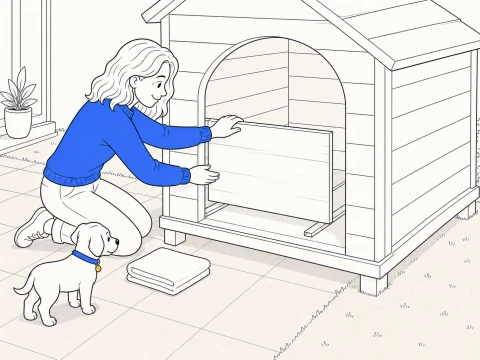
Assume you asked for too much before you assume anything is wrong with your dog. A dog soiling a properly sized kennel is usually being left in it longer than their bladder can manage, and the Animal Humane Society names the cost of letting that continue: “A dog who is forced to soil her crate as a result of being crated too long will be much more difficult to housetrain.” Best Friends puts it the same way — forcing a puppy “to break their instinctive aversion to soiling their sleeping area can lead to serious house-training difficulties.”
So shorten the stretch, take the divider in a size, and clean thoroughly enough that the smell doesn’t invite a repeat. Two exceptions to that: a dog who soils only when confined and is otherwise clean belongs in the distress section above, and a previously reliable dog who suddenly starts is a vet question, not a training one — the same red flag that runs through how long house training takes.
When can you stop using the kennel?
When your dog can be alone in the house without wrecking it or soiling it — and you get there through a middle step rather than in one jump. Humane World’s version is the clearest: “Crate your dog until they’re able to be alone in the house without accidents or destructive habits. You can graduate your dog from a crate to an enclosed area of your home, like your kitchen, before giving them access to the full house when you’re away.”
There’s no age attached to that, deliberately. It’s a behavior test, not a birthday. And plenty of dogs who no longer need the kennel keep using it by choice, which is the sign you did the first part well — Humane World’s advice is to leave the door open when you’re home so a dog who wants quiet has somewhere to take it.
What size and type of kennel does a dog need?
Big enough to stand at full height, turn around and lie down — and no bigger than that while you’re house-training, because the spare room becomes a bathroom.
The Animal Humane Society puts both halves back to back: “a dog should be able to stand up to their full height and turn in a circle comfortably. However, the crate should not be so big that there is a distinct potty and sleeping area.” Cornell’s advice is to buy the adult size once and manage the gap with a divider, for the same reason — without one, “if the kennel is too large, they can use one side as a bed and the other as a toilet.”
That rule relaxes once house training is done — Cornell allows “a larger crate with extra room to stretch out” for a dog whose crate is only there to prevent destruction.
On type, Cornell gives the clearest breakdown of the three:
- Wire — “durable and can fold relatively easily for storage,” and usually comes with the divider you want for a growing dog.
- Plastic — solid-walled, so “no covering is needed,” but bulkier to store.
- Fabric or mesh — for travel and small dogs only, since “they are not very durable, and puppies or chewers may destroy the material.”
If you cover a wire one, cover it partially: Cornell suggests “a sheet or another kind of custom crate cover that still leaves one or two sides open,” since the point is a den, not a blackout, and the RSPCA agrees a partial cover “can help nervous dogs.” Keep it out of direct sunlight either way — and before you buy twice, Humane World has the tip nobody else offers: “Your local animal shelter may rent out crates.”
What should never be in the kennel with your dog?
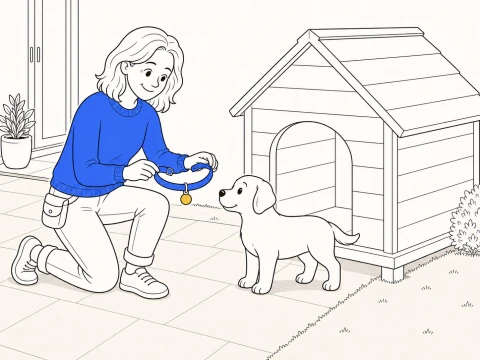
The collar. Of all the crate-training guides quoted on this page, only the AKC’s raises it — and it carries the worst outcome of anything on the list. Anna Flayton’s warning there is flat: “Dogs should never, ever have dog collars or tags or anything on when they’re in the crate.” The AKC states the reason in a single unadorned sentence of its own: “If the tag gets caught in the crate the dog could strangle.”
Bedding is a judgment call, not a given. Flayton again: “Depending on the dog you have, they may tear a dog bed apart or they may use it to pee on… It’s not a bad thing for them to just sleep on the crate mat itself.” If your dog is a shredder, our own call is that a bare tray beats a blanket, on the grounds that swallowed fabric is a vet problem — that reasoning is ours, not Flayton’s. A stuffed chew toy is the enrichment most of these guides reach for, the RSPCA, the AKC, Best Friends and Humane World among them; it’s worth watching the first few times your dog has one behind a closed door.
Is a kennel ever a punishment?
No, and every crate-training guide quoted on this page says so in near-identical words; the RSPCA’s is the shortest — “Crates must never be used as a punishment.”
The useful version of that rule is about timing, not mood. Humane World’s example: putting your dog in the kennel with a stuffed toy before guests arrive “is more effective than waiting for misbehavior and then putting your dog in the crate.” Same box, same dog — but one is a plan and the other is a consequence, and your dog can tell which. That distinction is also the honest test for the whole page: if the only reason your house survives the day is a shut door, you have a consequence, and a puppy-proofed room behind a gate does that job with far more space in it.
The honest short version
Kennel training is crate training. Build the association in stages with the door open, feed meals inside, close the door only while you’re sitting there, and leave the house last. Add the “kennel up” cue after your dog is already walking in, never before. Buy for the adult size and use a divider. Take the collar off. Never use it as a consequence.
On hours, take the lowest published figure that fits your dog and treat it as a ceiling. On timeline, expect weeks to finish the protocol and months to a dog you’d call easy about it. With an adult or rescue dog, start further back than any puppy guide suggests. And if what you’re watching is panic rather than protest, stop — that’s a different problem with a different specialist, and the one place where more training makes things worse. All of it fits inside a calm first week.
If you want one thing to do next: put the kennel where you already sit, fix the door open, and drop a few pieces of your dog’s dinner just inside it. Then walk away and let them find it. That’s the whole of stage one, and it costs three minutes.
Can an app help with kennel training?
Not with the kennel itself. ClickerPup doesn’t kennel train your dog. A kennel is management — a box, a schedule, and a limit somebody else published — and no app changes any of that, so we’re not going to sell you one that says it does.
What it coaches is the other half of a dog: sit, leave it, coming when called, and settle — a dog who can choose calm on a mat is easier to leave calm anywhere. Not the kennel; the settling. Two-minute sessions that check whether your dog actually got a skill before moving on. The division of labor is the whole offer — we coach the skills, you run the kennel. The clicker is free forever, and you get a plain reminder before anything ever charges.
Claim my early spot and we’ll bring you in as we open up.