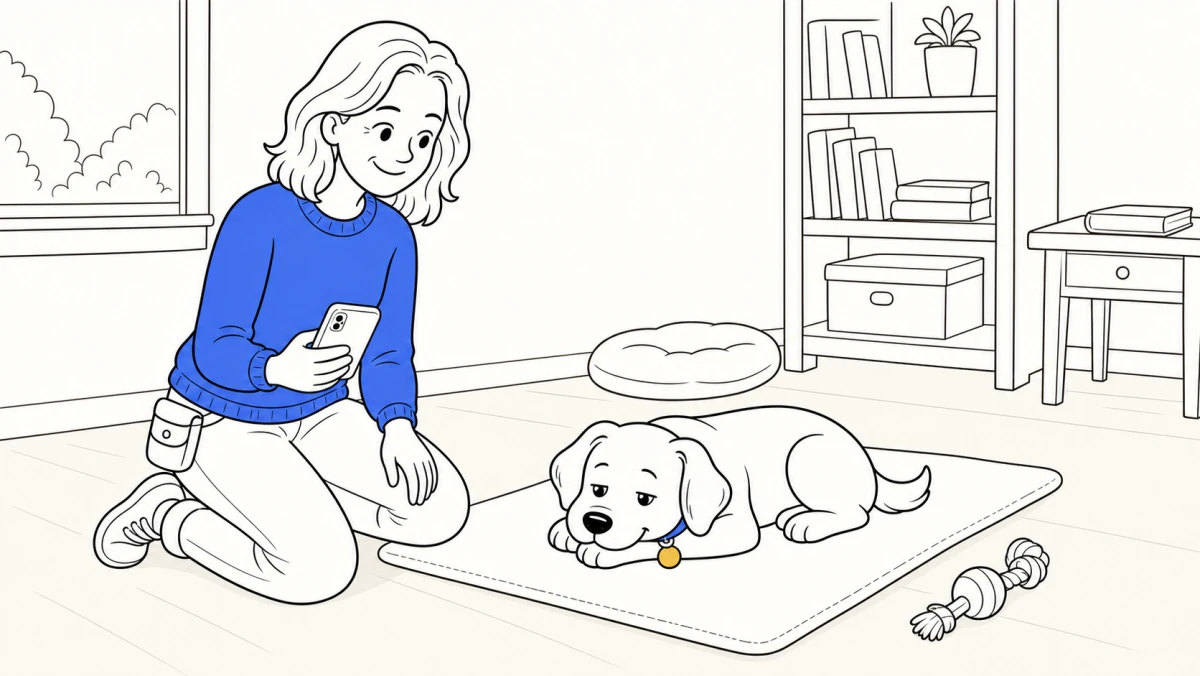
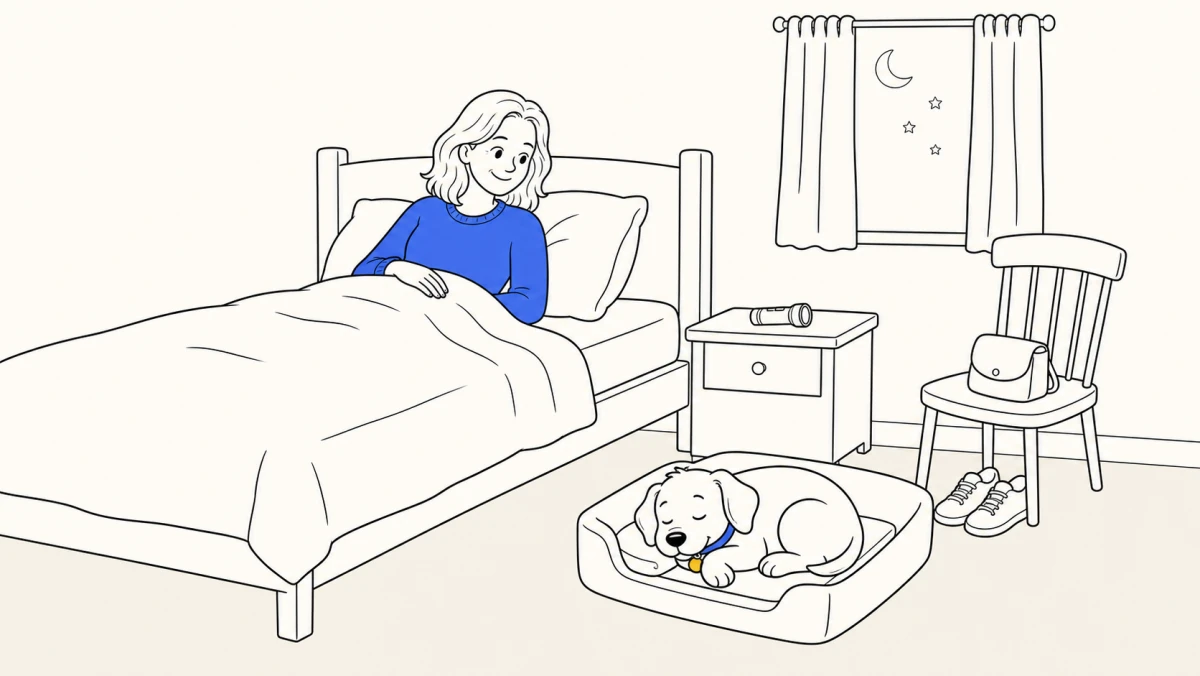
The first night is a management job, not a training one. Set the sleeping spot within arm’s reach of where you sleep, run one last potty trip, expect at least one wake-up, and answer the crying rather than out-wait it. A hard first night is the normal case, not a warning sign.
That last part is worth saying twice, because the fear underneath this search is usually that you are about to get something permanent wrong. The AKC, PDSA, Blue Cross and Dogs Trust all describe a rough first night as ordinary. What you are having, or are about to have, is a hard night with a baby animal who has never in their life slept anywhere except in a pile of their siblings. Everything below is what to have ready, where the published advice genuinely contradicts itself and how to read that, and what a good first night actually looks like — which is a lower bar than it feels like while you’re in the middle of it.
If it’s the whole week you’re bracing for rather than one night, start with the new-puppy checklist. If you’re past night one and the nights are still the problem, that’s the ongoing project, and it lives in how to get a puppy to settle and sleep.
What should you have ready before the first night?
Four things: the sleeping spot, something that smells of home, cleaning supplies you can find in the dark, and a route to the door you can walk half-asleep. Only one of them is a purchase. Get these in place before the first night and the rest of it gets easier:
- The sleeping spot, already set up in the room you sleep in. Not assembled in the dark around a puppy who is already upset. Whatever it is — crate, bed, pen — it wants bedding, and a safe chew is fine.
- Something that smells of where they came from. PDSA notes that breeders will usually send you home with something carrying the scent of the puppy’s mother, such as a blanket, and advises putting it where they sleep to help comfort and calm them.
- An enzymatic cleaner and a couple of old towels, within reach in the dark. Hunting for cleaning supplies at 3am with a wet crate pad is a bad way to spend the middle of the night.
- A route to the door you can walk half-asleep without turning on every light in the house. Dogs Trust’s evening advice is to get rid of unnecessary distractions — curtains shut, activities quiet and calm — and that applies to the middle-of-the-night trip too.
Everything else on the standard new-owner shopping list can wait for morning. The wider supply list, and what the first 24 to 48 hours should look like in daylight, belong to the first-week checklist — this page is about the dark bit in the middle. And the room itself should already be puppy-proofed, because a puppy who gets loose at 4am will find the one cable you forgot.
Where should a puppy sleep on the first night?
Not alone. The American Kennel Club, Humane World for Animals, PDSA, Blue Cross and Dogs Trust all put a person in the room with a new puppy on their first night — three of them say your bedroom specifically, the other two say wherever you are sleeping. That shared answer is worth knowing, because almost everything else about this question is argued over.
The American Kennel Club’s advice for day one is direct: “Put their crate in your bedroom. Your puppy will feel more secure if they have you nearby.” Humane World for Animals gives the same instruction with the practical reason attached — “it may be a good idea to put the crate in your bedroom or nearby in a hallway, especially if you have a puppy,” because “you’ll want to be able to hear your puppy when they whine to be let outside.” Blue Cross recommends “at least having them in your bedroom with you in the beginning in either a dog bed or crate.”
The other two put the person, not the bedroom, at the center of it. PDSA advises spending the first few nights in the same room with them, so a puppy doesn’t wake in a panic to find nobody there. Dogs Trust’s two named techniques both put a person in the room as well — either the puppy’s bed comes to your room, or you go and sleep beside theirs.
Five organizations, five house styles, one instruction. What they argue about is everything that happens after.
Should you move the puppy’s bed later, or start where you mean to finish?
If you want the bed to end up somewhere other than your bedroom, put it in that spot now and move yourself — sleep beside it for a few nights, then withdraw. That is the option that satisfies both of the charities that disagree about this, and they do disagree, flatly:
- Blue Cross: “Once they have settled after a few nights, you can gradually move their bed or crate away from you to the desired location, inch by inch.”
- PDSA: “Whether you plan on your puppy forever sleeping in your bedroom, or want them in a separate room, you need to start this from the beginning and stick to it. If you have your puppy in your bedroom but plan to move them into a different room at a later date, this can be really distressing for them.”
One says start close and move the bed later. The other says moving the bed later is the distressing thing, so pick the final spot on night one. Both are national veterinary and welfare charities. Both are talking about the same puppy.
Dogs Trust resolves it, almost in passing, by naming two techniques instead of one: “Start with their bed in your bedroom. Slowly move it further away every few nights until it’s where your pup will usually be sleeping,” or “Have your puppy’s bed where you prefer it to be and have a sleepover near them. Gradually move your temporary bed away from them every few nights until you’re in your own room.”
So everybody agrees the puppy should not be alone on night one. The only thing genuinely in dispute is which of you moves later — and one of those two options makes that a question about your sleeping arrangements rather than your puppy’s.
| Where they sleep on night one | What it optimizes for | What it costs |
|---|---|---|
| Crate or bed beside your bed, moved away over following nights | Fastest reassurance; you hear the first whimper | A second transition later, which PDSA warns can be distressing |
| Bed already in its permanent spot, you sleep near it and move yourself | One transition instead of two; nothing changes for the puppy | Several nights of you on a sofa or a spare mattress |
| Pen or a blocked-off room, crate open inside it | A puppy who physically cannot hold it still has somewhere to go | You are further from them, so you hear less |
| Your bed | Nothing to set up; maximum contact | Real physical risk to a very small puppy (below) |
| Alone in a separate room | Your own sleep, in a house where the bedroom genuinely isn’t an option | None of the five organizations cited here recommends it for a puppy’s first night |
Across the AKC, Humane World for Animals, PDSA, Blue Cross and Dogs Trust, not one recommends leaving a new puppy alone in a closed separate room on their first night. If your bedroom genuinely isn’t available — allergies, a partner who can’t, a room the crate won’t fit in — the sleepover option is the one that doesn’t require it.
Should your puppy sleep in your bed on the first night?
Blue Cross’s answer is “There’s nothing wrong with your puppy sleeping in bed with you,” and as a general position that is fair. The caution is narrower than a ban and it is about physics: if your puppy is small enough that you could roll onto them, the bed is the one sleeping arrangement with a physical risk attached to it, and their first night is a poor time to find that out.
Dr. Marty Becker, writing for Vetstreet, names the two risks plainly for a very small puppy: that you could hurt them in your sleep, or that they could fall or jump off the bed. His rule of thumb is to “wait until your pup is big enough to fend for herself before you bring her into the bed,” and the readiness markers he gives are sleeping through without a potty break and settling in the crate without crying — neither of which is true of a puppy on their first night in your house. Blue Cross’s own caveat runs the same way from the other end: think about “how much space they would take up in the bed when they’re fully grown.”
The two aren’t really in conflict. One is answering whether bed sharing is acceptable, which it is. The other is answering whether a puppy small enough to be rolled on is physically safe up there on their first night, which is a narrower question with a smaller answer.
On the longer-term behavioral question, Dale and colleagues survey the evidence on bedroom and bed sharing and conclude that “previous research is slightly ambiguous”: most of the studies they cite point toward a risk, one of them suggesting bed sharing “could potentially exacerbate” separation-related behavior, while another found no association at all. So the long-term question is genuinely open. The night-one one, for a very small puppy, isn’t.
Do you need a crate for the first night?
No. Two things get quietly conflated here: being contained and being in a crate. The evidence, such as it is, is about containment.
The nearest thing to direct evidence is Dale et al. (2024), a longitudinal analysis of 145 dogs from the Generation Pup cohort in the UK and the Republic of Ireland, assessed at six months old, published in Animal Welfare. It found that dogs “were less likely to develop SRBs if owners reported that, at ≤ 16 weeks old, puppies were restricted to crates/rooms overnight” — separation-related behaviors being the barking, whining, destruction and house soiling that show up when a dog is left alone. Note the wording: crates or rooms. A blocked-off kitchen counted, and so did nine or more hours of sleep a night before 16 weeks, which carried lower odds than sleeping six to eight.
The authors are careful about what this does and doesn’t establish: “These recommendations derive from correlational longitudinal study results, so analysis of interventional data is required for confirmation regarding effective prevention strategies.” It is a small sample, the effect size is imprecise, and it cannot tell you which way the causation runs.
Meanwhile, Humane World for Animals says outright that “for some dogs, crates won’t be an option,” and the Humane Society of Silicon Valley’s alternative for a puppy too young to hold it is “a portion of the kitchen blocked off with his crate placed in one corner, or an exercise pen placed in a tiled room.”
Why does my puppy hate the crate on the first night?
Because they haven’t been crate trained yet. Humane World for Animals’ own crate protocol puts sleeping in it overnight at step four, reached only “once your dog will stay quietly in the crate for about 30 minutes with you mostly out of sight” — which, the same page says, “may take several days or weeks.”
On night one your puppy is at step zero. A crate they met a few hours ago is a strange box in a strange house, and hating it is the expected result, not a sign the crate is wrong for them or that you bought the wrong one. It is also why advice written for a crate-trained dog — which is most of what you will find — does not transfer to this particular night. Keep the door open if that helps, put the crate inside a pen if you have one, and treat the next day as day one of teaching it.
When should the last potty trip be?
The genuine last thing, with nothing fun after it. The AKC is specific: “Remember that the last thing you should do before you go to bed for the night is to take your puppy out for one last potty break.” In PDSA’s bedtime order the final play comes before that trip, not after it — so the last thing your puppy does outside is the job, and the next thing is the bed.
Humane World for Animals adds one lever most people miss: take the water dish up roughly two and a half hours ahead of bedtime to cut overnight accidents. That is about the dish at bedtime, not about limiting a puppy’s water through the day. And Blue Cross adds the one rule that outlasts the first night: never use a dog’s sleeping area as a punishment, because it leads to them thinking the bed is a bad place and may make settling them harder.
Will your puppy need to go out during the night?
At eight or nine weeks, plan for one trip. Published rules put an eight-week-old’s bladder anywhere between two hours and seven, which looks like chaos until you notice they are answering different questions: daytime capacity, a crate-confinement limit and an overnight stretch are three separate measurements, and two organizations publish more than one of them.
The daytime version of this question — how often to take a puppy out, and which rule to plan a day around — is worked through on how long house training takes. What follows is the same published rules re-sorted by what each one actually measures, because the overnight answer is the one that gets lost.
| Published rule | What an 8-week puppy works out to | What it’s actually measuring |
|---|---|---|
| Humane World for Animals: “a puppy may be able to hold their bladder for about one hour for every month of age” | ~2 hours | Daytime capacity, awake and drinking |
| Humane Society of Silicon Valley: “he can hold it for up to two hours maximum during the day if he is not active” | ~2 hours | Daytime capacity, at rest |
| AKC, on its potty-training page: dogs “can control their bladders for the number of hours corresponding to their age in months” | ~2 hours | Daytime capacity, awake |
| AKC, on its potty-training timeline page: “take the age of your puppy in months and add one” | ~3 hours | Maximum gap between daytime potty breaks |
| Humane World for Animals: puppies “shouldn’t be crated for longer than their age in months plus one hour” | ~3 hours | A confinement limit, not a bladder measurement |
| Humane World for Animals: “most puppies can comfortably sleep for seven hours without a bathroom break” | ~7 hours (no age given) | Overnight, asleep and still |
Look at who is publishing what. The American Kennel Club gives one rule on its potty-training page and a different one on its potty-training timeline page. Humane World for Animals gives three numbers across two pages. Neither is contradicting itself — a daytime ceiling, a confinement limit and an overnight stretch are three different measurements, and each page is answering its own question — but between them, two organizations account for five of the six numbers here. That is most of the reason this looks like chaos from the outside.
The overnight column is the one that matters after lights out, and it is the one that gets quoted least. The AKC puts it plainly: “They’ll usually be able to hold their bladder for a longer period when they’re asleep and not active.” The Humane Society of Silicon Valley is more specific: “At night, most dogs can generally go longer. Most puppies by the time they are twelve weeks of age can sleep the entire night through without having to go out.” So an eight-week-old waking you once is anatomy, not a training failure — and the daytime rules are the wrong tool for predicting the night, whichever of them you were handed.
Where the night trips stop for good is a separate question, and the sources land in different places on it; that timeline is the subject of how to get a puppy to settle and sleep, with the wider clock in how long house training takes.
Why do the sources disagree about letting a puppy cry it out?
Because they are describing dogs at different stages of crate training, and on a first night only one of those descriptions fits yours. PDSA says leaving a puppy to cry “could actually be having the opposite effect to what you want and making them more anxious to be alone.” Blue Cross answers the same question with a flat “No,” on the grounds that being taken from their mother and littermates is “a huge shock” for a new puppy, so “leaving them alone to cry is stressful for them.” Humane World for Animals says that once you are sure the dog doesn’t need to go out, “the best response is to ignore them until they stop whining.” All three are serious organizations. Only the first two are describing your puppy.
Read the condition Humane World attaches to that sentence and the conflict mostly dissolves. Its advice is explicitly conditional: “If you’ve followed the training procedures outlined above, then your dog hasn’t been rewarded for whining in the past by being released from their crate. If that’s the case, try to ignore the whining.” That condition describes a dog days or weeks into a gradual crate protocol — the same protocol whose fourth step is sleeping in the crate overnight.
Its running order follows from the condition: ignore first, and only “if the whining continues after you’ve ignored them for several minutes, use the phrase they associate with going outside to eliminate.” That sequence is sound for a dog who already knows the crate is safe. It is not a description of a puppy who has never slept without their littermates — which is the puppy PDSA is talking about, and the one on your floor.
So on a first night, follow PDSA’s side, and borrow the parts of Humane World’s guidance that don’t depend on training your puppy hasn’t had yet:
- Go to them, and assume a real need. At eight or nine weeks it very often is one.
- Make it functional. In Humane World’s words, “this should be a trip with a purpose, not playtime” — stand in the spot, wait, come back in. No chatter, no lights, no game.
- Comfort without a party. A hand through the crate door or a calm hand on their back is enough. None of them tells you to punish whining: Humane World says “never punish them for whining,” and AVSAB’s 2021 position is that only reward-based methods should be used for all dog training.
- Then stop. Answering a frightened puppy is not the same as teaching them that noise summons company, and one boring response does not build a habit.
The ongoing version of this — a puppy still protesting on night twelve, when the settling skill should be building — is a different job with a different fix, and it’s covered in how to get a puppy to settle and sleep.
How do you tell settling-in from real distress?
Settling-in gets quieter across the night and quieter across nights; distress escalates. That is a practical read rather than a published diagnostic — on one night you are watching the direction of travel, not delivering a verdict, which is why almost nothing on a first night needs one.
Get a professional involved rather than working through it yourself if you see any of these:
- Distress that grows across the following nights instead of easing — a puppy who cannot be settled at all, who drools or damages the crate trying to get out, or who injures themselves doing it. That can be separation-related behavior, which is behavior modification with a qualified professional, not something to sleep-train through. Humane World for Animals is explicit that a crate is not the answer: “Attempting to use the crate as a remedy for separation anxiety won’t solve the problem.” A certified consultant is the right call; the International Association of Animal Behavior Consultants (iaabc.org) states in its Standards of Practice that it “opposes the intentional use of methods involving pain, fear, or intimidation and expects members to avoid shock and other punishment-based interventions.”
- Anything physical. A puppy who won’t drink, won’t eat at all, is vomiting, is straining, is cold, or simply seems unwell rather than unsettled is a vet call, not a training question — and on a first night, sooner rather than in the morning. That list is a routing rule, not a diagnosis: we are not going to tell you which of those is serious, because that judgment is the reason to make the call.
Neither of those is the common case. The common case is a healthy puppy having a bewildering night. If you want the fuller map of which chaos is normal, here’s what’s normal and when to get help.
What if there’s an accident?
Clean it up without a word and carry on. Humane World for Animals is direct about the alternative: “Never punish your puppy for having an accident.” Punishment on night one doesn’t teach a puppy to hold it — it teaches them that you are unpredictable in the dark, which is the exact opposite of what this night is for.
Their guidance for the wake-up itself is the same tone: “stay calm, take them out quietly, and return them to bed without turning it into playtime.”
One thing worth noting for the morning rather than acting on at 3am: dogs have, in the Humane Society of Silicon Valley’s words, “a natural instinct not to soil near them or in the place where they sleep,” and the confinement space it describes is “just big enough for him to lie down and turn around in.” So a puppy soiling their own bed usually means the sleeping area is bigger than that — a daylight adjustment, not a verdict on the night. The method itself is in how to potty train a puppy.
What does a good first night actually look like?
Everybody got some sleep, in whatever broken pieces it came in; the crying got answered rather than out-waited, so the sleeping spot didn’t become a frightening place; and nothing bad happened in the bed or crate — no punishment, no panic left to run. That is the whole bar, and it is worth writing down before you’re too tired to be fair to yourself.
Notice what isn’t on it: sleeping through, no accidents, no crying, no getting up. None of those are night-one goals, and treating them as goals is how a normal night gets read as a failure. The AKC’s own framing of the range is about as low-pressure as it gets: “Some puppies sleep through the night right from the start. Others may cry for a few nights.”
How many nights does this last?
Nobody publishes a reliable number, and the organizations closest to the question all decline to give one. What they say instead is some version of “a few nights,” with an explicit note that puppies vary.
- Blue Cross: “They may be restless or whine for the first few nights — this is perfectly normal,” and separately, “some puppies may need longer to settle than others.”
- Dogs Trust: “Every puppy is different and will need varying amounts of time until they’re comfortable sleeping alone.”
- AKC: “Some puppies sleep through the night right from the start. Others may cry for a few nights.”
We went looking for a studied figure specific to puppies and didn’t find one — no controlled trial, no cohort study that counts nights of crying after a puppy comes home. The nearest measured evidence is about a different animal in a similar situation: van der Laan and colleagues (2023), publishing in Scientific Reports, put accelerometers on 31 dogs adopted from a Dutch shelter and recorded their first four nights in the new home, with between 20 and 31 dogs contributing data on any one night. These were adults, mean age 3.6 years, not puppies. What they found was that “nocturnal activity was significantly lower on night 2 than night 1, but not on night 3 and 4” — a “rebound of resting” on the second night, after which nothing much changed.
Take that for exactly what it is: a small study, on grown dogs, arriving from a shelter rather than a litter. It is not a prediction about your puppy. But it is the nearest night-by-night measurement we could find of a first night in a new home compared with the second, and what it recorded was a quieter second night. None of the charities quoted above puts it that way; they simply decline to give a number at all. No source on this page supports a specific figure like three to five nights.
What happens the next morning?
Protect the sleep, and start the settling skill. Young puppies sleep enormously — the AKC puts some of them at 16 to 18 hours a day — and in the same correlational study above, puppies getting nine or more hours a night before 16 weeks had lower odds of separation-related behavior at six months than those getting six to eight. That figure is about night sleep rather than naps, so read it as a reason to protect sleep in general — a puppy who is short of it arrives at the night already overtired.
Then the training starts, and it starts small. The first thing worth teaching is the one thing you spent the night doing by hand: settling. Everything you did after dark was management — you made calm happen by arranging the room around your puppy. Once the first night is behind you, calm becomes something they can choose, which is a skill, which means it can be taught. The full method is in the settle-and-sleep guide; the week in order is in a first-week training schedule; and the shortest possible first session is clicker training on day one.
What ClickerPup does and doesn’t do here
Let’s be straight about the part an app can’t help with. ClickerPup does not get you through the first night, and it doesn’t ship crate training, potty training or sleeping through the night as skills it coaches. A first night is a bladder, a bewildered eight-week-old and a bed near yours — management, not training — and we’re not going to pretend software changes that.
What we’re building is the next morning’s half of that split. Settle — the calm you spent the first night arranging by hand — is a genuinely trainable skill, and so are sit, leave it and coming when called: two minutes at a time, with a marker, checked against whether the puppy in front of you actually got it rather than whether you finished a lesson. The clicker is free forever, and there’s a plain reminder before anything ever charges.
Which is the whole point of the split this page has been making. The first night is the one night you only get to manage. Everything after it, you can teach.
Claim my early spot and we’ll bring you in as we open up — with the force-free foundations ready for the morning after.