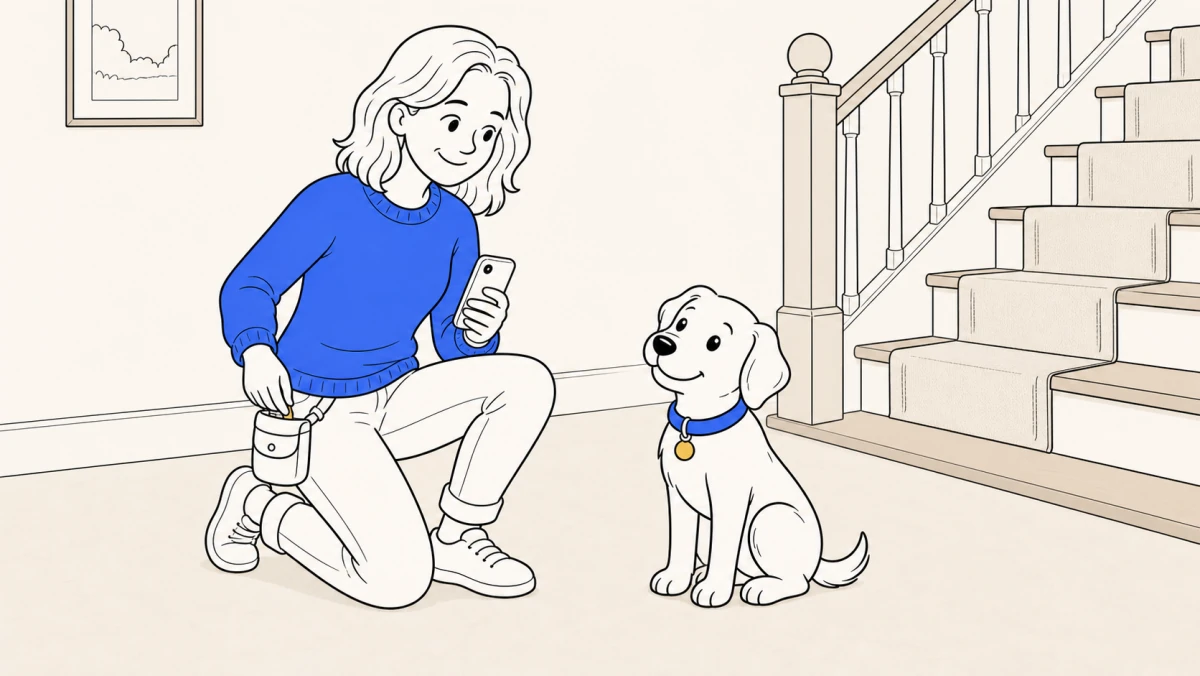
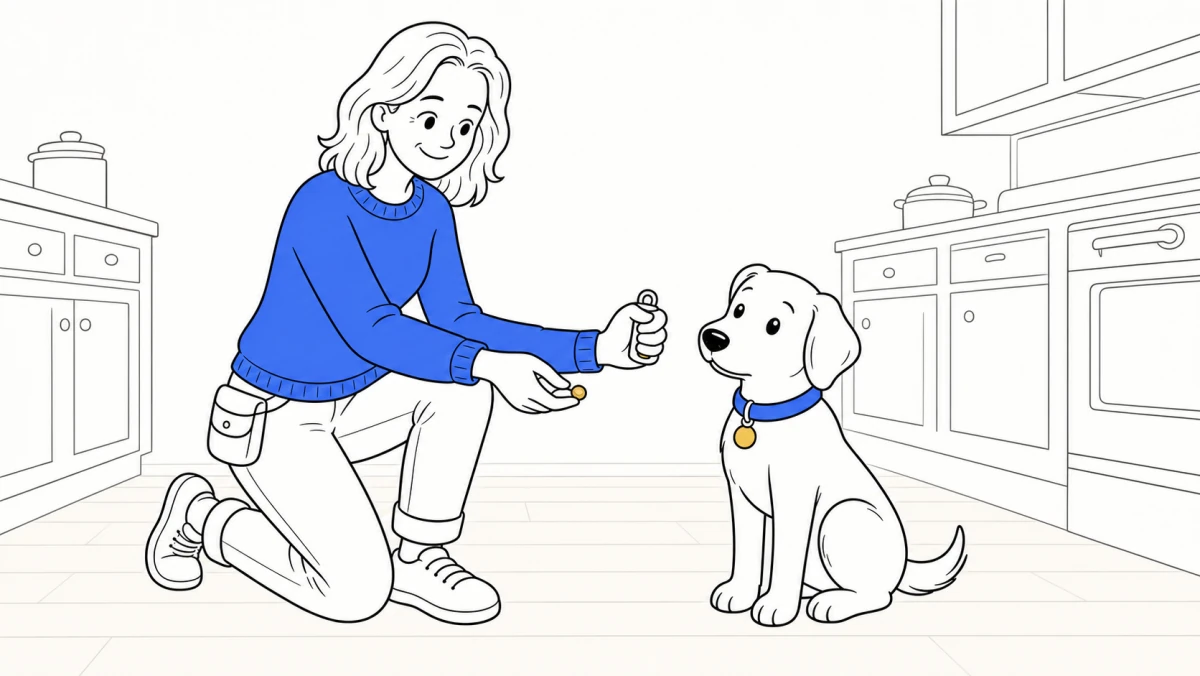
Most first attempts go the same way: determined for a few minutes, then the puppy bites your hand, gets distracted, or ignores “sit” for the third time in a row, and the determination quietly drains into guilt. Usually that just means the wrong five commands in the wrong order: sit, down, stay, come, and leave it, taught with a method that works. Every one of them can start as early as 8 weeks old, the week your puppy comes home — using a treat lure or a marker (a clicker or a word like “yes”) instead of collar pressure, matching AVSAB’s position statement that “only reward-based training methods” should be used. Here’s the exact method and click-point for each, in the order that sets your puppy up to succeed.
What do trainers actually teach before these five?
Professional clicker trainers add one skill before any of these, and hold off on one of these five entirely. Trainer Lori Chamberland, writing on Karen Pryor’s clicker-training site, names exactly three priorities for a puppy’s first week — a nose-to-hand target, sit, and going into the crate — and says plainly that “the first week is not the time to work on… a down stay.”
Hand-targeting comes first because it’s nearly impossible to fail, and it becomes the backbone of recall later on. Sit overlaps with both lists; stay is the one held back on both, for the same reason — it’s a duration skill added once something else is solid, not a stand-alone first win. If your puppy hasn’t tried a hand target yet, that’s the honest place to start.
How do you teach a puppy to sit?
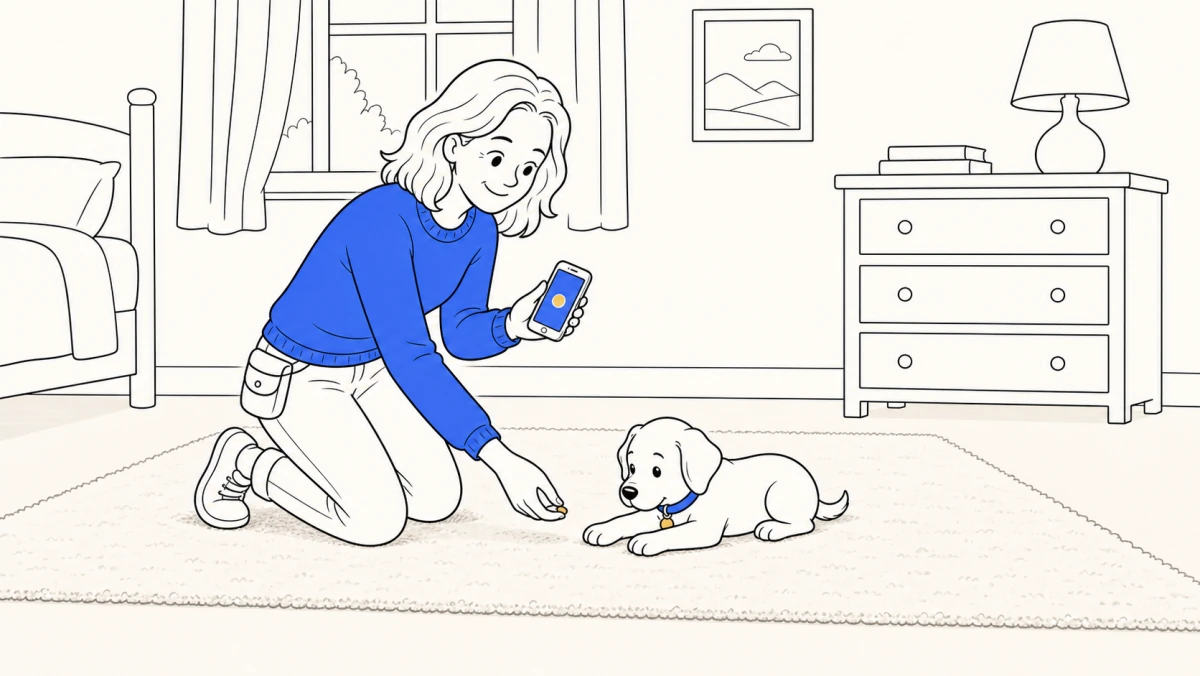
Lure your puppy’s nose up with a treat until their bottom lowers, click the instant it touches the floor, then fade the lure. Sit is the fastest, most reliable first win, because most puppies offer it on their own within a few tries.
- Hold a treat right at your puppy’s nose, then raise it slowly toward the top of their head.
- As the nose follows up, the bottom lowers. The instant it touches the floor — click (or say “yes”) — then treat, delivered at mouth height, in position.
- After a few reps, make the same hand motion empty. Once that’s reliable, add the word “sit,” then fade the hand motion to a small signal.
Click-point: the exact instant the bottom hits the floor — not a beat before or after. If your puppy jumps up or backs away instead of sitting, the treat is being held too high; lower it right over the nose and slow the motion down. There’s no fixed number of reps to hit before fading, either — as the AKC’s own guide to fading a lure puts it, “it’s OK to take your time fading the lure out at a pace they’re comfortable with.”
How do you teach a puppy to leave it?
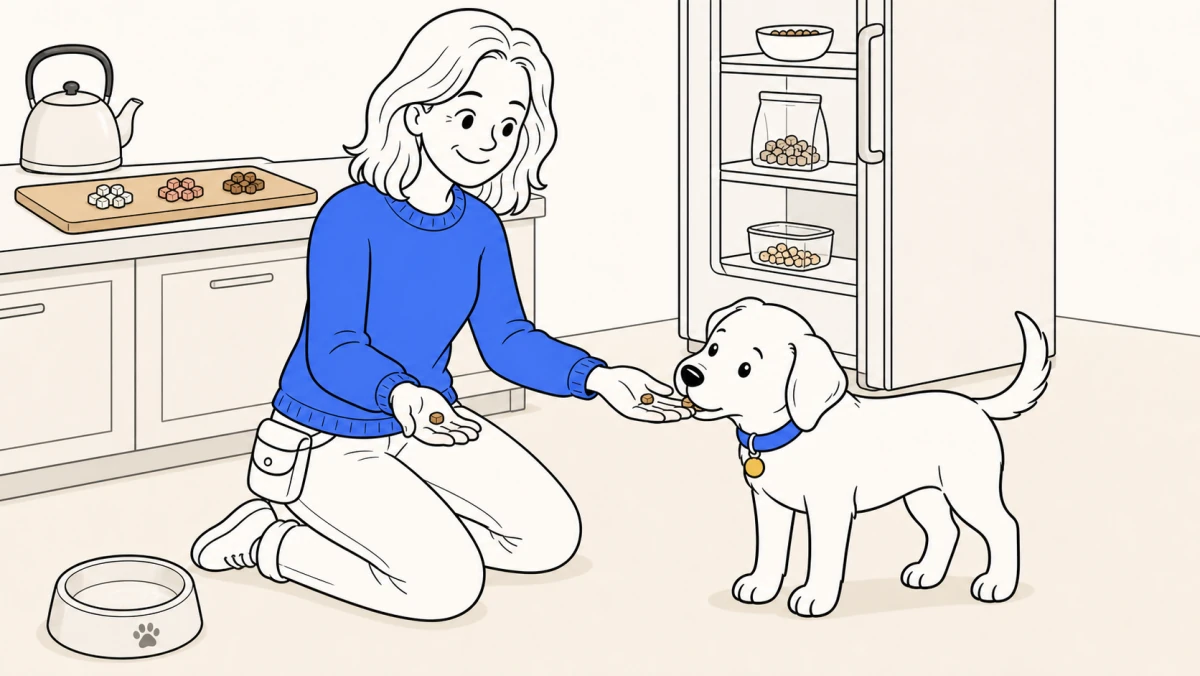
Present a closed fist with a treat inside, then click and reward from your other hand the moment your puppy backs off instead of nosing at it. Leave it is an impulse-control skill, not a scold — your puppy chooses to disengage, and that choice pays off.
- Hold a plain treat in a closed fist near your puppy’s nose. Wait.
- As soon as they stop nosing the fist and pull back or look away — click — and treat from your other hand, never the fist they left.
- Once that’s solid, try a treat covered by your hand on the floor, then briefly uncovered, before adding the word “leave it.”
Click-point: the moment of disengagement — the back-off, not the sniff. The one rule that makes or breaks this skill: rewarding from the same hand the puppy just left teaches the opposite lesson, so the treat always comes from somewhere else.
How do you teach a puppy to lie down?
From a sit, lower a treat slowly straight down between your puppy’s front paws and click the instant the elbows touch the floor. Down asks for a little more patience than sit, since it’s a bigger ask of a young body — keep these reps short.
- Start with your puppy already sitting. Hold a treat at their nose, then lower it slowly, straight down, to the floor between their front paws.
- When the elbows touch down — click — treat on the floor, in position.
- If they pop back up instead of folding down, restart and lower the treat even more slowly. Fade the lure once it’s reliable, then add “down.”
Click-point: the elbows touching the floor, not the head dropping. A cold or hard floor puts some puppies off lying down at all — a mat or rug fixes that faster than more repetitions will.
How do you teach a puppy to come when called?
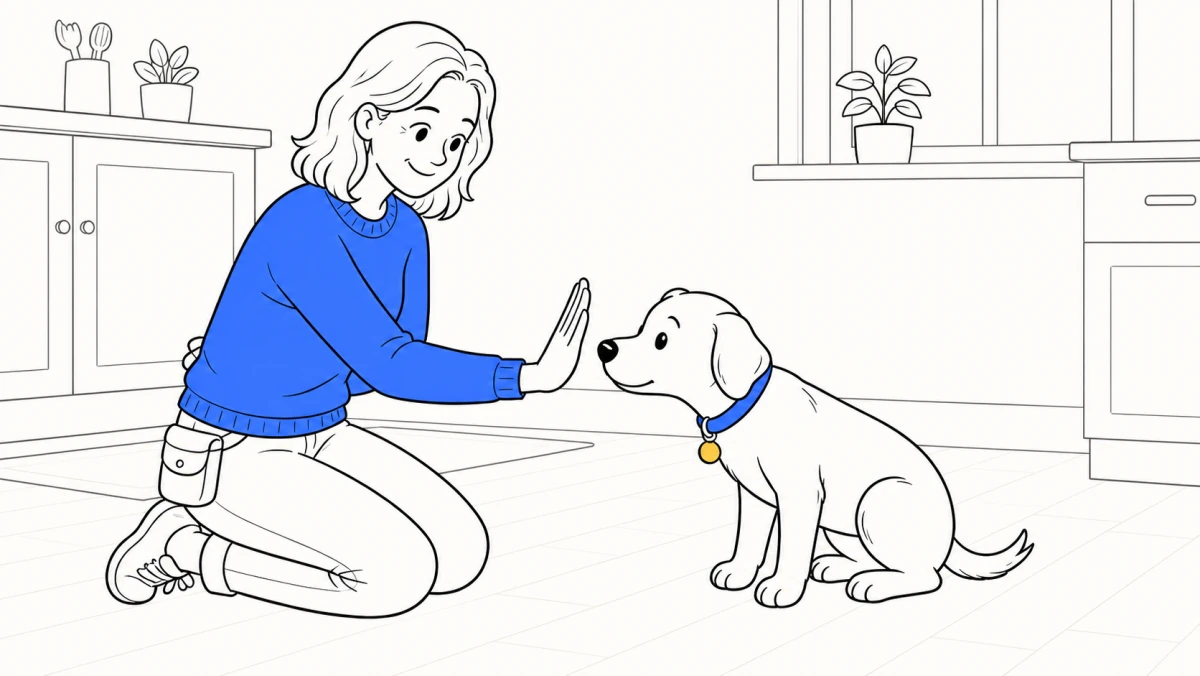
Say your puppy’s name, then “come” once, and click as soon as their nose touches your presented palm. Recall is the safety skill, and the good news is you’ve mostly already built it — it’s just your puppy’s name and a hand target, from further away.
- Start close, a couple of meters, indoors. Say your puppy’s name, then “come” once — bright, happy, crouched down, arms open.
- As they arrive, present your open palm low. The moment their nose touches it — click — treat at your feet.
- Add distance gradually: across the room, then from another room, before ever trying it outdoors on a long line.
Click-point: the nose-touch on your presented palm — a clean, visible finish instead of a vague “somewhere near me.” Never call your puppy for anything they’d dislike (bath time, nail trims, the end of play); that single habit is what breaks a recall, more than any single missed rep does.
How do you teach a puppy to stay?
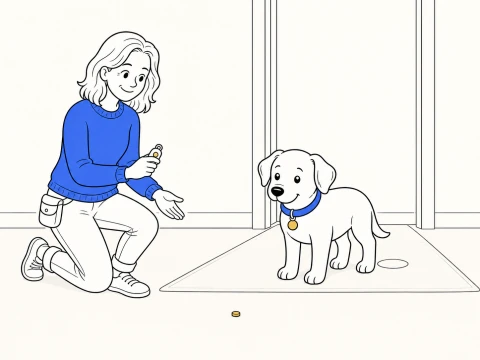
Once sit or down is reliable — usually a few weeks in, not day one — hold the cue for a beat, click and treat away from the spot so your puppy resets, then add a release word. Stay isn’t really a sixth skill; it’s a duration upgrade on a cue your puppy already knows.
Clicker trainer Helix Fairweather’s own troubleshooting on this skill names the biggest mistake: feeding treats while the puppy holds position — as Fairweather puts it, “This is a very nice place to be” — which caps how long a stay ever gets. Treat out of position instead, so your puppy resets and offers the next loop.
- Ask for the cue your puppy already knows solidly.
- Count a beat — one or two seconds at first — then click and treat away from the position, so your puppy resets to try again.
- Add a release word (“okay!”) that ends the stay, and click that response too. Raise the time in small steps, dropping back down whenever your puppy struggles.
Click-point: when the duration criterion is met, then the release. Early breaks usually mean the time was raised too fast or the release word wasn’t used consistently — use it every single time, and go back to an easier duration to rebuild.
What order should you teach these in?
Sit and leave it first — both are fast, nearly-can’t-fail wins that build your puppy’s confidence and your timing in the same week. Down comes next because it leans on a sit your puppy already has. Come follows once name recognition and a hand target are solid, since recall is really just those two skills from further away. Stay comes last on purpose: it’s the one duration-based skill on this list, and duration is easier to add to a cue that’s already reliable than to build from nothing.
Is my puppy’s mouthing during training normal?
Yes — a puppy nosing at your hand, lure, or fingers during any of these games is normal exploration and teething, not aggression, especially under about six months old. What isn’t normal: a stiff, frozen body, growling, guarding over food or toys, or a bite that breaks skin from a dog older than six months. Those deserve a certified trainer’s eyes, not a training tweak — here’s a fuller guide to what’s normal and when to get help.
How long should these sessions actually be?
Short. A couple of minutes per skill, a handful of reps, stopping while your puppy is still winning — not when you run out of patience. End on a success you can both feel, then walk away; the next session starts easier when this one didn’t grind into frustration. How long should puppy training sessions actually be covers the exact session-length guidance behind every method above.
Five skills, five short sessions, and a puppy who’s starting to offer behaviors instead of waiting to be told — the opposite of the guilty, guessing-game loop this started in, and the foundation everything else gets built on. If having a coach plan which of these five to work on today, and adjust when a session goes sideways, sounds useful, that’s exactly the gap we’re building ClickerPup to fill.