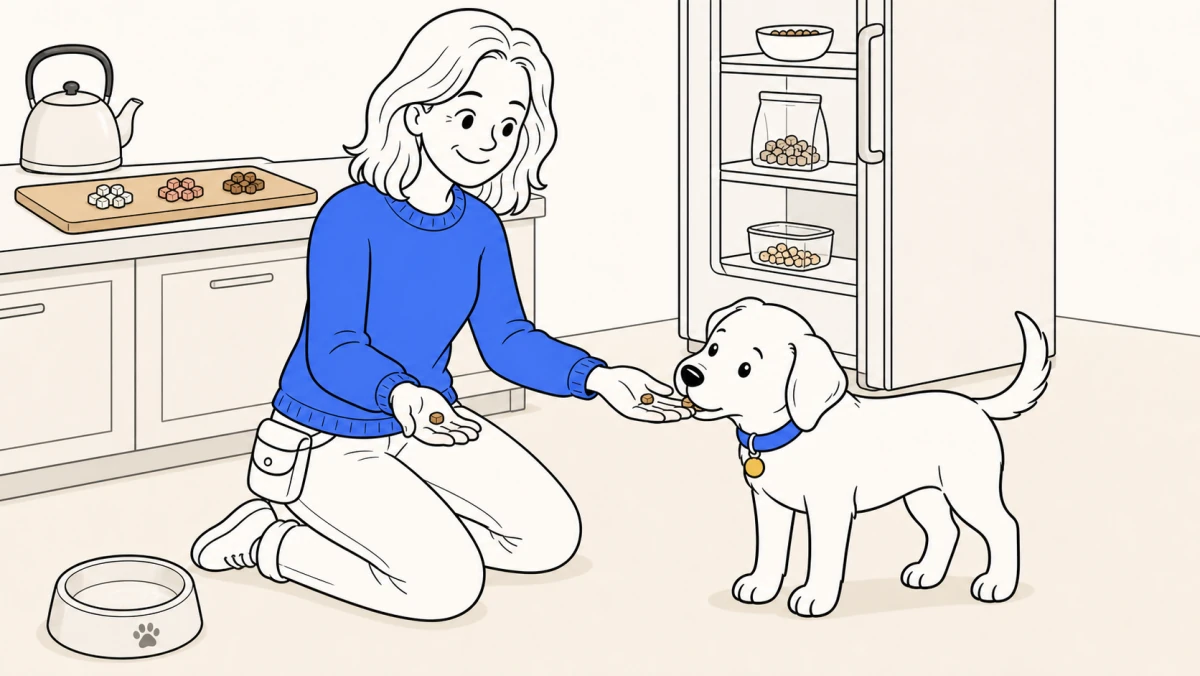
A high-value treat isn’t a category of food. It’s whatever your dog would choose right now, in this room, over everything else on offer — so value is a ranking, not an ingredient. The same piece of chicken can be worth working for in your kitchen and worth nothing at the park.
Which is why the lists don’t quite work. You bought the freeze-dried liver that four threads swore by, it was magic for three days, and then your dog looked straight through you at the park. That reads like your dog not caring, or you doing it wrong. It’s neither. The treat got outranked.
What makes a treat “high value”?
Value is defined by what the food does, not by what it is. A high-value treat is one your dog will actually work to get in the situation you’re both standing in — and if the behavior isn’t increasing, then whatever’s in your hand isn’t functioning as a reward, however much it cost.
Lori Chamberland, KPA CTP, puts the test bluntly in her troubleshooting guide for Karen Pryor Clicker Training: “If at any given time a reinforcer isn’t valuable to your animal, and he’s not willing to work to obtain it, by definition, it isn’t actually functioning as a reinforcer… It’s just ‘food.’”
The load-bearing phrase there is at any given time. It makes value a reading you take rather than a label the food carries — which is why the first question isn’t “what should I buy,” it’s “what does my dog rate, and how hard is today’s job.”
How do you find out which treats your dog actually rates?
Offer two at a time and see which one goes first. Run each food against the others and instead of a hunch you have a ranked list — your dog’s, not the internet’s.
That sounds like a party trick, and it’s a tested method. Vicars, Miguel and Sobie (2014) ran a paired-stimulus preference assessment on eight dogs — the formal, every-pairing version of the same procedure — then checked the result against how hard those dogs would work for each food, including a schedule that kept raising the price until the dog gave up. Their finding: “the preference assessment predicted reinforcer efficacy for all subjects.” What a dog picks between two different foods predicts which they’ll work hardest for. Note that scope: between different foods. Whether your dog would rather have a bigger pile of the same food is a separate question with a different answer.
Here’s the version that fits a kitchen:
- Pick three foods to start. Your dog’s ordinary kibble, whatever bagged treat you already own, and one thing from the fridge. Karen Pryor’s starter advice names the contrast: “Keep the treats small. Use a delicious treat at first: for a dog or cat, little cubes of roast chicken, not a lump of kibble.” AKC’s Stephanie Gibeault, MSc, CPDT, says most dogs “would put smelly items like cheese or bacon up at the top.” No brand needed for any of it.
- Cut everything to the same pea-sized piece, so you’re testing flavor rather than portion.
- Offer two, one in each closed hand, at the same height. Open both at once, let your dog take one, note which, take the other away. If your dog stiffens, freezes, or growls as food comes toward them, stop here — that isn’t a treat-selection problem, and it’s covered in what’s normal and when to get help instead.
- Run every pairing. Three foods is three pairs and takes about five minutes. For a full ranking, run six — that’s fifteen pairs, worth spreading over two or three short sessions.
- Rank by how often each was taken first. Write the order down, because you will not remember it.
Two practical notes, ours rather than the study’s. Run it before a meal, not after — a full dog ranks everything low and teaches you nothing. And re-run it every couple of months, because the order moves.
Is a bigger treat better than a tastier one?
On the best evidence available, tastier — from two small studies, of nine and ten dogs, that varied the number of pieces rather than the size of one. The finding underneath is the more useful one: what your dog picks isn’t automatically what makes your dog work, which is the trap the “ultimate list” pages fall into.
Riemer, Ellis, Thompson and Burman (2018) ran two small studies at the University of Lincoln — nine dogs for quantity, ten for quality. Each dog learned to run a 20-meter runway to a food bowl, then did two test sessions of ten trials about a week apart. Before any of that, every dog took a preference test, and those results were unambiguous: dogs significantly preferred five pieces of dry food to one piece (p = 0.006), and significantly preferred sausage to dry food (p < 0.001). They wanted more, and they wanted better.
Then the runway split the two apart. “Dogs ran significantly faster for the higher quality food compared to the lower quality food,” but “there was no significant effect of food quantity on running speed at any stage.” The authors say it directly: “this preference was not found to be consistently related to motivation.” Wanting the bigger pile didn’t turn into working harder for it. Wanting the sausage did.
Take that with the limits the authors put on it themselves. The samples were small — the results “should be interpreted with some caution given the relatively low sample sizes” — and they suspect one piece versus five “may not have been sufficiently great for magnitude-dependent effects to occur,” adding that “stronger effects would have emerged had we used either a larger food quantity disparity for the low value food or varied quantities of the higher value reward.” So this isn’t “quantity never matters.” It’s narrower: at the one-versus-a-few difference you actually make with your hand mid-session, upgrading the food moved something measurable and adding pieces didn’t. Their recommendation is to “deliver higher quality rewards, rather than a greater quantity of a lower value reward.”
Which makes pea-sized cheaper than it sounds. Gibeault writes that “Even for large dogs, a pea-sized treat is plenty. For small dogs, you can use even tinier pieces.” Riemer’s team varied the number of pieces rather than the size of one, so it isn’t a like-for-like test — but neither result suggests you need to hand over more food to get more effort.
It does bump into clicker training’s own canon. Karen Pryor’s fourth beginner tip: “Click once (in-out.) If you want to express special enthusiasm, increase the number of treats, not the number of clicks.” On the runway, extra pieces of the same food produced no extra effort — though nine dogs and a measure of running speed is not the last word. Our read: reach for a better treat before a bigger handful.
What happens when you change the payment mid-session?
Less than you’d fear, at least at first. Every dog in Riemer’s study ran both sessions, a week apart: one where the reward was poor throughout, and one where it was good for four trials, poor for four, then good again. After that mid-session downgrade the same dogs still ran faster than they had in the session that was poor from the start — they “continued to run faster following a downshift from the high quality to the low quality reward than when they had received the low value reward in all trials.”
The authors offer two explanations and hedge both. One is habituation: the dogs eating identical food for ten straight trials were getting bored of it, while the food the downshift landed on was still novel. The other is that dogs trained on the good reward simply arrived with better expectations of the task. And they don’t claim it lasts — “It is likely that performance would have declined if a higher number of trials had been conducted following the downshift,” and the dogs ran fastest in the very first trial after the drop.
So a step down mid-session isn’t the immediate collapse it feels like. It’s a grace period, not a free pass.
Why do high-value treats stop working outdoors?
Because value is relative to whatever else is competing for your dog at that moment, and outdoors the competition is enormous. Nothing about the chicken changed. The field it was competing in did.
Gibeault describes the same slide in practical terms: “You might be able to get away with using kibble as a reward in your quiet living room, but in a more distracting location, you should pull out the stinky treats your dog adores.” Chamberland’s instruction when a reward stops landing has the same shape — “it’s time to switch it up with something the animal does find reinforcing in that moment.”
Worth remembering that Riemer’s dogs were ranked in a dedicated test room, not on a street with a dog walking past. Your list is a starting order, not a guarantee.
And here’s the part the shopping guides don’t reach, which is our read rather than a published finding: past a certain level of distraction no food wins at all, and that isn’t a purchasing problem. Chamberland’s test tells you when you’ve hit it — if the behavior isn’t increasing, the thing in your hand isn’t working, and no upgrade to it will change that. The fix is distance, not a better treat: move further from the interesting thing, or go somewhere easier and work back toward it. It’s why recall is trained at a distance you can actually win at rather than at the edge of a field.
How do you build a treat hierarchy?
Three tiers is enough: what you pay for the easy stuff, what you pay for something new or slightly harder, and what you keep in reserve for the genuinely difficult. A treat hierarchy is only useful if it’s built from your dog’s own ranked list, which is why the test comes first.
| Tier | What it pays for | Where it comes from |
|---|---|---|
| Everyday | Cues your dog already knows, at home, nothing else going on | Ordinary kibble, measured out of the day’s food |
| Working | Something new, or something known in a slightly harder place | The middle of your dog’s ranked list |
| Reserve | Outdoors, recall, first time anywhere, anything genuinely hard | Your dog’s top one or two — and only here |
The three-tier split is a working convention, not a research finding. What the evidence supports is narrower: that a dog’s own ranking predicts which foods they’ll work hardest for, and that quality rather than quantity is what moves motivation. Where you draw the lines is a judgment call you make with the dog in front of you.
The discipline that makes a hierarchy hold is about the reserve tier: whatever sits at the top of your dog’s list stays out of ordinary life. Cheese handed down from the counter on a normal day isn’t reserve-tier anymore, whatever it cost.
Does a dog get bored of the same treat?
Some do and some don’t — and this is a genuine split in the evidence rather than a settled rule, so watching your own dog beats picking a side.
Bremhorst, Bütler, Würbel and Riemer (2018), in Scientific Reports, gave sixteen pet dogs a two-choice test between a varied food reward and a constant one. The result refuses to generalize: “six subjects showed a significant preference for the varied food reward and six for the constant food reward, while four dogs exhibited no significant preference for either option.” What did show up was a drift over time — across six blocks of ten trials, preference for variety rose, and the authors concluded that “introducing variation in reward types may maintain dogs’ motivation in operant tasks over a longer time period.” That fits the habituation the runway study ran into, which is why Riemer’s team closed on the caveat of “reward-specific habituation needing to be considered.”
Practitioners land on rotation. Chamberland: “Always have a buffet available! Using a variety of treats keeps dogs interested in what’s coming next. Keep a rotation of four or five different treats on hand, especially if you have a finicky dog.” Gibeault acts on the symptom rather than the calendar: “Dogs can become bored with the same old treat. If you notice your dog’s enthusiasm is fading, change to a different reward of equal or greater value.” Rotate on enthusiasm, not on a schedule.
What makes a treat easy to use, not just tasty?
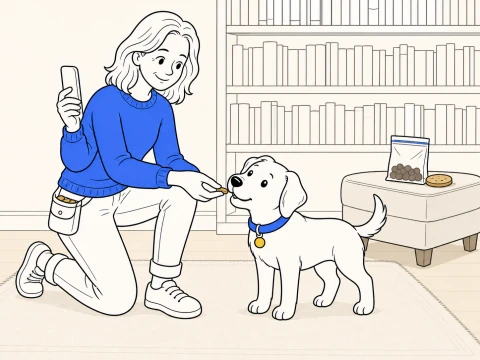
It has to be deliverable at speed. A treat that crumbles, needs chewing, or has to be fished one-handed out of a resealable bag costs you repetitions — and how often your dog gets paid is a different problem from what they get paid with. Chamberland separates the two deliberately, because trainers confuse them constantly, and nearly everything written about high-value treats is about the first one only.
She puts a number on the second: “Strive for roughly 10-15 clicks/treats per minute as a rough guideline but not a rule” — a guideline because, in the same breath, the right rate “depends on the complexity and difficulty of the behavior, the reinforcer used, the context, and more.” She’s blunt about how the slow version feels from the dog’s end: at one treat every 60 seconds, “the dog’s frustration at such a low rate of reinforcement might overshadow the opportunity to earn his paltry paycheck.”
Ten to fifteen payments a minute is one every four to six seconds. A biscuit your dog has to stand there and chew makes that impossible before you’ve done anything wrong, and a treat that shatters on impact sends your dog vacuuming the carpet instead of looking at you. So the working spec is: pea-sized, soft, doesn’t crumble, cut up before you start, and in a pocket rather than in your hand. (That’s about how fast you can physically pay inside a session — not about thinning rewards out to every second or third rep, which is a separate subject with its own rules.)
A marker buys you room on the delivery. Karen Pryor’s second beginner tip is explicit about which half of the sequence has to be exact: “The timing of the click is crucial… Give the treat after that; the timing of the treat is not important.” Fast with the sound, not with the food. That’s the argument for training with a marker rather than a lure, and it’s why treats belong in a pouch rather than a fist.
If your rate is dropping because sessions drag on, that’s a separate lever: how long a session should actually run.
How many high-value treats can a dog have in a day?
The reliable rule is a percentage, not a count — WSAVA puts treats at “less than 10% of a dog’s daily calorie intake.” What that comes to in actual food depends on your own dog’s daily energy requirement, which is a number to get from your vet rather than from a chart.
What makes it concrete is WSAVA’s own energy-density table, which happens to price the exact foods every high-value list recommends. These are the training-relevant rows of it:
| Food | Measure | Calories |
|---|---|---|
| Ham | 1 oz / 28 g | 46 |
| Lean cooked chicken breast (without skin) | 1 oz / 28 g | 47 |
| Lean turkey breast (without skin) | 1 oz / 28 g | 50 |
| Lean cooked beef | 1 oz / 28 g | 64 |
| Peanut butter | 1 tbsp | 81 |
| Cheddar cheese | 1 oz / 28 g | 120 |
The full table adds four more you wouldn’t train with: a digestive biscuit at 75 calories, a tripe stick at 217, a dried pig’s ear at 242, a rawhide bone at 700. WSAVA’s comment covers all of them: “For some dogs, consuming just one of these in the specified quantity could exceed their maximum recommended daily calorie intake from treats.” An ounce of cheddar is not a training session. For a small dog it can be more than the entire day’s treat allowance on its own.
What does 10% actually come to?
For a dog eating 1,456 calories a day, about 146 calories — AKC’s Anna Burke working it from four cups of food at 364 calories per cup. It scales with how much your dog eats, which is why the percentage travels and a treat count doesn’t, and why she’s careful that “The 10% refers to calories consumed, not volume or number of treats.”
One caution about lookup tables, including WSAVA’s own. “Feeding treats to your dog,” as published in November 2025, carries a table of maximum daily treat calories by body weight — and as printed it gives the same figure, 32 kcal, for every weight from 6 kg through 40 kg (roughly 13 lb to 88 lb), before jumping to 146 kcal at 45 kg. An 88-pound dog cannot have the same allowance as a 13-pound one, so something has gone wrong in that row, and it’s exactly the kind of table that gets screenshotted. Trust the percentage, and get the absolute number the way that document’s own footnote says to: “speak to your veterinary healthcare team to determine your own dog’s daily energy requirement.”
Which means reserve-tier food should be rare by arithmetic, not only by discipline. Ordinary work gets paid out of the measured daily ration — the mechanics of training out of the day’s food are the sibling guide’s territory — and the chicken is for the hard places.
Which foods should be off the list entirely?
WSAVA’s list of toxic ingredients, which it says “include: Chocolate · Macadamia nuts · Onions, leeks, shallots, garlic, chives · Grapes, raisins, currants and sultanas · Xylitol (sweetener) · Alcohol and raw yeast dough · Caffeinated drinks, including coffee, tea and energy drinks.” That “include” is doing real work — it’s a list of the common ones, not a complete one, which is why the second rule matters more.
The second rule is about your particular dog, and it’s WSAVA’s too: “If your dog has a medical condition, dietary sensitivities, or is being fed a veterinary-prescribed diet, conventional treats may not be appropriate. Ask your veterinary healthcare team for advice if you are unsure what is suitable for your dog.”
That’s the boundary of this page. It’s about what to pay your dog with, not about what to feed them. Weight, allergies, an upset stomach, a prescribed diet — those are vet conversations, and no amount of clicker mechanics substitutes for one.
What should you do if your dog won’t take the treat at all?
Stop testing treats. A dog turning down food they normally love is usually telling you something about the situation rather than about the food — that there’s too much going on, or they’re too full, or too tired. Make the job easier or move somewhere quieter, and try again later.
Two things take it out of training’s hands entirely. A dog who suddenly turns down food they normally eat, anywhere, is worth a call to your vet rather than a change of treat. And any stiffening, freezing, or growling over food, bowls, or chews is the one situation on this page we won’t coach you through: our guide to what’s normal and when to get help covers where that line sits, and an IAABC-certified behavior consultant (iaabc.org) is a good place to start — their Standards of Practice hold that “Positive reinforcement should be the primary training strategy,” and, since February 2025, that the association “strongly opposes the intentional use of aversive stimuli and requires members to refrain from using shock in training or behavior modification.”
The five minutes that replaces the shopping
Run the three-food version of the two-hands test and write the order down. Pay everyday work out of the measured daily ration, keep the top of the list for the places that are genuinely hard, and when something stops working, change the food or change the place — not the portion.
The mechanics aren’t the hard part. The hard part is knowing which tier today’s job actually is: whether the room you’re standing in counts as easy, whether your dog is ready to be asked in a harder one, and whether a flat session means the treat got outranked or you made the job harder too fast. It’s a call that’s easy to get wrong in both directions — reserve chicken for a cue your dog already owns, kibble for a first attempt outdoors.
That judgment is what ClickerPup is being built to make with you: two-minute sessions that record how the last one went, and tell you plainly whether to make the next one harder or hold where you are. Your phone is the marker, so there’s one less object in your hands. The clicker stays free forever, with a plain reminder before anything ever charges — and it coaches the training, not your dog’s diet. That part stays between you and your vet.
Claim my early spot and we’ll email you when the first version is ready to try.