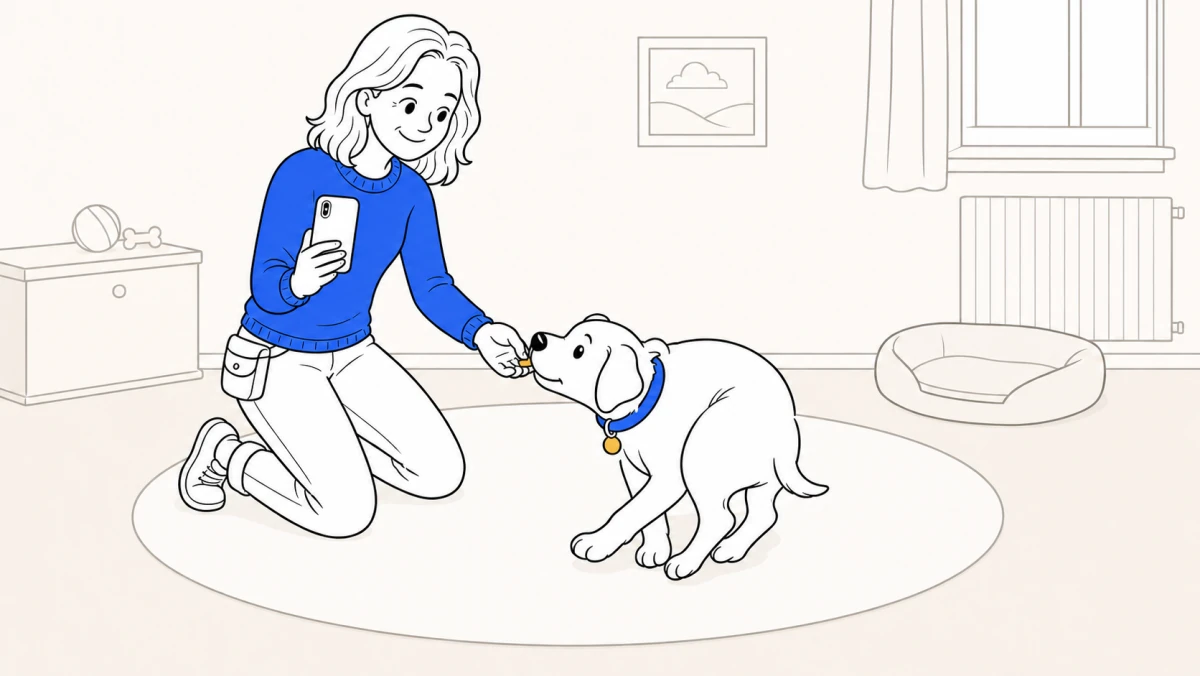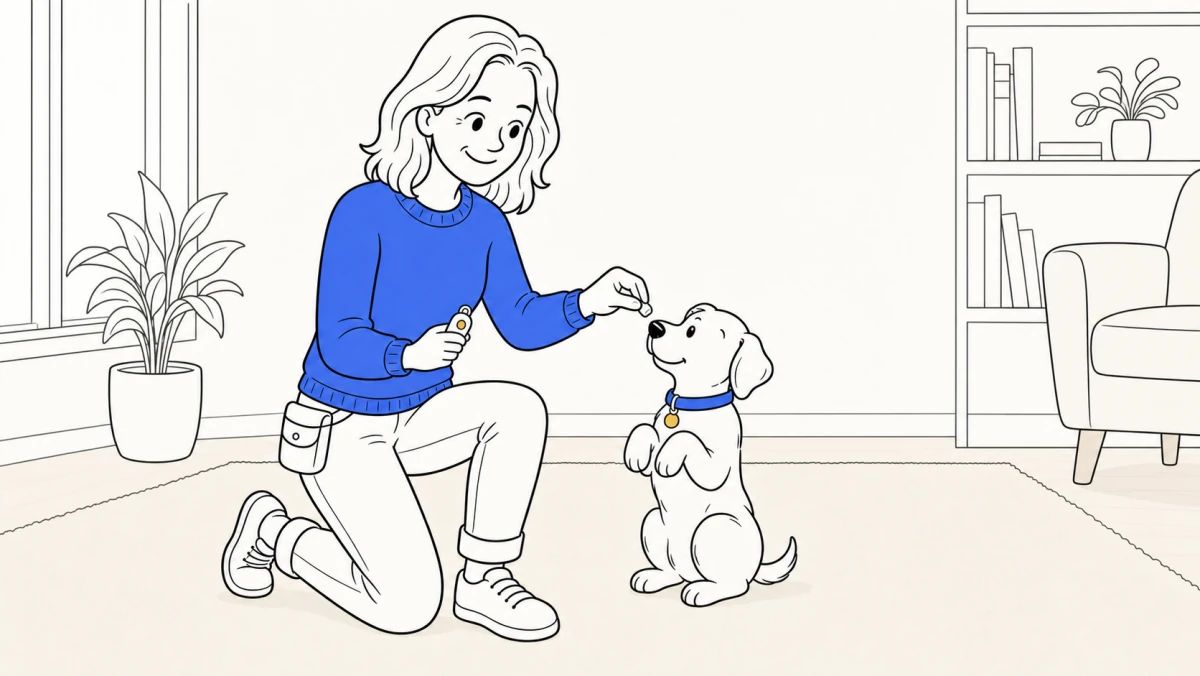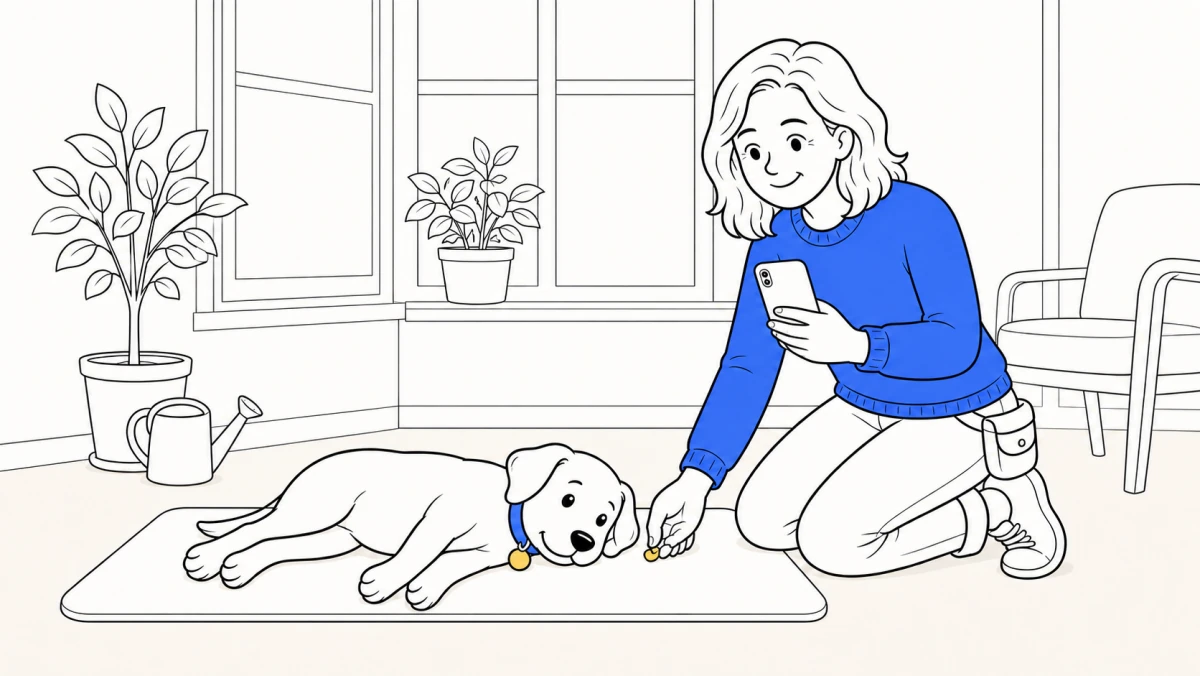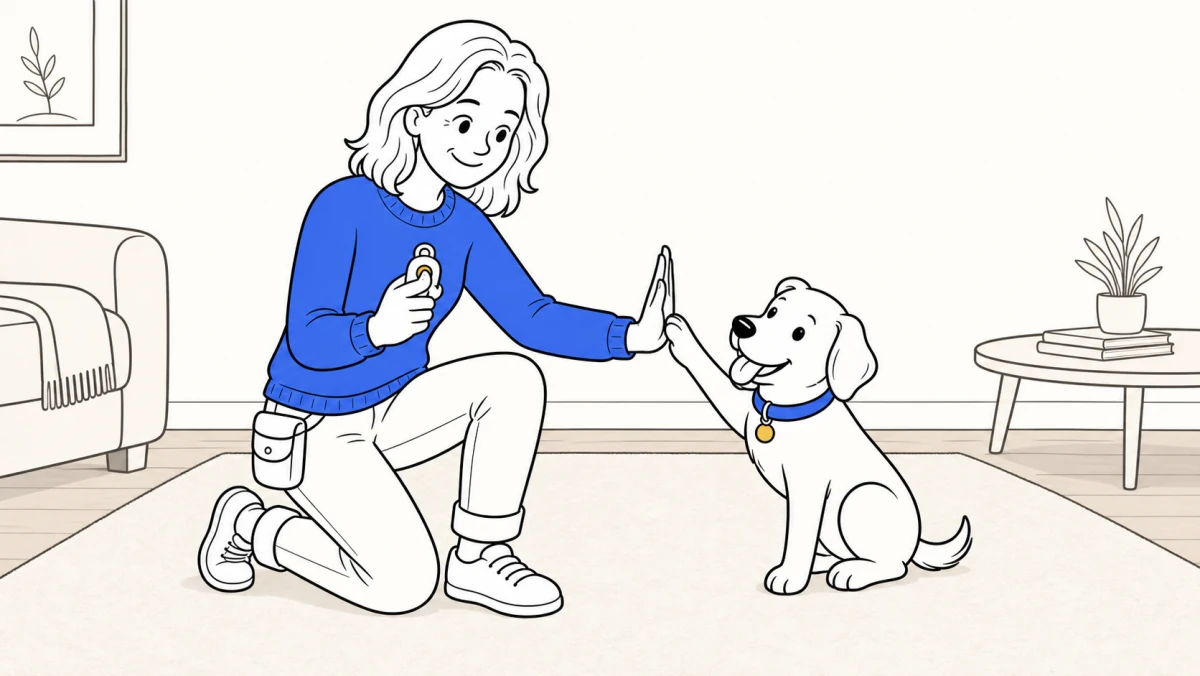
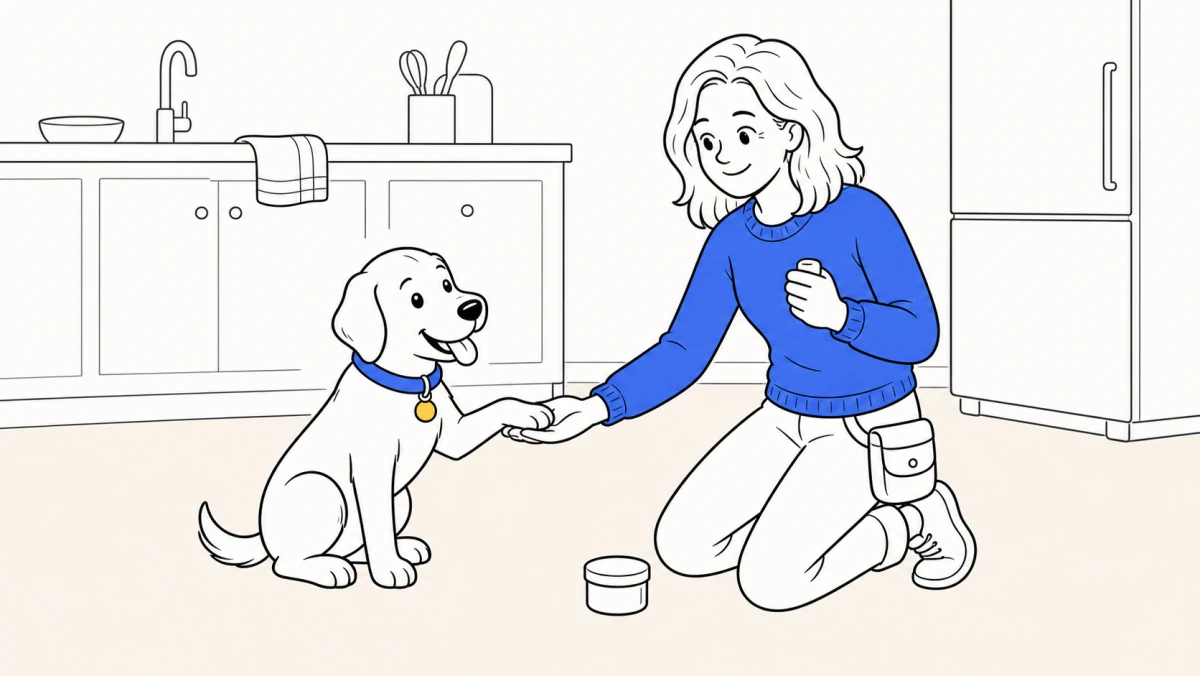
Shake (or give paw), spin, roll over, and beg are four of the easiest tricks to start with. Three need no other skill first; roll over is the one exception — it goes much more smoothly once your puppy has a reliable “down.” All four use the exact same clicker method as sit or hand-target. Pick one, keep sessions to a couple of minutes, and build from there.
If “sit” still isn’t fully reliable, tricks aren’t cheating or getting ahead of yourself — they’re the same skill, at lower stakes. A puppy who’s had three hard sessions of “sit” this week can still nail “spin” on the first try, and that quick win is worth more than it looks. Nothing here needs a class, special equipment, or a puppy who’s already “good at training.”
What’s the easiest trick to teach a puppy first?
Shake (or give paw) and spin — neither needs any other skill first, and both usually produce a click-worthy moment in the very first session. Roll over and beg are just as learnable, but they build on a little more patience (or a little more balance), so most owners get a faster confidence win by starting with shake or spin and saving the other two for once your puppy has one trick already under their belt. Here’s how the four stack up:
| Trick | Any prerequisite? | Why start here |
|---|---|---|
| Shake / give paw | None | Usually the fastest first “aha” |
| Spin | None | Great for wiggly, high-energy pups |
| Roll over | Goes much more smoothly with a reliable “down” already in place | Built in small steps, and easier once “down” is solid |
| Beg / sit pretty | Steady balance while sitting | The showiest trick, and the most physically demanding |
How do you teach a puppy to shake (give paw)?
You teach shake by rewarding a paw lift until your puppy offers it on cue, without needing a touch to trigger it.
- Have your puppy sit, then hold a treat in a closed fist near the ground in front of one paw.
- Most puppies paw at the fist to get at the treat — the instant a paw touches your hand, click and open your fist to reward. If your puppy doesn’t paw on their own, a gentle touch to the back of one leg, just above the paw, usually triggers a lift — click that instead.
- Repeat until the paw-lift happens without the touch or the closed fist.
- Once you get it right about 8 times out of 10, add the cue word (“shake” or “paw”) right before you present your open hand.
- Fade the closed fist or leg touch over several sessions — present your open palm alone and wait a beat before helping.
How do you teach a puppy to spin?
You teach spin by luring your puppy’s nose in a circle with a treat, then fading the lure once they’ll turn for the hand signal alone.
- Hold a treat at your puppy’s nose height and slowly lure their nose in a small circle.
- Click and treat for a quarter turn at first — that’s a real success, not a partial one.
- Once quarter-turns are reliable, ask for half a turn before clicking, then a full circle.
- Add the cue word and a small hand-circle signal once your puppy is turning on the lure alone.
- Fade the food lure: once your puppy spins reliably for the hand signal, reward from your other hand instead of the one doing the luring.
How do you teach a puppy to roll over?
Roll over goes much more smoothly with one thing already in place: a reliable “down.” AKC’s own instructions say it’s “helpful if your dog knows the ‘down’ cue before you start teaching this trick” — and in practice, luring a roll from a puppy who won’t settle into “down” usually means fighting the down, not teaching the roll. Teach “down” first if your puppy doesn’t have it yet.
- Ask for “down” and wait until your puppy is settled — belly on the floor, not popping back up a second later.
- Hold a treat by their nose and draw it slowly toward their shoulder — most puppies flop onto one side to follow it. Click the moment their weight shifts, even before a full roll.
- Next rep, lure a little further — shoulder toward spine — and click that small step. Keep raising the bar in pieces this small.
- Repeat across several short sessions until the lure carries them all the way over. Add the cue once they’re rolling for the lure reliably.
- Skip this one, or keep it very light, if your puppy has a long, low back like a dachshund’s — that body shape carries a much higher risk of a spinal condition called IVDD (Dr. Julie Buzby, DVM), and vets generally advise dogs built that way away from movements that twist or strain the spine. It’s also worth skipping if your puppy seems nervous going onto their side: rolling over is a genuinely vulnerable position, and it’s not worth pushing through fear or discomfort for a trick. Ask your vet if you’re at all unsure.
How do you teach a puppy to beg (sit pretty)?
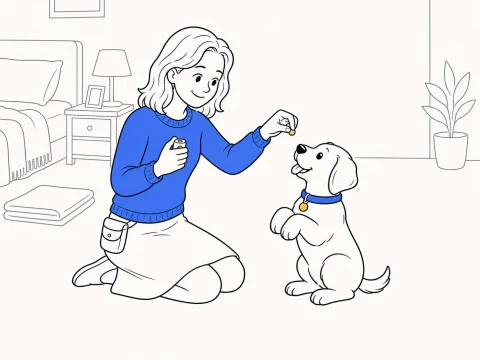
You teach beg by rewarding a brief lift of both front paws from a sit, then building duration in small steps. Balancing on the haunches is real physical effort for a small puppy, so keep these reps especially short — a few good lifts beat a long drilling session. Skip this one, or keep it very brief, if your puppy seems wobbly or reluctant, or you have any concern about their joints — ask your vet first.
- From a sit, hold a treat just above your puppy’s nose — high enough that they lift their front paws off the ground to reach it, not so high they stand up.
- Click the instant both front paws leave the ground, even for a half-second, then treat.
- Build duration in tiny increments — an extra half-second at a time — before adding the cue word.
What other tricks use the same method?
High-five is shake’s cousin: same shaping, but click for a raised paw at nose height instead of a paw at the ground. Play dead builds from “down” the same way roll over does — lure their head toward the floor and click for stillness, building duration before adding a cue.
Fetch is the same click-and-reward loop stretched over distance: click the pick-up first, then the turn back toward you, then the release into your hand — three small skills chained, not one big one. Speak is the one trick here you capture rather than lure: click a bark your puppy already offers, name it once it’s predictable, and you end up with a bark on cue. (That’s a different job from quieting a puppy who barks at every noise — for that, see why your puppy is barking and how to stop it.)
Worth knowing: ClickerPup’s dedicated tricks module currently runs spin, shake, roll over, and beg — that’s exactly why those four get the full step-by-step above. High-five, play dead, fetch, and speak are yours to freestyle with the identical method.
When can I start teaching my puppy tricks?
As early as eight weeks. There’s no minimum age and no required skill first — tricks use the exact same short, reward-based sessions as sit or hand-target, so if your puppy is ready for those, they’re ready for tricks too.
Keep sessions in the same one-to-two-minute range you’d use for any brand-new skill — see how long puppy training sessions should be for the full breakdown by age.
How many tricks should I teach at once?
One at a time. Karen Pryor’s foundational shaping rules in Don’t Shoot the Dog! are explicit on this: raise criteria in increments small enough that your puppy still has a realistic shot at getting it right, and train one criterion at a time. Teaching two brand-new tricks in the same session usually means neither one sticks.
Get one trick solid — about 4 out of 5 clean tries across two separate sessions — before starting the next. It’s the same reliability bar this site uses for every skill, tricks included.
Will my puppy need treats forever to do tricks?
No. Fade the food lure once your puppy performs the trick reliably and consistently — the same way you’d fade a lure for sit. The AKC’s guidance on lure-fading is direct: begin fading once your dog performs the cue consistently, not on a fixed rep count, and a lure used this way isn’t a bribe — it’s a teaching tool with a planned exit.
Are tricks just for fun, or do they help with real training too?
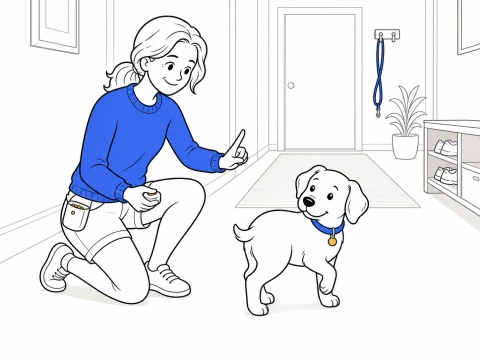
Both, honestly. Tricks are built from the identical shaping and timing mechanics as any clicker skill — click at the right instant, reward the try, raise the bar in tiny steps — so every rep is real practice, even though the stakes are lower.
That lower stakes is the actual point. A puppy who’s had a rough week on “sit” can still get a clean win on “spin,” and a clean win is worth more to a discouraged first-time owner than another repetition of the thing that isn’t working yet.
One caution: any trick — spin included — should feel like a game, not a struggle. If your puppy yelps, flinches, goes stiff, or seems reluctant partway through, stop. That’s not stubbornness, and pushing through it isn’t training, it’s coercion. Sudden reluctance paired with limping, appetite change, or low energy is worth a vet visit; fear that doesn’t ease with gentle, short sessions is worth a certified behavior consultant (IAABC-certified, at iaabc.org). Here’s a fuller guide to what’s normal and when to get help.
The bottom line
Shake, spin, roll over, and beg will get you four real tricks using nothing but a clicker — or a cheerful “yes,” which AVSAB’s humane-training guidance treats as a legitimate equal — and a few treats. Same method, same short sessions, same one-thing-at-a-time patience as everything else your puppy learns. Start with whichever looks easiest for your puppy today; there’s no wrong first trick.
If keeping four tricks (plus everything else) straight sounds like a lot to track solo, that’s exactly what we’re building ClickerPup to do: it runs spin, shake, roll over, and beg as their own module, sized into the same short sessions, and it only calls a trick “reliable” once your dog has actually proven it twice — not just performed it once for the camera. The clicker is free forever, with a plain reminder before anything ever charges.
Claim your early spot and we’ll bring you in as we open up.