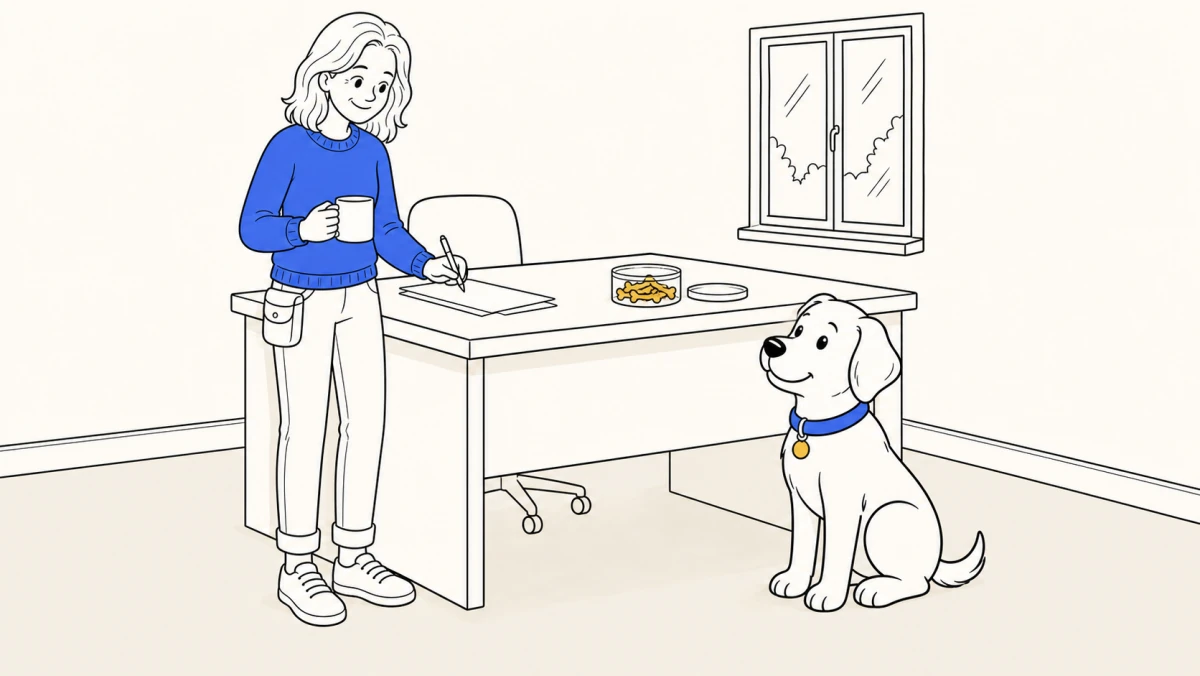
No — you don’t have to use treats forever. But you don’t stop rewarding, either. The change that actually matters is that food stops appearing before the behavior: your dog responds to the cue and gets paid afterward, out of a pocket they can’t see. How often you pay after that depends on whether you’re raising the bar or holding it steady.
That first distinction is the whole answer, and almost every “wean your dog off treats” guide skips straight past it. So if you’re standing in your kitchen holding a piece of chicken, wondering whether you’ve built a dog or a vending-machine habit — you haven’t done anything wrong yet. You’ve just stopped one step short.
Why does my dog only listen when I have a treat in my hand?
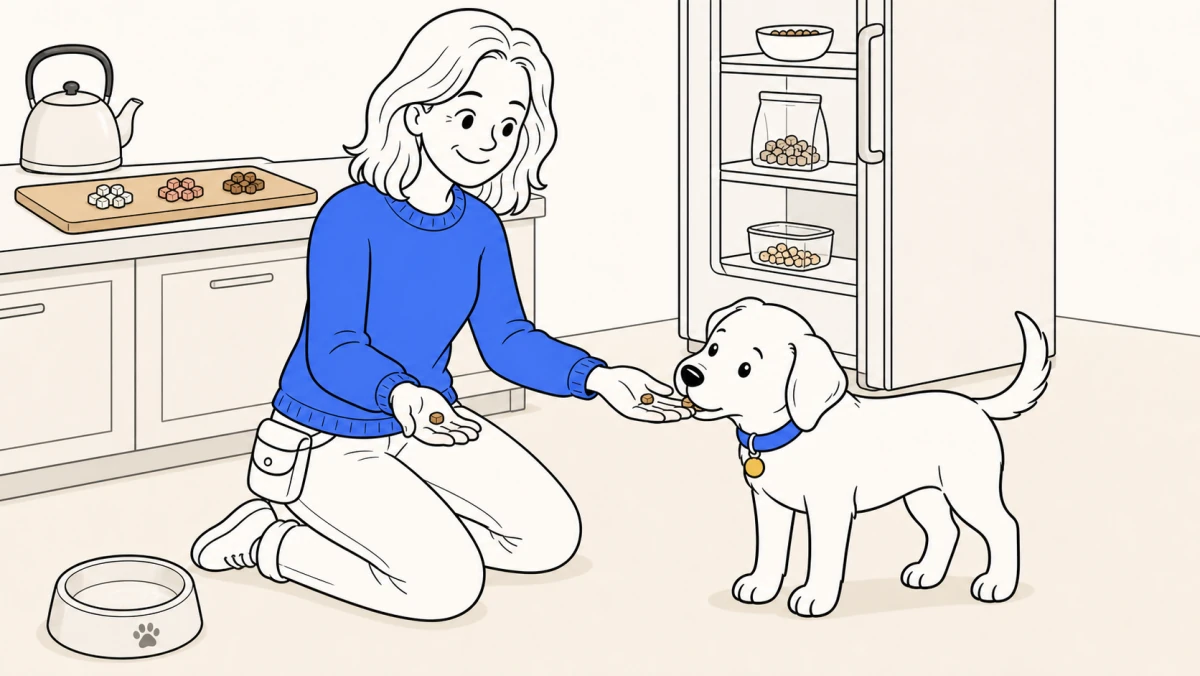
Because the treat is still doing the job of a lure rather than a reward. If the food is visible before your dog acts, your dog is following the food. Take the food away and there’s nothing to follow — so nothing happens, and it looks like the training never took.
The American Kennel Club’s Stephanie Gibeault, MSc, CPDT, names this exact failure: “If you’ve ever felt like your dog will only listen when you have a treat in your hand, you may have missed a crucial step in the process.” The step is the one below — and it’s not a matter of trying harder or using better treats.
What’s the difference between a lure and a reward?
A lure is food your dog can see, used to move their body into a position. A reward is food your dog couldn’t see, delivered after they’ve already done the thing. Same piece of chicken, two completely different jobs — and, as Gibeault puts it, “your dog needs to understand that the lure and the reward are two separate things.”
| Lure | Reward | |
|---|---|---|
| When the food appears | Before the behavior | After the behavior |
| What your dog is following | The food | The cue |
| Where the food comes from | The hand doing the signal | A pouch, pocket, or your other hand |
| What happens with no food visible | Nothing | The behavior still happens |
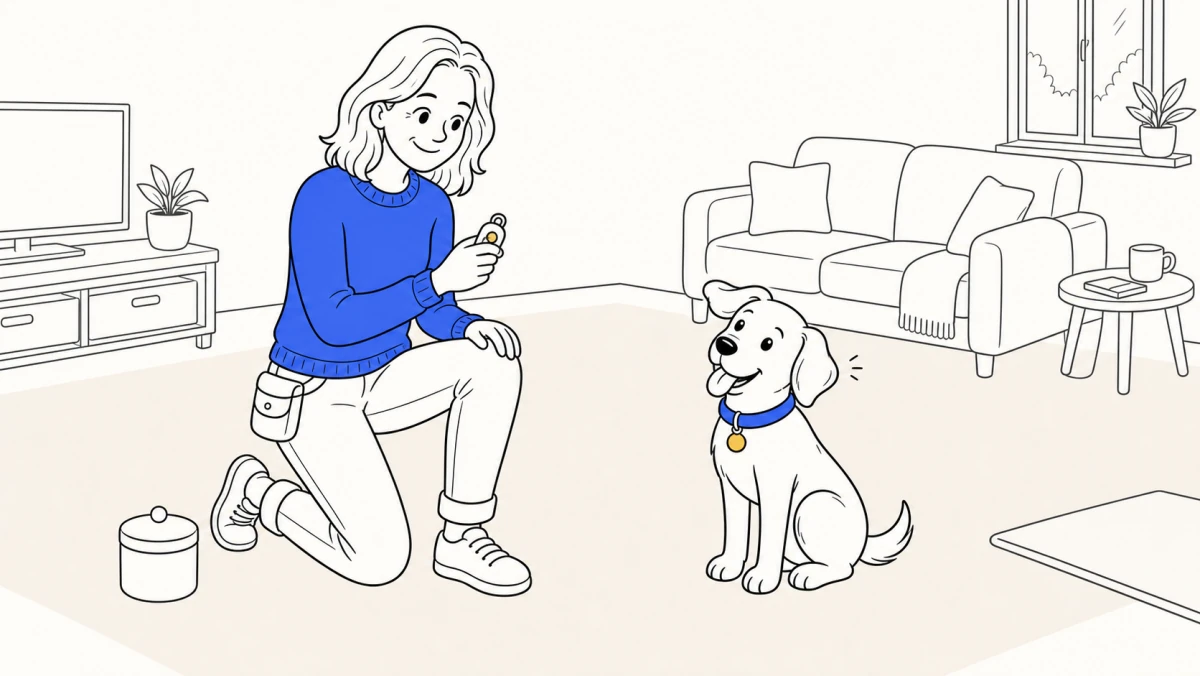
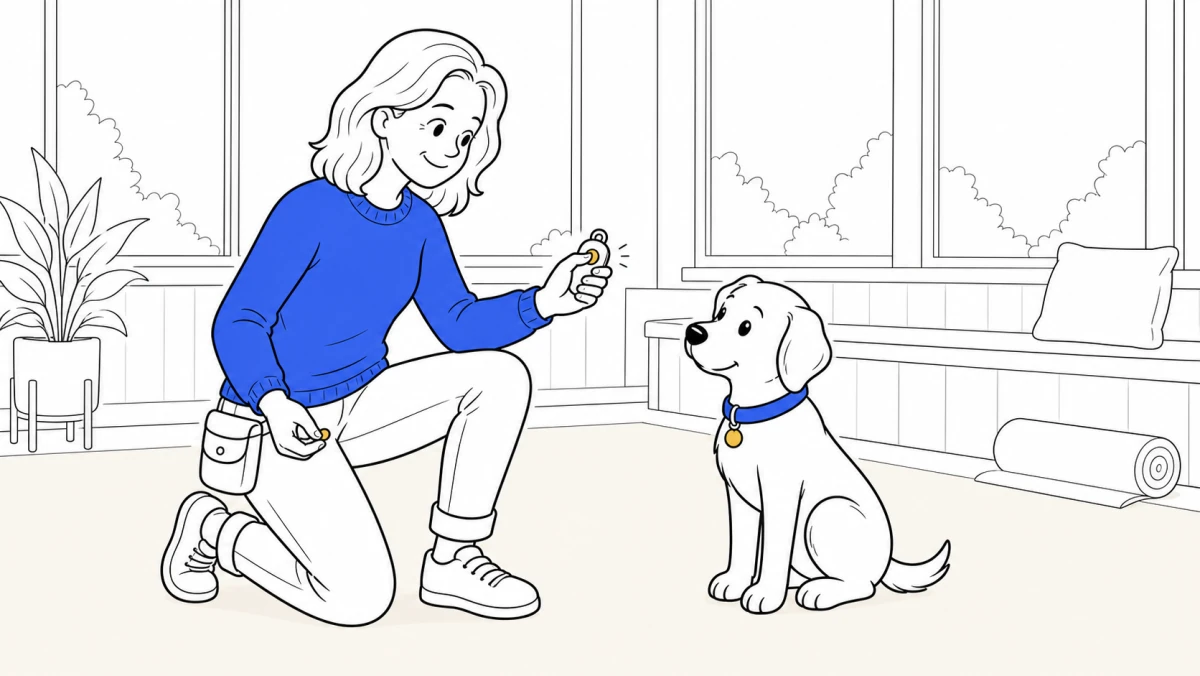
This is why a marker — a clicker, or a clear “yes” — carries so much weight. It lets you keep the food completely out of sight until the moment has already been earned, because the sound does the telling and the food only does the paying. If that idea is new, start with what clicker training is and whether it works, then charge the marker properly — an uncharged marker is just a noise, and the food goes straight back to being a bribe.
When should you start fading the treat?
As soon as your dog is doing the behavior consistently with the lure. That’s the trigger — not a number of repetitions, and not a number of days.
AKC’s Sassafras Patterdale, CPDT-KA, CTDI, puts the timing plainly: “As soon as your dog is performing the cue consistently with the lure, you want to start fading it out.” Notice what’s not in that sentence: a rep count.
Is it true you should fade the lure after six repetitions?
That number is real and it has a real author — it just isn’t a universal rule. It’s Ian Dunbar’s, from his lure-reward method: “Food lures should not be used for more than half a dozen trials,” because “after just half a dozen repetitions, the food lure is no longer necessary.”
So treat it as a rule of thumb inside one trainer’s system rather than a settled figure. Patterdale’s AKC guidance above reaches the same destination by a different route and names no number at all.
Our own bias is the performance-based version, for a beginner-specific reason: a rep count can run out while your dog is still guessing, and then you’re fading something that was never solid in the first place. Fade on what your dog is actually doing, and the question of the right number never comes up.
One more thing worth hearing before you rush it, from the same article: “lures shouldn’t be considered bribes. Despite wanting to fade out lures to polish a trick or command, there is no problem with using treats to teach a skill.” The lure isn’t the mistake. Keeping it is.
How do you fade the lure, step by step?
Three steps, and you can move through all three in a single short session with a behavior your dog already knows. Gibeault’s progression:
- Lure with a treat, reward with that same treat. This is where most people already are.
- Lure with a treat, reward from your other hand. The hand that guided isn’t the hand that pays. Your dog starts noticing that the payment comes from somewhere else.
- Lure with an empty hand, reward from your other hand. The signal is now just a hand motion. The food was never in it.
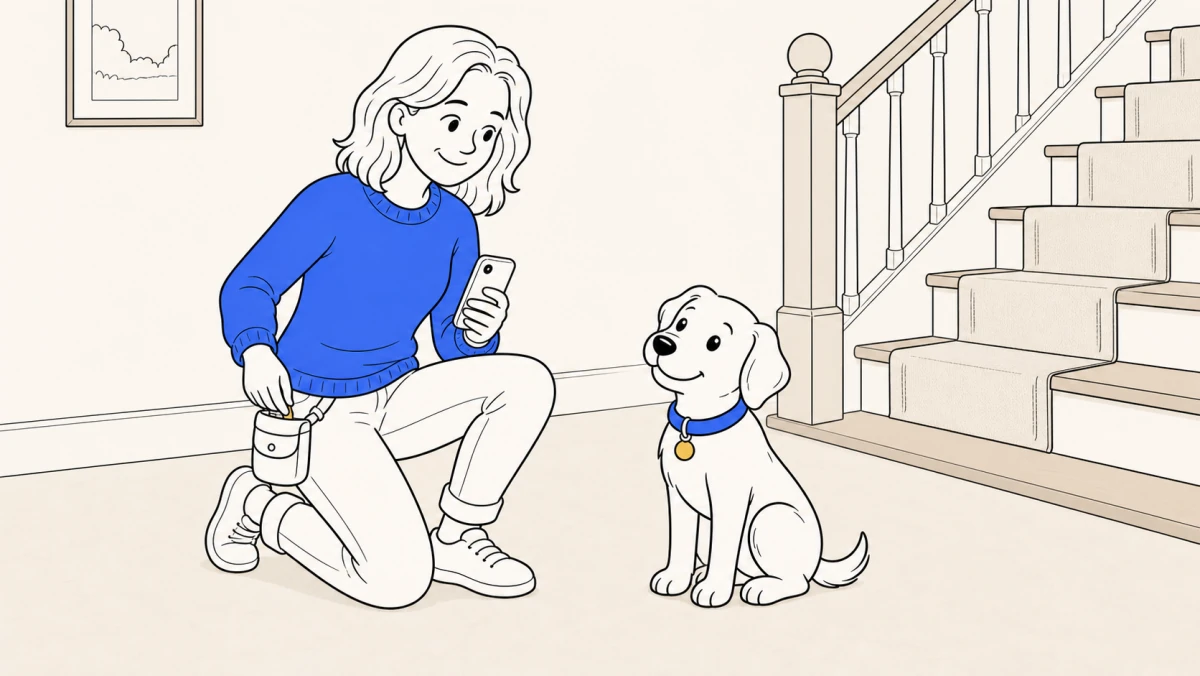
Then the piece that makes it stick: “You might also want to keep your treats in a treat pouch until it’s time to reward your dog. This way, your dog will never know where the food is coming from.” A pocket works just as well as a pouch. What matters is that your dog can’t audit your hands before deciding whether you’re worth listening to.
If a step falls apart, you moved too fast — go back one, get a few clean reps, and try again. That’s not a setback; that’s the method working exactly as designed.
Do you stop rewarding once your dog knows a cue?
No. You change when the reward comes, not whether it comes. And the trigger for that change isn’t “my dog knows this now” — it’s “I’ve just made this harder.”
Karen Pryor’s own article on reinforcement schedules is unusually specific about this, and it’s the opposite of the folk advice: “As soon as you want to improve the behavior… and you raise a criterion, the dog is on a less predictable schedule… From the dog’s standpoint, the schedule has become variable. When the dog is meeting the new criterion every time, the reinforcement becomes continuous again.”
So the reward doesn’t get thinner because you decided to be stingier. It gets thinner because you asked for something harder — a longer stay, a noisier room, a bigger distance — and your dog is now sometimes clearing the new bar and sometimes not. When they’re clearing it every time, you’re back to paying every time, and the next raise starts the cycle again. The same source describes oscillating between continuous and intermittent reinforcement as what “allows you to raise criteria extremely fast.”
So what does a fully trained dog actually work for?
Something worth having — just not something they can see in advance. Not nothing, which is the myth worth putting down. Sometimes food, sometimes the ball, sometimes being released straight back to the thing they wanted in the first place.
That progression from first try to reliable is the thing worth chasing, and it’s what “trained to reliable” actually means rather than a dog who performs once in a quiet kitchen with an audience of nobody.
When should you not thin out the rewards?
On anything you’re only maintaining, on recall, on behavior chains, and on anything where your dog has to pick correctly between two options. In those four cases a thinner schedule does damage rather than building resilience, so keep paying.
Pryor names three cases where a variable schedule is the wrong tool. The first one is important enough to take on its own.
Should you thin the treats once your dog has a cue down?
No — and this is where the usual advice has it backwards. A behavior that’s finished changing is a behavior to keep paying for.
Pryor is blunt about it: “NEVER purely for a maintenance tool. Behaviors that occur in just the same way with the same level of difficulty each time are better maintained by continuous reinforcement, or by reinforcing in various combinations with other behaviors, than by deliberately letting satisfactory behavior go unreinforced.”
Read that against the plan most owners are handed — start thinning the treats out once your dog has it — and they’re opposites. “Your dog knows it now” is the reason people give for paying less. By this account it’s a reason to keep paying.
What are the other cases where thinning backfires?
Two more from the same source, plus one from ordinary life:
- Behavior chains — anything made of several steps in sequence. Her example is a service dog fetching a dropped bill: “failing to reinforce the whole chain at the end would inevitably lead to pieces of the chain beginning to be extinguished down the road.”
- Discrimination tasks — anything where your dog has to choose correctly between two options. “If you are asking the dog to make a choice between two objects or stimuli, you have to tell him when he’s right; putting him on ‘twofers’ just punishes correct answers.”
There’s a fourth case worth adding from ordinary life, and it’s the one most likely to bite you.
So when is a variable schedule the right tool?
When you’re making things harder — that’s the whole list. In Pryor’s words: “In raising criteria. For building resistance to extinction during shaping. For extending duration and distance of a behavior.”
Every one of those is a bar going up. None of them is a budget going down. If you can’t name the criterion you just raised, you don’t have a reason to pay less.
Should you ever stop rewarding recall?
No. Coming back to you competes with every interesting thing outdoors, so a dog who learns that returning is sometimes unpaid is a dog quietly doing the arithmetic on whether it’s worth it.
Keep recall generously paid, jackpot it now and again, and — the part people skip — sometimes click, treat, and release your dog straight back to whatever they were doing. Being called shouldn’t reliably mean the fun is over. That’s the difference between a dog who comes and a dog who considers it.
What can you use instead of food?
Whatever your dog would choose right now if you let them. Food is the easiest reward to deliver at the right moment, which is why it dominates early training — but it isn’t the only currency your dog trades in, and it stops being the strongest one the moment there’s a squirrel involved.
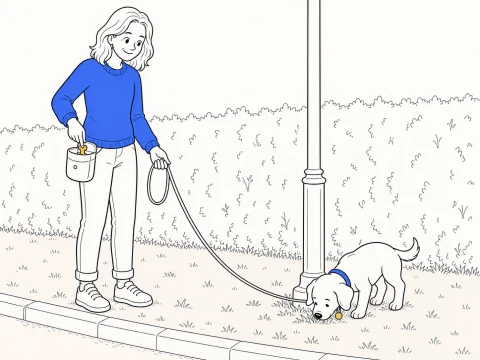
The rewards already sitting in your day: the ball thrown, the sniff at the interesting lamppost, the door opening, the leash going on, being released back to a game, thirty seconds of the specific scratching your dog leans into. AVSAB’s 2021 position statement on humane dog training endorses reward-based training generally rather than food specifically — the requirement is that the consequence is something your dog wants, not that it comes in a bag.
The catch is timing. A thrown ball is a fine reward and a terrible marker, because by the time it lands your dog has done four other things. This is exactly the gap a marker fills: mark the instant, then pay in whatever currency fits.
Will all these treats make my dog fat?
Only if they stack on top of the day’s food instead of coming out of it. WSAVA’s guidance on feeding treats is direct: “Treats should always make up less than 10% of a dog’s daily calorie intake,” and “Treats should never replace a meal — every dog needs a complete and balanced diet.”
The practical version: measure out the day’s food in the morning and train out of that bowl, so ordinary kibble does the ordinary work. Save the higher-value stuff — a scrap of chicken, a pea of cheese — for the genuinely hard places, and count that toward WSAVA’s 10%. Keep pieces pea-sized and soft, so there’s no crunching pause between reps. Training doesn’t need to be extra food. It needs the same food, handed over at better moments.
What if fading the treats made everything fall apart?
Then you thinned too fast, and the fix is boring and reliable: go back to paying every time for a few sessions, then raise one thing at a time.
The failure worth avoiding is the habit version — marking your dog and then not paying, over and over, because you’ve decided they should be past needing it. Karen Pryor, citing the research of Dr. Jesús Rosales-Ruiz, warns that people who make a habit of delaying the treat or sometimes forgetting it “may find that the clicker becomes less meaningful because the automatic conditioning has deteriorated.” She even names the tell: your dog doesn’t stop at the click any more, but “continues the behavior while watching your hand; hand movement has become conditioned instead.” If your dog has started reading your hands rather than your marker, that’s this. A deliberate variable schedule is not the same as quietly welching. Your dog can tell the difference; that’s the entire mechanism you’ve been using.
And if your dog stops taking food altogether in a particular situation, that’s rarely stubbornness — it’s usually a dog who is over threshold, full, or tired. Make it easier or train later.
When is treat refusal something to take seriously?
Turning down food your dog normally loves, in a place they normally cope with, is information rather than defiance — and it’s the point to stop training and start watching. The same goes for any stiffening, freezing, or growling around food, bowls, or chews.
None of that is something to work through with better treats. Our guide to what’s normal and when to get help covers where the line sits, and IAABC-certified consultants (iaabc.org) are a good place to start — their standards require members to refrain from using shock in training or behavior modification. There’s a welfare reason to route it that way rather than escalating pressure: in a study of 92 dog-owner pairs, Vieira de Castro and colleagues (PLOS ONE, 2020) found dogs trained with aversive methods showed more stress-related behavior and a larger rise in salivary cortisol than dogs trained with rewards — a quasi-experimental study of dogs with a mean age of 11.9 months, already enrolled in training schools, so it shows an association rather than proof of cause; but the direction is consistent with AVSAB’s position and with everything else on this page.
The habit that makes this stick
Get the food out of your hand and keep it in your pocket. Pay every time while things are steady, and expect to pay unpredictably only while you’re raising the bar. That’s the whole transition from bribing to training, and it’s roughly a week of slightly awkward sessions rather than a project.
The part that’s genuinely hard isn’t the mechanics. It’s knowing when your dog has actually earned the next raise, and noticing when you’ve thinned too fast — which is where most people either stall at step one for months or fade so quickly the whole thing collapses and they conclude the method doesn’t work.
That’s the judgment call ClickerPup is being built to make with you: two-minute sessions that track whether the last one was solid enough to raise the bar, and tell you plainly when to stay put. Your phone is the marker, so there’s one less object in your hands. The clicker stays free forever, with a plain reminder before anything ever charges.
Claim my early spot and we’ll bring you in as we open up.