Force-free dog training means teaching a dog without pain, fear, force, or intimidation. You reward what you want, and you change the setup so that everything else stops paying off. It works well for teaching skills. Its real weakness isn’t the method. It’s that no body regulates the term, and the four organizations an owner gets pointed to publish four separate standards that don’t all draw the line in the same place.
Which is why you can read that force-free is the only humane way to train and, two threads later, that it produces dogs with no boundaries, and both writers can honestly believe they’re describing the same thing. They aren’t. If you’ve sat with four tabs open trying to work out which one is lying to you, the answer is neither: they’re using one word for several different standards, and nobody made them stop.
What follows is the version with the definitions laid out, the evidence attached, and the disagreements left in, including the ones inside the force-free camp.
What does “force-free” actually mean?
It means an absolute limit on what may be done to the dog: no pain, no fear, no force, no intimidation, in training or in ordinary handling. It is a boundary on method, not a method in itself: not a technique, a curriculum, or a brand of leash.
The clearest published definition belongs to the Pet Professional Guild, the membership body that made the term its condition of entry. Its Guiding Principles open with a section titled “The Non-Negotiables”: “Pet Professional Guild members understand Force-Free to mean that: No shock, No prong, No choke and No Pain, No fear, No Force are ever employed in the training, behavior modification, care, or management of any pet.” The same document defines physical force as “any intentional physical act against a pet that causes psychological or physical pain, harm or damage to the pet.”
That shape matters. It tells you what a trainer will never do. It doesn’t tell you what they will do, and the gap between those two is where nearly all of the confusion about this term lives.
One more word does a great deal of work in every document below, so it’s worth pinning down now: an aversive. The glossary in the CCPDT’s November 2025 position statement defines it as “Any stimulus, including training equipment, behavioral intervention strategies, or environmental factors, the dog seeks to avoid or escape.” That definition is the thing almost every online argument misses: an aversive is defined by the dog’s reaction, not by the object. The same head halter is unremarkable on one dog and genuinely aversive to the next. So arguing about lists of hardware never settles anything, because the same object lands differently on different dogs.
Who actually decides what counts as force-free?
Nobody, in any binding sense. No US body regulates the term: there is no legally enforceable standard behind it, and the CCPDT, the body behind the CPDT-KA credential, describes its own role in its November 2025 position statement as “advisory rather than regulatory due to the lack of legally enforceable standards for the dog training industry.”
So the label travels a good deal further than any rulebook behind it. That is not your fault for finding it confusing — it is confusing. Here are the four organizations you are most likely to run into, and what each one has actually published:
| Organization | What it publishes | Where it lands on aversives |
|---|---|---|
| AVSAB (American Veterinary Society of Animal Behavior), 2021, reaffirmed 2025 | “AVSAB recommends that only reward-based training methods are used for all dog training, including the treatment of behavior problems” | Should not be used at all; aversive methods “should not be used under any circumstances” (2025 board statement). Never uses the words “force-free” |
| Pet Professional Guild | “No shock, No prong, No choke and No Pain, No fear, No Force” | An absolute bar, and a condition of membership |
| IAABC, Standards of Practice (2025 update) | “Positive reinforcement should be the primary training strategy because it promotes learning while minimizing unwanted side effects” | “strongly opposes the intentional use of aversive stimuli and requires members to refrain from using shock” |
| CCPDT (the body that awards the CPDT-KA credential), position statement approved 11/20/2025 | “endorses reinforcement-based training strategies as the primary method for modifying behavior” | Permits punishment-based strategies and certain equipment under documented, safety-justified conditions |
Look down the right-hand column. All four are reward-first; three of them rule aversives out entirely or very nearly. The fourth keeps a documented exception, and it’s the body behind CPDT-KA: a credential worth understanding properly before you read it as a guarantee.
Is force-free the same as positive reinforcement, or R+?
No, though they get used interchangeably. Positive reinforcement, often written “R+”, is one specific consequence: adding something the dog will work for, so the behavior happens more often. As with an aversive, it’s the dog who decides what qualifies. Force-free is an ethical limit on the entire toolbox. A trainer can use positive reinforcement most of the time and still not be force-free.
The difference shows up in what a trainer does on the days rewards aren’t enough. “I use positive reinforcement” describes a preferred tool. “I’m force-free” describes a line that doesn’t move, whatever the day is like.
What is LIMA, and is it the same as force-free?
LIMA stands for “Least Intrusive, Minimally Aversive,” and no — it’s a decision procedure where force-free is a boundary. It ranks interventions from least to most intrusive and asks a trainer to work down that list in order, which means the most intrusive options remain on the list, at the bottom, available. (The CCPDT notes that the three procedures bundled at step five are “not listed in any order of preference” — the ordering is between steps, not inside them.) Force-free deletes the bottom of the list rather than ranking it.
The Humane Hierarchy, step by step
The CCPDT’s LIMA policy described a LIMA trainer as one who “uses the least intrusive, minimally aversive strategy out of a set of humane and effective tactics likely to succeed in achieving a training or behavior change objective.” Attached to it is Susan Friedman’s Humane Hierarchy — six ranked steps a trainer works through in order:
- Health, nutritional, and physical factors — rule out pain and illness first
- Antecedents — change the setup, so the wrong thing is harder to do in the first place. In the policy’s words: “Redesign setting events, change motivations, and add or remove discriminative stimuli (cues) for the problem behavior”
- Positive reinforcement
- Differential reinforcement of alternative behavior — teach and pay something else instead: “Reinforce an acceptable replacement behavior and remove the maintaining reinforcer for the problem behavior”
- Negative punishment, negative reinforcement, or extinction — the middle one is defined as “Contingently withdraw an aversive antecedent stimulus to increase the probability that the right behavior will occur”
- Positive punishment — “Contingently deliver an aversive consequence to reduce the probability that the problem behavior will occur”
The bottom of that list is the entire argument, and it’s finer-grained than the shouting suggests. Step five bundles three different procedures, and force-free trainers use two of them: taking away a reward, and letting a behavior stop paying. (Even those two get argued about inside the strict end of the camp, since losing an expected reward is frustrating, and by the definition above only the dog decides whether that tips into aversive.) The third, negative reinforcement, works by switching off something the dog wants to escape, and step six delivers something unpleasant outright. Those two need an aversive by definition, which is exactly why LIMA keeps them on the list at the bottom and force-free removes them altogether. Everything from step one to step four — plus two of the three procedures at step five — both camps agree on. The two positions look identical right up until the moment something goes wrong.
What changed in 2025
Then, in 2025, both certifying bodies dropped the LIMA label, and moved in opposite directions.
The IAABC went stricter. Its Standards of Practice, updated that year, don’t mention LIMA at all. What they say instead is that “The IAABC strongly opposes the intentional use of aversive stimuli and requires members to refrain from using shock in training or behavior modification,” and that in February 2025 it folded its old shock-collar addendum into the main standards “to present a unified position on humane training.” Its standalone LIMA page no longer resolves.
The CCPDT went the other way. Its current standards index lists no LIMA policy either; what it lists is Susan Friedman’s Hierarchy promoted to a standalone standard in its own right, alongside a Standards of Practice and Code of Ethics, a Position Statement on Behavior Change Procedures, and a Prohibited Practices Policy. The latter two are both dated November 20, 2025, and between them they permit prong, electronic and slip collars under documented conditions (the specifics are in the trainer-vetting section below). So the CCPDT kept the ladder, dropped the label, and wrote down when the bottom rungs may be used.
Neither organization has published an explanation we could find on its own site, so treat the reasoning as unconfirmed. The standards themselves are the record. All of the above was checked against each organization’s own published documents on July 28, 2026. This is a corner of the field that moved twice in one year, so if you’re reading this much later, it’s worth checking whether it has moved again.
What’s the difference between force-free and “balanced” training?
A balanced trainer uses rewards and aversives deliberately, and treats the mix as the point. Force-free rules the second half out. That’s the real fault line in this industry, and you make the choice the moment you hire someone.
In practice, balanced training usually means food and praise for the behavior you want, plus a correction for the behavior you don’t: a leash correction, or a prong, slip, or electronic collar, depending on the trainer. The argument for it isn’t stupid, and the fairest version of it comes from the CCPDT, not from a marketing page: “in specific situations, studies have demonstrated that the use of negative reinforcement and positive punishment can contribute to improved outcomes related to safety and long-term welfare.”
Worth knowing exactly what that sentence is, though. It names no studies. We read the statement end to end, and it carries no reference list at all, so the strongest institutional case for the balanced position currently rests on an assertion a reader can’t follow up. Set against it, AVSAB’s 2021 statement makes the opposite claim and attaches twenty-one references — mostly observational studies, as the limits section below gets into, but they are there to be checked.
AVSAB’s statement also names the label directly, and reports what happened when researchers compared all three approaches on obedience: “Dogs trained with a combination of rewards and aversive-based methods (often referred to as ‘balanced’ in the dog training industry) produced lower obedience levels than reward-based but better than exclusively aversive-based training.” Both of those are AVSAB’s own words, summarizing a 2004 survey study by Hiby, Rooney and Bradshaw: in AVSAB’s account, “obedience levels were highest for dogs trained exclusively with reward-based methods.” (We have not read the Hiby paper itself, so it is not in the source list below — take it as AVSAB’s reading of it.)
Be precise about what that is: a survey, ranking three groups, with reward-only on top. It’s a strong signal about methods in aggregate. It is not proof that any particular balanced trainer gets worse results than any particular force-free one.
So what do force-free trainers do when the dog is wrong?
They change something, and the something is almost never aimed at the dog. Four moves, in rough order: make the wrong thing harder to rehearse, reward the alternative loudly, stop whatever was paying for the unwanted behavior, and end the repetition before it becomes practice. “Nothing happens” is not on the list, and the standards bodies say so in plain terms.
AVSAB answers this exact objection in its own FAQ: “Use of reward-based methods does not mean dogs are allowed to do anything they want. All animals learn best when given appropriate structure, routine, and guidelines. However, it is imperative that these boundaries be taught without the use of fear, intimidation, or pain.”
Here’s what those four moves look like on a kitchen floor:
- Change the setup first. This is step two of the hierarchy. Most owners skip it. The counter gets cleared, the stairs get a gate, the leash goes on before the door opens. A behavior your dog never gets to practice is a behavior you never have to untrain.
- Reinforce the alternative, hard. Four feet on the floor earns the greeting; jumping earns a turned back and nothing else. That’s differential reinforcement, and it’s the difference between “no” and “here’s what to do instead.” See how to stop a puppy jumping up for the full version.
- Take the payment away. The door stops opening while the leash is tight. The game ends the moment teeth land on skin, which is the whole mechanism behind stopping puppy biting without punishment. The consequence is real; it just lands on the payoff rather than on the dog.
- End the repetition and make the next one easier. A dog getting it wrong over and over is usually a dog being asked something too hard, in a room that is too interesting.
AVSAB puts the principle in one line: “Training methods are most effective when they focus on teaching the animal what to do, rather than punishing them for unwanted behaviors.” The CCPDT’s LIMA policy framed the same idea as a question a trainer should always be able to answer — “What do you want the animal TO do?” — and argued that punishment “offers no acceptable behavior for the animal to learn to replace the unwanted behavior.”
One warning belongs with move three, because it’s exactly where people quit. When the payoff for a behavior disappears, the behavior often gets louder before it fades. Trainers call this an extinction burst. The definition in Karen Pryor Clicker Training’s glossary is the one most owners will meet: “the animal will increase the intensity or frequency of the behavior in an attempt to earn the reinforcement again,” and the behavior “will eventually diminish but often not until after an extinction burst.” Note the “often” — bursts are common enough to plan for, not guaranteed, and how often they actually occur is still an open question in the research. But when it happens, a spell of things getting worse is the method working, and it is precisely the moment a correction starts to look reasonable.
That’s the honest version of “no corrections.” Consequences exist. They land on the environment and the payoff instead of on the animal.
And if you’re reading that list thinking I have tried all of this and my puppy still bites me — that isn’t a sign you picked the wrong method, and it isn’t a sign you’re bad at it. Most of these moves take a week or two of unglamorous repetition before they look like anything, which is a genuinely hard sell when you’re the only person in the house doing them.
What about an emergency — a dog heading for the road?
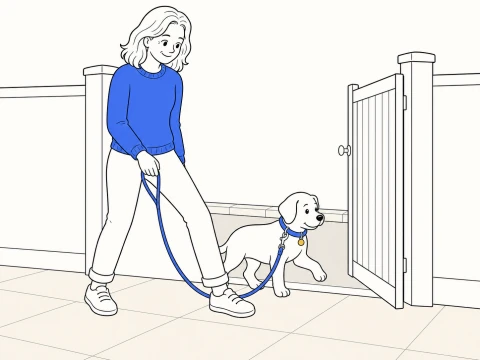
You physically stop them, and that breaks nothing. The force-free rules do reach management — the Pet Professional Guild’s non-negotiables cover “training, behavior modification, care, or management” — but what they bar is pain, fear and force, not the leash itself. A gate, a harness, a body between your dog and the curb, or picking them up are none of the prohibited things; PPG says explicitly that most leashes, harnesses and non-choking collars “would not be considered physical force.”
AVSAB puts management inside the method rather than outside it. Its 2021 statement says management “can include avoiding situations that lead to the unwanted behavior and ensuring the safety of all involved,” and that management strategies “have a vital role in dog training and should be considered in all training and behavior modification plans.”
The distinction that does the work here is between preventing and punishing. Grabbing the leash before your dog reaches the road stops an outcome rather than delivering a consequence, and no standard quoted on this page counts it as a correction. What force-free rules out is what some people do a second later: the jerk, the shock, the shout intended to make the road frightening. And because stopping an outcome isn’t the same as teaching an alternative, the actual training happens afterward, somewhere quiet, on a day when nothing is at stake: a recall built properly, one step of difficulty at a time.
Does force-free dog training actually work?
For teaching skills, yes, and the comparative evidence runs one way — though most of it is observational, which is a caveat worth carrying. AVSAB’s 2021 conclusion is the strongest single statement on the record: “There is no evidence that aversive methods are more effective than reward-based methods in any context.”
The sharpest individual study is on recall, which AVSAB names as the most common reason owners reach for a remote shock collar in the first place. China, Mills and Cooper allocated “a total of 63 dogs with known off-lead behavioral problems such as poor recall” to three groups of 21: one trained with electronic collars by manufacturer-nominated trainers, one by those same trainers using “a mix of food rewarded positive reinforcement and negative reinforcement such as lead pressure” instead, and one by professional trainers running a reward-focused program. The reward-focused dogs “had a higher proportion of obeys after first command to both ‘Come’ and ‘Sit’ commands” and started coming back sooner than the e-collar group. The authors’ conclusion: “we conclude that an E-collar is unnecessary for effective recall training” (Frontiers in Veterinary Science, 2020).
Two caveats belong with that, and neither is fatal. Flat refusal was rare and no different across the arms. In the authors’ words, “there was no significant difference in the proportion of command disobeyed between the three groups,” so the result is about how promptly dogs responded, not whether they did. And the reward-focused arm used different trainers from the other two, and was run in a later season, which tangles trainer skill and cohort up with method. What survives both caveats is the authors’ own verdict on the tool: for the job people buy an e-collar to do, they found it wasn’t needed.
Why it works is a separate question, and it’s covered properly in what clicker training is and why it works.
What are the honest limits of force-free training?
Four. The evidence is mostly observational rather than experimental; the professionals genuinely disagree, and the disagreement is live right now; plenty of reward-based trainers won’t use the word at all; and the method asks more of you than a correction does. None of those is the objection the internet actually argues about, and all four are things a trainer selling you the philosophy has a reason not to mention.
The evidence is mostly observational
AVSAB says this about its own supporting literature: “Survey studies cannot differentiate between causation and correlation.” Even the best-known welfare study is careful with itself. Vieira de Castro and colleagues followed 92 companion dogs across seven training schools in Porto, Portugal, average age 11.9 months, and found the aversive-trained group showed more stress-related behavior and a larger post-training rise in cortisol. Their own caveat: “because this was a quasi-experimental rather than an experimental study, we cannot infer a true causal relationship between training methods and dog welfare.” Their conclusion is correspondingly measured: “our study points to the fact that the welfare of companion dogs trained with aversive-based methods is at risk, especially if these are used in high proportions.”
The professionals disagree, and the disagreement is live
The CCPDT’s November 2025 statement says plainly that “opinions regarding the use of punishment-based training strategies and certain types of training equipment differ within the professional community” — and it leaves room for punishment-based strategies in documented safety cases. In the same year, AVSAB didn’t shift its position so much as restate it, pointedly: its 2025 board statement reaffirms the 2021 statement as “the most current and authoritative expression of our views,” says aversive methods “should not be used under any circumstances,” and disavows “an outdated and since-rescinded AVSAB document” that had been circulating and “suggesting that the use of aversive tools may be appropriate in certain situations” — “AVSAB does not support the use of aversives in any context, regardless of the tools used or the trainer’s level of experience.” Two respected bodies, one year, and a widening gap between them. We think AVSAB has the better of the argument, and everything on this site is built that way. You should still know the argument is happening, because the trainer you call may be standing on the other side of it.
Plenty of reward-based professionals won’t use the term
This is the disagreement inside the camp, and it’s visible in the documents themselves. Of the four organizations in the table above, only the Pet Professional Guild uses “force-free” at all — we searched the full text of each and the phrase appears nowhere in AVSAB’s 2021 statement, nowhere in its 2025 board statement, nowhere in the IAABC’s Standards of Practice, and nowhere in either of the CCPDT’s November 2025 documents. AVSAB, whose own bar is at least as absolute as PPG’s, writes “reward-based” throughout instead.
The objection behind that choice is a fair one: every trainer alive restrains a dog, closes a door, holds a leash, or ends a session the dog wanted to continue. A label promising no force at all claims more than any method can deliver, which is why a lot of R+ professionals consider it an over-claim and pick a plainer word. It doesn’t make PPG’s standard weaker. That standard is the strictest of the four, and it defines its terms. It does mean a trainer who avoids the phrase is not thereby admitting to anything.
It asks more of the human
The CCPDT concedes this from the opposite direction: “Adhering to the Hierarchy requires a high level of competency and education.” Setting a dog up to be right takes more planning, better timing, and more attention to what’s quietly reinforcing the behavior than telling a dog it was wrong does. That’s a genuine cost, and neither side’s marketing tends to mention it.
What about aggression, fear, or separation anxiety?
Those aren’t skill problems, and this page isn’t the place for them, but the standard doesn’t bend for them either, which is the part people assume. AVSAB is unusually blunt about it: “Animals with challenging behavior disorders such as aggression should be treated with effective, compassionate, and humane methods of training, rather than with ‘a heavy hand’. There are no exceptions to this standard.”
What it tells a stuck trainer to do is refer rather than escalate: consult another reward-based trainer, “or refer to a veterinarian, board-certified veterinary behaviorist, or certified applied animal behaviorist.”
If you’re not sure whether what you’re watching is ordinary puppy behavior or a red flag, our guide to what’s normal and when to get help draws the line. For a certified behavior consultant, the IAABC directory is the place to look — see the trainer-vetting section below for what its standard does and doesn’t promise.
How do you find a force-free dog trainer, and check they really are one?
Ask what happens when your dog gets it wrong, then check what their credential actually requires — because the letters don’t all mean the same thing. The credential check is the part that surprises people: a widely held American certification permits or leaves open three tools that the strictest standard bans by name.
Both of the strict bodies publish searchable directories, which is the quickest place to start: the Pet Professional Guild lists trainers who have signed its no-shock, no-prong, no-choke pledge as a condition of membership, and the IAABC lists certified behavior consultants whose standards require them to “refrain from using shock in training or behavior modification.” Neither listing is a guarantee about an individual, which is why the questions below still matter.
What does a CPDT-KA actually permit?
More than most owners assume, though it starts from a genuinely humane floor. CPDT-KA is a real credential from an NCCA-accredited body, and the CCPDT’s Prohibited Practices Policy (adopted 11/20/2025) forbids a long list outright: alpha rolls and pinning, “jerking or yanking a leash or collar,” ear pinches, flooding, food or water deprivation, helicoptering, restricted airflow, physical punishment, and “interpreting or communicating dog behavior through the lens of debunked dominance hierarchies or alpha theory.”
For four tools, though, the policy sets conditions instead of a ban, and that’s where the two standards come apart:
| Tool | CCPDT (Prohibited Practices Policy, 11/20/2025) | Pet Professional Guild |
|---|---|---|
| Prong collar | Conditioned: “prohibited for dogs under six months of age or as a primary tool for teaching new behaviors” | Banned — “No prong” |
| Electronic collar | Conditioned: “prohibited for dogs under one (1) year of age”; “not permitted for dogs of any age to teach foundational skills”; certificants “must avoid using electronic training collars in any training situation that does not pose safety risks” | Banned — “No shock” |
| Slip collar (a choke collar) | Not prohibited as a tool; what is prohibited is “Applying forceful or abrupt pressure, such as yanking, jerking, or sharply pulling the leash” | Banned — “No choke” |
| Head collar | Not prohibited as a tool; same forceful-pressure rule applies | Not ruled out — “many (or even most)” head halters “would not be considered physical force” if used per its principles and “as intended and designed” |
Three of those four are things one standard permits or leaves open and the other bans by name, with no age threshold and no exception. So two trainers can advertise the same word and be promising you different things.
And to close the loop with the definition at the top of this page: hardware lists don’t decide whether a dog finds something aversive. Only the dog does that. They matter here because a written standard has to commit to something checkable, and a list of objects is the only thing anyone can enforce.
What three questions should you ask before you book?
- “What will you do the first time my dog gets it wrong?” You want an answer that names the setup, the replacement behavior, and the payoff being removed. A trainer who answers with a piece of equipment has answered a different question.
- “Is there anything you won’t use?” Force-free has a short, specific answer to this. Vagueness here is the answer.
- “What happens if this doesn’t work?” AVSAB tells stuck trainers to refer rather than escalate. A trainer who has already thought about their own ceiling will name the referral, not the next tool.
AVSAB’s guidance to veterinarians making referrals names a straightforward red flag, and it works just as well as a hiring filter: “If a trainer is observed using aversive training methods or if a trainer discusses out-dated ideas such as ‘dominance’, ‘leader of the pack’, or ‘alpha’ theories, then clients should be advised against hiring them.” The same passage points toward trainers connected to the Pet Professional Guild, the IAABC, the Karen Pryor Academy, Jean Donaldson’s Academy for Dog Trainers, Victoria Stilwell’s Academy, and Fear Free certification.
One correction to that, recent enough that most pages quoting the 2021 list haven’t caught up. In a 2025 board statement AVSAB says it “has not issued any statements endorsing or opposing the use of trainers from any specific organization,” and that its goal is “not to certify or promote individual trainers or credentialing bodies.” So read the 2021 list as a description of the kind of education worth looking for, not as a seal of approval on any of those names. The organizations themselves are careful about that distinction, even where the marketing around them isn’t.
Can you train this way on your own?
For the everyday skills that fill the first few months, yes, and that’s most of what a new owner actually needs. Force-free leans on something a correction doesn’t: your dog being able to tell exactly which half-second earned the reward. That’s what a marker is for, and it explains why marker training and the force-free standard tend to travel together.
If you want one thing to do with all of this, it’s small enough to finish in two minutes:
- Pick your marker — a clicker, or just the word “yes,” said the same way every time.
- Pay it a handful of times before you ask for anything. Marker, then treat, then test with one marker and still hands — if your puppy looks for the treat, it’s landed. That’s the whole session.
- Then raise exactly one thing — a new room, a longer wait, a bit more distraction. One. Not three.
From there, the first full session is written out step by step, and how the treats eventually come out of your hand is the piece most people miss. None of that needs a subscription, a certification, or a trainer in your living room — the method is free and always has been. What it does need is someone deciding, session by session, whether your dog earned the next step up.
Force-free is a standard rather than a feature list, and standards are easy to state and awkward to keep in the ninth minute of a session that isn’t going well. That’s the part ClickerPup is being built around, including the one thing that follows directly from this page: an AI coach that declines aversive-tool questions instead of answering them, because a method with a line in it should still have that line on the days nothing is working. Your phone is the marker, the clicker is free forever, and there’s a plain reminder before anything ever charges. The rest of how it works is written out in full, bar by bar.
Claim my early spot and we’ll bring you in as we open up.