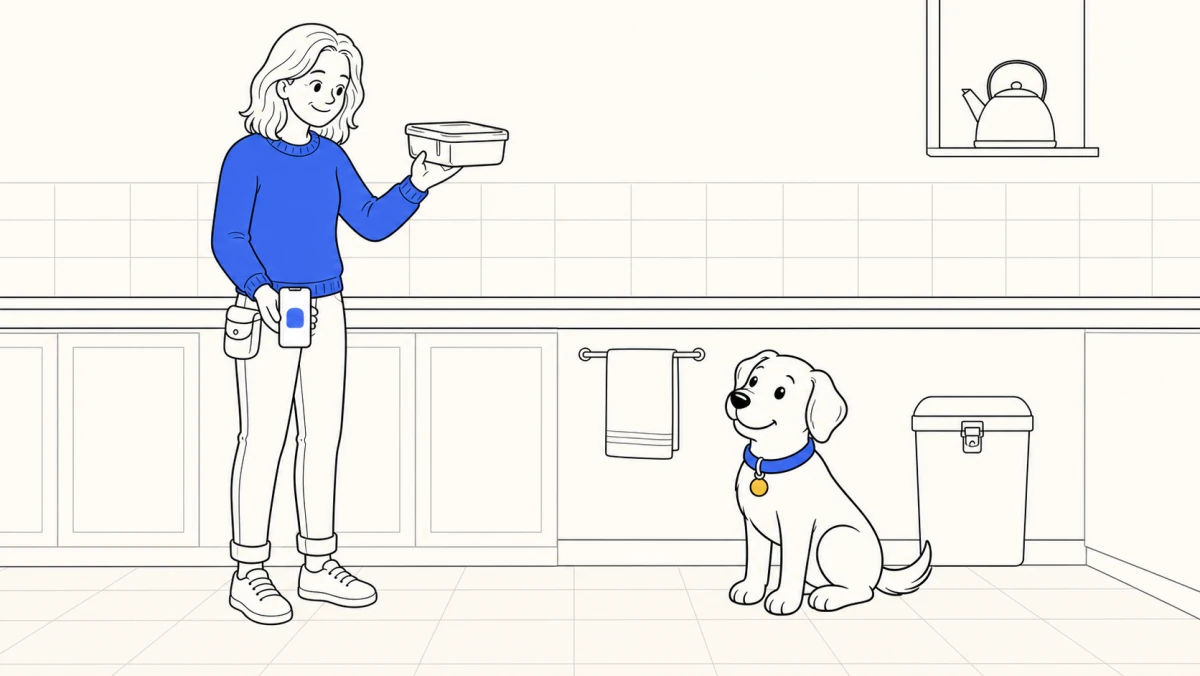
Stop a dog counter-surfing by clearing the counters first and training second. The reward here isn’t your attention — it’s the food, and the counter hands it over instantly. So every successful theft makes the habit stronger, and no amount of training outruns a countertop that still pays. Manage the access, then teach leave-it and somewhere better to be.
That order is the whole article, and it’s the part most advice gets backwards. If you’re here because a sandwich vanished, or because your dog has started doing the casual kitchen loop with their nose at counter height, you’re not dealing with a defiant dog. You’re dealing with a dog who found a slot machine that pays out.
Why does my dog counter surf?
Because it worked at least once. Counter-surfing is self-reinforcing: the reward isn’t your attention, it’s the food, delivered instantly by the counter itself. Best Friends Animal Society puts it plainly — “Dogs are optimists and opportunists, so even if your dog has only found food on the counter once or twice, they will keep on jumping up to look for it.”
That single fact reorders everything else. Most puppy problems are powered by you — jumping up on people works because it gets your face closer, so removing your attention removes the payoff. Counter-surfing doesn’t need you at all. The AKC’s Stephanie Gibeault, MSc, CPDT, names the mechanism in one phrase: once a dog discovers a “self-rewarding” act, “they’ll continue to do it.” Which means the stolen sandwich is a better trainer than you are — perfect timing, every single rep, no missed clicks. You can’t out-reward it. You can only stop it paying out.
Why does my dog keep checking a counter that’s always empty?
Because the searching is rewarding in itself, not just the finding. This is the part that surprises owners who’ve done everything right for a week and still catch their dog doing the hopeful lap.
Victoria Stilwell Positively describes foraging itself as the reinforcer: “Dogs are foragers and finding food is a self-reinforcing behavior because not only does eating the food feel really good, the very act of seeking it out strengthens the dog’s desire to find their next tasty meal.” So the searching is its own habit, running slightly ahead of the payoff.
The practical consequence is a change in what you measure. Judge your progress by whether the counter has paid out, not by whether your dog has stopped looking — the looking outlasts the clearing, and a hopeful lap around an empty kitchen in week two is not a failed plan. We’re deliberately not giving you a number of days here, because none of the sources give one; the AKC only goes as far as “many dogs improve significantly within weeks when management and training are combined.” What you can control is the run itself, and Positively is blunt about protecting it: “Do not leave your dog in the kitchen unsupervised.”
Is counter surfing normal, and is my dog too small to do it?
It’s normal, and size is less of a defense than owners expect. The AKC’s answer to the first question is one word: “Yes. Dogs are opportunistic scavengers by nature, but that doesn’t mean the behavior can’t be changed.”
On size, the AKC describes three different ways dogs get up there: larger dogs “may place their snouts or front paws on the counter for a forbidden snack,” and “Some small-breed dogs can even jump from the floor straight onto the countertop!” So “she can’t reach” is worth testing rather than assuming, and it’s worth re-testing as a puppy grows — the reach changes months before the habit does. One honest gap while we’re here: we could not find a reliable figure for how many dogs counter surf. Plenty of sources call it common; none of them appear to be counting, so we’re not going to hand you a percentage that isn’t real.
Why does clearing the counters matter more than the training?
Because management is the load-bearing half here — it’s what removes the reward, and nothing else does. Left in reach, food keeps paying; taken out of reach, the behavior stops earning and starts fading. Best Friends states the objective directly: “arrange your environment (the kitchen and countertops) so that the dog does not have the opportunity for reinforcement (finding food).”
This is not the boring bit you skip on the way to the real training. The American Veterinary Society of Animal Behavior’s 2021 position statement puts management on the same footing as teaching: “Management strategies, including antecedent arrangement, have a vital role in dog training and should be considered in all training and behavior modification plans,” and it says outright that common training issues “can be managed by arranging the environment appropriately and reinforcing desirable responses.”
What does managing the counters actually look like?
Six moves, most of them things you do once and then keep doing. Five of these come straight from Best Friends or the AKC; the last one is our own extension of the same rule, and it’s labeled as such:
| Move | Why it matters |
|---|---|
| Nothing left on the counter, ever — including “just for a minute” | One win reinstates the habit. “Never keep food on your counters. If your dog doesn’t find any food, they’re not getting rewarded for counter surfing.” (Best Friends) |
| Wipe the countertops down after cooking | “Licking something tasty on a counter can be just as rewarding as finding a piece of food to snack on.” (Best Friends) |
| Food into airtight containers and cabinets, not left out | AKC’s storage rule — the counter stops being a food location at all |
| Keep food back from the counter edge while you cook | AKC’s advice while cooking is to “avoid putting food near the edge of the counter” |
| A baby gate, a closed door, or a crate during meal prep | Best Friends: cooking spreads food across the counters, which is exactly when a dog can “snag a morsel when you’re not looking” |
| A latched trash can — and not “up on the counter” either | Our extension, not from either source: the trash is the same reward on a different surface, and moving it onto a countertop is a fix for a dog who can’t reach, not for one who counter surfs |
If your layout won’t let you clear everything — an open-plan island, a trash can living behind a sink door a determined nose can open — the answer is a door or a gate, not more vigilance. Positively is direct about the limit of watching: “Do not leave your dog in the kitchen unsupervised.”
The AKC adds the timing argument for doing this now rather than later: “The more they practice the habit, the harder it will be to break.” Positively puts the same point in reinforcement terms: “Each time he is successful is another opportunity for reinforcement and makes counter surfing harder to stop.”
What if my dog hasn’t started counter surfing yet?
Then you’re in the easiest position there is, and the job is simply to keep it that way. The AKC is direct about it: “The best way to stop counter-surfing is to prevent it from happening in the first place. If your dog never finds food on the counter, they’ll never think of it as a source of food and won’t bother looking there.”
The catch is how little it takes to start the habit — “even small amounts of forgotten food can cause your dog to develop a bad habit,” which is why the AKC calls vigilance essential with puppies and adolescent dogs. A dog who has never once been paid by a countertop has nothing to un-learn, which is a far shorter job than the one below.
What should you actually train your dog to do?
Two things, and they’re both small: leave it, the brake that works before your dog takes something, and a paid station — a mat or bed that earns rewards while you cook, which trainers call a settle or a “place.” Neither one is a rule about counters — they’re behaviors your dog gets paid for, which is the only kind that holds up when you’re distracted.
How do you teach leave it for counter surfing?
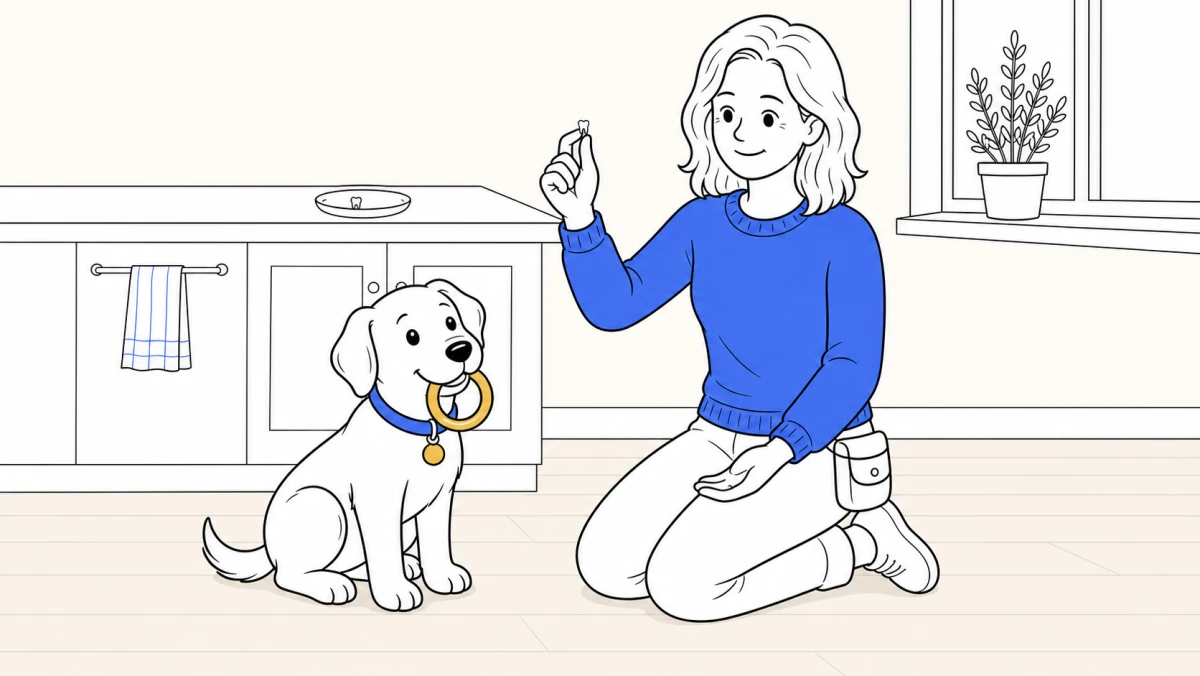
Start with a closed fist, and pay from the other hand. Hold a plain treat in a closed fist near your dog’s nose and wait. The instant they stop nosing at it and pull back, mark it — a click, or a crisp “yes” — and then pay from your other hand, never the fist they just left. Pay from the thing they left and you’ve taught the exact opposite lesson: that holding out gets you the item.
Best Friends teaches the same closed-fist step and the same non-negotiable — mark when your dog is done sniffing, then “offer your dog the treat from the other hand” — and at their next stage, a treat tossed on the floor, they add the value rule: pay with “a treat that they like even more than the one on the floor.” One deliberate difference worth naming: Best Friends says “leave it” from the first rep, while the ClickerPup curriculum holds the words back until the dog already understands the choice, so the cue never gets attached to a guess. Either way, leave it is a choice your dog gets paid for making. It is never a telling-off, and the moment it becomes one it stops working.
The full progression, the failure modes, and how leave-it pairs with its sibling live in how to teach a dog to leave it, and the post-grab version — trading for something better instead of chasing your dog around the kitchen island — is how to teach a dog to drop it. The AKC names both as the pair that matters here, precisely because of what ends up on counters. If the marker itself is new to you, what clicker training is and whether it works covers what the click is doing.
What should your dog do instead while you cook?
Give the kitchen a paid job. Put a mat or bed down at the edge of the room and make it the place where good things happen while food is out — so your dog has somewhere to be rather than only a thing not to do.
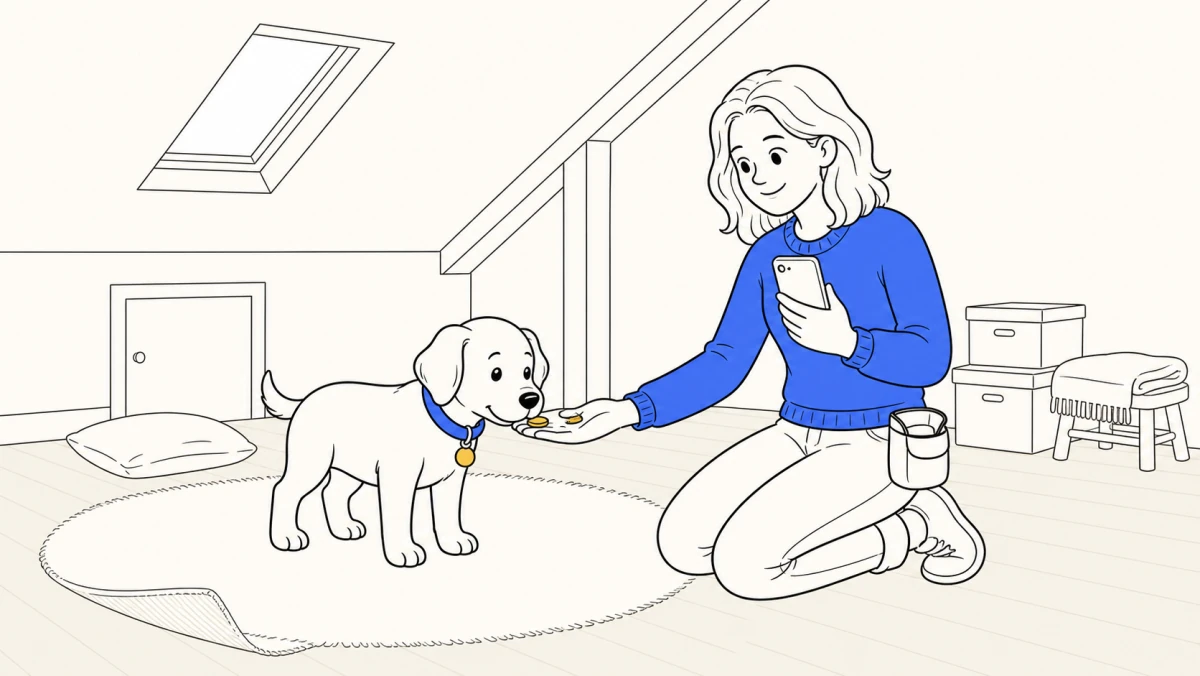
Start by marking any interest in the mat and delivering the treat on it. Shape toward lying down, then toward a genuinely soft body — the sigh, the hip rolling to one side — not a tense sphinx watching your hands. Then build duration, then distance, then distraction, in that order. The AKC teaches the same “place” progression and adds the part that keeps it alive: “remember to toss a few treats on the bed while you cook to thank your dog for their good behavior.” Best Friends recommends the same bed-or-special-place cue for exactly this moment. The step-by-step version, including what a real settle looks like versus a forced down, is in how to teach a puppy to settle.
How do you know the station is actually working?
By three criteria you can watch for, in order — not by how it feels. First, your dog chooses to lie on the mat four times out of five. Then they hold it for 20–30 seconds with the treats spaced further apart, including while you take one step away and come back. Then they hold it in a busier room.
The ClickerPup curriculum reads each of those as four-out-of-five across two separate sessions before you raise anything, and that’s the difference between a station that survives a real cooking session and one that only works when nothing is happening. Pay generously at the start — early on, the mat has to out-earn the counter — then stretch the gaps between treats as the calm holds, which is exactly the criterion above. Two minutes is a session, and short-and-frequent beats one long drill; how long puppy training sessions should be has the evidence on why.
What do I do when my dog is already up at the counter?
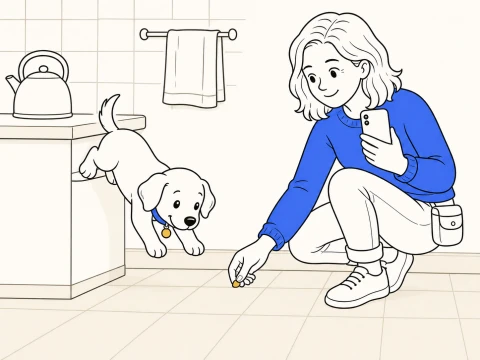
Lure them off and pay them for landing. Don’t shout, and don’t grab. Best Friends teaches “off” as a rewarded exit: put a treat in front of your dog’s nose, use it to guide them down to the floor while you say “off,” and the moment “their feet hit the ground,” mark it and pay. After three or four reps, say “off” first and let them do it without the lure. If they don’t move on the word, go back to luring for a few more reps rather than saying it again louder — Best Friends notes that “some dogs learn the cue quickly while others take a little more time.”
Two honest caveats. It can feel like you’re rewarding the jump — you’re not; you’re paying the landing, the same logic as rewarding four paws on the floor rather than reacting to the leap. And if the food is already in their mouth, “off” is the wrong tool: that’s a trade for something better, or it’s letting it go, and it is never a hand in the mouth. And if there’s any stiffening, freezing, or growling over the item, don’t trade either — that’s the resource-guarding case further down this page, and it needs a professional rather than a technique. “Off” handles the moment. The clear counter handles the habit.
Do deterrents, shaker cans, or booby traps stop counter surfing?
They’re the wrong tool, and AVSAB names several of them directly as things to avoid — “squirt bottles, shaker noise cans, compressed air cans, shouting, staring.” A startle can suppress the jump while the trap is set, but it never removes the reward, so the habit survives and waits.
Mats sold to keep dogs off counters are worth a line of their own, because they’re what people reach for when they want the counter to do the correcting for them. They come in more than one kind, and AVSAB’s avoid-list covers the range: the intimidation tools quoted above, and separately “training tools that involve pain (choke chains, prong collars, or electronic shock collars).” If you have to check the product page to work out which half of that sentence your mat falls under, you already have your answer. The word AVSAB uses for both categories is avoid — not “use sparingly.”
What’s the actual harm in punishing a dog for counter surfing?
Two kinds of harm: documented welfare fallout, and a behavior that goes underground instead of away. The fallout is documented rather than theoretical. AVSAB’s 2021 statement lists the consequences of aversive methods as “increased anxiety and fear-related aggression, avoidance, and learned helplessness,” and notes that animals so trained “may be less motivated to engage in training and less likely to interact with human members of the household.” Its recommendation is unambiguous: “only reward-based training methods are used for all dog training, including the treatment of behavior problems.” The same statement cites Hiby et al. (2004), which found obedience highest in dogs trained exclusively with reward-based methods and lowest in dogs trained exclusively with aversive ones.
The AKC’s own FAQ answers the punishment question in one word: “No. Punishment can increase anxiety or lead to sneaky behavior. Prevention and training are more effective.” On a behavior the food is already paying for, a telling-off doesn’t remove the payoff — it just adds a reason to wait until you’ve left the room. Which is exactly what tends to happen next.
Why does my dog only counter surf when I’m not in the room?
Because that’s what the pattern taught them. If the counter pays when you’re absent and costs when you’re present, your dog learns a rule about you, not a rule about counters. That’s discrimination — a completely ordinary learning outcome, and a sign the plan is leaning on your presence instead of on the environment.
Best Friends flags the same ceiling on the training half: “Obviously, these strategies only work when you are there to give the cue.” A cue you have to be present to give is not a solution to a behavior that mostly happens when you’re not there. Management is.
Does the guilty look mean my dog knows they did wrong?
No — the best available evidence says that face is a response to you, not a confession. Which matters here, because “he knows it’s wrong, he only does it when I’m out” is the single most common reason owners escalate to punishment instead of clearing the counter.
Alexandra Horowitz’s 2009 study in Behavioural Processes videotaped 14 dogs across trials that varied both whether the dog ate a forbidden treat and whether the owner had been told they did. There was no significant effect of the dog’s actual obedience on “guilty look” behaviors — but scolding produced them reliably (a mean of 2.4 such behaviors in scold trials against 0.6 in greet trials). Her conclusion: “the so-called guilty look is a response to owner scolding; it is not expressed more often when actually guilty.” It’s one small study, not the last word on dog cognition, but it’s a useful correction: the look you’re reading as remorse is a response to you, so it can’t tell you what your dog did, and it isn’t evidence that a telling-off landed.
Is counter surfing actually dangerous?
Yes, and this is the reason to fix it rather than live with it. The things that end up on a countertop include foods that are genuinely toxic to dogs, plus cooked bones, wrappers, skewers, and hot pans. The AKC makes the point directly: “Dogs who regularly steal food from the counter are at greater risk of consuming something that could harm them.”
Chocolate, xylitol (birch sugar), grapes and raisins, and onions and garlic are the short list worth knowing, and puppy-proofing your home has the ranked poison-control data, the xylitol detail, and the emergency number to save before you need it. If your dog has already eaten something dangerous, that’s a phone call to your vet or to the ASPCA Animal Poison Control Center at (888) 426-4435 — right away, without waiting for symptoms. (The ASPCA notes a consultation fee may apply; for a real poisoning it’s the right call regardless.) It is not a training moment, and nothing on this page applies until they’re safe.
When is it not counter-surfing?
When there’s tension around the food rather than just interest in it. A dog who stiffens, freezes, hovers over a stolen item, growls, or snaps when you approach isn’t failing leave-it — that’s resource guarding, and it’s a different problem with a different plan.
Don’t work through that one from an article, and don’t reach into a dog’s mouth to take food back — that’s how a guarding problem gets a bite attached to it. In the moment, back off and give the dog space rather than escalating a confrontation over the item; then get a professional involved rather than running more reps. (If what they’ve taken is toxic, that’s still a call to your vet, not a physical retrieval — say what happened and let them tell you what to do.) A consultant certified by the International Association of Animal Behavior Consultants (IAABC — iaabc.org) is a solid place to start, and what’s normal and when to get help has the fuller picture of which puppy chaos is ordinary and which isn’t.
How long does it take to stop counter surfing?
The AKC’s honest answer: “It depends on how long the habit has been practiced and how consistent you are. Many dogs improve significantly within weeks when management and training are combined.” A dog who has stolen food fifty times has a stronger habit than one who managed it twice, and the clock effectively restarts with each new success.
So the thing to protect isn’t your training streak — it’s the run of days where nothing on the counter pays. The AKC is blunt about the household side of that: “Any mistakes or forgotten food will set you back in your training program,” and everyone who cooks in your kitchen has to be running the same rule. One person who leaves the leftovers out is keeping the habit alive for everybody.
The honest shape of this fix
Counter-surfing is one of the few dog problems where the environment does more of the work than the training does — and saying so plainly is more useful than pretending a cue can beat a sandwich. Clear the counters. Then teach the two small skills: a leave-it your dog is rewarded for choosing, and a station that pays while you cook.
Those two — leave-it and the settle — are exactly what ClickerPup is being built to coach, along with drop-it for the times the food gets taken anyway. Planned into two-minute sessions, and adapted to how the last one actually went. It won’t clear your countertops for you; that part stays yours. The clicker stays free forever, with a plain reminder before anything ever charges.
Claim my early spot and we’ll bring you in as we open up.