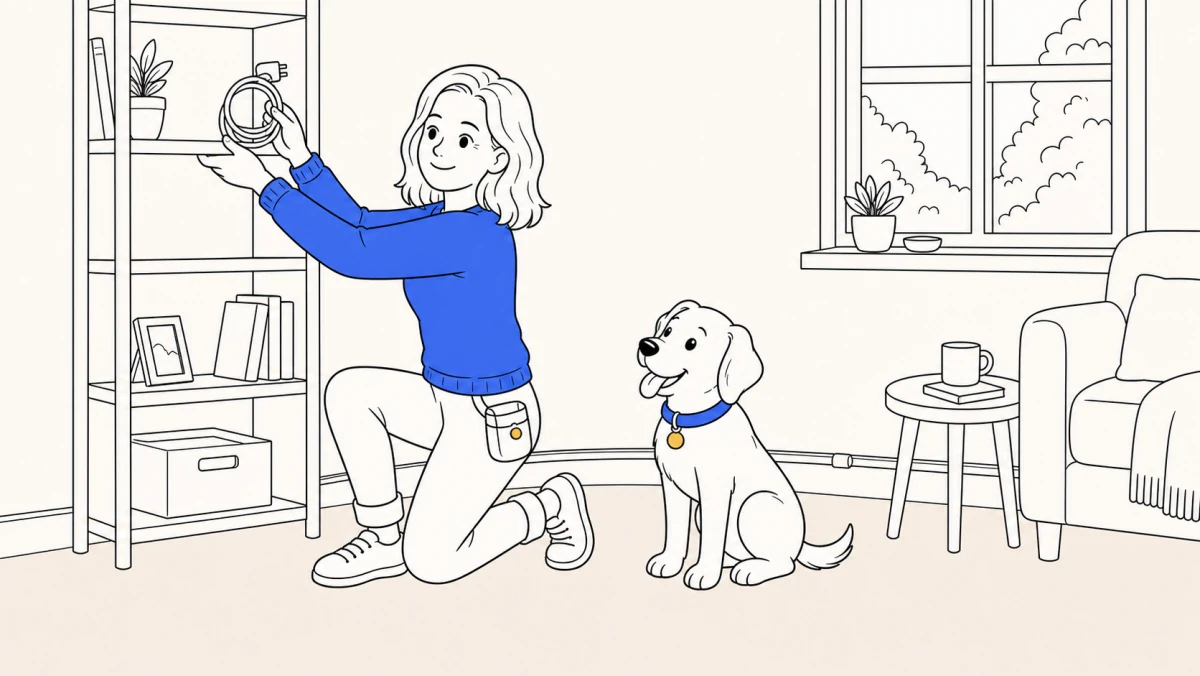
Puppy-proofing your home comes down to getting three things out of reach in every room — anything toxic, anything small enough to swallow, and any electrical cord — and then giving the chewing somewhere legal to go. Start with the medicine cabinet and the kitchen counter, not the houseplants; the poison data says that’s where the real risk sits. And know from the start that proofing only buys you time. The thing that actually keeps an adult dog safe is teaching them to leave stuff alone, which is a separate job.
If you searched this with a tiny land shark already working through your baseboards, you’re in the right place, and nothing is wrong with your puppy. A whole community thread on r/puppy101 is literally titled “How did you protect your home from the destructive havoc.” That’s the normal opening chapter, not a sign you adopted the wrong dog. It’s one line on your bigger first-week checklist. Here’s the room-by-room checklist, the hazards that actually send puppies to the vet, and the part most guides skip: where proofing stops and training has to take over.
How do you puppy-proof your home, room by room?
Go through each room at your puppy’s eye level and remove or block three things: anything poisonous, anything small enough to swallow, and any cord they can reach. The fastest way to see what they see is to get down on the floor: hazards that are invisible from standing height are obvious from six inches up.
Work through the house in the order a puppy actually explores it:
| Room | Get out of reach first |
|---|---|
| Kitchen | Trash behind a latched door or up on a counter; human food off low surfaces; cleaning products in a high or latched cabinet; plastic grocery bags away (a suffocation and swallowing risk) |
| Bathroom | All medications shut away, not on a low shelf; toilet lid down; cotton balls, floss, and razors in a closed drawer |
| Living areas | Electrical and charger cords bundled into concealers or run behind furniture; blind and curtain cords tied up out of reach (a strangulation risk); small objects — coins, hair ties, jewelry, batteries, kids’ toys — off the floor |
| Bedrooms | Socks, underwear, and shoelaces off the floor; purses and backpacks (they hold gum, meds, and snacks) up high |
| Garage & yard | Antifreeze, fertilizer, pesticides, and rodent bait sealed away or gone; toxic plants removed; a secure fence, and a fence around any pool |
The American Kennel Club’s own room-by-room advice lands on the same short list: conceal or remove cords, put every medication away, secure the trash, close the toilet lid, latch the cleaning cabinet, and clear small choking hazards like coins, paper clips, rubber bands, and jewelry. Do a lap of each room this way before pickup if you can, and expect to do it again in a week when your puppy finds the one thing you missed.
What household items are most dangerous to puppies?
Medications, not chocolate. The single most useful fact for prioritizing your proofing is that the things most likely to poison a dog live in the bathroom cabinet and on the kitchen counter, not in the places puppy guides usually point.
The ASPCA Animal Poison Control Center handled more than 451,000 toxic-exposure calls in 2024, and published how they broke down. The ranking is worth reading before you decide what to lock away first:
| Rank | Category (2024) | Share of exposures |
|---|---|---|
| 1 | Over-the-counter medications (ibuprofen, acetaminophen, cold/flu, supplements) | 16.5% |
| 2 | Human food and drinks (protein bars, xylitol gum, grapes, raisins, onions, garlic) | 16.1% |
| 3 | Human prescription medications (heart, antidepressant, ADHD) | — |
| 4 | Chocolate | 13.6% |
| 5 | Veterinary products | 8.6% |
| 6 | Plants and fungi | 8.1% |
Read the top of that list twice. The two biggest categories are the medicine cabinet and human food, and prescription drugs rank above chocolate. Chocolate is real and worth locking away, but a dropped ibuprofen or a chewed pill bottle is statistically the bigger threat. That one reordering, meds and food before candy and plants, is the highest-value move in this whole checklist.
What foods and plants are poisonous to puppies?
The short list of foods to keep well out of reach is chocolate, xylitol, grapes and raisins, and onions and garlic; the plant that most deserves your attention is the sago palm. These are the ones with the clearest evidence and the worst outcomes, so they’re where to focus rather than trying to memorize every item on a long chart.
Xylitol is the one that catches careful owners out, because it hides in “healthy” foods. The FDA warns that xylitol, a sugar substitute, triggers “a potent release of insulin” in dogs, causing a rapid drop in blood sugar that “can occur within 10 to 60 minutes of eating the xylitol” and, untreated, “can quickly be life-threatening.” It’s in sugar-free gum and candy, and (the part that matters most) in some peanut butters and nut butters. Peanut butter is exactly what many owners smear inside a chew toy, so check the label for xylitol before you fill your puppy’s Kong. Chocolate (from the theobromine in it), grapes and raisins, and onions and garlic round out the foods the ASPCA names most often among human-food poisonings.
Among plants, the sago palm is the standout danger. The ASPCA lists it as toxic to dogs, with a toxic agent called cycasin, and clinical signs that run from vomiting to “liver damage, liver failure, death.” It’s a common ornamental and patio plant, so it’s genuinely worth checking whether you have one. If you want to audit your own houseplants and yard properly, the ASPCA keeps a free, searchable toxic-and-non-toxic plant list, a better use of ten minutes than trying to eyeball it.
Why does my puppy chew and swallow everything?
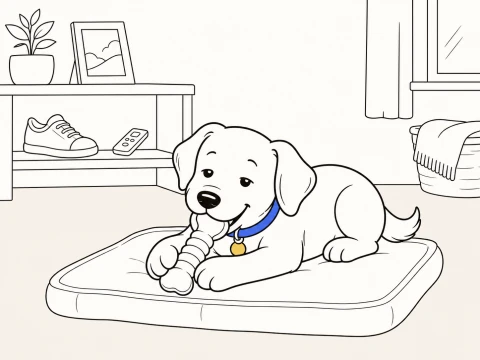
Because that’s how puppies investigate the world, with their mouths, and because they’re teething. Preventive Vet puts it plainly: “Puppies explore the world with their mouths, making small objects a target and a potential choking hazard.” This isn’t defiance or a training failure; it’s a developmental stage, and it comes with two distinct risks worth separating.
The first is poisoning, which the section above covers. The second is a physical one: puppies swallow things that don’t pass. Socks, string, coins, hair ties, and batteries are the classic culprits, and Preventive Vet singles out batteries in particular among household items to keep away from a curious mouth. A swallowed object that lodges in the gut can become a surgical emergency, which is why the “small enough to swallow” test matters as much as the “toxic” test when you’re scanning a room. The chewing itself is normal and will ease: puppies generally finish teething around six months, as their adult teeth come in. It’s a season, not a permanent state.
Because chewing is a need rather than a bad habit, the fix is to redirect it instead of punishing it. Give your puppy an always-available supply of legal chew outlets (appropriate chew toys they’re actually allowed to destroy) so the drive has somewhere to go, and manage what they can reach so the wrong choices simply aren’t on the menu yet. This is also where a system like ClickerPup fits: not by “proofing” anything for you, but by coaching the impulse-control skills that make your management hold up over time.
How long do you have to puppy-proof for?
There’s no fixed birthday where you can stop. The intense teething chewing usually eases around six months as the adult teeth finish coming in, but curiosity and chewing carry on well past that, and plenty of dogs are still enthusiastic chewers past their first birthday. What changes isn’t the calendar; it’s how much your dog can be trusted.
So you loosen your management as your dog earns it, rather than on a fixed date. Give a puppy the run of a room only after they’ve shown, repeatedly, that they’ll leave the interesting-but-forbidden stuff alone in that room. A six-month-old with a rock-solid leave-it needs far less proofing than a wild ten-week-old, and a distracted, over-tired puppy of any age needs more. Judge the dog in front of you, not the number of months. Which raises the question most proofing guides quietly skip.
Can you puppy-proof your way to a safe dog?
No. Proofing is environmental management: you’re controlling the puppy’s access to hazards, which keeps them safe today. But management on its own teaches your dog nothing. A puppy who has only ever been blocked from the sock drawer hasn’t learned that socks are off-limits; they’ve learned that the drawer is sometimes shut. The moment you slip — a door left open, a bag set down — the sock is gone.
That’s why the durable safety layer isn’t a better set of latches; it’s teaching the dog to leave things alone even when you’re not managing the situation. Two clicker skills do the real work here. Leave-it is the pre-grab brake, teaching your puppy to turn away from something before they pick it up (how to teach a puppy to leave it). Drop-it is the post-grab trade, teaching them to spit out what they’ve already grabbed, in exchange for something better, instead of a game of chase (how to teach a puppy to drop it). Together they’re what turn “I have to watch this puppy every second” into “this dog leaves the dropped pill alone on its own.” The ClickerPup training curriculum moves leave-it early for exactly this reason, because impulse control is what the chewing, scavenging, and counter-surfing all lean on.
None of that means punishing the mistakes while you teach. The American Veterinary Society of Animal Behavior’s position is that “only reward-based training methods” should be used, and that there’s no evidence aversive methods work better (AVSAB, 2021). Punishing a puppy for chewing or grabbing teaches them to do it where you can’t see, which is the opposite of safe. Manage the environment so mistakes are rare, and reward the choices you want so they stick. If it helps to see how the marker training underneath leave-it and drop-it actually works, what clicker training is and whether it works covers the method.
What should you do if your puppy eats something dangerous?
Call your vet or the ASPCA Animal Poison Control Center at (888) 426-4435 right away, and don’t wait for symptoms to appear. With a fast-acting toxin like xylitol, dangerous effects can begin within 10 to 60 minutes, so early action beats watching to see whether your puppy seems unwell. It helps to have that number saved in your phone before you ever need it, alongside your vet’s after-hours line. (The APCC is a paid consultation service, but for a genuine poisoning it’s money well spent.)
Most puppy chewing and mouthing is normal development, but a few patterns are worth a professional’s eyes rather than more proofing. Compulsive eating of non-food objects like rocks, dirt, or fabric (pica) can have a medical cause and deserves a vet visit. And a puppy who stiffens, freezes, or growls when you approach something they’ve grabbed isn’t “failing leave-it”; that’s resource-guarding, and it’s a job for a certified behavior professional, such as a consultant certified by the International Association of Animal Behavior Consultants (IAABC, iaabc.org), not for harder corrections. For the fuller breakdown of what’s ordinary puppy chaos and what deserves a call, see is my puppy normal, or should I get help?
Puppy-proofing is the easy, buyable half of keeping a puppy safe: get toxins and swallowables out of reach, room by room, starting with the medicine cabinet. The half that actually lasts is teaching your dog to make the safe choice on their own, and that’s trainable, starting this week. If you want a coach that plans today’s two-minute leave-it session and adapts to how it went, claim your early spot on the ClickerPup waitlist.