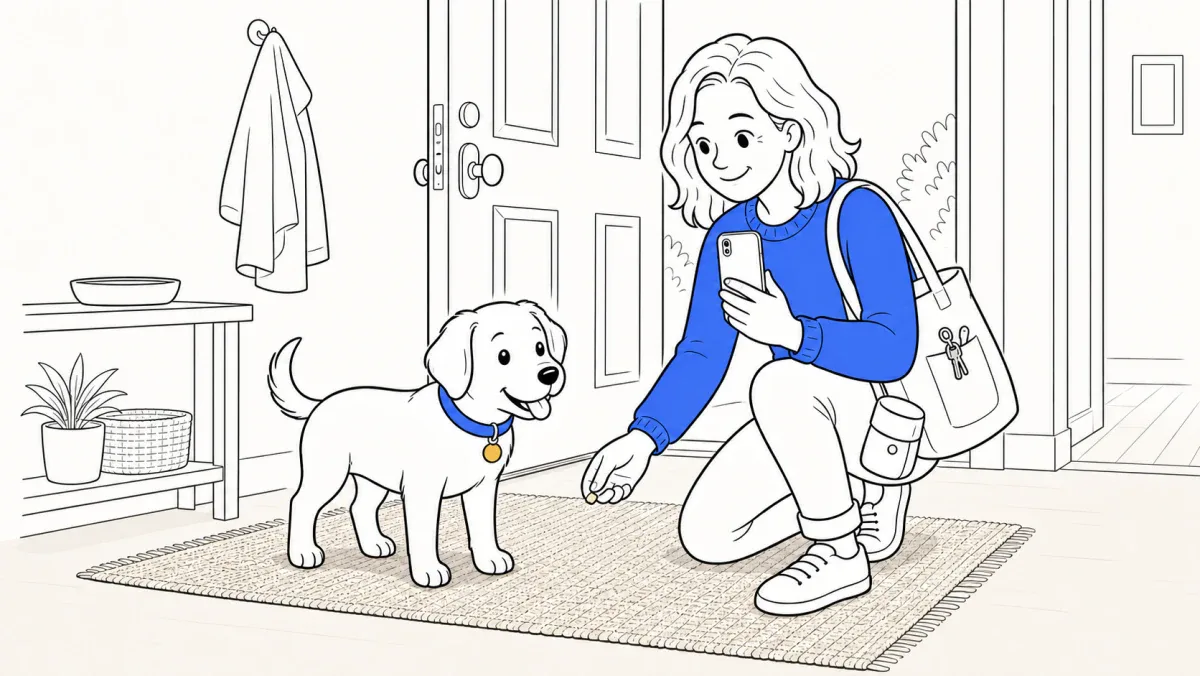
Stop a dog jumping on people by rewarding four paws on the floor and a sit to greet, every single time — and never knee, push off, or scold when they do jump. All three of those still count as attention, and attention is exactly what taught the jump to work. With a full-grown dog, manage the greeting too, so the old habit stops getting rehearsed while the new one is still being built.
If you’re reading this mid-greeting — muddy paws already on your jeans, or a guest laughing it off while you apologize on their behalf — you’re in the moment most owners go looking for this fix. The reason it feels so persistent is simple: your dog isn’t being naughty. They’re repeating the one thing that has always gotten your face closer to theirs.
The whole plan is four moves:
- Stop the rehearsal. Gate, leash or closed door, so no greeting pays the jump while you’re teaching.
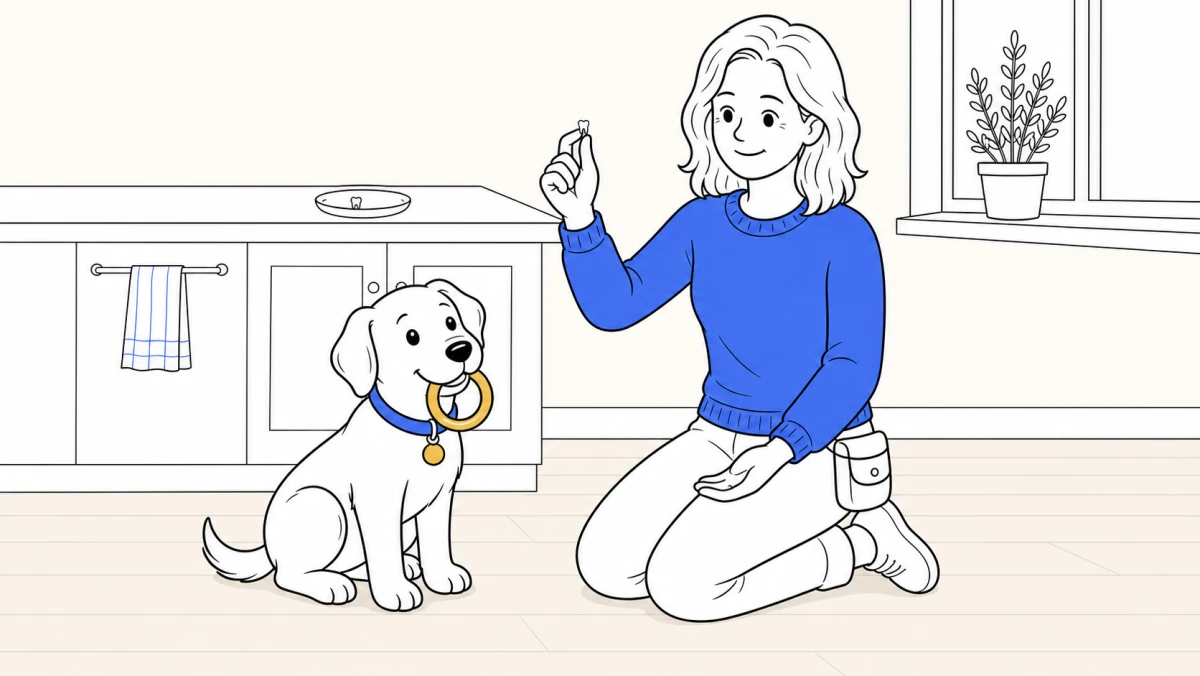
- Pay four on the floor. Mark and treat all four paws down, at floor level, before the launch.
- Upgrade to a sit-to-greet. The greeting itself becomes the reward the sit earns.
- Recruit every human. One person who pays the jump keeps it alive for everybody else.
Why does my dog jump on people?
Because it works. Jumping puts your dog’s face and paws right where the attention is, and the first time that got any reaction — even a startled “no” or a scolding — your dog learned that going airborne gets a response. Whatever gets attention gets repeated.
The American Kennel Club’s Stephanie Gibeault, MSc, CPDT, puts the mechanism plainly: your dog is “simply trying to say ‘hello’ face-to-face,” and jumping “is an effective way to get your attention.” Everything below flows from that one fact, so it’s worth holding onto: you’re not correcting a bad dog, you’re changing what actually pays.
Is it dangerous when a dog jumps on people?
It can be, and size is most of it. Humane World for Animals puts it plainly: “A child or frail adult can be knocked down and seriously injured.” Best Friends Animal Society makes the point from the other end of the scale too, noting that even small dogs jumping “can startle someone or cause them to lose their balance.”
That is the honest reason this stops being a manners problem as a dog grows. Best Friends is direct about the trajectory: an excited puppy jumping “may seem cute,” but “it’s not a behavior to encourage as it can become more problematic as they get older and bigger.” Left alone, it’s also the thing that quietly shrinks your life, because it becomes easier to shut the dog away than to answer the door.
None of that means your dog is aggressive. Jumping on greeting is over-friendliness, not a threat. But it does mean the safe move is to manage the greeting from the start rather than waiting for training to finish.
How do you stop the jumping getting rehearsed?
Stop it paying today, before you teach anything. Every greeting where your dog gets both paws on a visitor is another rep of the habit you’re trying to retire, and you cannot out-train a behavior that keeps getting practiced at full volume twice a day.
Best Friends Animal Society leads with exactly this: “First, prevent the dog from practicing the jumping behavior, so they don’t get a chance to receive any kind of attention for it.” The tools it names are ordinary ones — a baby gate, a closed door, an exercise pen, or a leash held by someone who isn’t doing the greeting. A 12-pound puppy who jumps at the mail carrier is embarrassing; a 70-pound one is a liability, and this is the layer that buys you the weeks the training needs.
Management isn’t cheating and it isn’t forever. It’s how you make sure every greeting your dog does get is one they can win.
How do you teach a dog “four on the floor”?
Catch the moment before the jump, not after it. At the moments your dog usually launches — you walking in the door, someone approaching — mark the instant all four paws are still on the ground with a click or a cheerful “yes,” then deliver the treat down at floor level, so down there stays the interesting place to be.
AKC’s guidance points at the same moment: reward your dog for having, in the AKC’s own words, “front feet on the floor,” rather than waiting to react once they’re already airborne. If click-and-treat timing is new to you, what clicker training is and whether it works covers the mechanics in two minutes.
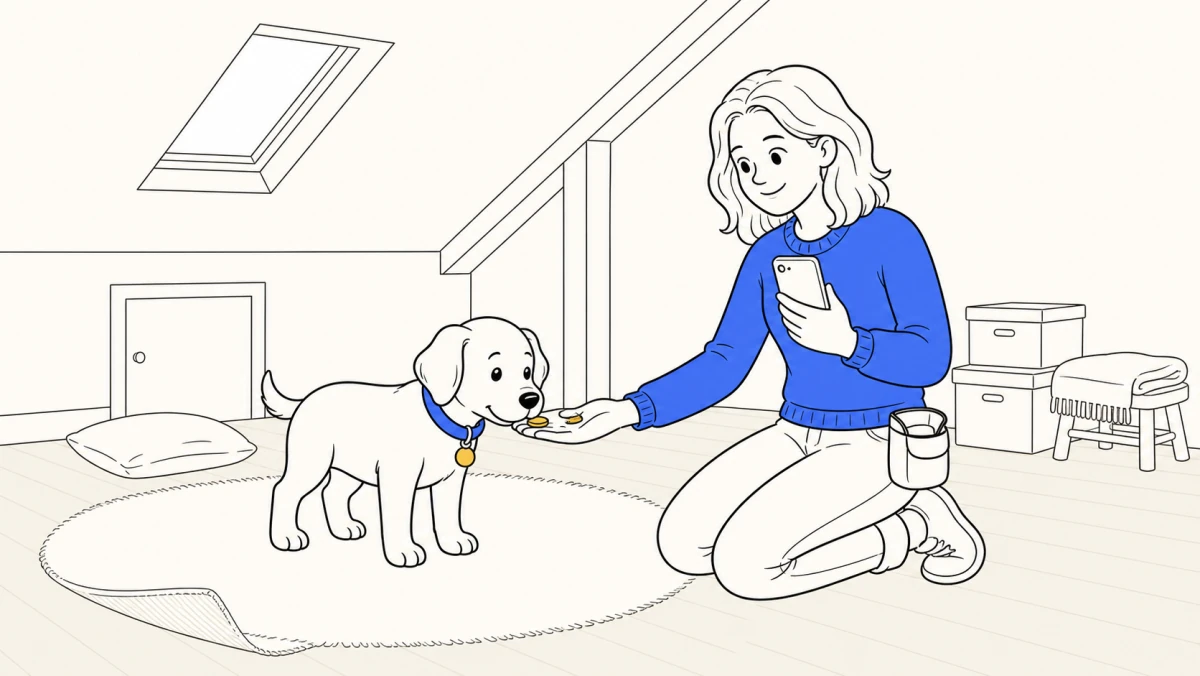
Keep the practice small and boring. Our own guide to how long a training session should be puts it at three to eight clean reps inside about two to five minutes, ending on a success — and that shape holds here. Run those reps at your own front door, on your own terms, with nobody on the other side of it. A dozen quiet reps alone beat one attempt in front of an excited guest.
How do you teach a dog to sit to greet people?
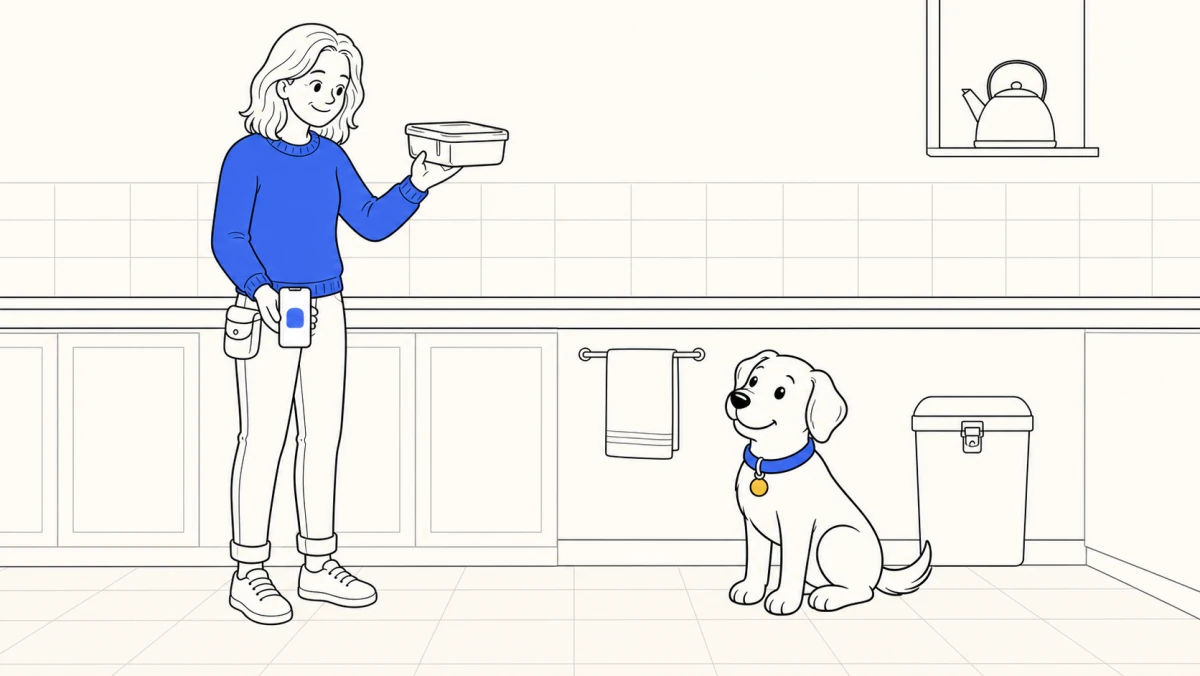
Once four-on-the-floor is earning rewards, raise the bar: ask for, or wait for, a sit before the greeting continues. Now the sit itself becomes the reward — the fuss, the hello, the attention your dog wanted all along. Humane World for Animals frames the logic in one line: teach something “incompatible with jumping up, such as sitting,” because dogs “can’t sit and jump up at the same time.”
If sit isn’t solid yet, teach your dog to sit first — this whole plan leans on it. And a rock-solid sit-stay is what seals it, because a dog holding a stay can’t be halfway up your leg.
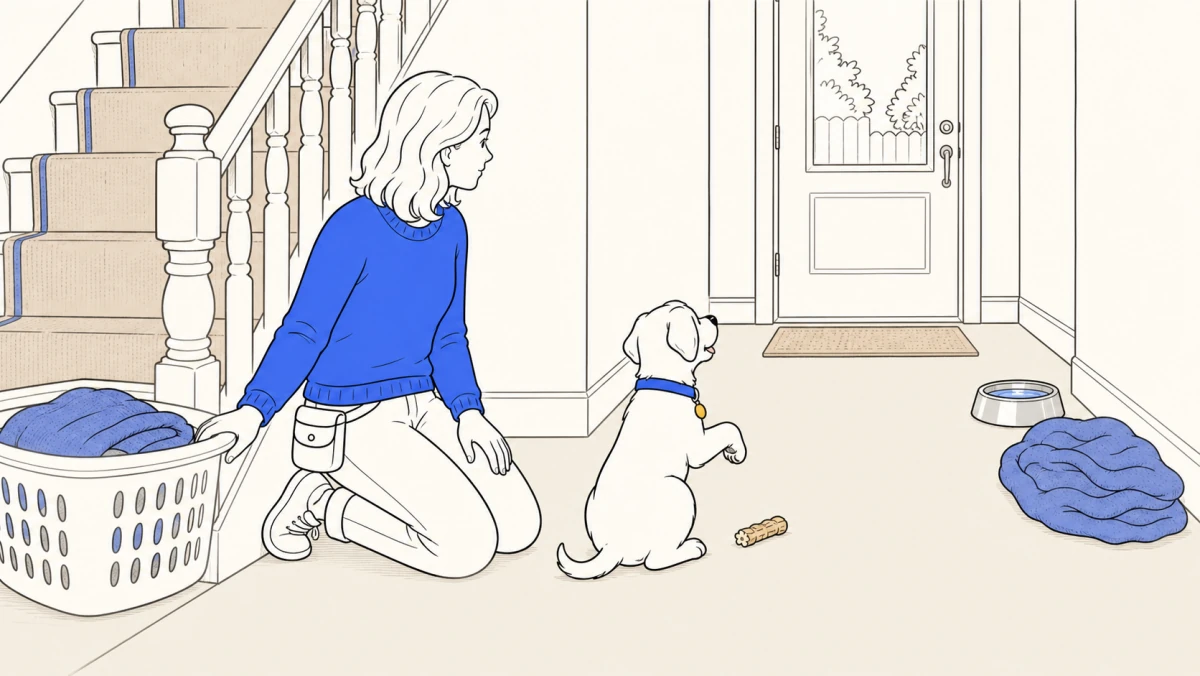
Move up one rung at a time, and use a real bar for when to move. The same session guidance puts it at about four correct out of five, across two separate sessions and ideally on different days, before you make anything harder. So: you alone first, then one familiar person, then a stranger, then the doorbell. Expect to rebuild the whole thing in the hallway specifically — a sit that’s perfect in the kitchen is a genuinely new skill at the front door with a visitor in it, which is the point of training a behavior until it’s reliable in real places rather than only easy ones.
Should you knee a dog or push them off for jumping?
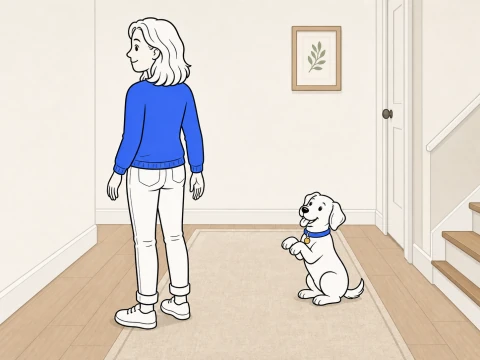
No. Kneeing, pushing off, or grabbing your dog’s paws can look like a correction, but it still counts as attention — and attention is exactly what rewards the jump. The fix isn’t a firmer response; it’s removing the attention entirely.
Gibeault’s AKC guidance is direct about why the “correction” backfires: for many dogs, “kneeing can be interpreted as attention or a wrestling game,” and “even a negative response, like grabbing your dog, holding their paws, or pushing them away, is still attention and therefore will reward the jump.” Pushing is wrestling, and wrestling is a game your dog is happy to keep playing.
So: the instant your dog jumps, no words, no eye contact, no hands — just a calm turn away. The moment all four paws land again, the greeting resumes.
Why is pushing them off the most common mistake?
Because more owners do it than any other correction. In the largest UK study of the question — Royal Veterinary College researchers’ survey of the Pandemic Puppies cohort, published by Brand and colleagues in Animals in 2024 — the most-used aversive method of any kind wasn’t shouting and it wasn’t leash corrections. It was physically moving the dog, the paper’s own examples including pushing them down when they jump up, reported by 335 of 758 owners (44.2%). Shouting came second at 40.9%, leash corrections third at 40.2%.
So the single most popular correction in that cohort is the one aimed at this exact behavior, and it is the one that reliably pays it. That handling is counted as an aversive method — and aversive methods are what the American Veterinary Society of Animal Behavior’s 2021 position statement rules out, stating they “should not be used in canine training or for the treatment of behavioral disorders,” and that training works best when it focuses “on teaching the animal what to do, rather than punishing them for unwanted behaviors.”
Does ignoring a jumping dog actually work?
On its own, rarely. Turning away removes your attention, but it does nothing about the visitor who is already saying hello, and it gives your dog no better option to take instead. Ignoring only works as one part of a plan.
The other parts are the ones above: no rehearsal, so the jump stops getting paid by anyone, and a paid alternative your dog can offer instead. Humane World for Animals and Best Friends both land on that second half — Humane World is explicit that the alternative behavior is the mechanism, because a dog “can’t sit and jump up at the same time.”
Why does the jumping get worse before it gets better?
Because the old habit fights back before it fades, and that is the single most common reason people abandon this method. The jumping usually gets worse first. Karen Pryor Clicker Training’s glossary describes the effect plainly — when a previously reinforced behavior stops being reinforced, “the animal will increase the intensity or frequency of the behavior in an attempt to earn the reinforcement again,” and the behavior “will eventually diminish but often not until after an extinction burst.” So a harder, more insistent jump in the first handful of tries is the method working, not failing. That is also the exact moment most people give up and go back to pushing — which pays the bigger jump, and teaches your dog that escalating is what works.
How do you get visitors and the household on the same page?
Agree on one household rule and run it every time, with everyone — one person who rewards the jump keeps the habit alive for everybody else. For genuinely excitable visitors, stage the greeting behind a gate or on a leash for the first few tries.
AKC names the inconsistency trap as a rule: “Don’t let your dog jump on you when you’re in jeans but not when you’re in a suit.” Humane World for Animals is equally plain: “Everyone in your family must follow the training program all the time.” The people who break the rule are almost never being difficult, either — they’re delighted to see your dog, and a delighted person is a very effective reward. Give them a job instead: hand the visitor three treats at the door and tell them what to wait for. People follow a script far more willingly than they follow a ban.
What about a dog who jumps on strangers on walks?
Same rule, less control — so lean harder on the leash and on asking first. You can’t brief a stranger the way you brief a guest, and a dog who is thrilled by every passer-by is rehearsing the jump on people who never agreed to help you train. Best Friends treats polite greetings on leash as its own piece of work, “getting your dog to greet other people politely when leashed and on walks.”
In practice that means keeping enough leash length to prevent the jump rather than correct it, asking for the sit before the person is in range, and being willing to say “they’re in training — could you wait until they sit?” Most people are happy to. The ones who aren’t are exactly the greetings to walk past.
Why is it harder to stop an adult dog jumping than a puppy?
Mostly rehearsal. A four-month-old has been paid for jumping a few hundred times; a two-year-old has been paid for it at every greeting for two years, by dozens of different people, in dozens of doorways. The method doesn’t change — the number of reps does, and so does the honest timeline.
There’s a second, smaller factor worth knowing if your dog is somewhere between six and twelve months, because it explains a stretch that feels like backsliding.
Does training really get worse around eight months?
For one measured command, in one study, it did — and the dip was aimed squarely at the owner. In a 2020 Biology Letters study, Lucy Asher, Gary England, Rebecca Sommerville and Naomi Harvey tested the same dogs at five months and again at eight months — 69 dogs completed both sessions — and found the odds of repeatedly ignoring a well-established “sit” were more than twice as high at eight months. The detail that makes it useful: the dogs only ignored their own owner. Given the same cue by a stranger, they actually got better.
Hold that finding to its real size. It measured one command, in one cohort of retrievers and retriever crosses, at one age — it is not a map of adolescence, and it doesn’t predict your dog. Writing about the paper afterward, Asher described the change as “just a passing phase.” What it usefully tells you is that if your sit-to-greet gets shaky around eight months, the likeliest reading is developmental rather than a training failure, and the answer is more easy reps, not a harder correction.
How do you stop a puppy jumping up?
The same plan, with two advantages: far fewer rehearsals to undo, and a dog small enough that management is easy.
It also helps to know how ordinary this is. In the UK Pandemic Puppies cohort at 21 months, jumping up at people was the second most-reported problem behavior — 507 of 890 owners, 57.0% — behind pulling on the leash (601 of 892, 67.4%) and just ahead of not coming back when called (466 of 898, 51.9%). Among the owners in that cohort who answered on all 24 behaviors, 762 of 788 (96.7%) reported at least one problem behavior. If jumping is the one you’re dealing with, you’re not managing a broken puppy; you’re managing a puppy. The rest of the first-few-months picture lives in the full guide to training a puppy, and you should expect wobbly weeks around genuinely exciting visitors — that’s their age, not a failure of the method.
What about jumping on furniture, counters, or at the table?
That’s a different problem wearing the same name. Jumping on people is a greeting behavior — it’s about your face and your attention. Jumping up at counters or the table is usually about the food up there, and the trainable piece of that is a solid “leave it”, plus simply not leaving food within reach while the habit is young. Don’t try to solve both with one rule — they’re not the same conversation your dog is having with you.
How long does it take to stop a dog jumping on people?
Weeks for a young puppy who has only rehearsed it for a month; longer for an adult dog who has been paid for jumping at every greeting for two years. The pattern that stalls progress fastest is inconsistency, not a slow dog. Four-on-the-floor gets rewarded on a quiet Tuesday, then a delighted relative lets the jump slide on Sunday, and the lesson gets muddier instead of clearer.
Nobody can give you a date, and anyone who does is guessing. What’s fair to promise is a direction: with the greeting managed so the old habit stops getting reps, and the new one paid every time you realistically can, clean landings start outnumbering jumps — first with you, then with the household, then, last and hardest, with the visitor your dog adores.
Is jumping up ever a sign of something more serious?
On its own, no — even a lot of it is exuberance, not aggression. Get a certified behavior professional involved if the jumping comes with a stiff, tense body, growling, or snapping, rather than plain over-friendly excitement, or if it’s paired with hard, skin-breaking bites rather than mouthy excitement.
The guide to what’s normal and when to get help has the fuller picture. IAABC-certified consultants (iaabc.org) are a solid, credentialed place to start if you need one.
The habit that makes this stick
Four paws pays, a sit pays more, and the jump quietly stops being worth the trouble. The same reward-the-alternative logic that settles this also fixes why puppies bark and how to stop it — you reward the behavior you want, not the one you don’t. The genuinely hard part isn’t the rule. It’s holding it consistently, every entrance, every visitor, on the days you’re tired and it would be so much easier to just let the hello happen.
That consistency is what ClickerPup is being built to help with: a calm sit-to-greet is part of the app’s core foundation plan, sized into two-minute sessions and adapted to how the last one actually went. The app is being built puppy-first, for the early months — so if your dog is already four, the method on this page is yours to run, and the app isn’t the thing that runs it for you yet. The clicker side stays free forever, and it works the same on a four-year-old as on a four-month-old. Joining costs nothing, commits you to nothing, and gets you word the day the coaching opens.