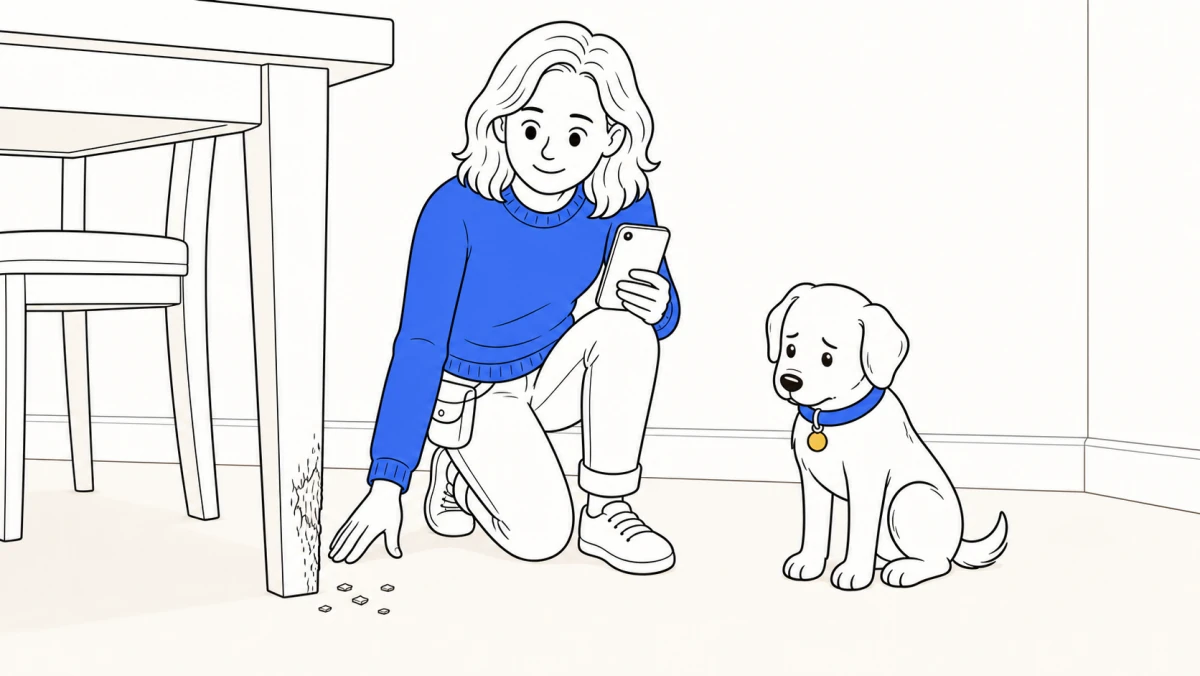
Stop a dog chewing furniture by working out which of four things is driving it — teething, boredom, a normal chewing need with nowhere legal to go, or distress at being left alone — and then fixing that one. Manage what your dog can reach, supply chews they’re allowed to destroy, and train the trade. Punishment fixes none of the four.
If you’re reading this over a gnawed table leg or a baseboard with teeth marks in it, the useful starting point is that your dog wasn’t getting back at you. “Destructive chewing” is one label stretched across at least four separate problems, and the advice that fixes one of them does nothing for the others — which is probably why the last three pages you read didn’t help. Working out which one you have is the whole difference between a plan and a shopping list.
Two things jump the queue before any of that. If your dog swallowed a piece of what they chewed, call your vet now — that’s a medical emergency, not a training problem, and there’s a section on it below. And if the chewing happens only when your dog is home alone, that’s separation-related distress rather than a chewing habit; skip to that section, because nothing in the middle of this article is the right answer for it.
Why do dogs chew furniture?
Because chewing is normal dog behavior, and your furniture is the best thing available to do it on. The ASPCA is blunt about the baseline: “It’s normal for puppies and dogs to chew on objects as they explore the world.” For young dogs, it says, “it’s a way to relieve pain that might be caused by incoming teeth. For older dogs, it’s nature’s way of keeping jaws strong and teeth clean.” It adds that chewing “also combats boredom and can relieve mild anxiety or frustration.”
Furniture gets picked for unglamorous reasons. Writing for the American Kennel Club, Stephanie Gibeault, MSc, CPDT, points out that with wooden table legs and baseboards “it may simply be your dog using the only objects available” — they sit at mouth level, and wood and plastic are “firm yet likely have enough give for a satisfying chomp.” Softer targets often get chosen because they smell like you.
So the real question isn’t how to stop your dog wanting to chew. You can’t — it’s a need, not a habit. The question is which of four drivers is aiming that need at your couch.
Which kind of chewing do you actually have?
Answer three questions: does it happen while you’re home, or only when you’re out; how old is your dog; and what gets chosen. Those three answers fork everything below, because the four drivers need four different responses.
| What you’re seeing | Most likely driver | What actually changes it |
|---|---|---|
| Under about six months, chews anything with give, mouth clearly sore | Teething | Legal chew outlets, some of them frozen, plus management while it passes |
| Any age, chews while you’re home and awake, favors things that smell like you | A normal chewing need with nothing legal to aim it at | Supply and rotation, food in puzzle toys, your stuff put away |
| Chews after long stretches with nothing to do, alongside other invented jobs like digging or stealing | Boredom and under-exercise | More physical and mental work, especially before a stretch alone |
| Only when alone, or far worse when alone; damage at doors and windows; whining, pacing, accidents | Separation-related distress | Not a training article’s job — a vet, then a certified behavior professional |
That last row is the one that matters most, because it’s the one most often mistaken for naughtiness. The ASPCA’s description is specific: “Dogs who chew to relieve the stress of separation anxiety usually only chew when left alone or chew most intensely when left alone. They also display other signs of separation anxiety, such as whining, barking, pacing, restlessness, urination and defecation.” Gibeault adds a location tell — destruction “around window or door frames” points the same way. If that’s your dog, skip ahead to the alone-time section; nothing else here is the right plan.
Is it teething, and when does that stop?
Teething is the most common driver under six months, and it does end. The ASPCA puts the intense phase plainly: “This intensified chewing phase usually ends by six months of age.” Humane World for Animals describes the same window — puppies “teethe for about six months, which usually creates some discomfort.”
While it lasts, cold helps. The ASPCA suggests “ice cubes, special dog toys that can be frozen or frozen wet washcloths to chew, which might help numb teething pain.” If your puppy is also treating your hands as a chew toy, that’s the same set of teeth, and the plan for puppy biting covers the in-the-moment version.
One caution before you start counting down: the end of teething is the end of the sore-gum phase, not the end of the chewing.
What do you actually do about furniture chewing?
You redirect and supply — you don’t suppress. The job is to make the legal options better than the furniture, and the furniture harder to get to, in that order.
- Put away what you can. The ASPCA’s framing is the right one: “Make it easy for your dog to succeed.” And don’t hand over your retired shoes as toys, because “it isn’t fair to expect your dog to learn that some shoes are okay to chew and others aren’t.” The room-by-room version of this is puppy-proofing your home.
- Supply chews your dog is allowed to destroy, and rotate them. The ASPCA suggests you “introduce something new or rotate your dog’s chew toys every couple of days so that he doesn’t get bored with the same old toys,” and warns against cooked bones, which can splinter. Ask your vet what’s safe for your particular dog’s chewing style.
- Aim a stuffed toy at the moments it actually happens. Again the ASPCA: “Identify times of the day when your dog is most likely to chew and give him a puzzle toy filled with something delicious. You can include some of your dog’s daily ration of food in the toy.”
What should you do when you can’t supervise your dog?
Confine them somewhere dog-proofed, with legal chews, and put a ceiling on how long. The ASPCA’s number is up to six hours in a confinement area stocked with appropriate chews — and it is equally clear in the other direction: don’t “leave your dog in a crate for lengthy periods of time (more than six hours) to prevent chewing.”
Confinement buys supervision you don’t have; it isn’t storage. If the only way your furniture survives the day is a crated dog, the plan underneath it needs work, and a dog who is confined more needs noticeably more out of the hours when they’re not.
Does more exercise stop destructive chewing?
It fixes one of the four drivers — boredom and under-stimulation — and does nothing for the other three. Worth doing, not worth expecting a cure from.
The ASPCA’s own list of ways to work a dog’s mind and body names “daily walks and outings, off-leash play with other dogs, tug and fetch games, clicker training classes, dog sports (agility, freestyle, flyball, etc.), and feeding meals in food puzzle toys.” Note that half that list is mental rather than physical: a dog who is only ever run tired often just becomes a fitter dog with the same empty afternoon.
Everything in these three sections is management. Management works while it’s running and teaches your dog nothing on its own — which is the part most furniture-chewing guides leave out, and the reason there’s a training section further down.
Do anti-chew sprays actually work?
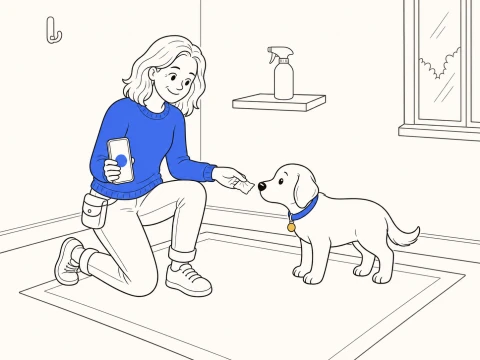
Sometimes, partly, and not on their own — and that is the position of every organization we can point to, not our opinion. Taste deterrents are a management tool for the things you can’t put away, like baseboards and table legs.
The ASPCA’s method is to introduce the taste on a piece of tissue first so your dog connects the smell with the taste, then “spray the deterrent on all objects that you don’t want your dog to chew. Reapply the deterrent every day for two to four weeks.” Its own caveat follows immediately: “Please realize, however, that successful treatment for destructive chewing will require more than just the use of deterrents. Dogs need to learn what they can chew as well as what they can’t chew.”
Humane World for Animals is more direct about the failure rate: “Some dogs will chew an object even if it’s coated with a taste deterrent,” and “you must reapply some of these deterrents to maintain their effectiveness.” So a deterrent is a thing that sometimes works, on some dogs, for as long as you keep applying it.
How long do you have to keep reapplying a chew deterrent?
Every day, for a few weeks — and the reapplication is doing the work, not the first coat. The ASPCA’s window is “every day for two to four weeks.” Gibeault’s AKC guidance says bitter sprays “may help deter your dog,” applied “every day for at least three or four weeks,” and pairs that window with establishing new habits rather than with the spray doing the job alone.
Put all three sources together and the honest verdict is narrow: a deterrent reapplied daily can buy you time on the targets you can’t move, none of the three claims it teaches your dog anything, and every one of them hedges. We’re not naming products, and we’re not passing on a homemade recipe — none of the sources above has tested one.
What part of furniture chewing can you actually train?
The contraband moment — the trade. Everything above is management; this is the piece with a training plan behind it, and it’s what keeps working on the day your management slips.
The ASPCA’s in-the-moment version is simple: “If you see him licking or chewing an item he shouldn’t, say ‘Uh-oh,’ remove the item from your dog’s mouth, and insert something that he CAN chew. Then praise him happily.” Humane World adds the part that matters once your dog has opinions about giving things up: trade for something better, and “as your dog catches on to this idea, you can add the command ‘give’ as their cue to release the object in exchange for the treat.”
Should you take things out of your dog’s mouth?
Not if you can trade for them instead, and never by chasing. Humane World names the cost of the grab-it-back reflex plainly: “Removing items from your dog’s mouth can cause your dog to develop guarding behaviors or run from you when you need to get an item back.”
The chase is worse, because it’s fun. “If you chase them, you’re only giving your dog what they want. Being chased by their human is fun!” A dog who has learned that your approach means losing the prize gets faster, not more cooperative — and that’s how a chewed slipper turns into a dog who guards the sofa cushion.
What does the trade actually look like?
Smaller and more boring than people expect, which is exactly why it holds up under pressure. You rehearse it cold, on things your dog doesn’t much care about, long before you need it on a table leg.
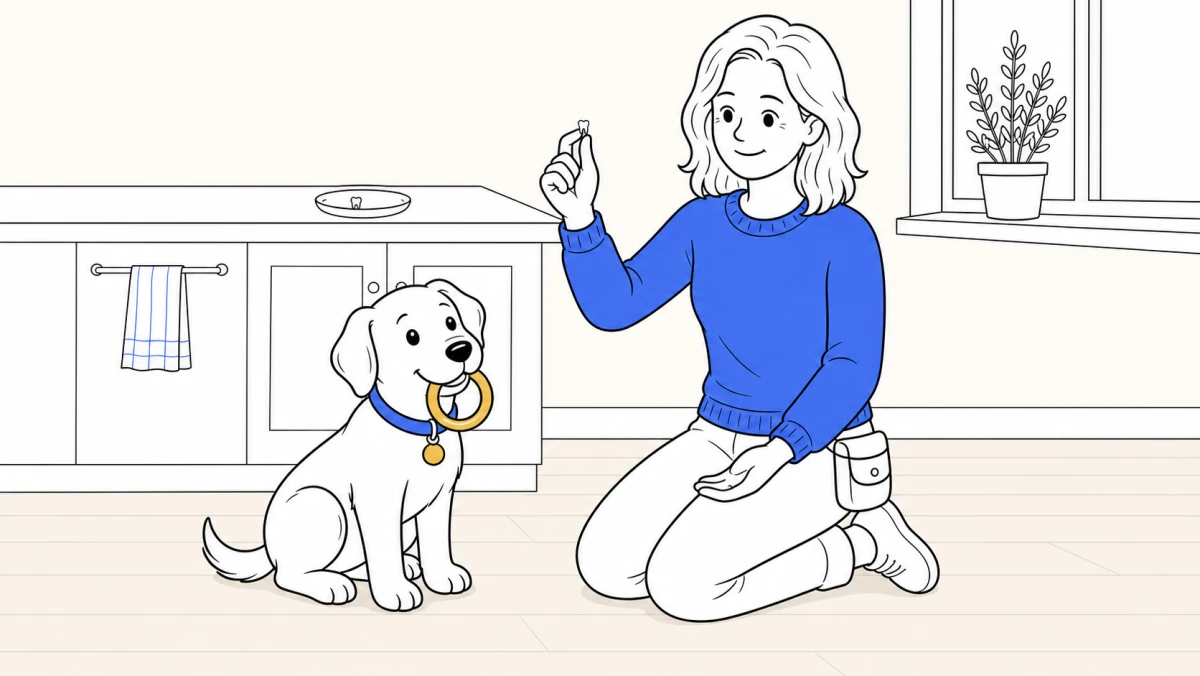
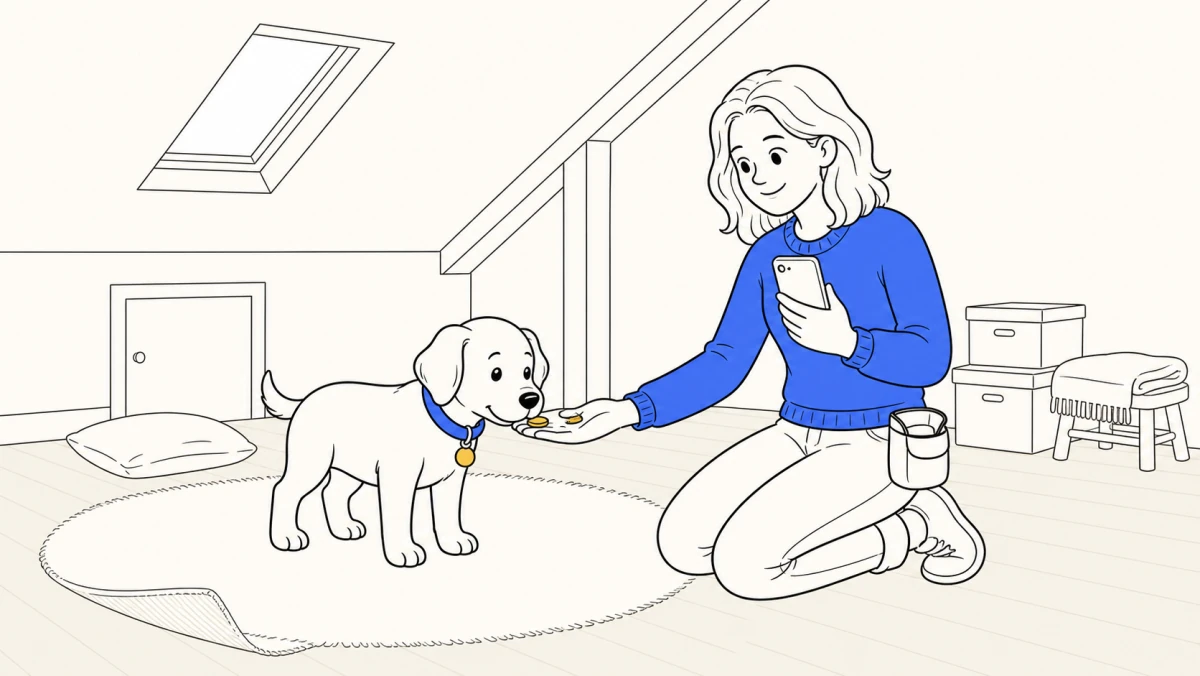
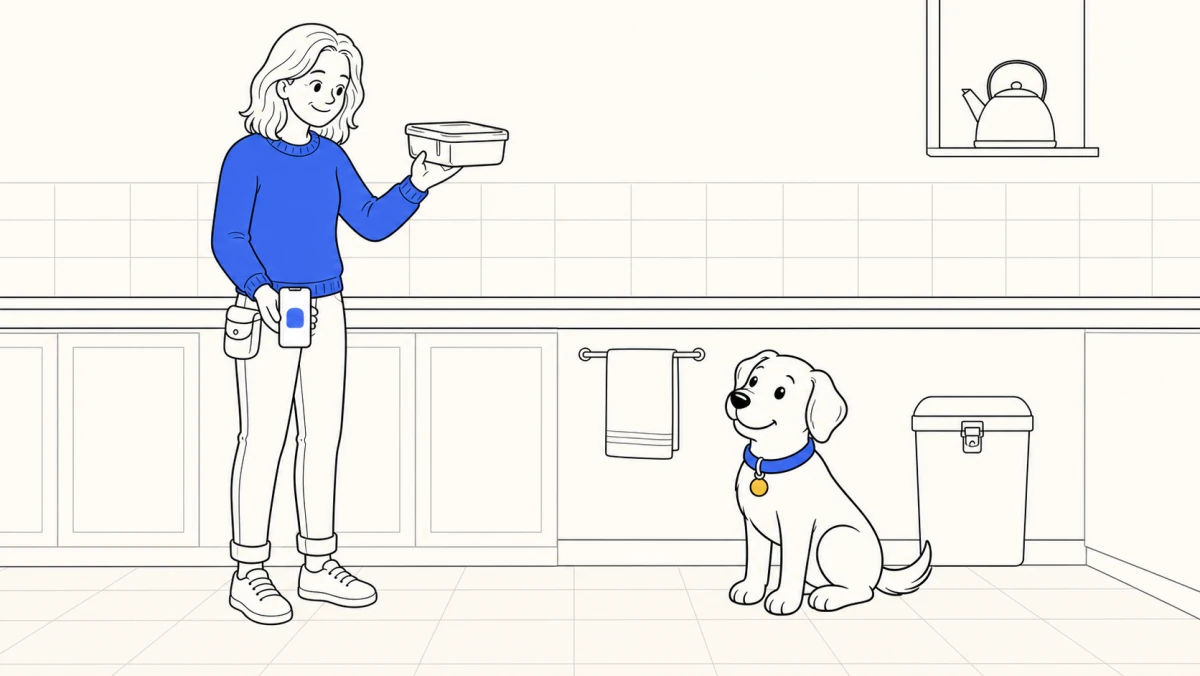
Show something clearly better. Mark the exact instant they let go — that timing is the whole skill. Pay. And most of the time, hand the original thing straight back, so giving something up pays, and then pays again. Nothing gets pried out of anyone’s mouth and nobody runs, which is why the trade still works when the item is genuinely valuable to your dog.
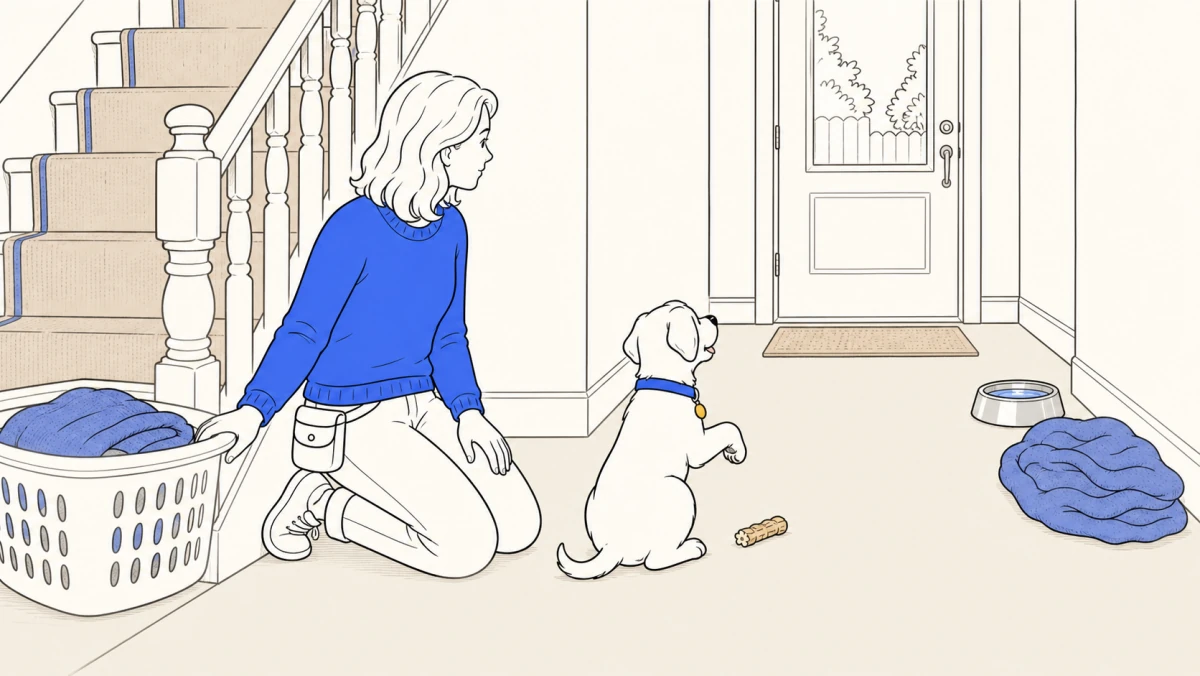
Three trained skills carry all of that. Leave it is the brake before the grab, taught as a game your dog wins rather than a telling-off. Drop it is the trade after it. And settle is the off-switch for the dog whose chewing is really an arousal problem — the one who can’t come down after a walk and finds a table leg instead. All three are marker-trained, and if you want the mechanism first, what clicker training is and whether it works covers it.
Does training actually reduce destructive chewing?
The best evidence available is suggestive rather than settled, and it points the right way. In a retrospective survey of 1,023 dogs from 641 owners, recruited through the Center for Canine Behavior Studies’ mailing list and social media, dogs who attended training at six months of age or younger had 0.60 the odds of owner-reported destructive behavior (95% CI 0.37–0.96; Dinwoodie et al., 2021).
Hold that loosely. It’s correlational and owner-reported — the authors themselves note that “owner reporting is a poor substitute for a clinical diagnosis” and that recollections “can sometimes be unreliable” — and the sample skews toward owners who already had behavior concerns. Read it as a reason to start this week rather than next month, not as a guarantee about your dog.
Should you punish a dog for chewing the furniture?
No — and coming home to the damage is the exact moment punishment does the least. The ASPCA is explicit: “Do not show your dog the damage he did and spank, scold or punish him after the fact. He cannot connect your punishment with some behavior he did hours or even minutes ago.”
That sits inside the wider standard. “Based on current scientific evidence, AVSAB recommends that only reward-based training methods are used for all dog training, including the treatment of behavior problems,” the American Veterinary Society of Animal Behavior’s 2021 position statement says, adding that there is “no evidence that aversive methods are more effective than reward-based methods in any context.” Startle devices belong in the same bracket as scolding — and a dog who learns that chewing gets them shouted at mostly learns to chew where you can’t see.
Why does my dog look guilty about the chewing?
Because of you, not the table leg. As Humane World puts it, that “guilty look” is actually a canine submissive posture that dogs show when they feel threatened or unsafe.
That matters practically, not just morally: the look people read as an admission is a response to your face, voice and body language in the moment you walked in. It tells you nothing about whether your dog connects the damage with your reaction — and the ASPCA says plainly that they don’t.
What should you never do to stop a dog chewing?
The ASPCA’s do-not list is unusually specific, and worth having in mind if any of it gets offered to you as advice. Don’t hold a dog’s mouth closed with duct tape — “this is inhumane, will teach your dog nothing, and dogs have died from this procedure.” Don’t tie the damaged object to your dog. Don’t muzzle to prevent chewing. And don’t fix it with long confinement.
The pattern under all four is the same: each one punishes the dog for a need they can’t switch off, and none of them tells your dog what they’re supposed to chew instead.
What if my dog only chews when I’m out?
Chewing that happens only when your dog is alone — especially alongside damage at doors and windows, drooling, or injury to the dog — is separation-related distress rather than a chewing habit, and it needs a professional rather than a training plan.
We won’t coach you through it here, because it isn’t a chewing problem with a chewing fix, and treating it as disobedience makes it worse. Start with your vet to rule out anything physical, then work with a certified behavior professional — the International Association of Animal Behavior Consultants keeps a directory at iaabc.org. Don’t let anyone sell you a correction, a startle device, or more crate time for it. The fuller picture of what’s ordinary and what deserves a call is in is my puppy normal, or should I get help?
What if my dog swallowed part of what they chewed?
Call your vet right away. A swallowed piece of fabric, stuffing, wood or cord is a medical question, not a training one, and it doesn’t wait. Cornell University College of Veterinary Medicine’s Riney Canine Health Center is unambiguous: “GI obstructions are emergencies often requiring surgical removal, and prompt veterinary intervention is critical.”
The Riney Center lists toys, socks or pieces of clothing, rocks, corn cobs and bones among the common culprits, and singles out string and ribbon as worse, because linear foreign bodies “can cause more severe damage by creating holes or intestinal perforations.” The signs it names are vomiting, loss of appetite, abdominal pain, diarrhea, dehydration and lethargy. If you know your dog swallowed something, don’t wait for those to show up before calling.
Is a dog chewing their own paws the same problem?
No, and this article doesn’t cover it. Chewing or licking their own paws is a different behavior from chewing your furniture, and it’s a question for your vet rather than a training plan — take it there first, before anyone tries to train it out.
Will my dog grow out of chewing?
The sore-gum phase ends; the chewing need doesn’t. AKC’s Stephanie Gibeault, MSc, CPDT, is blunt about it: “But dogs grow out of that, right? Nope! Adult dogs love to chew and if they don’t learn appropriate chewing behavior, you can expect many more years of household destruction.”
What changes as your dog grows up is the reason, not the behavior: teething stops, and recreational chewing carries straight on. So the plan shifts from “get through the sore-gum months” to “keep a legal outlet available for years,” which is a much easier thing to do once you stop expecting it to end.
Is destructive chewing only a puppy problem?
No. In a study of adolescent and adult dogs rehomed through a New Zealand animal shelter, 40 of the 57 dogs with behavior information available — 70% — had at least one reported problem behavior, most often poor manners (46%), then destruction of household items (30%), then excessively high energy (28%) (Gates et al., 2018).
Read that as a picture of one rehomed shelter population rather than a prevalence rate for dogs in general: the sample is small, owners were surveyed anywhere from a week to six months after adoption, and a dog settling into an unfamiliar home is not the average household dog. Taken with that limit, it’s still a useful corrective to the idea that chewed furniture is a puppy-only phase — a third of those adult and adolescent dogs were destroying household items in their new homes.
When can you stop managing the house?
When your dog has earned it, which is a behavior test rather than a birthday. Give back a room once your dog has repeatedly left the tempting thing in it alone, while you were there to see it — and take the room back for a while if that stops being true.
A dog with a reliable leave-it needs far less management than one without, which is the whole argument for training the trainable slice instead of buying more latches. Expect the loosening to be gradual and slightly annoying, and expect one relapse in a week where something changes — a new routine, a house guest, an under-exercised stretch.
The honest version of “stopping” it
You can’t stop a dog chewing. You can decide what they chew. That’s four moves: name the driver, put your things away, keep something legal and genuinely interesting within reach, and train the trade so the contraband moment has an answer that isn’t a chase across the living room.
The last move is the one ClickerPup is built for. Leave it, drop it and settle are part of the app’s core plan, sized into two-minute sessions and adjusted to how the last one actually went. It won’t manage your house for you, and “chewing” isn’t a skill it ships — the trade is. The clicker stays free forever, with a plain reminder before anything ever charges.
Claim my early spot and we’ll bring you in as we open up.