Puppies whine because whining works — though usually not for the reason the internet assumes. A whine can be an unmet need, pain, frustration, plain excitement, a request your puppy has learned gets answered, or real distress at being left alone. The standard advice to ignore it is right for exactly one of those, and worst of all applied to the last. So the first move isn’t a technique. It’s telling them apart.
If you’re on the floor with a puppy grizzling at you for what feels like the fortieth time, two questions are running at once: how do I make it stop, and is something actually wrong with him. Both are fair, they have different answers, and most pages only answer the first. This sits inside the wider how to train a puppy picture, next door to barking — the same problem at higher volume.
Why is my puppy whining?
Because whining is a signal built to summon help, and it’s still doing its job. Whining isn’t a training failure or a defect — the ASPCA files it as “one of many forms of canine vocal communication,” one of the small number of ways your puppy can tell you anything at all.
There’s direct experimental evidence that the signal works — inside the litter, at least. Massenet and colleagues, publishing in PNAS in 2024, analyzed 4,400 whines from 220 Beagle puppies across 40 litters, then played whines back to 16 mothers from a speaker outside the nest. The mothers responded in 180 of 192 trials, and gave more care in response to whines derived from their own puppies than from strangers. Their responses were a mixed bag, not pure devotion: the authors log “the provision of maternal care, olfactory or visual attention to their puppies, olfactory or visual attention to the playback source, and/or stress-related behaviors.”
Note the limits before you carry it too far: the puppies were three weeks old, at breeding facilities in France, and the animal answering was a dog rather than a person. It’s not a study about your ten-week-old in a living room. What it does establish is that a whine is a functioning signal with a job — it summons an adult, and adults answer. Which is worth knowing for one practical reason: sitting through one is hard because it’s built to be hard, not because you’re soft.
What are the different kinds of puppy whining?
Six, broadly — and the useful part is that they need six different first moves. Sort by when it happens, what it’s aimed at, and what the rest of the body is doing; those three usually place you.
| What the whine is | What it tends to look like | The right first move |
|---|---|---|
| An unmet need | After waking, eating or playing; pacing, circling, heading for a door | Meet it — then look at the schedule, not the whining |
| Pain or illness | New, sudden, or paired with any physical sign | Vet, before you change anything about training |
| Frustration | A toy under the sofa, a barrier, something just taken away | Solve the problem or redirect; the whine ends with it |
| Excitement or appeasement | At greetings; either loose and wiggly, or tucked and lowered | Manage the arousal, or build confidence — never scold |
| A learned request | Aimed squarely at you; stops the instant you engage | Stop paying it, pay quiet, and teach a better way to ask |
| Distress when left alone | Escalates rather than settles; drooling, exit damage, soiling | A professional — not a plan from an article |
Only one of those six rows is answered by ignoring the whine. That’s worth a second, because ignoring is the answer that surfaces first for this question, and it was written for that row alone. Pointed at any of the other five, it isn’t so much wrong as aimed at the wrong problem.
Should I ignore my puppy’s whining?
Only if it’s a learned request — a whine aimed at you that stops the moment you engage — and only once you’ve ruled out a need, pain, frustration, excitement and distress at being left. This is the part where the published guidance genuinely contradicts itself, so it’s worth putting both halves side by side instead of trusting whichever one you found first.
Here’s the ASPCA, under a heading that reads Attention-Seeking Whining: “Use dramatic body language such as turning away from your dog or folding your arms across your chest and completely ignore her to indicate to your dog that her attention-seeking whining won’t work.”
And here’s Dr. Wailani Sung, MS, PhD, DVM, DACVB — a board-certified veterinary behaviorist — writing for PetMD about puppies specifically: “Do not ignore your puppy’s whines or cries, and try to know the cause of their distress.” She adds, in the same piece: “When your puppy is distressed, it is fine to comfort them.”
Which answer is right — the ASPCA’s or the veterinary behaviorist’s?
Both, because they’re answering different questions. The ASPCA’s sentence sits under a heading that names its own scope, on a page that separately tells you to rule out pain and separation anxiety first. Dr. Sung is describing a distressed puppy, and says so in the sentence. Neither is telling you to apply their line to every noise in the house — but stripped of its heading and passed around as “just ignore it,” that’s exactly what happens.
So the rule that survives both is narrower and more useful than either quote alone: ignoring is a response to a learned request, not a response to a whine. Applied to a full bladder, it teaches your puppy that asking doesn’t work. Applied to pain, it delays a vet visit. Applied to real panic it can make things worse — the PDSA is blunt about the cry-it-out version: leaving a puppy to cry “could actually be having the opposite effect to what you want and making them more anxious to be alone, causing them more stress. Just because they’re quiet, doesn’t mean they’re OK!”
What should I check before deciding it’s “just attention”?
Six things, in this order, and none of them takes long. This is the pass that makes the ignore advice safe to use.
- Bladder. After sleeping, eating, playing or any excitement, assume it’s this first. Puppy bladders are small, and the schedule is doing more work than the training is — the potty-training method covers the timings.
- Hunger and water. Boring, and boringly often the answer.
- Comfort, and the bed itself. The PDSA’s note is worth stealing: a bed that’s “too open and exposed” can leave a puppy feeling vulnerable. Check for anything trapped or pressing.
- Something out of reach. Dr. Sung names this as its own category: “If a favorite toy rolls out of reach, the puppy may cry if they cannot retrieve it.” Her fix isn’t to ignore it — interrupt with a noise, redirect to something legal, or simply hand back the toy that rolled away.
- Sleep. An overtired puppy loses their brakes, and noise is one of the ways that shows. If the grizzling arrives with frantic biting and zoomies, that’s the evening boil-over, and it wants a nap rather than a training session.
- Whether it only happens when you’re gone. The other five can all come back clean without anyone asking this one, and it changes the answer completely. If the whining starts when you go out of sight and stops when you come back, you’re not in the learned-request row — skip to the section on being left alone, below.
Anything new, sudden, or paired with a physical sign skips this list and goes to the vet. If the first five come back clean and the sixth is a no — the whining is aimed at you, and it stops the moment you engage — now the ignore advice is the right tool.
Is my puppy whining because something hurts?
It’s possible, and it’s the one cause you never work around. The ASPCA is direct about it: “Dogs often whine in response to pain or a painful condition. If you notice that your dog vocalizes frequently or has suddenly started to vocalize, it’s important to take her to the vet to rule out medical causes.” The two words doing the work there are frequently and suddenly.
Dr. Sung gives the two everyday versions. Pain: puppies whine “when they experience pain, such as being stepped on, getting their first vaccine, or having their nails trimmed too short.” Illness: “In addition to the crying, they may have other signs of illness such as vomiting, diarrhea, or discharge from their eyes or nose.” The AKC’s rule of thumb closes the loop — if every need is met, nothing is making your puppy anxious, and there’s still no obvious reason for the noise, that’s a vet visit rather than a training project.
Can a whine that started as pain become a habit?
Yes — and this is the part almost nobody mentions, which is a shame, because it dismantles the tidy table above.
Mills and eighteen co-authors, reviewing pain and problem behavior in Animals in 2020, make the link explicitly: “Comfort seeking, clinginess, and attention seeking are all widely recognized by owners as a response to pain in dogs, and thus it is not surprising that this behavior may become conditioned, especially in a species as sensitive to social reinforcement as the dog.” Their next sentences are the practical part: “When sick, animals may learn what behaviors gain extra attention and resources, and this can develop into a more serious attention seeking problem, even after the illness has been successfully treated.”
Read what that does to “is it pain, or is it attention-seeking?” It stops being a choice between two boxes. One can become the other and leave no trace of where it started — a puppy who learned to whine while they felt awful can keep whining long after they feel fine, and it will look, from where you’re standing, exactly like a demanding dog.
How often is pain actually behind a behavior problem?
More often than the training-first instinct assumes, though the honest number needs its caveats attached. The same review reports that across a caseload of 100 recent dog cases from several of the authors, “a conservative estimate of around a third of referred cases involve some form of painful condition, and in some instances, the figure may be nearly 80%.”
Take that for exactly what it is. Those are dogs already referred to behavior specialists — the hard end of the caseload, not a sample of ordinary puppies — and the authors describe it as a review of their own cases rather than a controlled study. It’s not a claim that a third of whining puppies are in pain.
What it’s good for is one decision: “we already decided this one was behavioral” is a conclusion worth reopening. If a puppy who has been emptied, fed, rested and made comfortable is still whining, and a couple of weeks of consistent ignoring has moved nothing, the next call is your vet — not a firmer version of the same plan.
How do I stop attention-seeking whining?
Stop paying the whine, pay the quiet, and teach a better way to ask. The step-by-step version of that loop already lives on the puppy barking page — same mechanism, louder symptom — so rather than run it twice, two things about the whining version.
What counts as payment is wider than you’d think. The ASPCA is explicit: “Realize that any eye contact, touching or talking to your dog—even if you’re scolding her—all constitute attention.” Telling a whining puppy to stop is answering them. So is the sigh.
And the half everyone skips, from the ASPCA again: “you need to reward your dog for being quiet. Teach your dog that she must always be quiet before receiving your attention, play or treats.” A puppy who learns that whining fails still needs some way to ask — a sit at a door, a settle on a mat, any of the first cues. The replacement is the half that holds.
Why does the whining get worse when I start ignoring it?
Because it’s supposed to, briefly, and that’s the method working rather than failing. Karen Pryor Clicker Training’s glossary names the effect: when a previously reinforced behavior stops being reinforced, “the animal will increase the intensity or frequency of the behavior in an attempt to earn the reinforcement again,” and it “will eventually diminish but often not until after an extinction burst.” Dr. Stephanie Borns-Weil, of the Cummings School of Veterinary Medicine at Tufts, puts it as an instruction: “Once you start ignoring, you must persist until your dog’s unwanted behavior has stopped completely.”
Which makes half-ignoring the worst option on the table. Hold out through ten minutes of escalating noise and then give in, and the lesson isn’t that whining fails — it’s that whining works if you go louder and longer, because the reinforcement landed on the escalated version. Same across the household: if one person holds and another answers, nobody held. So decide before you start, and if you aren’t sure this is a learned request, or aren’t sure you can sit through the burst, don’t.
Should I tell my puppy off for whining?
No — and with whining there are two separate reasons, not one.
The general one first. AVSAB’s 2021 position statement concludes that “only reward-based training methods are used for all dog training, including the treatment of behavior problems,” and that aversive methods “should not be used in animal training or for the treatment of behavior disorders.” That is still the live position: a 2025 AVSAB board statement confirms the 2021 document is “the most current and authoritative expression of our views,” and puts it more bluntly still — aversive methods “should not be used under any circumstances.” Worth knowing if you go looking, because AVSAB also notes that “an outdated and since-rescinded AVSAB document has been circulating recently, suggesting that the use of aversive tools may be appropriate in certain situations.” There’s corroboration specific to puppies and to being left alone: in the Generation Pup cohort, puppies whose owners used more punishment-based responses to unwanted behavior had increased odds of separation-related behaviors at six months. Correlational, and the authors say so — but it points where everything else points.
The second reason is particular to this behavior, and it’s the one that catches people out. A scolding is attention, so telling a demanding puppy off pays the exact behavior you meant to stop. And for the whine that comes from a worried, tucked-up, appeasing puppy, punishment makes the thing itself worse: “Avoid physical and verbal punishment. Intimidating your dog will only decrease her confidence level and may increase appeasement whining.” Two failure modes, opposite directions, same intervention.
Why does my puppy whine in the crate or at night?
Usually because being alone is brand new and nothing about it is normal yet. Dr. Sung puts it plainly: puppies “are used to sleeping with their mother and littermates cuddling up to other warm bodies. Learning to sleep alone can be scary and lonely.”
This page isn’t the right home for the full answer — how to get a puppy to settle and sleep is, and it covers the bedtime setup, the overnight potty trip most young puppies still need, and how to teach settle as a skill. Two things are worth carrying across. First, a night whine is usually the bladder before it’s anything else, and that’s worth ruling out every time rather than deciding on the third night that it has become a habit. Second, the Generation Pup study found that puppies reported to get nine or more hours of sleep at night at 16 weeks or under had lower odds of separation-related behaviors at six months than those getting six to eight. That’s correlation from an owner-reported cohort, not a guarantee — but protecting sleep is on the short list of things that appear to help later, and it costs nothing to start now.
Does leaving the TV or radio on help a puppy left alone?
Possibly the opposite — and this is worth passing on precisely because the usual advice runs the other way. In a 2026 trial by Dale, Casey and Burn in the Journal of Veterinary Behavior, 34 owners filmed their puppies alone at four points across their first six months. Across all groups, “when radio or TV was on, versus off, puppies showed more passive anxious and less active positive behavior.”
Read it carefully before acting on it. What the trial randomized was the advice owners were given, not whether the radio was on — so this is an observed association, not a controlled comparison, and the authors call the study exploratory on its own terms: “recruitment challenges caused sub-optimal sample size, rendering findings exploratory.” One more scope note: the trial filmed puppies left alone, not puppies settling for the night, so read it as an alone-time observation rather than a bedtime rule. A reason to try the silence and watch, then, rather than a rule to follow.
What if my puppy only whines when I leave?
Then you’re in the row this page routes out rather than answers. Whining that happens only in your absence is the one pattern here we won’t coach through — the rest of this section is about telling it apart and knowing who to call, not about fixing it yourself. That’s a deliberate limit rather than a gap in the writing.
Some fussing when a young puppy is first left alone is ordinary. What matters is the direction of travel and the company it keeps. Stop and get help rather than a plan if you see panic that doesn’t wind down at all, distress that grows across days instead of shrinking, drooling, destruction concentrated at doors and windows, house-soiling that only ever happens when your puppy is alone, or any injury from trying to get out.
The ASPCA describes the same pattern: a dog who whines only around your departures will usually show at least one other sign — “pacing, panting, excessive drooling, destruction (especially around doors and windows), urinating or defecating indoors, depression or other signs of distress.”
Is it different if my puppy whines when I just leave the room?
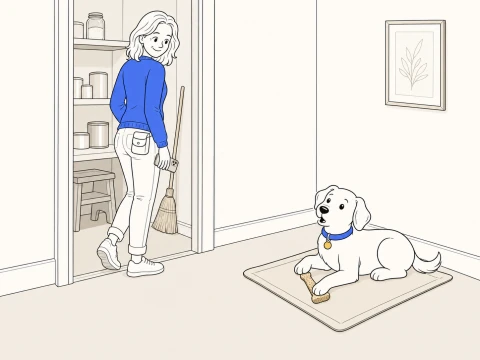
Not necessarily — which is why it’s worth watching rather than assuming. Dr. Sung lists both distances in one breath. Having described the puppy who cries at bedtime, she adds that they “may also vocalize when family members go out of sight for short or long periods of time, such as to the bathroom or work.” A puppy who grizzles when you step into the kitchen might be making an ordinary request, or showing the same distress in a smaller dose.
What tells them apart isn’t the noise, it’s what comes with it — and the list to check against is the ASPCA’s, quoted above: pacing, panting, excessive drooling, destruction around doors and windows, indoor soiling, or other signs of distress. A puppy who grumbles for a moment and then goes back to what they were doing shows none of those. If any of them are present, treat the short absence exactly like the long one and get someone qualified to look, rather than reaching for a technique off a page. This isn’t a call you should have to make alone, and it isn’t one we’re going to help you make from here.
How common is it for a puppy to whine when left alone?
Common enough to be unremarkable — but the published numbers disagree so widely that any confident percentage should make you suspicious. The closest study to your situation is the Generation Pup cohort: Dale, Burn, Murray and Casey, in Animal Welfare in 2024, followed puppies to six months and found 68 of them, 46.9%, showing at least one separation-related behavior of any kind. Whining specifically, reported only when the dog was left alone, came in at 7.6% — second behind pacing at 14.5%, ahead of spinning or circling at 6.9%. So roughly one puppy in thirteen was whining when alone and not otherwise; roughly one in two was doing something.
The caveats are large and the authors state them: 145 dogs in the final analysis, owner-reported, a self-selected cohort, a case definition of the researchers’ own choosing. They also note that estimates across the wider literature run “from 6 to 55%” — a spread that’s itself the finding. What the numbers are good for is a smaller, sturdier point: a puppy who struggles with being left is ordinary, and it isn’t evidence you did something wrong.
Who should I call about separation distress?
Your vet first, because pain sits underneath more behavior cases than most people expect. Then a certified behavior consultant: IAABC-certified consultants at iaabc.org are a good place to look. Worth knowing what that credential commits them to, since you’re handing over a frightened animal — the IAABC’s Standards of Practice say that “positive reinforcement should be the primary training strategy,” that the organization “opposes the intentional use of methods involving pain, fear, or intimidation,” and that it “strongly opposes the intentional use of aversive stimuli and requires members to refrain from using shock in training or behavior modification.” A board-certified veterinary behaviorist is the right call where medication may be part of the picture. Our guide to what’s normal and when to get help has the wider version of that line.
You’ll find graduated-departure protocols online, and we’re deliberately not printing one. The versions that work are built around a specific dog’s threshold, assessed by someone watching that dog. A generic version applied to a puppy who is already panicking just rehearses the panic.
How long does puppy whining last?
There’s no dependable published answer, so be careful what you plan around. Chewy’s guide — one of the first pages most people land on — says “a decrease in whining typically occurs after a puppy is in their new home for about a month,” and adds, fairly, that “this timeline can vary depending on the individual puppy and the circumstances in which they are living.” We went looking for the study underneath a figure like that and didn’t find one: Generation Pup counts how many puppies show separation-related behaviors at six months, not how long whining lasts, and nothing we could find measures duration at all. So treat any week count, including that one, as an impression rather than a finding.
What is knowable is more useful anyway: the cause sets the timeline, not the calendar. A need ends the moment it’s met, and if it keeps coming back the schedule is the problem rather than the puppy. Pain resolves on your vet’s timeline, not yours. Frustration ends with the situation. A learned request follows the extinction curve: worse first, then genuinely quieter, provided nobody in the house pays the loud version. And distress at being left is the one to hand to a professional rather than wait out.
Judge it across a week rather than a day, and count the quiet stretches rather than the whines. If nothing has moved after about two weeks of a consistent plan, that isn’t a sign to try harder — it’s a sign the diagnosis was wrong — so start again at needs, pain, frustration, excitement, a learned request and distress at being left, and work down more slowly.
The short version
Whining is a signal, not a fault. Check the boring things first — bladder, food, comfort, something out of reach, sleep, and whether it only happens when you’re gone. Treat anything new or sudden as a vet question, and remember that pain can leave a whining habit behind after the pain itself is gone. Ignore only the learned request, and only if you can hold through the burst. Never scold it — you either pay it or you make it worse.
Here’s the honest boundary. ClickerPup doesn’t run your nights, crate train your dog, or treat separation problems. Whining isn’t a skill, so there’s nothing in it for a clicker to shape directly, and we aren’t going to pretend otherwise on a page you found because the house is noisy.
What ClickerPup does coach is the other half of every answer above: the thing you want your puppy to do instead. Clicker training gives you a marker precise enough to pay a two-second pause of quiet before it turns back into noise, and the app plans short sessions around what your dog actually did last time — sit, settle, hand target, leave it. A puppy with a polite way to ask has much less use for a loud one. The clicker stays free forever, with a plain reminder before anything ever charges.
Claim my early spot and we’ll bring you in as we open up.