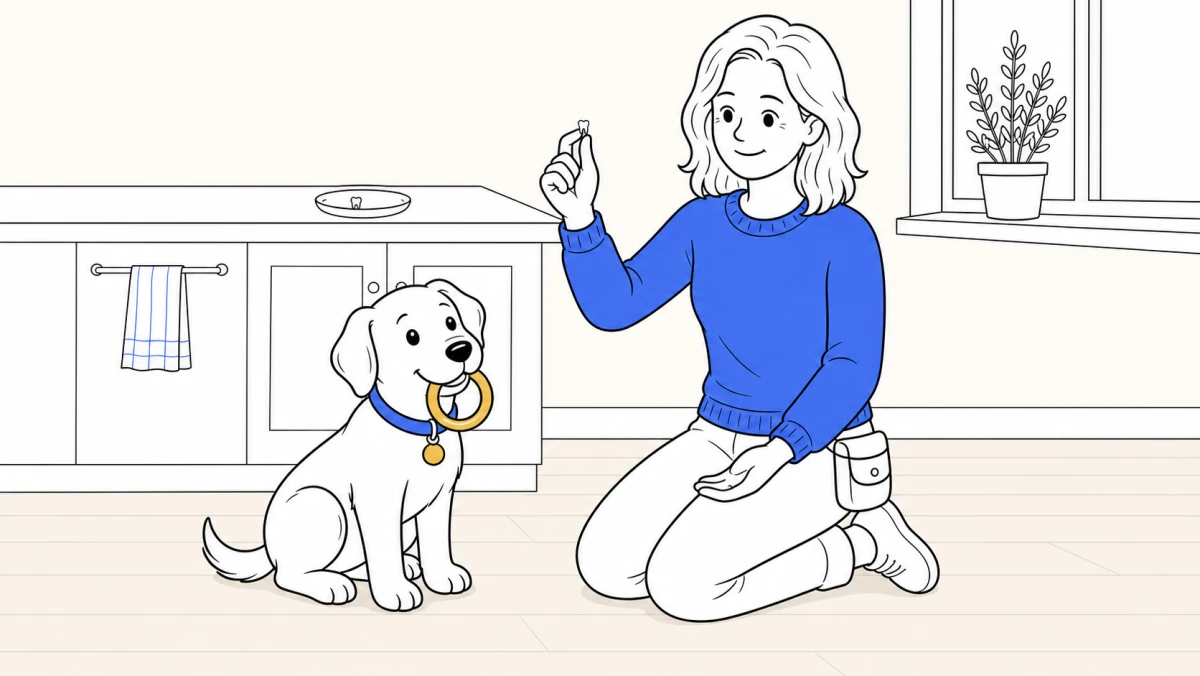
Puppy teeth start falling out around three to four months old, and the full set of 42 adult teeth is normally in by six to seven months. But if you’re really asking when the chewing stops, that’s a different, more honest question — the sore-gum kind of chewing ends with the teeth, and the general urge to chew keeps going for months after, easing gradually rather than switching off on a specific day.
If you’re mid-teething right now — stepping over shredded cardboard, finding a tooth on the kitchen floor, wondering if the blood on the chew toy is a problem — the two questions in that title feel like the same one. They’re not quite. One is biology on a fairly predictable schedule. The other is behavior, and it runs longer than the teeth do. This page answers both, with the actual timeline underneath each one, sourced to the vets and organizations who’ve published it.
When do puppy teeth start coming in?
Baby (deciduous) teeth start emerging around two to four weeks old, while your puppy is still with their mother and littermates — the American Kennel Club’s own teething timeline places it at “weeks 2 to 4,” and PetMD and VCA Animal Hospitals both put the start a little later, closer to three weeks. By somewhere around five to eight weeks, the full set is in: puppies grow 28 baby teeth, all sharp, all temporary.
None of this happens where you can see it. It’s why almost nobody searches for it before their puppy comes home — the first set of teeth is done and settled by the time you meet your puppy. The questions start with the second set.
When do puppy teeth fall out?
Baby teeth start loosening and falling out around three to four months old (12 to 16 weeks), as the permanent teeth underneath begin pushing them out — both the AKC and VCA place the start of shedding here. PetMD’s own timeline runs a little later, putting the start of baby-tooth loss at three-and-a-half to five months; that gap between sources is a useful reminder that these are averages your puppy doesn’t have to hit on the day.
The order is fairly consistent once it starts, according to PetMD veterinarian Mallory Kanwal, DVM, DAVDC: adult incisors and canines come in first, usually between three and five months; premolars follow at four to six months; and molars — which don’t have baby-tooth predecessors, so nothing has to fall out first — come in last, at five to seven months. Most puppies are fully done, all 42 adult teeth in, by six months. Some run a month longer, and PetMD is explicit that “notable variation among individual dogs and breeds” is normal, not a sign anything’s wrong.
What’s the full puppy teething age chart?
Puppies grow 28 baby teeth in total, and go on to grow 42 permanent teeth as adults. Here’s the same timeline as a chart, sourced line by line rather than as one uncredited table:
| Age | What’s happening | Source |
|---|---|---|
| 2–4 weeks | Baby (deciduous) teeth start coming in | AKC, PetMD, VCA |
| 5–8 weeks | All 28 baby teeth are in | AKC, PetMD, VCA |
| 12–16 weeks (3–4 months) | Baby teeth start loosening; permanent teeth begin erupting | AKC, VCA |
| 3–5 months | Adult incisors and canines come in | PetMD |
| 4–6 months | Adult premolars come in | PetMD |
| 5–7 months | Adult molars come in | PetMD |
| 6–7 months | All 42 permanent teeth are normally in | AKC, PetMD, VCA |
Treat the age bands as overlapping, not sequential boxes — a puppy can be losing incisors and cutting premolars in the same week. What matters for your own puppy is the direction of travel, not hitting a date.
What are the stages of puppy teething?
Three stages, and only the middle one is visible to you.
Stage 1 — before you’re home (2 to 8 weeks). All 28 baby teeth erupt and settle in. You never see this stage; it’s finished by the time most puppies go to their new home around eight weeks.
Stage 2 — the shedding stage (roughly 3 to 6 months). This is teething as most owners actually experience it: baby teeth loosen and fall out, permanent teeth push up underneath, and chewing intensifies because gnawing on something firm relieves the pressure and discomfort of a tooth working its way through the gum — VCA describes this as chewing that “seems to alleviate what is assumed to be discomfort associated with the teething process.” This is also the stage where you’ll find small, sharp teeth around the house, and notice drool or tiny spots of blood on toys.
Stage 3 — settling in (5 to 7 months). The last molars come in, the mouth finishes filling out, and the sore-gum driver behind the heaviest chewing goes away. This is the stage most “when does it stop” searches are really asking about — and the honest answer is that the teeth finish here, but the chewing habit doesn’t fully stop here. More on that below.
Is it normal for a teething puppy’s gums to bleed?
A little bleeding is normal and expected. The AKC names two specific signs that come with a tooth working loose: “drooling” and “little spots of blood on their toys.” Both are the ordinary trace of a baby tooth detaching from the gum as the permanent tooth pushes it out — not an injury.
What isn’t normal is bleeding beyond that trace, or a puppy who stops eating or seems unwell alongside it. The AKC’s own guidance is plain: “if you notice anything unusual, talk to your veterinarian since both symptoms could also be related to a more serious issue.” That’s a low bar deliberately — a quick call costs you nothing, and a genuinely sore mouth is worth ruling out rather than guessing about.
Cold helps while it’s happening. The ASPCA suggests “ice cubes, special dog toys that can be frozen or frozen wet washcloths to chew, which might help numb teething pain” — the same advice that applies whether your puppy is chewing a toy or your hand. If the hand-chewing is the part you’re dealing with today, the plan for puppy biting covers redirecting that in the moment.
When should you call the vet about your puppy’s teeth?
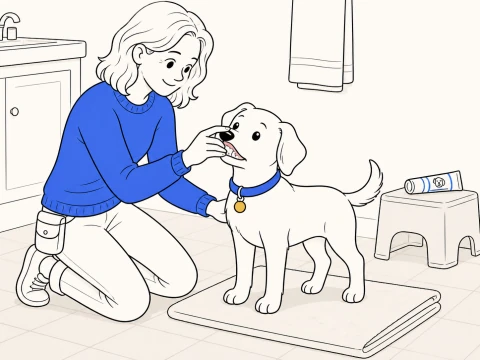
Mostly for one specific thing: a retained, or “persistent,” baby tooth — a baby tooth still sitting in place after the adult tooth beside it has already come in. VCA Animal Hospitals defines it plainly: “A deciduous tooth that is still present when the permanent tooth erupts is referred to as a persistent tooth.” Since puppies typically have all their adult teeth by six to seven months, VCA recommends checking your puppy’s mouth weekly out to seven or eight months, and getting any baby tooth still visible after that timeframe looked at.
It’s worth the check because a retained tooth isn’t just cosmetic. VCA’s Dr. Lorraine Hiscox, DVM, FAVD, Dip. AVDC — a board-certified veterinary dentist — and her co-authors list the downstream effects: crowding that can push the adult tooth out of its proper position, food and debris trapped between the teeth, a higher risk of tartar and gum disease, and in some cases tooth fractures from the abnormal contact. Small-breed and brachycephalic dogs (bulldogs, pugs, Boston terriers, boxers) run a higher risk, and the upper canines are the tooth most often affected, followed by the lower canines and incisors. The fix, when it’s needed, is straightforward: extraction under general anesthesia, ideally before the adult tooth has drifted out of position.
Outside of that one scenario, a puppy who’s drooling more, chewing everything in sight, and occasionally leaving a speck of blood on a toy is doing exactly what teething looks like. You’re not missing something by not calling the vet for that.
When does puppy chewing actually stop?
This is the question underneath most of the searches that land here, and it has a more honest answer than a single date. Teething-driven chewing — the kind caused by sore gums and a mouth full of new teeth — is largely over by six months. The ASPCA states it directly: “This intensified chewing phase usually ends by six months of age.” Humane World for Animals agrees on the window, saying puppies “teethe for about six months.”
The chewing itself keeps going well past that six-month teething mark, though, and treating six months as the finish line is where a lot of owners get blindsided around month seven or eight. Royal Canin describes what comes next as an “adolescent chewing” phase, distinct from teething, that “may continue until your puppy is around a year old.” VCA veterinarian Richard Lerner, DVM, MPH, and his co-authors put the tail end even later: “Excessive chewing behavior seems to subside around 18 months of age” — and add that it continues at a lower level for life after that, never fully switching off.
Stack the three answers and the honest picture is a taper, not a cliff: the sore-gum urge that makes teething so intense is mostly gone by six to seven months; the broader “puppy chews everything” phase usually keeps easing through the following six to twelve months; and ordinary, occasional chewing is just something dogs do, for as long as they’re dogs. If your nine-month-old is still going through the mail, that’s not teething come back — it’s the entirely normal next stage, and it’s still getting better, just more slowly than the first phase led you to expect.
What’s the difference between teething and destructive chewing?
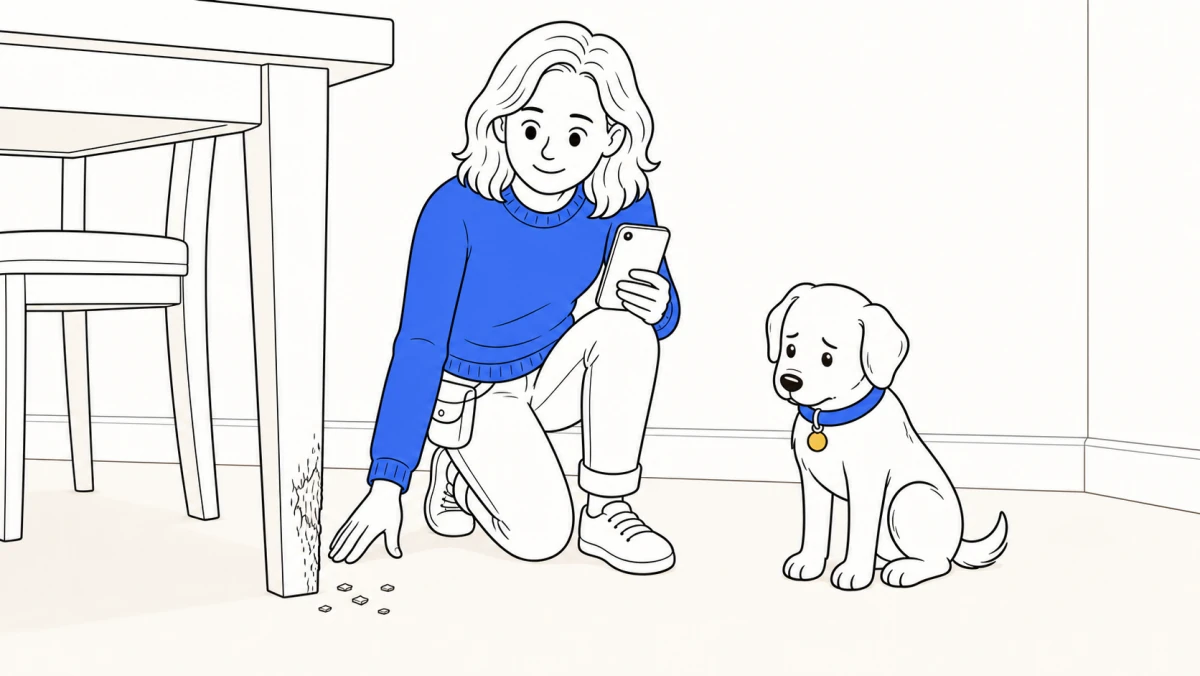
They’re related but not the same question, and this page and How do you stop a dog chewing furniture? answer two different ones that get typed the same way. This page is the developmental timeline: when teething starts, what the stages look like, when it’s normally over, and what’s worth a vet call. That page is the troubleshooting guide for what to actually do about the chewing itself, at any age — because teething is only one of four things that drive it, alongside boredom, an ordinary chewing need with nothing legal to aim it at, or distress at being left alone.
If you’re here because of the damage — a table leg, a baseboard, a favorite pair of shoes — that page has the diagnostic table and the management plan. If you’re here because you want to know whether what you’re seeing is normal and how long it lasts, you’re in the right place.
How do you help a teething puppy in the meantime?
Supply something better to chew, and supervise. That’s most of it, while the season passes. Beyond the cold-chew tip above, keep legal chew items in every room your puppy has access to, so the choice in the moment is between “the thing I’m allowed to chew, right here” and “the thing I’m not,” rather than nothing being available at all. Rotate what’s on offer every few days — a chew that’s been available all week stops being interesting, which is when the couch starts looking novel by comparison.
This page deliberately doesn’t turn into a shopping list. What’s “safe” and “appropriate” varies by your puppy’s size, age, and how hard they chew, and that’s a better question for your own vet than for a generic list of products. If the destructive side of the chewing is the part you need a plan for, How do you stop a dog chewing furniture? covers supply, rotation, and what to do about a deterrent spray.
What if the chewing seems like more than teething?
If it’s paired with real distress — chewing that only happens when your puppy’s alone, panic at being left, or your puppy chewing at their own paws — that’s not a teething question, and this page isn’t the place to work through it. Those are worth a closer look with your vet first, and is my puppy normal, or should I get help? covers where the line sits and what to do about it.
The short version
Baby teeth are in by about two months old, before you’ve met your puppy. They start falling out around three to four months, and the last adult molar is usually in by six or seven. The sore-gum chewing that comes with all of that mostly ends there too — but the broader urge to chew everything in sight tends to taper off for months longer, sometimes into your puppy’s second year, before it settles into the ordinary background chewing that adult dogs never fully give up.
None of that is a skill ClickerPup coaches — there’s no clicker cue for growing a tooth faster, and this page won’t pretend otherwise. What the app does teach, sized into two-minute sessions, is the trainable slice sitting right next to it: leave it, drop it, and the trade, so your puppy learns what’s actually okay to put their mouth on. The clicker stays free forever, with a plain reminder before anything ever charges.
Claim my early spot and we’ll bring you in as we open up.