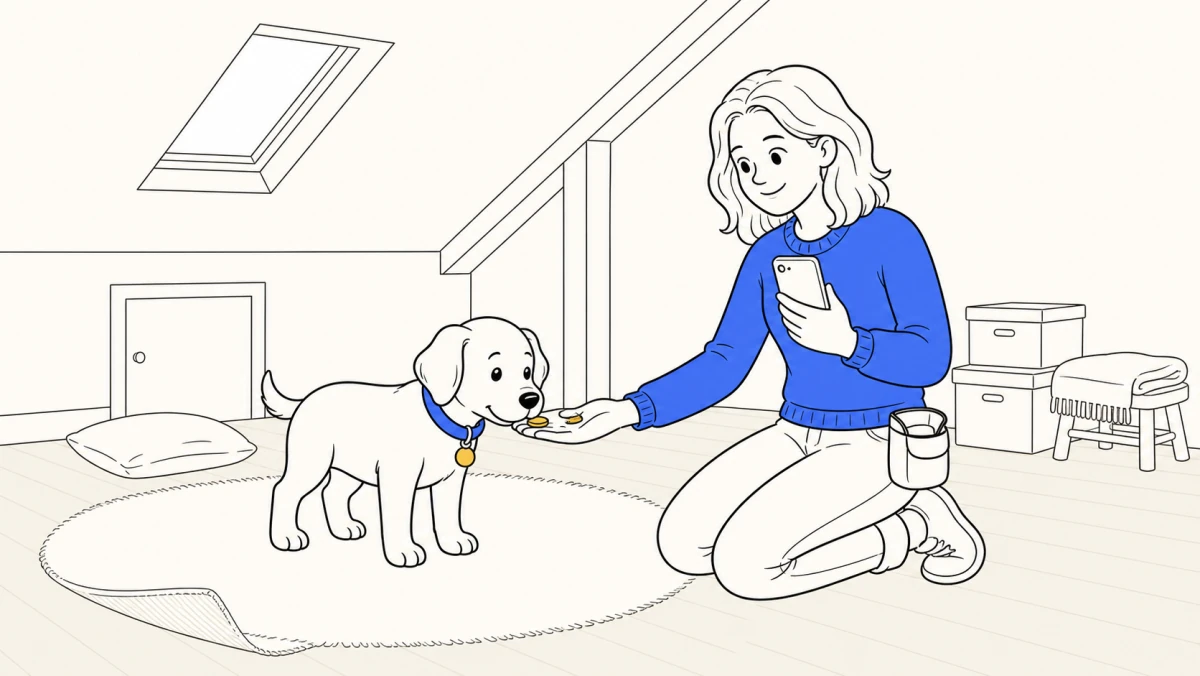
Bite inhibition is a dog’s control over how hard it closes its mouth — a calibrated jaw, not an absence of mouthing. You can teach a puppy to mouth more gently. Whether that makes an adult dog’s bite less damaging is a widely repeated claim that the field is openly split on and no study has settled.
That second sentence is the one nobody puts on the page, and it’s the reason you’ve read four articles that all sound certain and still don’t agree. If you’re here because someone told you that you have a narrow window to teach this and you’re already at week eleven with scratched-up forearms — you have not ruined anything. What follows is what each side actually claims, what the evidence does and doesn’t cover, and what’s worth doing with the ten minutes you’ve got. For the in-the-moment plan when teeth land on skin, our guide to stopping puppy biting without punishment is the one to read first; this page is about the concept underneath it.
What is bite inhibition in a puppy?
Bite inhibition is how hard a dog closes its mouth when its mouth is on something — a calibrated jaw rather than a jaw that stays shut. Ian Dunbar, the veterinarian and trainer who popularized the term, defines it in a way worth reading twice: “Good bite inhibition does not mean that your dog will never snap, lunge, nip, or bite. Good bite inhibition means that should the dog snap and lunge, his teeth will seldom make skin contact and should the dog’s teeth ever make skin contact, the inhibited ‘bite’ will cause little, if any, damage.”
Read carefully, that definition is about force, not frequency. A dog with a soft mouth still has teeth and still uses them. It’s the pressure behind them that’s supposed to be dialed down. Almost every argument about bite inhibition online is really two people using the same phrase for two different things — one meaning “my puppy stopped biting,” the other meaning “my dog’s jaw is calibrated.”
Why is the goal a soft mouth instead of no mouthing at all?
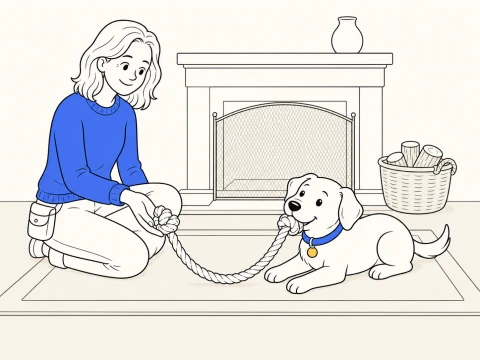
Because on Dunbar’s account, a puppy who never mouths never gets the feedback that calibrates the jaw. His framing is blunt: “Puppies bite—and thank goodness they do. Puppy biting is a normal, natural, and necessary puppy behavior. Puppy play-biting is the means by which dogs develop bite inhibition and a soft mouth.” He goes further, and this is the part most owners find counterintuitive: “It is the puppy that does not mouth and bite as a youngster whose adult bites are more likely to cause serious damage.”
That is Dunbar’s stated position, not a research finding — a distinction this page applies to every claim on it, including his. It also explains why “stop all mouthing immediately” and “teach bite inhibition” are, in his system, opposite instructions, and why so much of the advice you’ve read contradicts itself. His own sequence runs in a fixed order, and one of his articles carries it as a subheading: “Inhibit Force Before Frequency.” Softer first, then less often — most advice runs the two together, or skips straight to the second. And if your puppy is at full boil rather than playing, that’s arousal rather than calibration: the witching hour is its own problem with its own fix.
Where do puppies learn bite inhibition — the litter, the mother, or you?
Nobody has established this either, and it’s worth knowing that the answer you’ve read everywhere — the littermates — is the one a certified trainer has publicly argued gets cause and effect backwards. The candidates on the table are the litter, the mother in the first three weeks, something the puppy arrives with, and you. No study picks between them.
The ASPCA gives the version most people have heard: “Puppies usually learn bite inhibition during play with other puppies. If you watch a group of puppies playing, you’ll see plenty of chasing, pouncing and wrestling. Puppies also bite each other all over.” Bite too hard, the game stops, the lesson lands.
Kama Brown, CPDT-KA, writing in the IAABC Foundation Journal, names that same ASPCA page as one of the sources she is rebutting, and reads the research as pointing the other way: “Nothing in the research suggests that the puppies learned to inhibit their bites through play-fighting.” Her reading is that “It was the fact that puppies already had bite inhibition which allowed the play-fighting to influence species identification” — the soft mouth came first and made the play possible, not the reverse. Her alternative is offered as an inference, not a result: “This suggests that bite inhibition is either learned directly from the mother in the first three weeks or that it is an innate behavior.”
If Brown is right, the most-repeated explanation in puppy content has cause and effect backwards, and much of what happens in the litter is being credited with a job it didn’t do. Pulling the other way is what practitioners report seeing: on Benson’s page, “a gradual reduction of bite pressure is what puppy class instructors see, in thousands upon thousands of puppies.” Neither observation is a study, and they can’t both be the last word — which is roughly the state of this entire topic.
When does the bite inhibition window close?
Dunbar puts it at eighteen weeks — four-and-a-half months — and treats it as a deadline: “Bite inhibition must be established in puppyhood, before eighteen weeks of age, since it is difficult to instill bite inhibition in an adolescent or adult dog.” That date is genuinely his. It is the Fifth Developmental Deadline in his book AFTER You Get Your Puppy, where he ranks it first in importance among everything a puppy has to learn. It is a framework, though, and not a finding — no study fixes the date.
He isn’t alone on the direction, only on the precision. Kristi Benson of the Academy for Dog Trainers reaches a similar conclusion by a route worth noticing — an absence rather than a result: “It does appear that once puppies are past the socialization window, ABI is not modifiable, based on the lack of any known successful attempt to modify ABI in adult dogs.” Nobody having managed it yet is a weaker claim than nobody being able to, and she says so.
The same over-precision shows up in the neighboring number: the socialization window gets quoted as a hard wall too, and what the research actually says about the socialization window is fuzzier than the countdown clocks suggest. AVSAB’s own position statement on puppy socialization uses a period, not a cutoff — “The primary and most important time for puppy socialization is the first three months of life” — and recommends puppy classes on socialization grounds. Treat eighteen weeks as one trainer’s urgency ranking, not a door slamming.
Does teaching bite inhibition really prevent serious bites later?
Nobody knows, and the field is openly split on it. Ian Dunbar, who originated the framework, calls bite inhibition “the single most important item on the educational agenda of any pup” and holds that “when good bite inhibition has been firmly established in puppyhood, when the dog is provoked as an adult, he seldom causes harm and consequently, rehabilitation is comparatively easy and safe.” Kama Brown, CPDT-KA, writing in the IAABC Foundation Journal, puts the counter-case just as plainly: “Bite inhibition training gives the public the impression that dogs who play with other dogs as puppies are safer towards humans as adult dogs and that simply has no evidence to support it.”
Dunbar’s version has been in print since his behavior column in the November 1993 American Kennel Gazette, and the case he makes is clinical rather than experimental. The accidents that provoke a bite are, by definition, the ones you didn’t plan for — the case histories he lists in AFTER You Get Your Puppy include a car door shut on a dog’s tail, a woman in heels stepping on a sleeping Rottweiler’s thigh, and a visitor tripping headlong into an Airedale chewing a bone. Since you can’t prevent all of those, his argument runs, the one variable left is how much damage the jaw does when it happens. It’s a coherent argument. It just isn’t a tested one.
Why do trainers disagree about bite inhibition?
Because one side is arguing from clinical experience and the other is arguing from the absence of studies, and those two things can both be honestly held at once. Neither camp has an experiment to point at.
Brown’s objection targets the mechanism as much as the promise. She asks what actually teaches a dog to have bite inhibition, lists the answers the field usually gives — playing with other dogs, puppies playing with puppies under 16 weeks of age, play-fighting with humans, humans teaching a soft mouth, shaping — and dismisses all five in one sentence: “There is no research to suggest that any of this is true.” So on her account there is no established payoff and no established route to it.
And from a third position — a trainer who does run the protocol — Kristi Benson of the Academy for Dog Trainers makes the same admission in her own explainer: “Unfortunately, research on acquired bite inhibition is scant.”
| The question | Dunbar’s position | Brown’s position |
|---|---|---|
| Where it comes from | Play-biting with people, dogs and other animals | Innate, or from the mother in the first three weeks |
| Can you train it? | Yes — and it’s the top priority before 18 weeks | You can train when and where, not the ability itself |
| Puppy group play | The main reason to attend off-leash puppy class | Should be dropped from class until evidence supports it |
| Evidence offered | Clinical experience and case histories | The absence of research supporting the claim |
Notice what nobody is arguing about. Neither side wants you to punish a puppy for using its mouth, neither thinks hard biting should be ignored, and both want the puppy meeting appropriate dogs. The fight is over what you’re buying — and that matters, because it decides whether “he’s had puppy class, he’ll be fine” is a reasonable thing to believe about a grown dog. On the evidence, it isn’t.
Does yelping teach a puppy bite inhibition, or make it worse?
For some puppies it interrupts the bite. For others it is the best thing that has happened all day, and the biting gets worse. The ASPCA recommends the yelp and then builds in its own escape hatch. Ohio State’s Indoor Pet Initiative gives the clearest decision rule we found: “If your puppy looks fearful or cowers you should avoid the ‘ouch’. Also, some dogs perceive the ‘ouch’ as fun and attention and may inadvertently find it rewarding. Avoid the ‘ouch’ if mouthing increases.”
The ASPCA’s instruction itself is specific — “When he does, immediately give a high-pitched yelp, as if you’re hurt, and let your hand go limp” — and the escape hatch follows almost immediately: “(If yelping seems to have no effect, you can say ‘Too bad!’ or ‘You blew it!’ in a stern voice instead.)” It also concedes that “If you find that yelping alone doesn’t work, you can switch to a time-out procedure.” Read that as an organization documenting a method it knows fails on some dogs. We’d skip the stern-voice variant, for a reason the next section makes plain.
And a case study on Benson’s page — presented by Academy graduate Kristy Francis, in her own words — is the version that never makes it into the listicles: “I yelped and briefly moved away from her to end play when she delivered a hard play bite. In this case, the yelping and ending of play did not result in softer bites.” What moved the needle with that puppy was a time-out: “When she bit hard, a cue was issued and she was placed in timeout for 30 seconds to 1 minute.”
How do you tell whether the yelp is working on your puppy?
Watch the ten seconds after it, once. The usable version of this advice isn’t “yelping works” or “yelping is a myth” — it’s that a single repetition tells you which puppy you have, and you change your approach on that evidence rather than on a script.
| What your puppy does in the next ten seconds | What it means | What to do |
|---|---|---|
| Stops, backs off, re-engages more gently | The interruption landed | Keep it, and keep it quiet — one flat “ouch,” not a performance |
| Ramps up, gets louder, bites harder | You just became a squeaky toy | Drop the noise entirely; silent withdrawal or a brief time-out instead |
| Freezes, ducks, cowers, looks worried | It’s landing as a scare, not information | Stop using it — this is the one to abandon immediately |
The third row is the one that matters most, and it’s the one the popular advice never mentions. Frightening a puppy is not a training method: AVSAB’s position on humane dog training is unambiguous that “The application of aversive methods – which, by definition, rely on application of force, pain, or emotional or physical discomfort – should not be used in canine training or for the treatment of behavioral disorders.” A stern voice is a small step in that direction, which is why we’d leave it alone.
Worth drawing one line clearly, since our own guide is titled without punishment: stopping the game is not the thing AVSAB rules out. What’s ruled out is force, pain, and frightening a dog. Taking your hands and your attention away for thirty seconds is the mildest tool in this entire argument, and it’s the one both camps can live with.
How can you tell if a puppy has good bite inhibition?
Honestly, you can’t measure it — and you should never try to find out by provoking a bite. There is no home test and no threshold. What you can do is notice a trend across ordinary handling over several weeks: whether the pressure in play mouthing is dropping, whether your puppy lets go and resets when you go still, and whether food is taken off a flat palm without your fingers being collected too.
Trend beats snapshot. One bad day in a teething week is noise; six weeks with no change in pressure is a signal worth taking to a professional rather than a personal failing to sit with.
And the caveat that belongs on every page about this and appears on almost none of them. Brown’s closing recommendation is that owners be taught that “all dogs can bite with the full force of their physical ability and that nothing we know can fully predict that they never will, which is why lowering fear and stress, and respecting lower-level aggressive behavior such as growling is vital to reducing the numbers of dog bites.” A soft mouth is not a safety guarantee, and it is never a reason to leave a dog and a small child unsupervised.
What if my puppy left the litter early?
The best-known study on early separation did measure play biting, and it did find more of it — but only inside one subgroup, and it never measured bite force, because it was a questionnaire filled in by owners rather than anything instrumented.
Pierantoni, Albertini and Pirrone (Veterinary Record, 2011) asked the owners of 70 adult dogs adopted at 30 to 40 days, and 70 adopted at around two months, about sixteen behaviors — play biting among them. Age at separation on its own was associated with seven of the sixteen: destructiveness, excessive barking, fearfulness on walks, reactivity to noises, toy possessiveness, food possessiveness and attention-seeking. Play biting was not one of the seven.
Where it did separate was among dogs bought from pet shops. Franklin McMillan’s 2017 review in the Journal of Veterinary Behavior tabulates that split: of the pet-shop dogs whose owners reported play biting, 87% had been separated early and 13% had not (P = 0.032). Read that as a direction, not a risk figure — it is a composition rather than a rate, and the table publishes no group denominators to turn it into one. McMillan’s summary of the same study notes that “the source of the dog was not significantly associated with the behavioral categories examined,” so the pet-shop pattern sits inside that study rather than settling anything about where dogs come from.
Two caveats to carry with it: the data are owner-reported and retrospective, and the pet-shop finding is a subgroup result, which is the kind that most often fails to reappear. And note what none of it can tell you — how hard your adult dog will bite. Whatever the litter did or didn’t do is behind you. The dog in front of you is the one you can work with.
If the evidence is thin, what’s actually worth doing?
Everything both camps already agree on — which turns out to be most of the practical advice, minus the promise attached to it.
- Let the mouthing happen, and let hard bites end the game. Teeth get sharp, the interaction pauses for a few seconds, then resumes. Not a scolding and not a wrestle. Nobody in this argument objects to that; what they disagree about is what it buys you later.
- Pick your interrupter by what your puppy does next, using the table above, and switch after one bad repetition rather than ten. If the noise makes it worse, go silent for a week and see.
- Get the social exposure right rather than just frequent. AVSAB backs puppy classes on socialization grounds; Brown would rather that time went to “appropriate, tolerant and adult dogs—ideally that are likely to be in the puppy’s life regularly—for their puppy to socialize with.” Both roads lead to supervised time with dogs who tell the truth about their own boundaries — not a free-for-all.
- Spend the rest of the ten minutes on things you can measure. Teaching a puppy what to do instead is trainable and checkable in a way that jaw calibration isn’t — a hand target, leave it, and drop it each put a mouth-shaped behavior on cue and pay it, and you can tell within a week whether they took.
- Don’t relax supervision because you think you’ve bought protection. This is the practical cost of the myth: an owner who believes puppy class insured the adult dog watches the dog less closely around visitors and children. That’s the belief Brown is worried about, and she’s right to be.
When is a bite not a training problem?
When skin breaks, it stops being a training question. A bite that punctures skin is a matter for a doctor before it is a matter for a training plan, and whether it also has to be reported is a question for your vet or your local animal-control office — the rules are not the same everywhere, and they are not ours to interpret.
For context on how professionals grade this, Dunbar’s own six-level bite scale — published in its authorized form by the Association of Professional Dog Trainers — runs from Level 1, “Obnoxious or aggressive behavior but no skin-contact by teeth,” through Level 2, “Skin-contact by teeth but no skin-puncture,” to Level 3, “One to four punctures from a single bite with no puncture deeper than half the length of the dog’s canine teeth,” and upward from there. His own assessment of the distribution is that “Levels 1 and 2 comprise well over 99% of dog incidents,” where “The dog is certainly not dangerous and more likely to be fearful, rambunctious, or out of control.” That’s his clinical framing rather than a public-health dataset, but it’s the right corrective to the panic: the overwhelming majority of what frightens owners never breaks skin at all.
Separately from severity, some things aren’t mouthing at all and need a professional now, not a protocol: a stiff, frozen body; a hard stare; growling over food, chews or toys; any bite to a child’s face; broken skin from a dog past puppyhood; or biting that escalates rather than eases across several weeks. Our guide to what’s normal and when to get help covers where the line sits, and IAABC-certified consultants (iaabc.org) are a good place to start — their published standards of practice hold that “positive reinforcement should be the primary training strategy because it promotes learning while minimizing unwanted side effects.”
The honest version
Bite inhibition is a real concept and a useful one: it names the difference between a dog whose mouth is calibrated and one whose isn’t, and that difference is real. The part that isn’t established is the promise stapled to it — that what you do in week ten determines the damage in year four. One camp says it does. Another says the claim has no evidence behind it. A third uses the protocol anyway and admits the research is scant. Anyone telling you it’s settled hasn’t looked.
What that leaves you with is smaller and more useful than the promise: respond to hard bites consistently, pick your interrupter by watching your own puppy rather than trusting a script, get real social exposure, and spend the remaining minutes teaching behaviors you can actually measure.
That last part is the bit ClickerPup is built for, and we should be straight about the boundary: mouthing management isn’t a skill the app ships, and on a page whose honest conclusion is “the headline claim is unproven,” we’re not about to sell you one. What it does coach is the clicker side — marking and paying the alternative behaviors, the impulse-control work, and the fluency ladder that tells you whether your dog has actually got a skill or just did it once in a quiet kitchen. If that’s new, start with what clicker training is and whether it works.
Claim my early spot and we’ll bring you in as we open up.