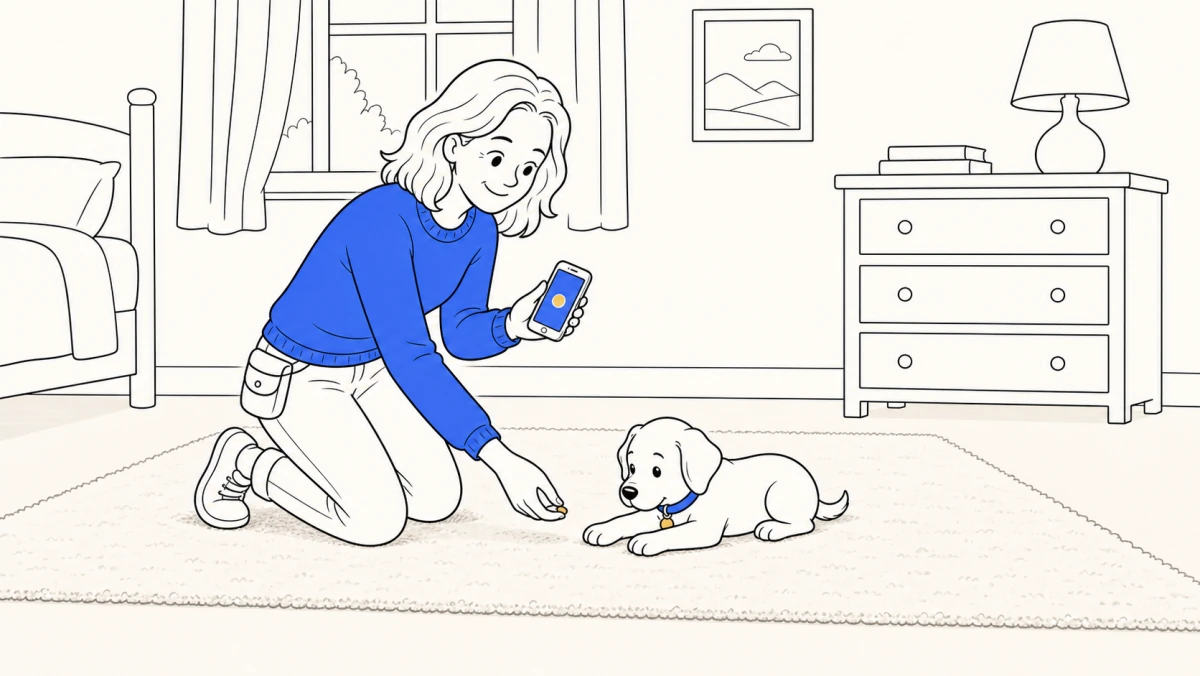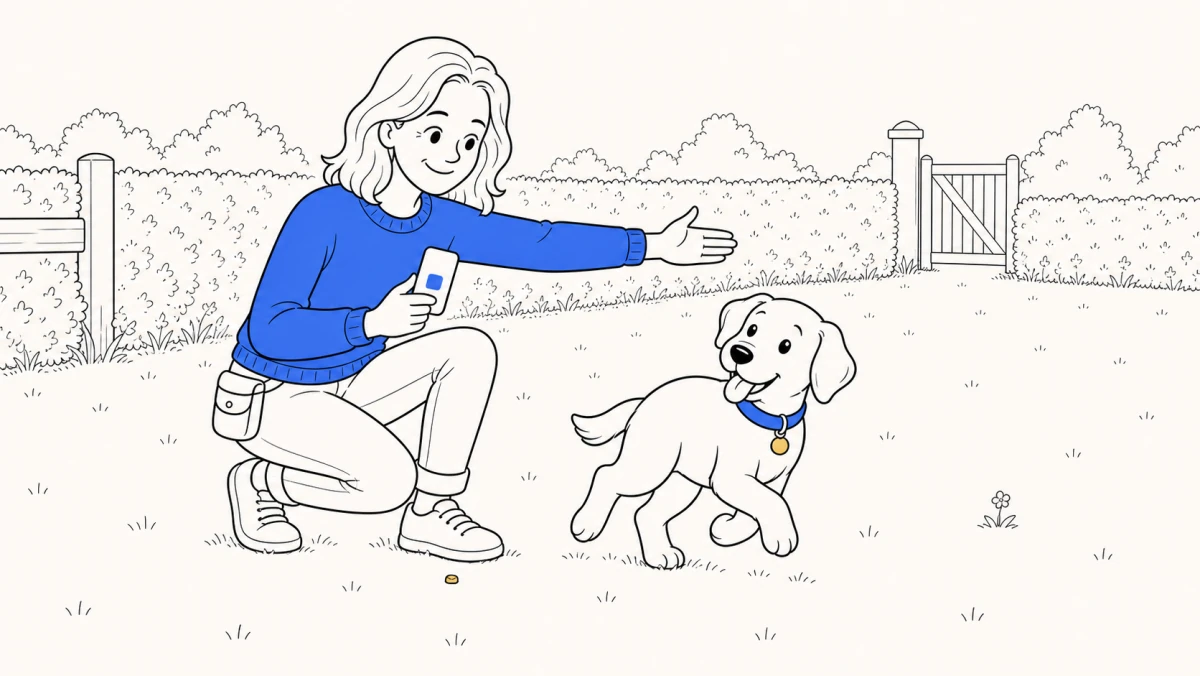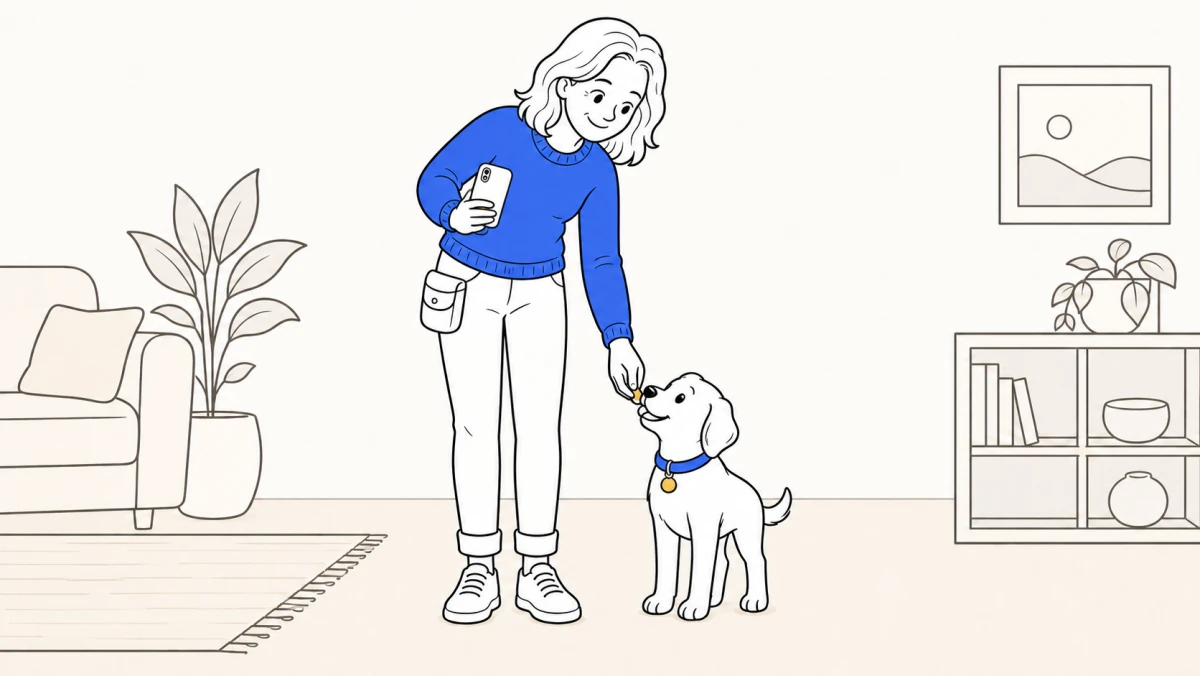
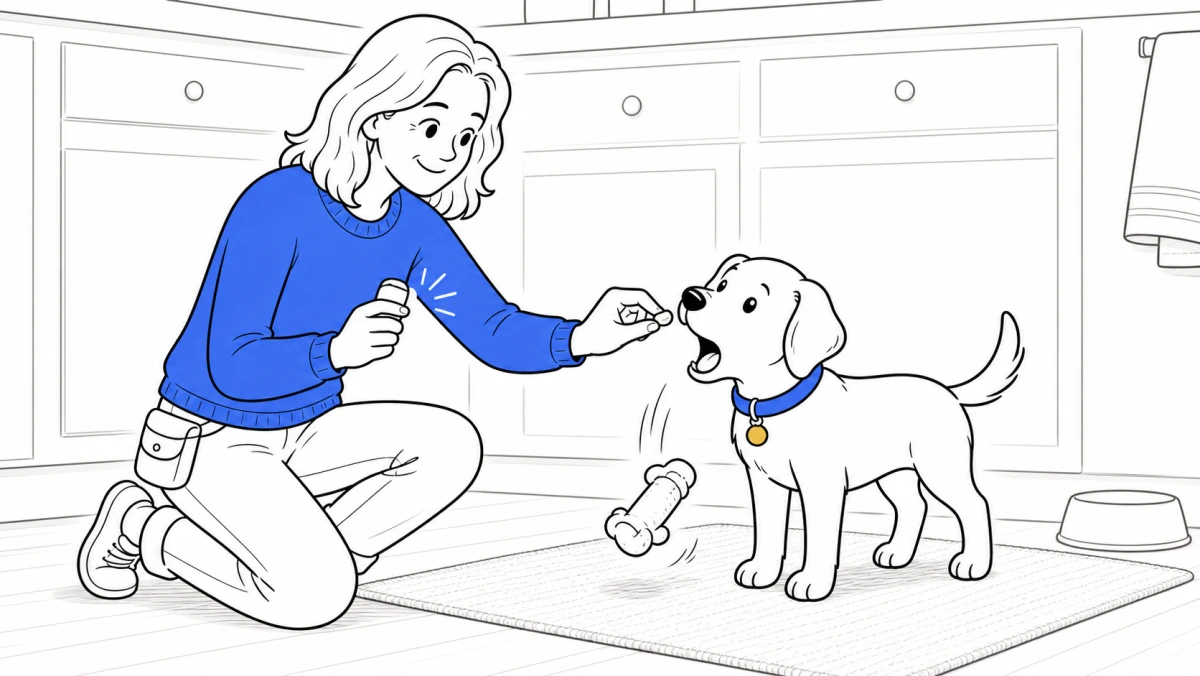
Offer something clearly better than what’s in your puppy’s mouth, click the instant they release, pay — and most of the time give the original toy right back. Drop it is a rewarded trade, not a confiscation: releasing pays, and often pays again with more play.
If you’ve already chased a sock through the living room, dug fingers into a clenched jaw, or yelled “drop it!” while your puppy danced just out of reach — and watched the determination drain into quiet guilt — you’re not failing. You’re usually one mechanic away: make the trade unfairly good, mark the open mouth, and stop teaching that keep-away is the fun part. Here’s the exact method, the failure modes, and how drop it pairs with leave it.
How do you teach a puppy to drop it, step by step?
Start with a low-value object, trade for a high-value treat at the nose, mark the release, pay, then hand the object back — add “drop it” only once the trade is already easy. That is the AKC’s treat-trade sequence: boring item first, never chase, never pry.
- Offer a low-value toy. Let them hold it a few seconds.
- Place a high-value treat at their nose. The instant the mouth opens — click (or say “yes”) — then deliver the treat.
- While they chew, pick up the toy and present it again. Hand it back most of the time so releasing predicts more play, not permanent loss.
- When releases are quick and calm, say “drop it” just before you show the treat.
- Fade the visible treat: cue first, then pay from your pocket. Maddie’s Fund uses the same lure-then-reward progression.
What if my puppy isn’t food-motivated?
Use a second identical toy. VCA and the AKC both endorse animating the new toy until they drop the first, then mark and restart the game — same reward-based trade, different currency.
That still matches AVSAB’s position that “only reward-based training methods” should be used — a trade and a marker, not a tug-of-war over the jaws.
What’s the exact moment to click when teaching drop it?
Click the instant the mouth opens and the object leaves — not while you’re still waving the treat, and not after they’ve already snatched the item back. That half-second is the whole point of a marker.
Timing is not a nicety. In Browne’s 2015 University of Waikato research on delayed reinforcement, dogs succeeded about 60% of the time when the reward came immediately, but only about 25% when it arrived one second late. A marker that bridges that gap still helped learning land. Your hands will never be as fast as a puppy mid-steal; the click buys back the precision you don’t have yet. Pay for the open mouth, then — on safe training objects — give the thing back so releasing stays a double win, exactly as the AKC describes during the teaching phase.
Why won’t my puppy drop it?
The trade isn’t valuable enough, you’re racing them to the fallen toy, or keep-away already pays better than the treat. Fix the economics first — boring object, jackpot pay, give-it-back — before you raise the difficulty.
| What you see | Likely cause | Fix |
|---|---|---|
| Clamps harder when you reach | Trade looks like confiscation | Show the treat first; don’t grab; give the toy back after most reps |
| Runs away with the sock | Chase has become the game | Trade calmly; leash nearby for early practice (AKC); never pursue |
| Only drops when they see food | Cue never faded | Say “drop it,” wait a beat, then produce the treat (AKC fade) |
| Won’t take the practice toy again | Payoff too low | Make the returned toy fun; keep to 4–6 easy trades |
If they dive back on the toy, toss treats aside so you can collect it (AKC / Maddie’s Fund).
Should you chase your puppy or pry their mouth open?
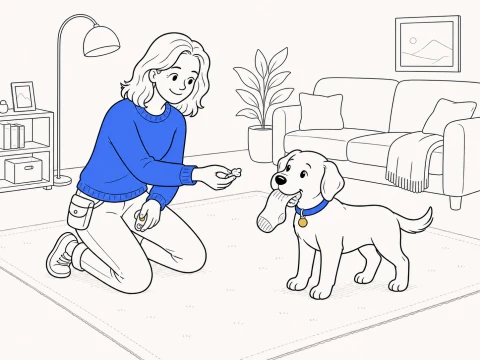
No. The AKC is blunt: chasing turns keep-away into their favorite game and raises the chance they’ll swallow the item; prying risks a bite and can tip toward guarding. Trade instead — show something better, mark the release, pay.
VCA’s behavior team makes the same chase point: many dogs steal household items specifically because the pursuit is rewarding, and the chase/capture cycle can trigger an aggressive response in some dogs. Calm trade breaks that loop. In a real hazard moment (medication, chocolate, cooked bone), still don’t wrestle the mouth — use the best trade you have, then call your vet if anything may have been swallowed. Practice the cue on safe objects so the emergency ask already means “something even better is coming.”
What age can you teach a puppy to drop it?
As early as the week most puppies come home — about 8 weeks, the same early window as other reward-based cues on the first-five commands list. Drop it is a trade game with a marker and a better payoff, not collar pressure. Keep sessions to about two minutes.
That early window matches the basic puppy commands hub. Cold-practice on boring toys first. If the clicker isn’t charged yet, clicker training on day one covers the five-minute test. The same trade shows up in how to stop a puppy from biting without punishment.
How do you use drop it in real life (socks, fetch, contraband)?
Practice cold with boring toys, then mildly interesting household items, then fetch resets — always paying the release, and only confiscating for good when the item is genuinely unsafe.
On fetch, VCA’s guidance is practical: show a second toy or treat as they approach, say “drop it,” and restart the throw the moment they release. On stolen socks, trade for something better, then swap in a legal chew so the mouth still has a job. A puppy who drops a boring chew in the kitchen can look blank with a favorite squeaky in the hallway — drop expectations one notch in each new spot and re-earn a few easy wins there.
How long should a drop-it training session be?
About two minutes and four to six easy trades, then stop while your puppy is still winning. Short sessions that end on a clean success beat one long drill that turns into a tug-of-war.
Build until the boring-object trade is quick and calm before you move to a more interesting toy, then until the spoken cue is reliable in a quiet room before you practice near real household temptations. If you want the research behind short-and-spaced practice, how long puppy training sessions should be covers the timing evidence in one place. For what the marker is doing under the hood, see what clicker training is and whether it works.
How do you pair drop it with leave it?
Leave it means don’t take the thing in the first place. Drop it means open your mouth and release something already held. Teach leave it first as the impulse brake; add drop it once your puppy can trade a toy or chew for something better.
They are siblings, not synonyms. Leave it is the pre-grab brake (closed fist → other-hand pay). Drop it is the post-grab trade (offer something better, mark the release, never pry jaws). The AKC teaches both for the same safety reason: socks and stolen sandwiches need a brake and a release. Leave-it steps live in basic puppy commands; both hub up through that list and the clicker method.
When is drop-it trouble actually something else?
A puppy who stiffens, freezes, growls, or snaps when you approach something in their mouth is not “failing drop it” — that is resource-guarding territory for a certified behavior professional, not harder trades.
Mouthing your fingers in early trades is usually normal teething under about six months. What isn’t: a stiff body, growling over a chew, snapping when you reach, or a bite that breaks skin from a dog older than about six months. Maddie’s Fund: if aggression shows up while teaching drop it, stop and get a positive-reinforcement trainer — IAABC-certified consultants at iaabc.org, or start with what’s normal and when to get help.
What’s the next step after you can trade?
Drop it is one short skill with a clear click-point, one non-negotiable rule (trade, don’t chase), and a real safety job when something unsafe hits the mouth. If having a coach plan today’s two-minute trade session — and catch the moment you almost turned it into keep-away — sounds useful, that’s exactly the gap we’re building ClickerPup to fill.
Claim my early spot and we’ll bring you in as we open up.