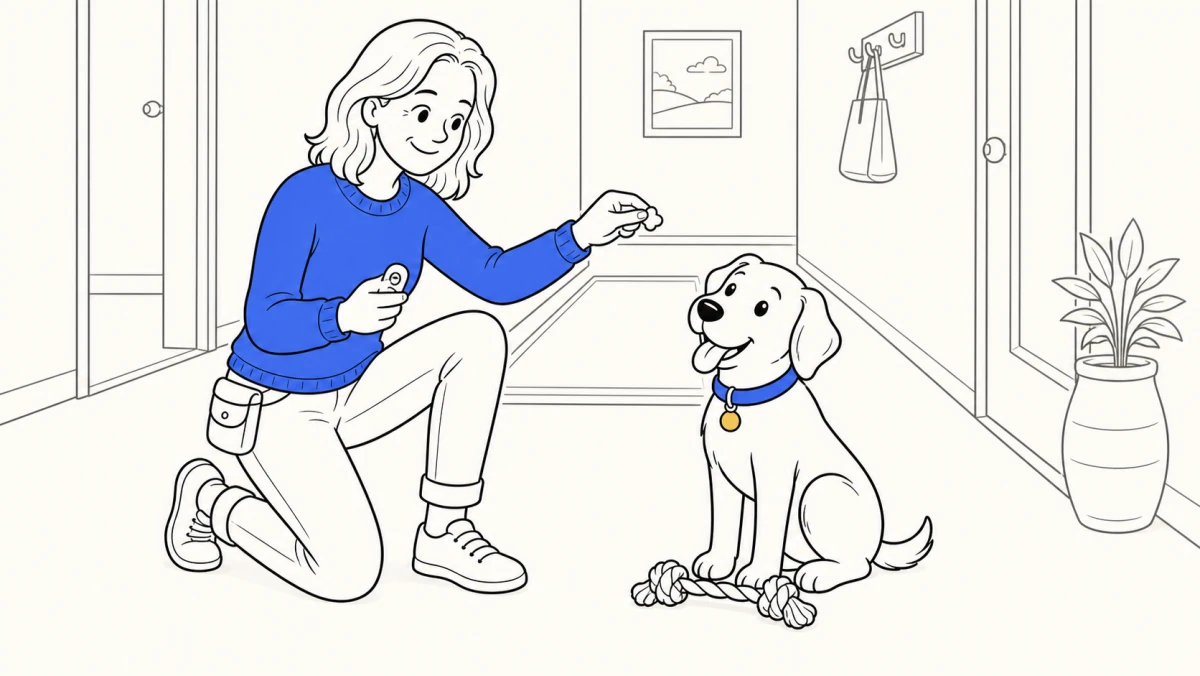
Hold a plain treat in a closed fist near your puppy’s nose, wait, and the instant they stop nosing and back off — click — then pay from your other hand, never the fist they left. Leave it is impulse control as a rewarded choice, not a scold — and if you’ve already yelled it at a sock, a chicken bone, or your own fingers, you’re usually one mechanic away from the version that sticks.
You’re not failing. Click the back-off (not the sniff), raise the difficulty one notch at a time, and keep the payoff coming from somewhere else. Here’s the exact method, the failure modes, and how leave it pairs with drop it.
How do you teach a puppy to leave it, step by step?
Present a closed fist with a treat inside, click the moment of disengagement, and reward from your other hand — then build to a covered floor treat, a briefly uncovered one, and only then the words “leave it.”
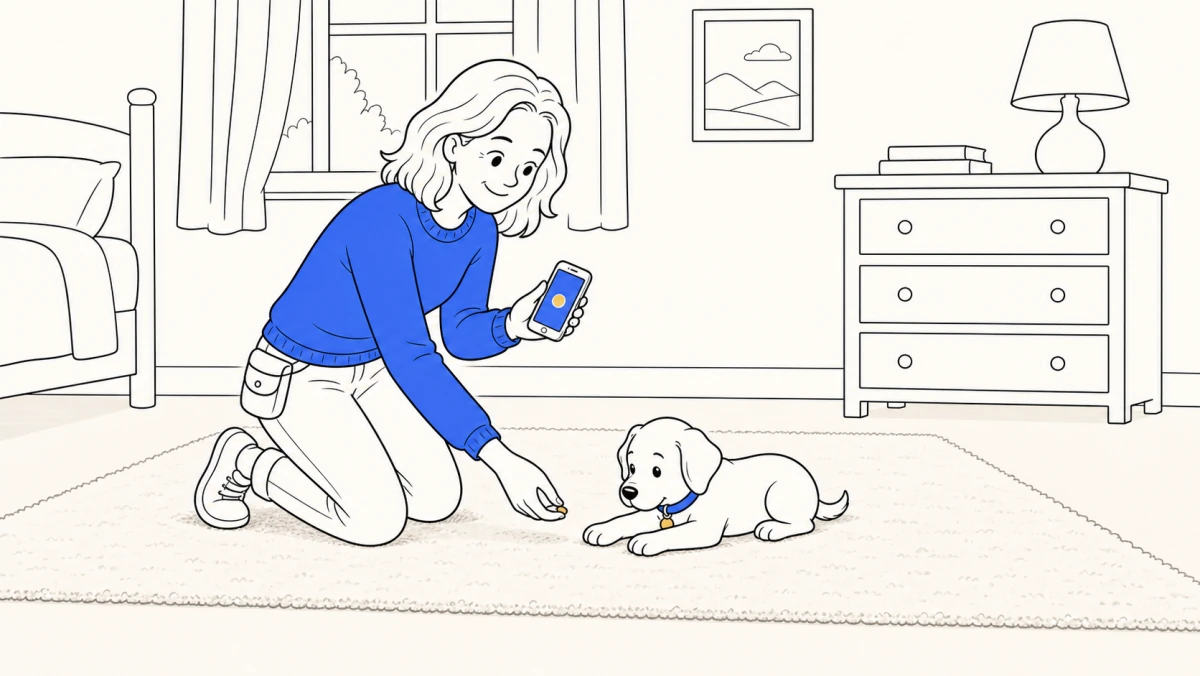
- Hold a plain, pea-sized treat in a closed fist near your puppy’s nose. Wait. Let them sniff, lick, and paw — don’t yank the fist away.
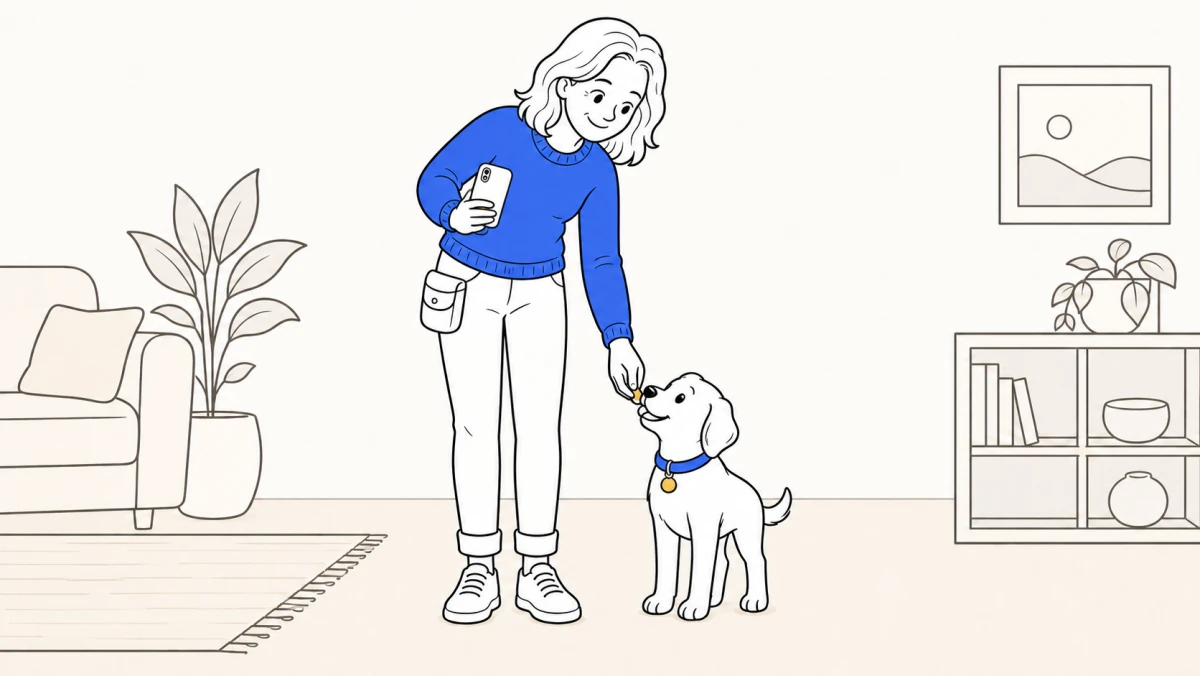
- The instant they stop nosing and pull back or look away — click (or say a crisp marker word like “yes”) — and deliver a treat from your other hand, never from the fist they just left.
- Repeat until backing off the closed fist is easy. Then place a lower-value treat on the floor under your hand; click and pay from the other hand the moment they stop trying to dig under your cover.
- When that is solid, uncover the floor treat for a second — ready to cover again if they dive — and click the look-away or lean-back.
- Only after the idea is understood, say “leave it” just before you present the temptation, then mark and pay the same way. Keep it a short, fun game, and work up from boring items before exciting ones.
That closed-fist capture is what the ClickerPup curriculum uses, and it matches the AKC’s core rule: the item left alone is never the prize.
Do I reward with the treat my puppy left alone?
No. The AKC is clear that the floor item is not the prize — pay with a different, usually higher-value treat from your pocket or other hand. Best Friends Animal Society frames the same trade: leaving something alone earns something even better.
This matches the American Veterinary Society of Animal Behavior (AVSAB) position that “only reward-based training methods” should be used — for leave it that means a marker and a better payoff for turning away, never a yank, a slap on the muzzle, or leave-it-as-a-telling-off. For what the marker is doing under the hood, see what clicker training is and whether it works. If you haven’t charged a clicker (or “yes”) yet, clicker training on day one covers the five-minute charge test.
What’s the exact moment to click when teaching leave it?
Click the instant your puppy disengages — the back-off or look-away — not while they are still digging at the fist, and not after they’ve already grabbed the thing. That half-second is the whole skill.
Timing is not a nicety. In Browne’s 2015 University of Waikato research on delayed reinforcement, dogs succeeded about 60% of the time when the reward came immediately, but only about 25% when it arrived one second late. A marker that bridges that gap still helped learning land. Your hands will never be as fast as a diving puppy; the click buys back the precision you don’t have yet. Treat from the other hand in the same beat — if you dig through a pocket for three seconds, the lesson blurs into “I sniffed, then maybe something happened.”
Why won’t my puppy leave it?
The usual failure is paying from the same hand the puppy just left — that teaches the opposite lesson. Always reward from your other hand. Other common fixes: slow down before uncovering a floor treat, stop using leave it as a scold, and never bait with a real hazard.
| What you see | Likely cause | Fix |
|---|---|---|
| Grabs harder after you “reward” | Paid from the fist or floor item they left | Other-hand / pocket pay only |
| Freezes or looks worried when you say “leave it” | Cue used as a scold | Soft voice; make the turn-away earn something better |
| Nails the fist, fails on the floor | Criteria jumped too fast | Cover longer; uncover briefly; split smaller |
| Wins in the kitchen, fails on walks | Context never practiced | Leash on; safe, planted temptations; one new place at a time |
| You panic-cue over real poison or glass | Using a hazard as bait | Management first — pick it up, block access; train only with safe stand-ins |
Best Friends is blunt on the trade: leaving something alone should mean something even more delicious, not nothing. The AKC adds the real-world progression — leashed walks past planted low-value items, then other objects — only after the living-room game is solid. Never use medication, cooked bones, or broken glass as training bait; those are management emergencies, not reps.
What age can you teach a puppy to leave it?
As early as the week most puppies come home (around 8 weeks). Leave it uses a closed fist, a marker, and a second treat from your other hand, not collar pressure, so a young puppy can start right away. Keep sessions to about two minutes.
You do not need to wait for formal classes. In the ClickerPup curriculum, leave it moves up early in the foundation order precisely because it only needs name recognition as a soft prerequisite and because impulse control is what biting, scavenging, and counter-surfing all lean on later. The American Kennel Club also pairs leave it with a permission cue (“take it”) so the puppy learns when something is okay — useful later, but not required to start the closed-fist game. Sit and leave it are the two fast, low-failure wins on the first-five commands list for the same reason.
How do you use leave it in real life?
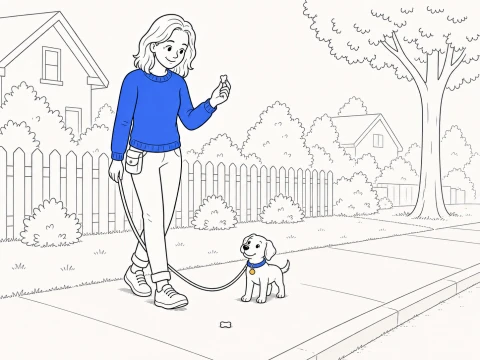
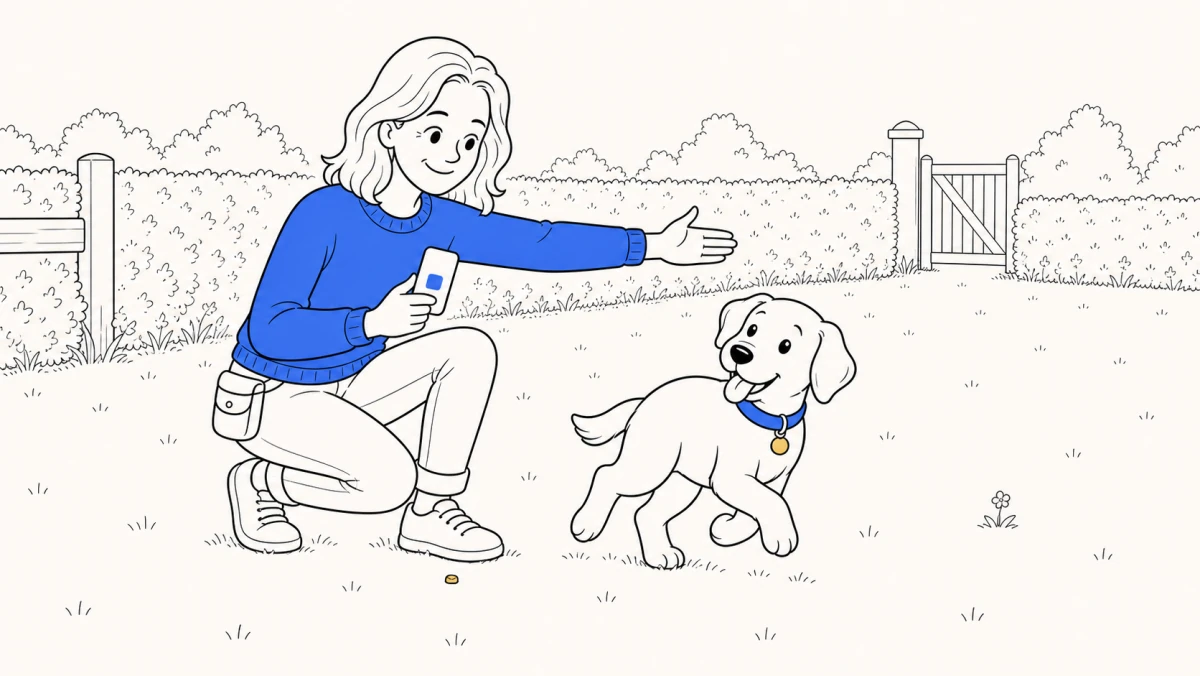
Practice on safe, planted temptations with a leash on, then walk past a short row of low-value items after you say “leave it,” paying from your pocket for each ignore — that is how the living-room game becomes a sidewalk brake.
Generalization is separate from acquisition. A puppy who leaves a covered treat in the kitchen can look blank beside a dropped napkin in the hallway; that is normal, not a step backward. Drop your expectations one notch in each new spot, change only the location, and re-earn a few easy wins there. The AKC’s outdoor progression — yard, then sidewalk, then gradually more interesting objects — is the same “one variable at a time” rule. Leave it also becomes the training half of mouthing management: when teeth hit skin or a forbidden object, the long game is a clear leave-it / redirect, not a scold — the day-one survival side of that problem lives in how to stop a puppy from biting without punishment.
How long should a leave-it training session be?
About two minutes and four to six easy reps, then stop while your puppy is still winning. Short sessions that end on a clean success beat one long drill that turns into a scold.
Aim for roughly four backs-off out of five on the closed fist before you uncover a floor treat, then four out of five on a spoken “leave it” across two easy sessions before you make the room harder. If you want the research behind short-and-spaced practice, how long puppy training sessions should be covers the timing evidence in one place.
How do you pair leave it with drop it?
Leave it means don’t take the thing in the first place. Drop it means open your mouth and release something already held. Teach leave it first as the impulse brake; add drop it once your puppy can trade a toy or chew for something better.
They are siblings, not synonyms — and teaching them as one mushy “no” is why both fall apart. Leave it is the pre-grab brake (closed fist → other-hand pay). Drop it is the post-grab trade (offer something better, mark the release, never pry jaws). The AKC’s drop-it guidance sits next to leave it for the same safety reason: cooked bones, socks, and stolen sandwiches need both skills. Full drop-it steps live in how to teach a puppy to drop it; both cues hub up through basic puppy commands and the clicker method.
When is leave-it trouble actually something else?
A puppy who stiffens, freezes, growls, or guards food, toys, or your hand when you approach is not “failing leave it” — that is resource-guarding territory, and it needs a certified behavior professional’s eyes, not harder reps.
Mouthing at your fist during early leave-it practice is usually normal exploration and teething under about six months — keep the palm closed, click only the back-off, and end before frustration spikes. What isn’t normal: a stiff body, growling over a chew, snapping when you reach for a stolen item, or a bite that breaks skin from a dog older than about six months. Those deserve a consultant certified by the International Association of Animal Behavior Consultants (IAABC — iaabc.org), not another closed-fist drill — here’s what’s normal and when to get help.
Leave it is one short skill with a clear click-point, one non-negotiable mechanic (pay from the other hand), and a real safety job on the floor and on walks. If you want a coach that plans today’s two-minute leave-it session — and catches the moment you almost paid from the wrong hand — claim your early spot on the ClickerPup waitlist.