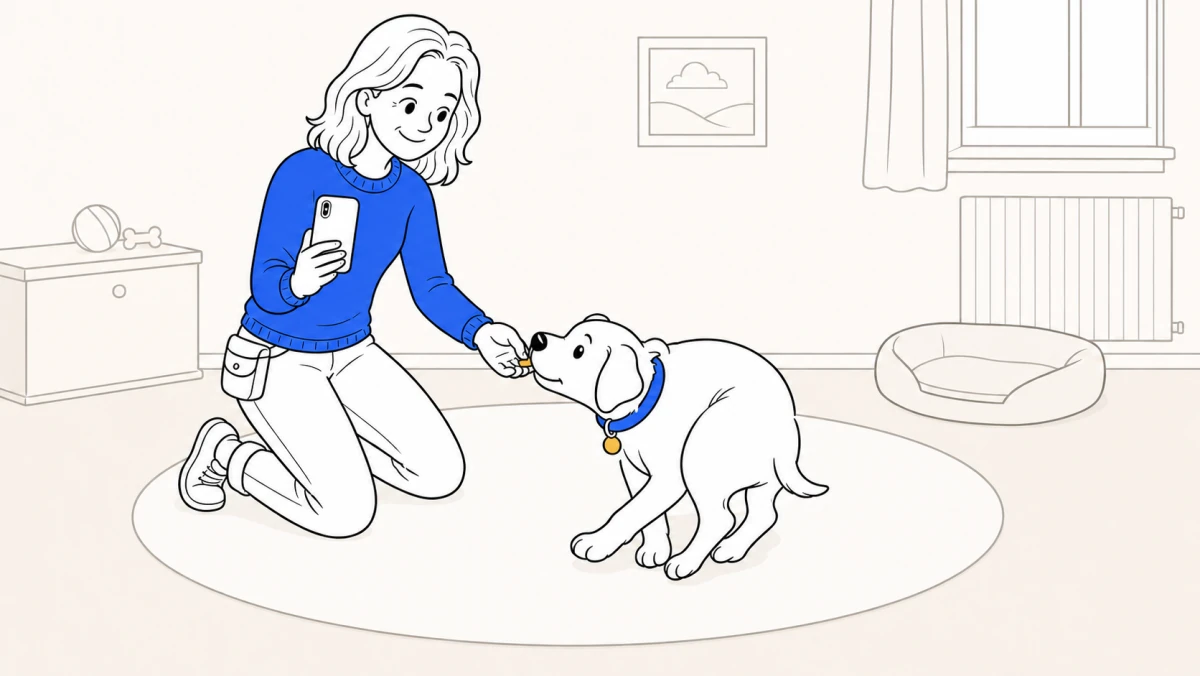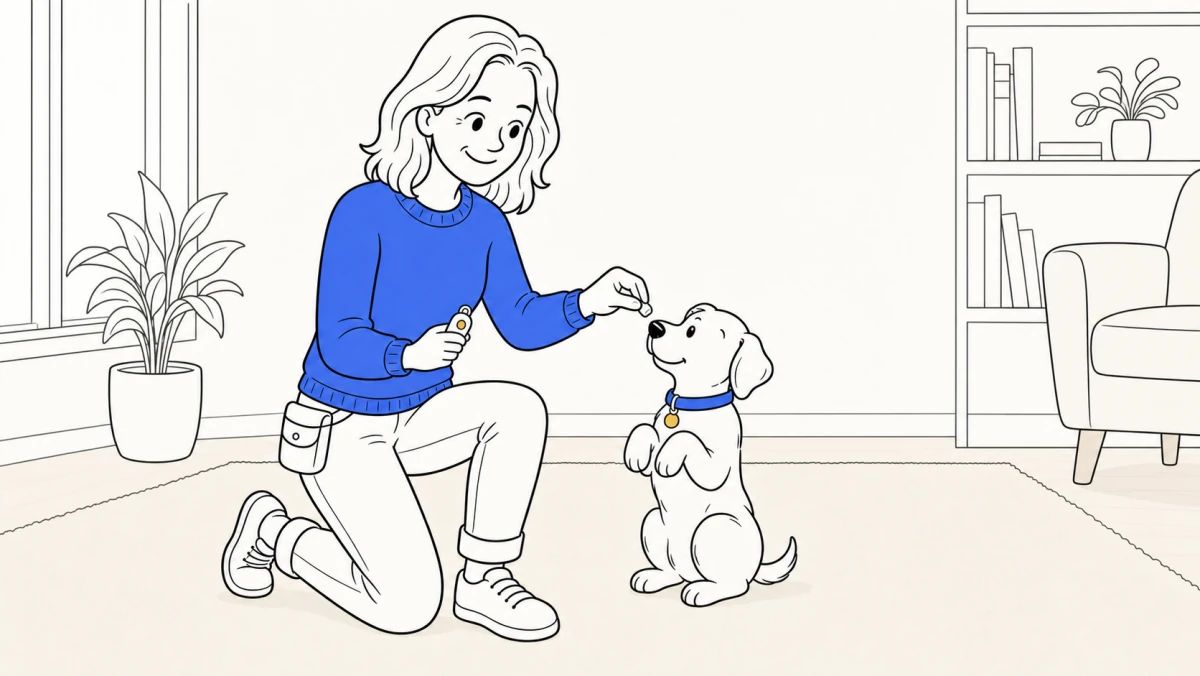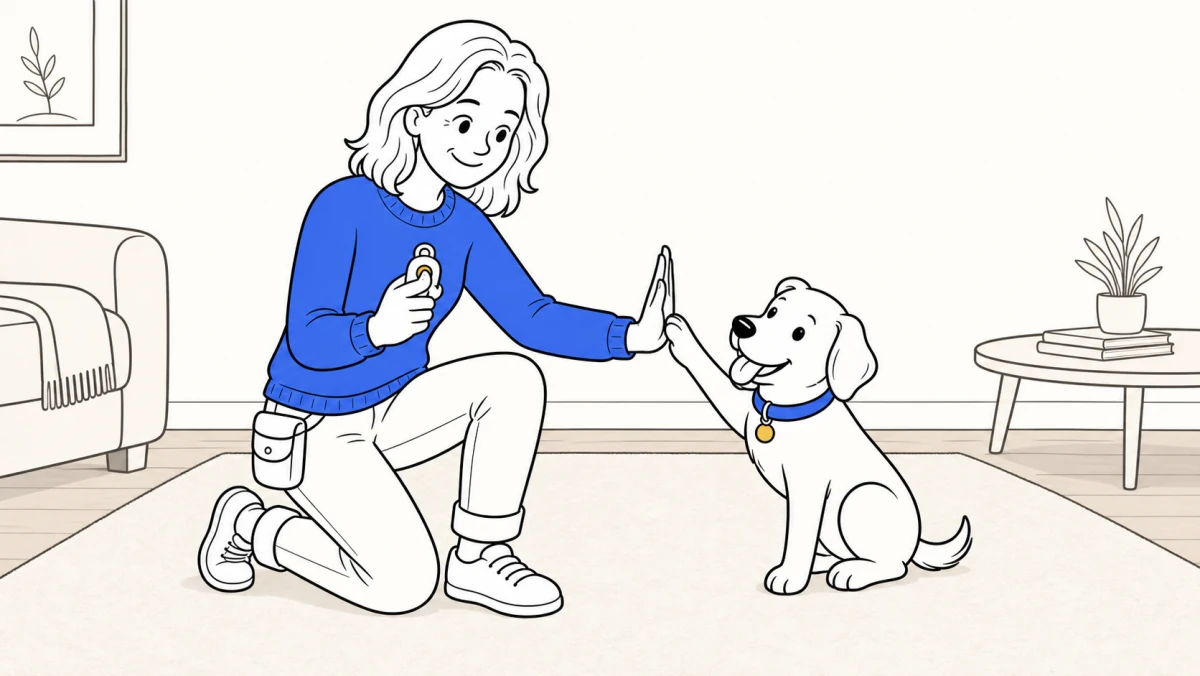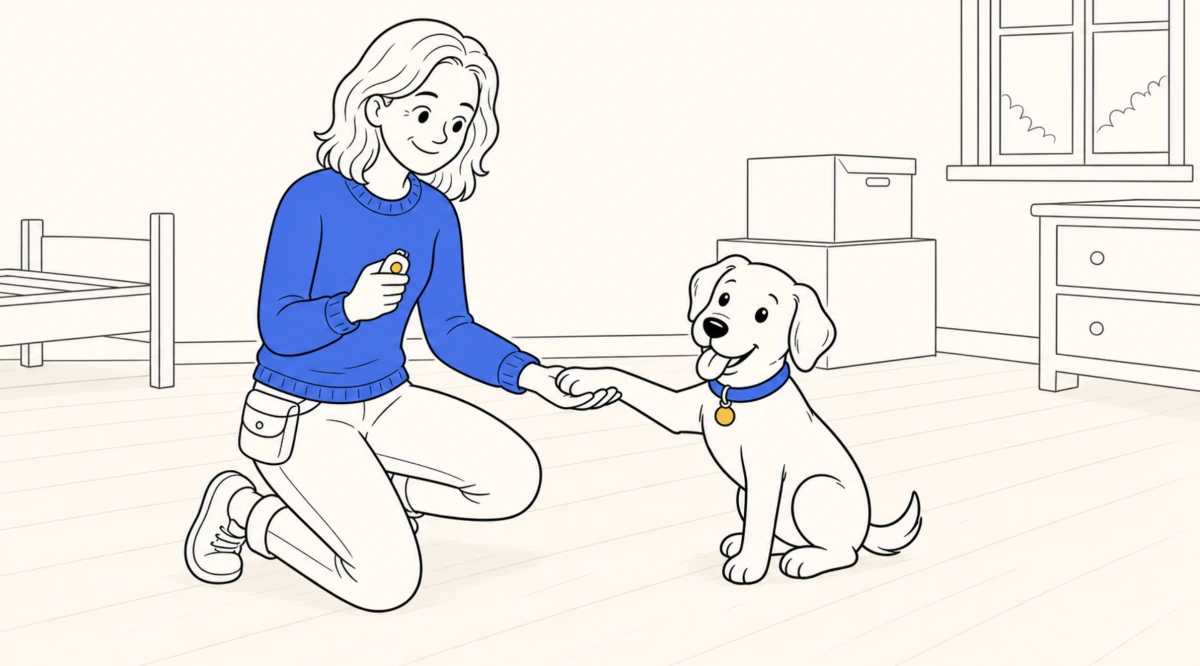
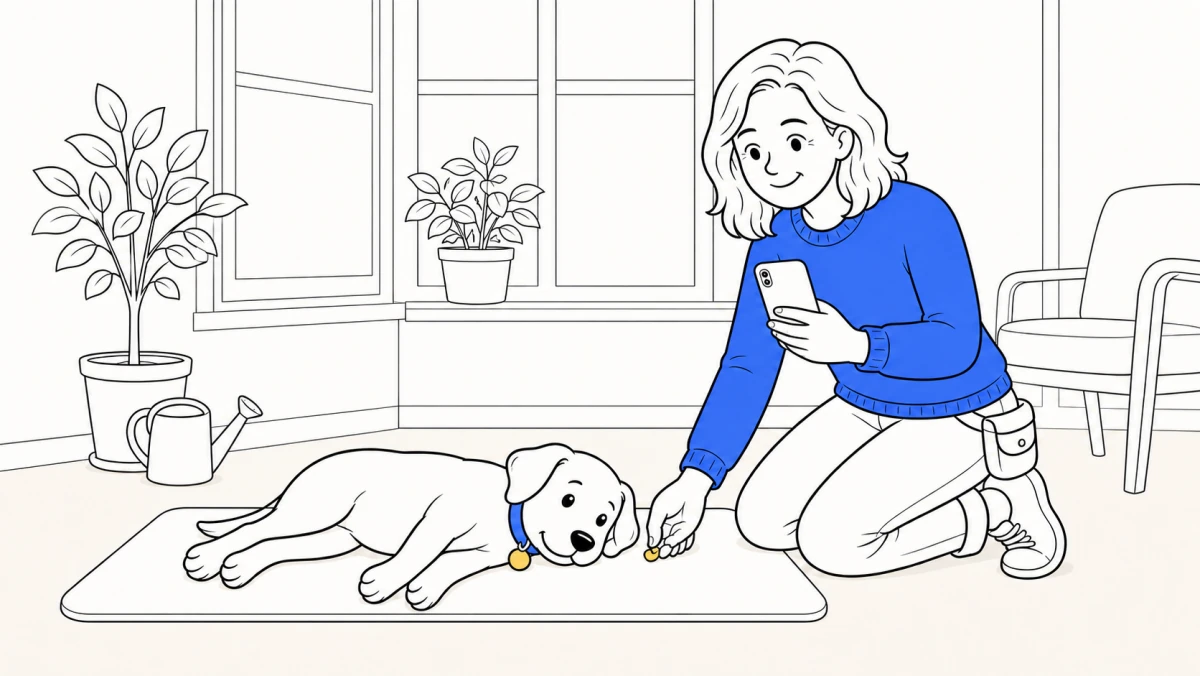
Teach play dead from a settled down: hold a treat at the side of your puppy’s head and move it slowly toward their shoulder so they roll onto their side, click that side-lie, then treat low. Once they’ll flop over reliably, wait a beat before you click so they learn to hold the position — and add a cue like “bang” or “play dead” only at the end. Never push them onto their side by hand.
If you want a proper showpiece after a rough week on “sit,” play dead is the one guests ask for by name. It looks dramatic on camera, but it’s built from the same click-and-treat loop as every other skill — and here’s the part most guides skip: play dead is really a stay lying on their side, not a stunt. The flop is easy. The stillness is the trick.
Does my puppy need to know “down” before play dead?
Yes — play dead is one of the few tricks with a real prerequisite. The American Kennel Club’s own play dead guide is blunt about it: your puppy “needs to know the DOWN cue before you start teaching this cute trick.” A calm, settled down on a soft surface is enough to begin; you don’t need a down that holds in every room yet.
If down isn’t there yet, teach it first — the basic puppy commands guide covers it in the same short-session style, and it’s worth having anyway. Aim for roughly four calm downs out of five asks in a two-minute warm-up before you start luring the roll. Trying to teach play dead on top of a shaky down usually means you spend the session fighting the down, not building the trick.
How do you teach a dog to play dead?
From a settled down, hold a treat at the side of your puppy’s head and move it slowly toward their shoulder so they roll onto their side — click that side-lie, then treat low. Once they’ll flop over reliably, wait a beat before you click so they learn to hold the position, and add a cue like “bang” or “play dead” only at the end. That order is the whole method: most guides lure the dog over and slap a cue on it the same day, then wonder why the puppy pops straight back up. ClickerPup treats the side-lie as its own success first, then the hold as a second one — the same shaping rule Karen Pryor puts first in Don’t Shoot the Dog! (the Ten Laws of Shaping): raise one criterion at a time, in steps small enough that your puppy still has a realistic shot.
What are the steps?
- Ask for “down” on a soft rug or bed and wait until your puppy is genuinely settled — belly on the floor, not bouncing back up.
- Hold a treat at the side of their head and move it slowly toward their shoulder, the way the AKC guide describes it. Most puppies tip onto one hip to follow it. Click the instant their shoulder and hip settle onto the floor, then treat low so they stay down.
- Repeat until the side-lie is easy — about four clean flops out of five in a short run. Whichever way they naturally lean is the direction to lure; one side is the trick.
- Now start the hold: wait one extra second after they land on their side before you click, then two seconds, then three. You’re clicking stillness now, not the flop.
- Hands never push or hold the dog down. If they pop up, go back to clicking the side-lie — don’t press them flat to “show” them.
Does the marker have to be a clicker?
No. This is reward-based work end to end. The American Veterinary Society of Animal Behavior (AVSAB) Position Statement on Humane Dog Training (2021) recommends reward-based methods only for dog training, and a cheerful verbal marker (“yes”) is a legitimate equal to a clicker if you’d rather not juggle a device on the floor. Whatever you use, the job is the same: mark the exact moment they settle onto their side, then pay.
Do you have to use “bang” as the cue?
No. “Bang” is just the most famous version — your puppy has no idea what the word means, so the cue can be anything you’ll actually say: “bang” with a finger-gun hand signal, “play dead,” “sleep,” or a silent flat hand. What they’re really following is the lure, and then the signal, not the word.
Pick the cue you won’t feel silly using in front of people, because that’s the one you’ll practice. A hand signal is worth adding either way: a finger-gun or a flat palm gives your puppy something to see as well as hear, and a clear visual cue is easy to use across a noisy room or on camera. The AKC’s own guide names the cue as “PLAY DEAD”; the “bang” and finger-gun version is the crowd-pleaser owners have layered on top. Both work identically, because to your puppy it’s all just “the signal that means flop onto my side and wait.”
How do you get your puppy to hold the play dead position?
Build the hold in tiny steps: once your puppy drops onto their side for the lure, wait one extra second before you click, then two, then three — the AKC guide calls this waiting “a few seconds so she holds the position before giving her the treat.” Play dead is really a stay lying on their side, so the stillness is the trick, not the flop.
Two things make the hold stick. First, add a release word so your puppy knows when “dead” is over — the AKC guide suggests “a release word (such ‘all done,’ ‘finished,’ or ‘OK’).” Without one, they decide when to get up, and the hold quietly falls apart. Say your cue, wait, click the stillness, treat — then release. Second, raise the time in seconds, not leaps: a puppy who can hold for three seconds is nowhere near a ten-second hold yet, and jumping straight there is how you teach them that popping up pays. This is the same one-criterion-at-a-time rule from Pryor’s shaping laws, applied to duration instead of distance.
What if my puppy pops up or won’t go onto their side?
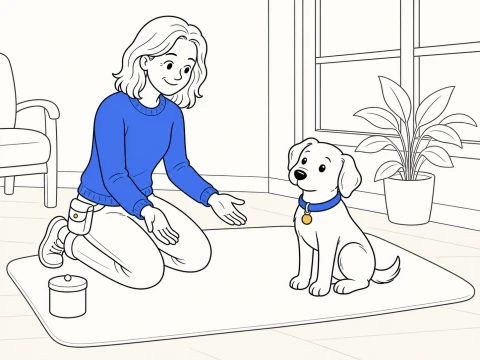
Most stuck moments are one of three things, and none of them is defiance. If they pop straight back up, you raised the bar too fast — drop back to clicking the plain side-lie with no hold, then rebuild the seconds. If they won’t tip onto their side at all, the surface is often the problem: a hard or cold floor makes lying flat unpleasant, so move to a rug, a mat, or their bed. And if they lie down but won’t relax onto their side, that’s information, not stubbornness — belly-and-throat-up is a genuinely vulnerable position for a dog, and some puppies simply don’t want to offer it yet.
Respect that no. It’s the same welfare rule ClickerPup uses for roll over: the vulnerable position is always the dog’s choice, hesitation is information rather than disobedience, and you never push them into it by hand. Stay at a shoulder-dip for a few short sessions, or swap to a trick they love — shake and spin, both on the fun tricks hub, earn the exact same grin and ask for nothing vulnerable. A puppy who trusts you enough to go belly-up will get there faster if you let it be their idea.
Is play dead safe for every dog?
For most puppies, a flat side-lie is one of the gentler tricks — there’s no jumping and little twisting. But keep it light, or skip the dramatic version, in two cases. If you’re tempted by the full roll-onto-the-back finish (the AKC notes you can teach them to “roll all the way over on her back instead of her side” for extra drama), treat that like roll over: a long, low-backed build like a dachshund’s carries a much higher risk of the spinal condition IVDD. Dr. Julie Buzby, DVM, writing on ToeGrips, puts it at an estimated 19–24% of dachshunds — roughly one in five, about ten times the risk for most other dogs — and a twist or awkward turn can be the trigger on discs that are already vulnerable. So keep that version to a gentle side-lie for a low-backed pup, and see the roll over guide for the full caution. And stop altogether if the reluctance looks like pain rather than ordinary hesitation — a yelp, a flinch, or stiffness getting down is a vet question, not a training one. When in doubt about your dog’s build, ask your vet before you drill it.
How long should a play dead training session be?
Keep each play dead session to about two minutes and three to five flops — it asks a puppy to lie still and stay settled, which is quietly tiring, so stop while it’s still an easy game. The same short-session logic that covers sit and settle applies here; see how long puppy training sessions should be for the age-by-age defaults. A handful of clean side-lies with a one- or two-second hold is a complete session. Nice work is ending early, not squeezing in one more rep after their body language has already gone flat and unenthusiastic.
When do you add the cue word?
Add your cue — “bang,” “play dead,” whatever you picked — once your puppy is dropping onto their side and holding it for a couple of seconds reliably, roughly four clean reps out of five across two separate short sessions. Say the cue just before you start the lure, so the word predicts the flop instead of chasing it. Then shrink the food lure into an empty hand signal and pay from your other hand.
Fade the lure once the behavior is consistent, not on a fixed number of reps. Sassafras Patterdale, a Certified Professional Dog Trainer – Knowledge Assessed (CPDT-KA), writing on lure-fading for the AKC, says to begin fading once your dog performs the cue consistently — a lure used this way is a teaching tool with a planned exit, not a bribe your dog needs forever. Generalize last, and only to another comfortable spot: a play dead on the kitchen tile is a different ask than one on the living-room rug, so change one thing at a time.
When should you stop and get help?
Play dead is a light, optional party trick — treat any real distress as a reason to stop, not push. If your puppy freezes, tucks, growls, or panics around handling and being on their side, that’s outside trick territory; use our guide to what’s normal and when to get help, and for behavior work look for an International Association of Animal Behavior Consultants (IAABC)-certified behavior consultant rather than a firmer hand. Sudden reluctance paired with limping, low energy, or an appetite change is worth a vet visit. A trick is never worth pushing a frightened or sore puppy through — the choice to lie down and stay is exactly what makes it worth teaching.
What should you do next?
Run one short session: get a settled down, lure the side-lie, click the flop a few times, then wait one extra second before your next click. That single added second is the whole trick in miniature — everything after it is just more seconds, a cue, and a fading lure. Keep it to a couple of minutes on a soft spot, respect a no when they’d rather not go belly-up, and add the “bang” only once the flop-and-hold is reliable.
Is play dead one of ClickerPup’s in-app tricks?
Not yet. ClickerPup’s tricks module currently runs spin, shake, roll over, and beg. Play dead uses the same clicker method — this page is the DIY version while that feature is still ahead. If you’d like those short sessions planned for the puppy on your floor anyway — including the tricks we do coach, sized honestly and only called “reliable” once your dog has proven them twice, not just performed them once for the camera — claim an early spot on the waitlist. The clicker is free forever, with a plain reminder before anything ever charges.
Claim your early spot and we’ll bring you in as we open up.