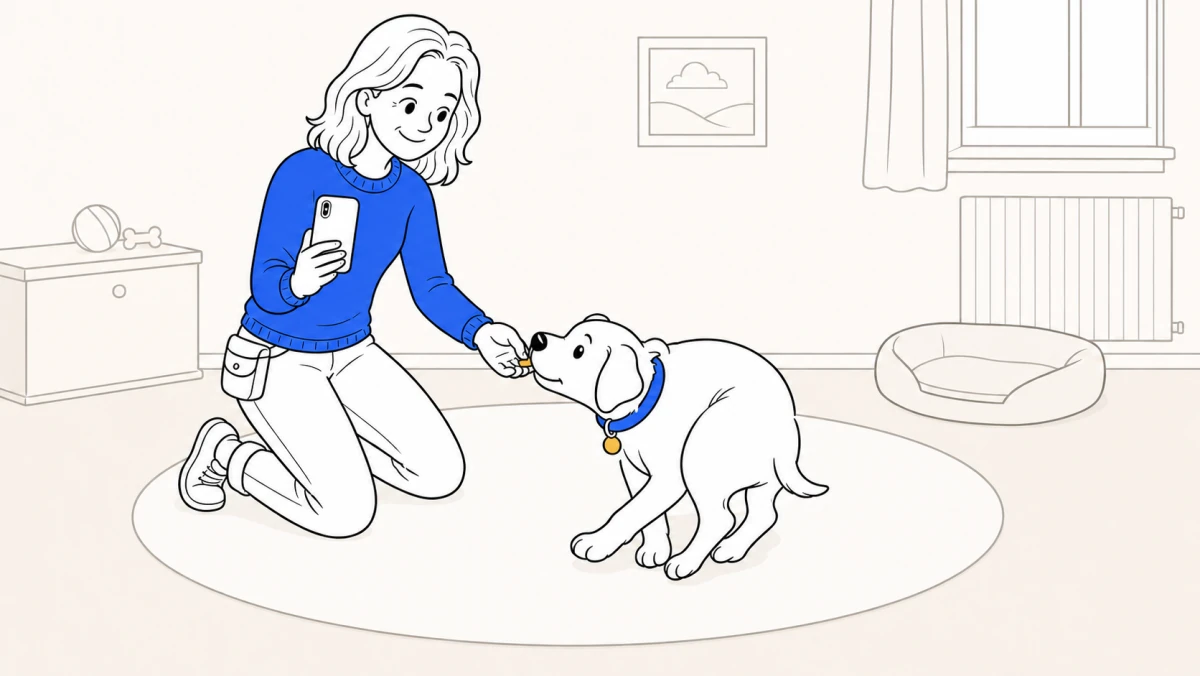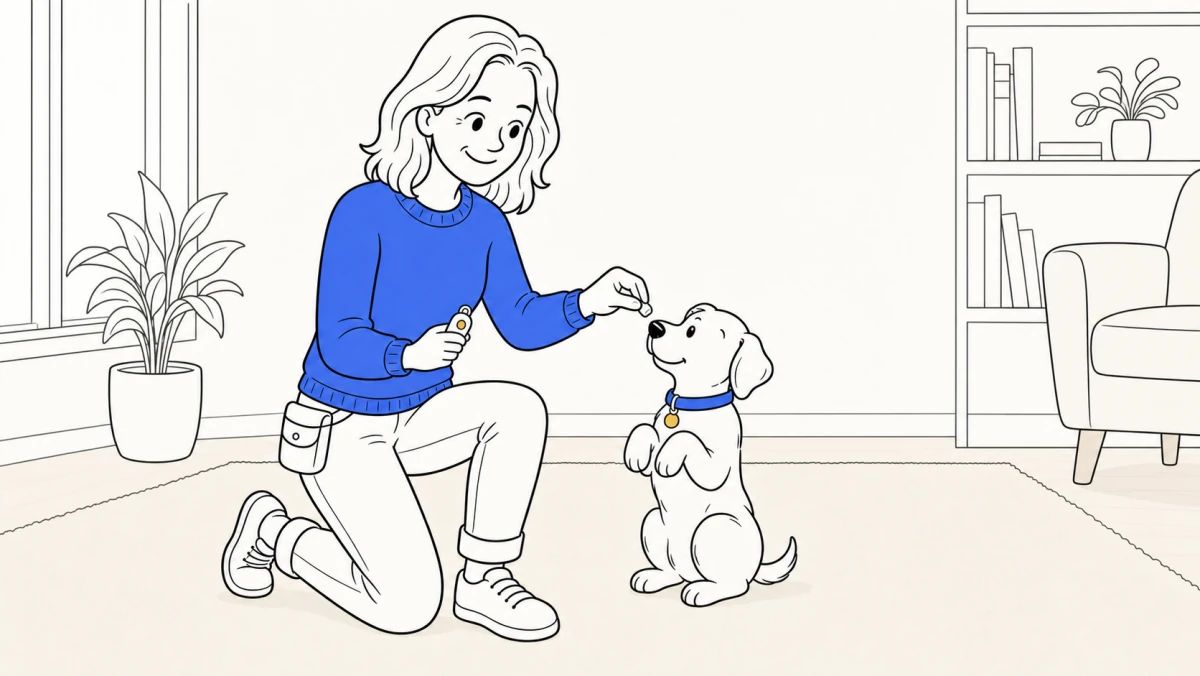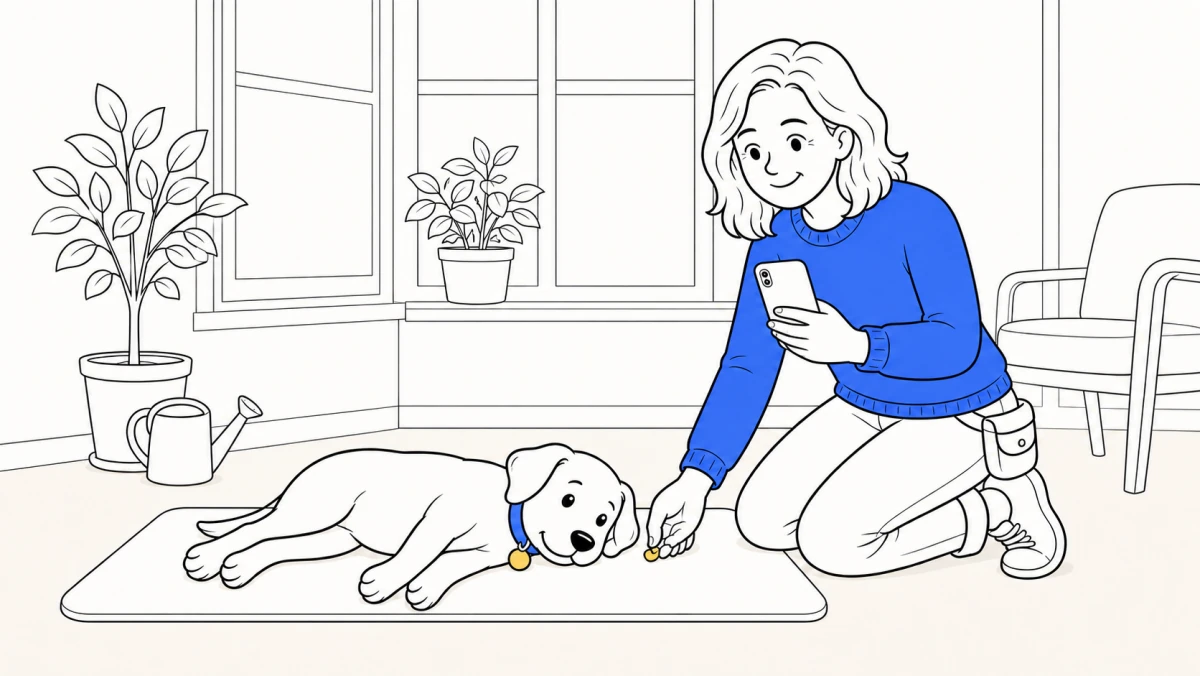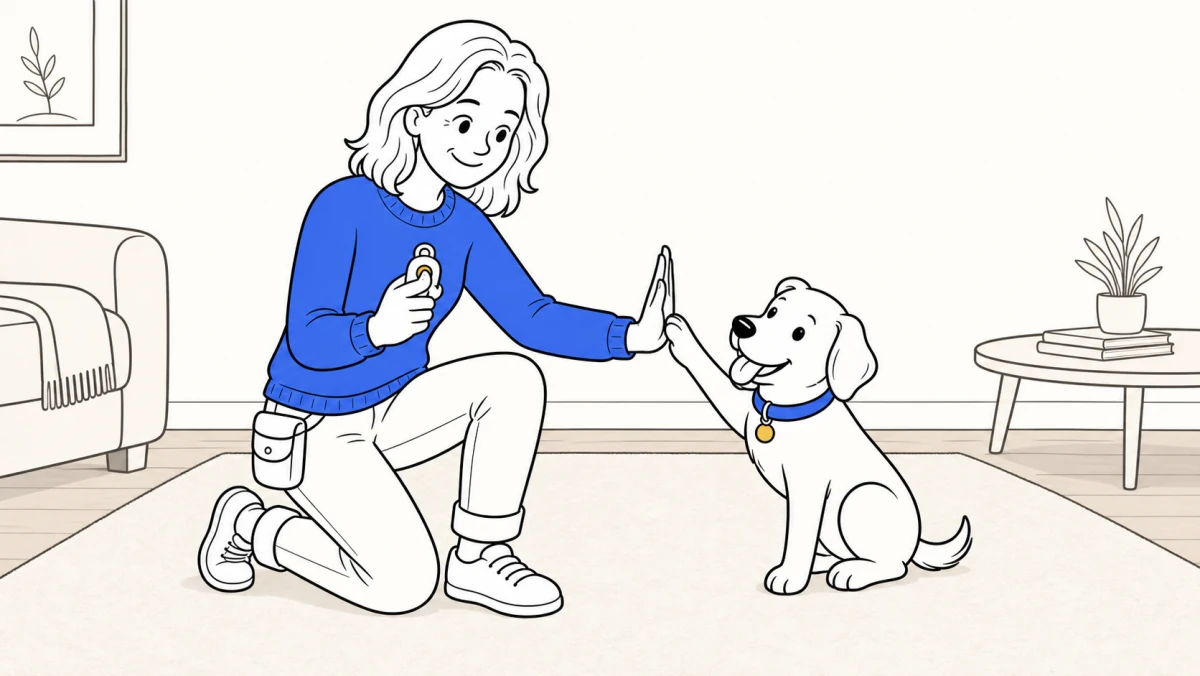
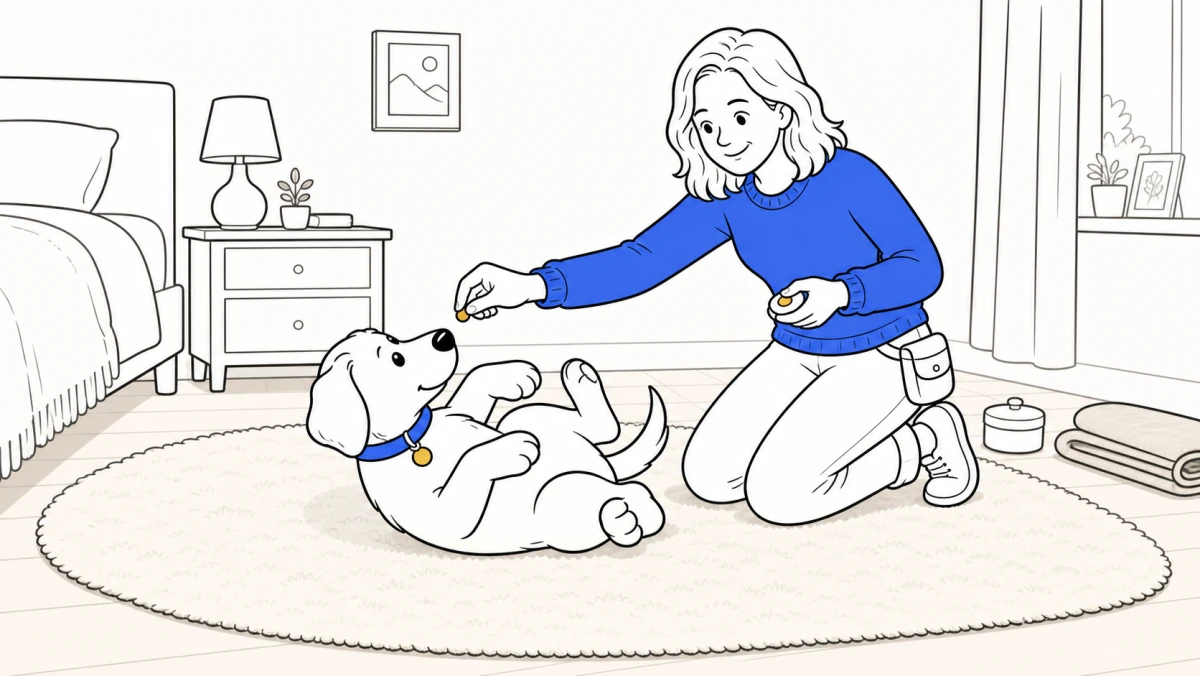
Teach roll over from a relaxed down on a soft rug: lure your puppy’s nose toward their shoulder, click the hip-roll first, then click the full roll — and never push them over by hand. A reliable “down” helps a lot, keep sessions to a couple of minutes, and skip or keep it light if they have a long low back or seem nervous going belly-up.
If you’re hunting a showpiece trick after a rough week on sit, you’re in the right place. Roll over looks fancy on camera, but it’s built from the same click-and-treat loop as any other skill — split small, pay the try, stop early. No class required, and no need to “roll them over” with your hands when they hesitate.
Does my puppy need to know down before roll over?
It goes much more smoothly with a reliable “down” already in place. The American Kennel Club’s own instructions say it’s “helpful if your dog knows the ‘down’ cue before you start teaching this trick” — and in practice, luring a roll from a puppy who won’t settle into down usually means fighting the down, not teaching the roll. Teach down first if your puppy doesn’t have it yet; the basic puppy commands guide covers that cue in the same short-session style.
You do not need a finished, generalized down in every room. A calm belly-on-the-floor down on one soft rug is enough to start — aim for about four calm downs out of five asks in a two-minute warm-up before you ever start the roll lure. If they pop straight back up, click and treat for staying down a beat, then try the roll.
How do you teach a dog to roll over?
From a relaxed down on a soft rug, lure your puppy’s nose slowly toward their shoulder so their weight rolls onto one hip — click that hip-roll, then treat low — then continue the arc over the shoulder until they roll all the way around onto the other side, clicking as the roll completes. That split is the whole method: most guides jump straight to “lure them over,” and then owners wonder why the puppy stands up or freezes. ClickerPup’s coaching treats the hip-roll as its own success first — the same shaping rule Karen Pryor puts first in Don’t Shoot the Dog! (the Ten Laws of Shaping): raise one criterion at a time, in steps small enough that your puppy still has a realistic shot.
What are the steps?
- Ask for “down” on a soft rug or mat and wait until your puppy is settled — belly on the floor, not popping up a second later.
- Hold a treat by their nose and draw it slowly toward their shoulder. Most puppies flop onto one hip to follow it. Click the moment their weight shifts onto that hip, even before a full roll, then treat low.
- On the next reps, continue the same arc a little further — shoulder toward spine — and click that small step. Keep raising the bar in pieces this small.
- When the lure carries them onto their back and all the way around, click as the roll completes and treat low on the other side. Whichever way they naturally lean is the direction to lure; one direction is the trick.
- Hands never touch the dog. If they stall mid-roll, go back to clicking the hip-roll — do not finish the roll for them.
Does the marker have to be a clicker?
No. This is reward-based work end to end. The American Veterinary Society of Animal Behavior (AVSAB) Position Statement on Humane Dog Training (2021) recommends reward-based methods only for dog training; a cheerful verbal marker (“yes”) is a legitimate equal to a clicker if you prefer that sound.
What if my dog stands up or won’t go onto their back?
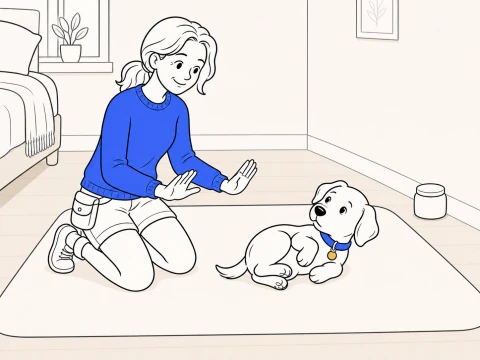
Most stuck moments are one of three things: they stand up to chase the lure (slow down and click the hip-roll again), the floor is hard or cold (move to a rug), or they don’t want to go belly-up — which is information, not defiance. Fix the setup before you raise the criteria.
Belly-up is a vulnerable position. If your puppy freezes, tucks, or keeps hopping up, stay at the hip-roll for two or three short sessions — three to five easy hip-rolls is still a complete session — or swap to shake or spin in our fun tricks hub. Never roll them over by hand. A forced roll teaches them your hands are something to brace against.
Only rolling one way forever is fine. Pick their easy side and stick with it.
Is roll over safe for every dog?
Skip this one, or keep it very light, if your puppy has a long, low back like a dachshund’s — that body shape carries a much higher risk of a spinal condition called intervertebral disc disease (IVDD), and twisting or straining the spine is one of the everyday movements that can trigger a disc problem. Dr. Julie Buzby, DVM, writing on ToeGrips, notes that an estimated 19–24% of dachshunds develop IVDD — roughly one in five, and about ten times the overall risk for most other dogs — and that a twist, jump, or odd turn can be the acute insult on discs that are already vulnerable. Ask your vet if you’re unsure whether this trick is a good fit for your dog’s build.
What if my puppy seems scared of rolling over?
Skip the full roll, or stay at a side-flop only, if your puppy seems nervous going onto their side or back. A trick is not worth pushing through fear or discomfort. If they yelp, flinch, or the reluctance looks like pain rather than ordinary caution, stop and talk to your vet — and if fear, aggression, or panic shows up around handling, that’s outside trick territory; use our when-to-get-help guide and, for behavior work, an International Association of Animal Behavior Consultants (IAABC)-certified behavior consultant.
How long should a roll-over training session be?
Keep each roll-over training session to about two minutes with three to five full rolls at most — it’s real physical work for a growing puppy, so stop while the game is still silly and fun rather than drilling one extra rep until they flop out of that whole trick. The same short-session logic that covers sit and settle applies here; see how long puppy training sessions should be for the age-by-age defaults. A handful of easy hip-rolls on a soft rug is a complete session. Nice work is ending early, not squeezing in one more full roll when their body language has already gone flat.
When do you add the cue word?
Add “roll over” once your puppy is completing the full roll for the lure reliably — roughly four clean rolls out of five, across two separate short sessions — then say the word just before you start the lure. After that, shrink the food lure into an empty circular hand signal and pay from your other hand. Sassafras Patterdale, a Certified Professional Dog Trainer – Knowledge Assessed (CPDT-KA), in How to Successfully Fade the Lure in Dog Training for the AKC, says to begin fading once your dog performs the cue consistently, not on a fixed rep count — the same exit plan you’d use for sit.
Generalize last, and only to another soft, comfortable spot. A kitchen tile roll is a different ask than a living-room rug roll; change one thing at a time.
What should you do next?
Keep sessions to a couple of minutes on a soft rug, respect a no when they refuse belly-up, and add the cue only once the lure roll is reliable — or claim an early spot on the waitlist if you want those short sessions planned for the puppy on your floor. Once the full roll is solid, it’s the first half of play dead — a natural next trick built from the same belly-up move.
A slow hand, small steps, and permission to stop at the hip-roll or swap to shake is the whole playbook. If keeping the splits and “is this reliable yet?” straight sounds like a lot to track alone, that’s what ClickerPup’s tricks module is for — roll over with spin, shake, and beg, sized into the same short sessions, called “reliable” only after your dog has proven it twice. Claim an early spot on the waitlist. The clicker is free forever, with a plain reminder before anything ever charges.