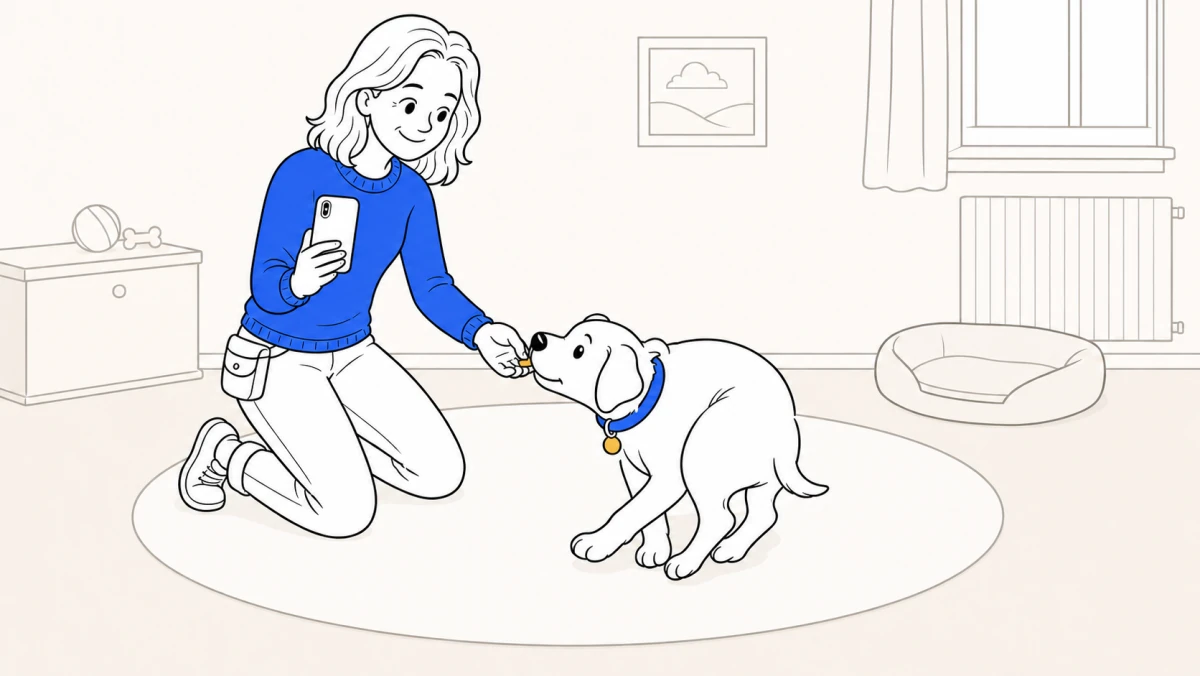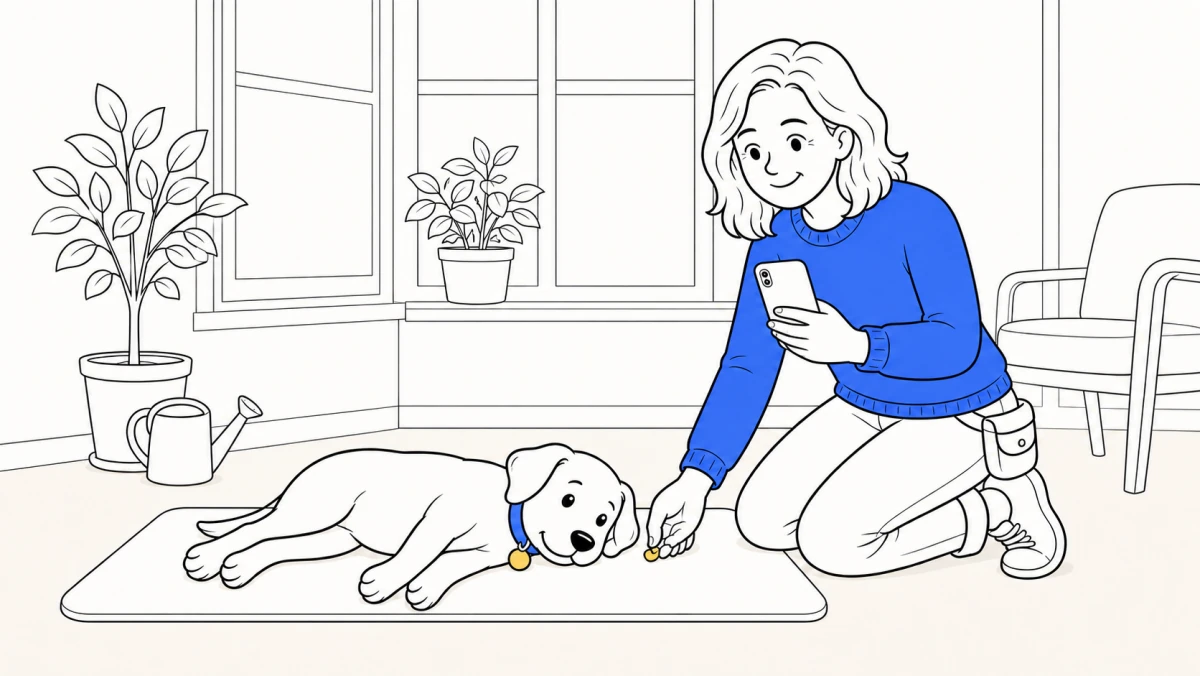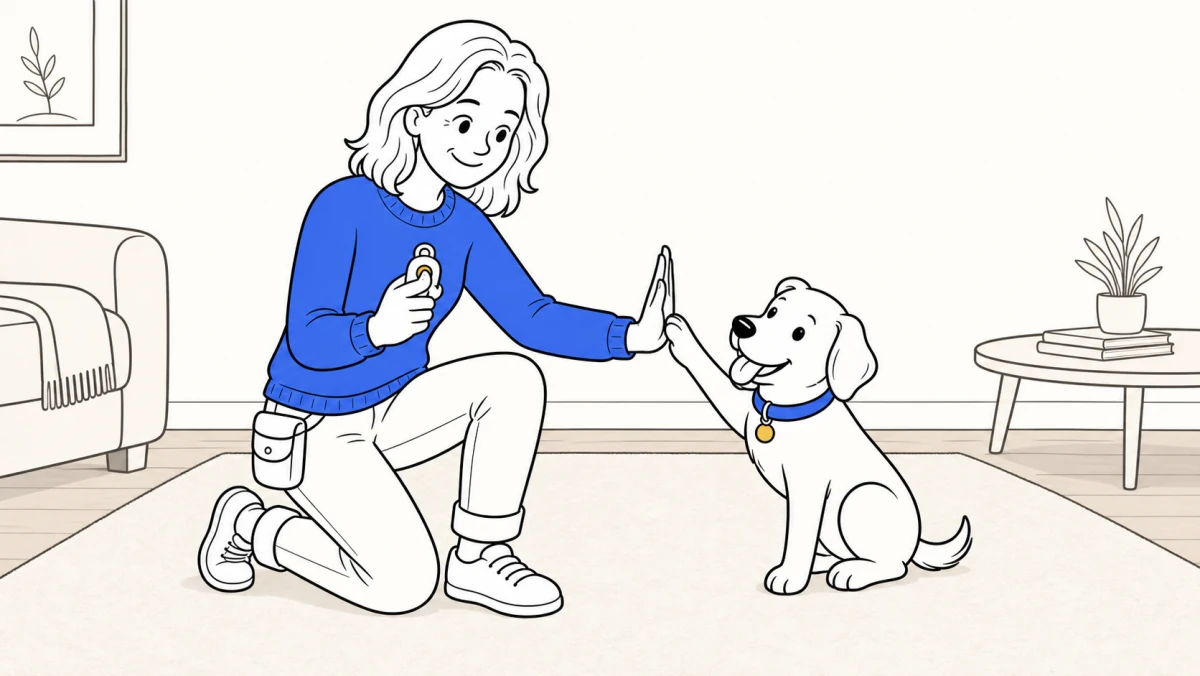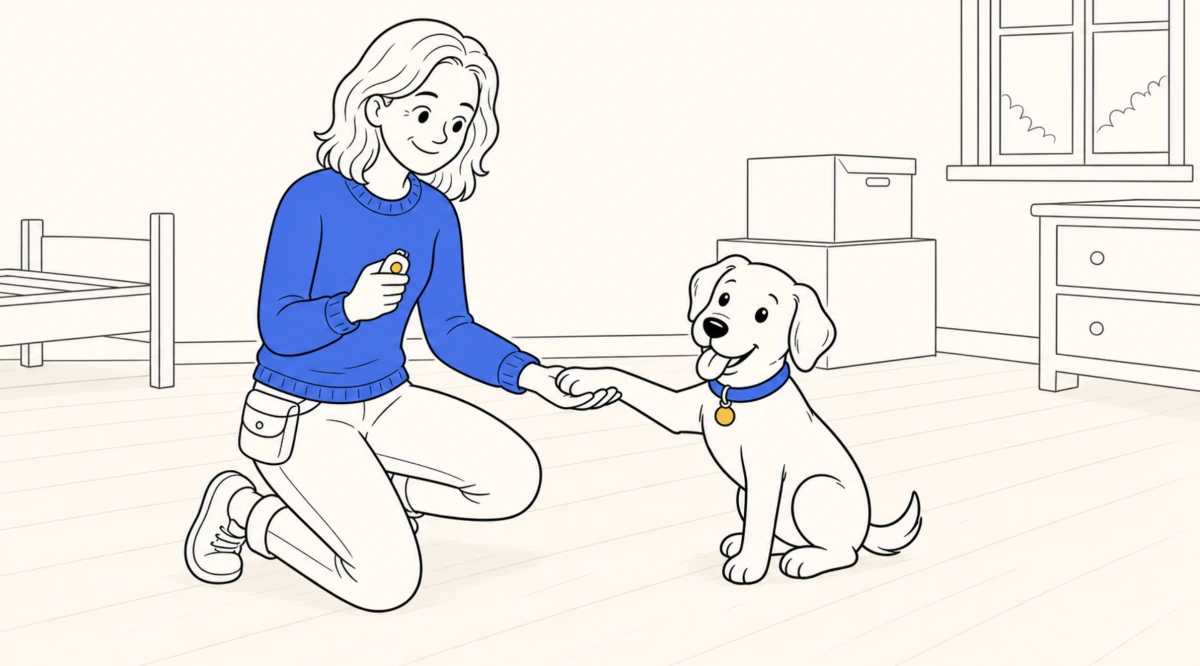
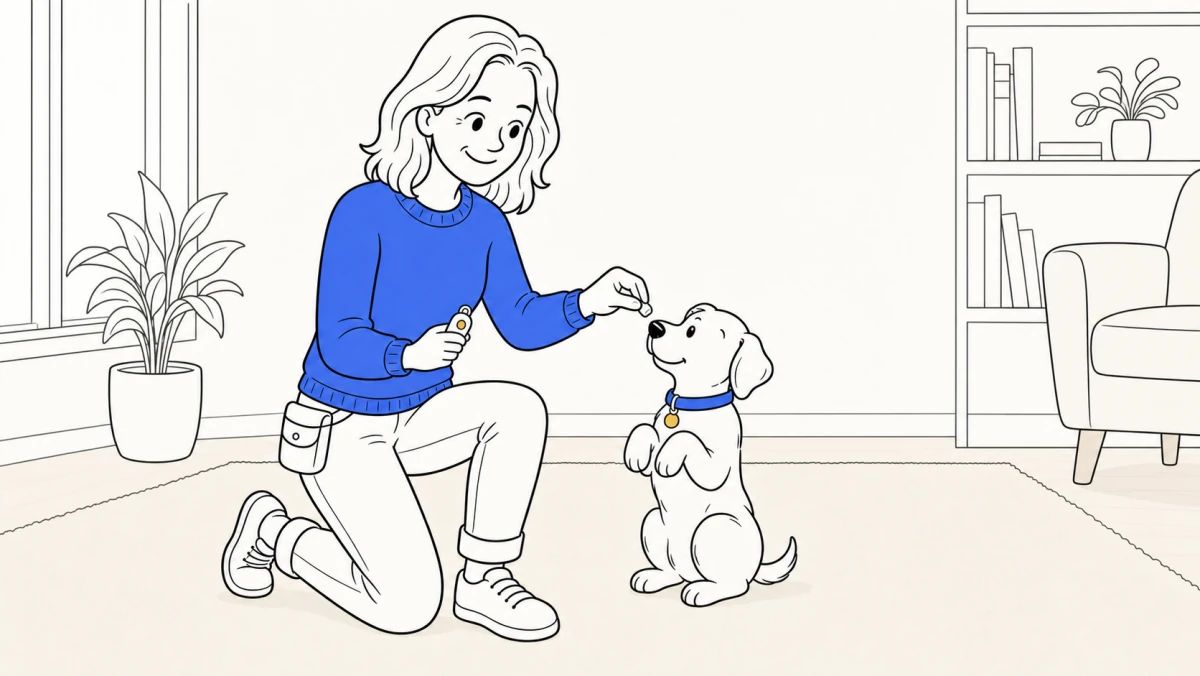
Teach sit pretty from a steady sit: hold a treat a whisker above your puppy’s nose so their front paws lighten and lift, click the instant both paws leave the floor, and feed the treat up at their mouth so they’re paid in position. Build the balance a half-second at a time, and never lift or prop them. One honest caveat first, though: because it loads the spine and core, sit pretty is the trick to go slow on with a young, growing puppy.
Sit pretty is the photo trick — the one that ends up as somebody’s phone wallpaper, and the one a guest asks for by name. It’s built from the same click-and-treat loop as teaching a sit or teaching a shake, so if you’ve had a rough week on the basics, this is still a real win hiding inside a party piece. The difference from the other tricks is physical, not fiddly — so we’ll cover when it’s safe before we cover how, because that order actually matters for this one.
What is “sit pretty,” and is it the same as beg?
Sit pretty and beg are two names for the same trick: from a sitting position, your puppy rocks back and lifts both front paws off the floor, balancing upright on their haunches. The American Kennel Club describes it as the dog using “their core muscles to raise their torso onto their haunches, with their front legs in the air.” You’ll also hear it called “sit up” or “meerkat.” It looks like a plea for a treat, which is where “beg” comes from — but as a trained cue it’s a balance skill, not table manners.
That distinction matters, because a strong sit pretty is a genuine little feat of core strength and balance — which is exactly why it’s the most physically demanding trick in the fun tricks set, and the one with a real readiness question attached.
Is sit pretty safe for a puppy?
Introduce it gently and keep it brief — and hold the full, upright beg until your puppy is more physically mature. This is the honest headline for sit pretty, and it’s not ours alone: the AKC calls it “a higher-impact trick” that “requires significant core strength for dogs,” and warns that “the position can also put pressure on a dog’s joints and their back.” Their guidance is direct — “it’s best to avoid this trick with puppies who are still developing or dogs who have a history of back injuries.”
The reason is underneath the skin. A puppy’s long bones grow from soft zones called growth plates, which AKC’s growth guidance describes as soft and flexible while a puppy is still growing, hardening and “closing” only as they mature. When that happens depends on size: small breeds are often done growing by 6 to 8 months, giant breeds by 12 to 18 months, and the very largest, like Mastiffs, closer to 24 — so how long “still developing” lasts is really a question about your dog’s build. A soft, still-growing frame is easier to overload, and a repeated, held beg asks a lot of one — which is why we keep the full pose for later, and why AKC’s own advice is to avoid this trick with puppies who are still developing.
So the safe version for a young puppy is small: a few brief, half-second paw-lifts from a sit, on secure footing, never a held pose and never forced. Save the sustained, straight-backed sit pretty for once your puppy is physically grown — and if you have any doubt about their joints, their age, or their build, ask your vet before you build height. Be especially cautious, or skip it, with long, low-backed breeds like dachshunds: that body shape carries a much higher baseline risk of the spinal condition IVDD — Dr. Julie Buzby, DVM puts it at roughly one in five dachshunds — so for a dog already at that kind of risk, it’s sensible to skip a spine-loading pose altogether and pick a flatter trick like shake instead.
Does my puppy need to know “sit” first?
Yes — a steady sit is the launch pad for sit pretty, because the whole trick is a controlled rock backward from a settled sit. If your puppy pops straight back up or isn’t sitting reliably yet, teach a calm sit first; it makes sit pretty far easier and safer, since a wobbly base is where the straining and standing-up come from.
You don’t need a perfect, generalized sit in every room — just a relaxed, balanced sit on one comfortable surface that holds for a couple of seconds before you reward. Our guides to teaching sit and the other basic puppy commands cover that first cue in the same short-session style. Get the sit steady, and you’ve already done the hard part of sit pretty.
How do you teach a dog to sit pretty?
From a steady sit on soft carpet, hold a treat a whisker above your puppy’s nose — just high enough that their front paws lighten and lift, not so high they stand up — then click the instant both front paws leave the floor and feed the treat up at their mouth, so they’re paid in position. Then build the balance a half-second at a time. The move most guides skip is clicking the smallest version first — a weight-rock, one paw lightening — instead of holding out for the full upright pose. That split is Karen Pryor’s first shaping law in Don’t Shoot the Dog!: raise one criterion at a time, in steps small enough that your puppy still has a realistic shot.
You’re on the living-room carpet with a handful of treats from the kitchen bag — that’s the whole setup. No special gear beyond a clicker or a cheerful “yes.”
What are the steps to teach sit pretty?
- Start with your puppy in a steady sit on carpet or another soft, grippy surface — not a couch or bed, where a wobbly base makes balancing harder.
- Hold a treat a whisker above their nose. Draw it up just enough that their front paws lighten or lift. The instant a paw comes off the floor, click, then feed the treat up at their mouth so they’re rewarded in the sit-pretty shape, not after they’ve dropped down.
- On the next reps, ask for a fraction more — both paws off, then a heartbeat of balance — clicking each small step. Keep the increments tiny.
- Stop at three or four good lifts. A few brief, balanced lifts is a complete session for this trick.
- Hands never lift or steady your puppy. They rise on their own or not at all today — both are fine.
Does the marker have to be a clicker?
No. Sit pretty is reward-based work end to end, and the marker can be a clicker or a cheerful spoken “yes” — the clicker method is identical for every skill. The American Veterinary Society of Animal Behavior (AVSAB) Position Statement on Humane Dog Training (2021) recommends reward-based methods only for dog training. What matters is the timing — the marker lands the moment the paws lift — not which sound you use.
What if my puppy stands up on their hind legs instead?
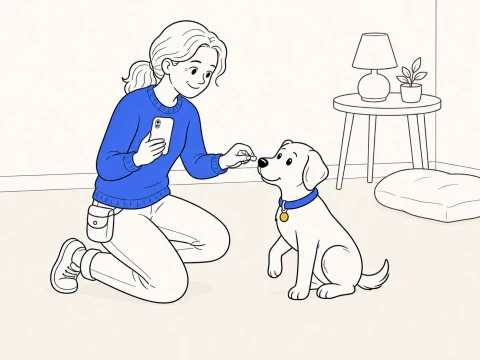
That almost always means the treat is too high or moving too fast. The AKC’s own troubleshooting is that standing up “likely means that you’re luring too quickly or that the hand position is just slightly too high,” so your puppy strains up to reach it. Lower your hand to a whisker above the nose, slow right down, and click the smallest lift — even one paw lightening — before you ask for more.
Footing is the other quiet culprit. On a slippery floor, a couch cushion, or a bed, your puppy can’t get a stable base to rock back from, so they stand instead. AKC recommends starting “on carpet or other soft and supportive flooring that’s easy for your dog to balance on.” Some puppies — many terriers especially — offer a natural sit pretty all on their own; if yours does, you can simply capture it, clicking the pose the moment it happens instead of luring it. Either way, reward staying seated, not rearing up.
How long should a sit pretty training session be?
Very short — about three to four brief lifts and you’re done, well before your puppy is tired. Balancing on the haunches is real physical effort, so sit pretty stays tiny on purpose: a few good half-second lifts beat a long drilling session, and stopping early is the point, not a compromise. The same short-session logic covers every skill; see how long puppy training sessions should be for the age-by-age defaults. With this trick especially, the finish line is ending while it’s still easy — not squeezing in one more lift after the balance has gone wobbly.
When do you add the cue word?
Add “sit pretty” (or “beg”) once your puppy is rising into a balanced, straight-backed lift for the lure reliably — roughly four clean lifts out of five, across two separate short sessions — saying the word just before you raise the treat. Cue too early and you pair the word with a stand-up or a stumble; cue once the lift is smooth and you’re naming a shape they can already make.
After that, fade the food lure. Sassafras Patterdale, a Certified Professional Dog Trainer – Knowledge Assessed (CPDT-KA), writing for the AKC, advises beginning to fade once your dog performs the cue consistently, not on a fixed rep count — shrink the treat lure into an empty upward hand motion and pay from your other hand. Generalize last, and only to another soft, secure surface.
When should you skip sit pretty, or get help?
Stop, and skip the trick for now, if your puppy yelps, flinches, tips over, or seems reluctant to rock back — that’s information about their body, not defiance, and no photo is worth pushing through it. Sudden reluctance paired with limping, stiffness, or a change in appetite or energy is worth a vet visit. And as above, keep this one very light or skip it entirely with a young, still-growing puppy, a long-backed breed, or any dog with a history of back or joint trouble — your vet has the final word on whether their build is suited to it.
Trick training should feel like a game. If fear, stiffness, or pain shows up around handling or movement rather than easing with gentle, short sessions, that’s outside trick territory: see our guide to what’s normal and when to get help, and for behavior work use an International Association of Animal Behavior Consultants (IAABC)-certified behavior consultant.
What should you do next?
Keep the lifts brief, the footing soft, and your hands off the dog; add the cue only once the balanced lift is reliable, and save the full upright beg for a body that’s finished growing. Done that way, sit pretty is exactly what it looks like — a joyful, camera-ready finish to everything else your puppy has learned.
If keeping the splits, the reliability check, and the “is this trick right for my dog’s age and build yet?” question straight sounds like a lot to track alone, that’s what ClickerPup’s tricks module is for. It runs sit pretty alongside spin, shake, and roll over, sized into the same short sessions and flagged for the physical-readiness caution — and it only calls a trick “reliable” once your dog has actually proven it twice, not performed it once for the camera. Claim your early spot on the waitlist. The clicker is free forever, with a plain reminder before anything ever charges.