You stop puppy barking by matching the fix to the reason — not by yelling over it. Name the bark, remove what is paying it, reward quiet and calm alternatives, and teach a settle mat as the durable off-switch. Shrink the excess; do not try to delete your puppy’s voice.
If you searched this mid-chaos — puppy at full volume, you scrolling for a magic cue — you are not alone. Maybe you’re the one trying to ignore the bark while someone else on the sofa answers it with a “shh” or a tossed toy, and the noise just got paid again. Or you’re in an apartment, flinching every time the bark hits the shared wall, wondering what the neighbors think. Threads titled things like “How to reduce/stop puppy barking?” sit at the top of Google for a reason, and first-time owners type the same fear under the noise: is something wrong with my dog? Usually not. The ASPCA puts it plainly: barking is one of many forms of vocal communication, and the first step is figuring out why this bark is happening before you try to treat it. This sits inside the wider how to train a puppy map — barking is one behavior problem with a cause-matched plan, not a separate species of training.
Why is my puppy barking so much?
Because they are talking — and something in the environment is making that talk pay. Cornell’s canine-health guidance is blunt: dogs always have a reason for barking, even when the reason does not feel worthy to you. The ASPCA’s starting rule is the same: identify the cause and the motivation before you try to treat the problem, because each bark type does a different job. And if a bark keeps getting what it wants — attention, access, the “scary” thing leaving — your puppy learns to use volume as a tool. The honest goal is to decrease the excess, not delete barking altogether.
ASPCA guidance sorts the common types owners actually meet. Use the table as a first pass: when and where it happens, and who or what the bark is aimed at, usually tells you which row you are in.
| Bark type | What it usually looks like | First move |
|---|---|---|
| Attention / demand | Barks at you for play, food, out, or fuss | Stop rewarding the bark; reward quiet + a polite ask |
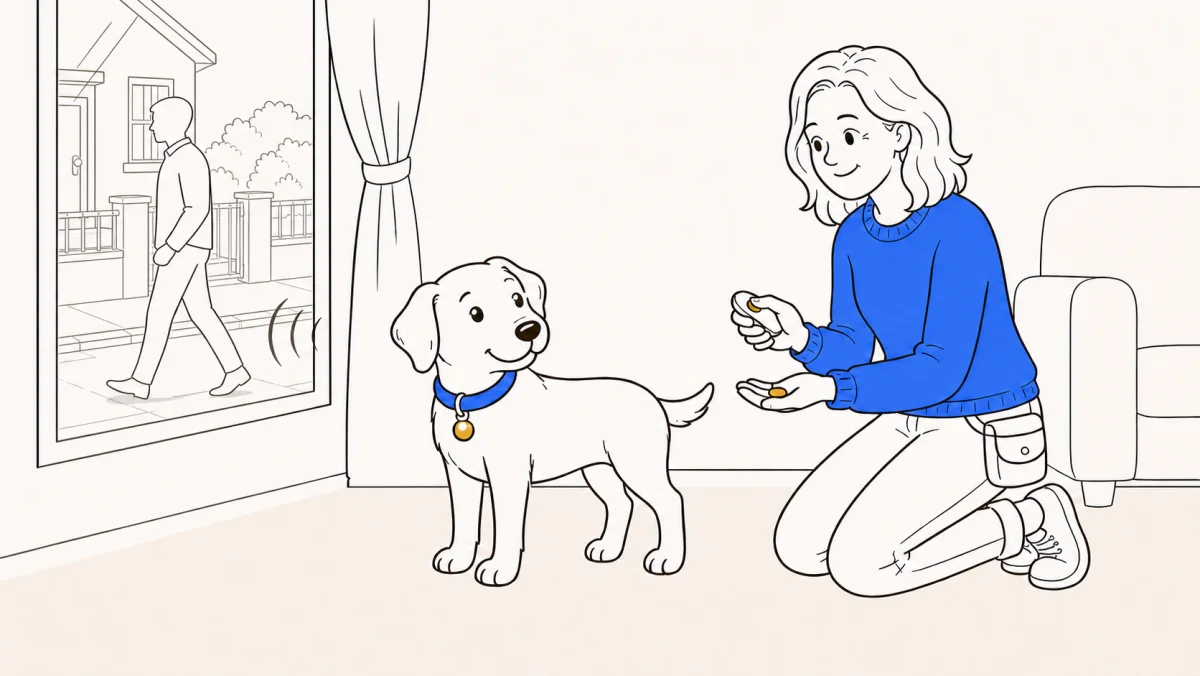
| Alert / territorial | Stiff body, window or door focus, repeats at triggers | Block the view or sound; reward quiet away from the trigger |
| Greeting / play | Loose body, wagging, happy noise at people or dogs | Manage arrivals; reward calmer greetings |
| Boredom / frustration | Repeats when under-stimulated or stuck behind a barrier | Add legal outlets; change the setup, not just the volume |
| Overtired / overstimulated | Stacks with frantic biting or zoomies | Nap and wind-down — not more excitement |
| Fear / separation | Panic when alone, or fear that does not fade | Professional help — do not DIY the panic |
One survey finding worth knowing, with its limits attached: in Dinwoodie and colleagues’ 2021 retrospective study of 1,023 dogs, attending training at six months of age or younger was associated with 0.68 the odds of owner-reported excessive barking (95% CI 0.47–0.99) compared with dogs that had not attended puppy training. That is correlational, on a behavior-problem-skewed sample — not a promise that a class “cures” barking — but it lines up with the practical pattern: early, reward-based practice beats waiting until the noise owns the house.
How do I stop my puppy barking for attention?
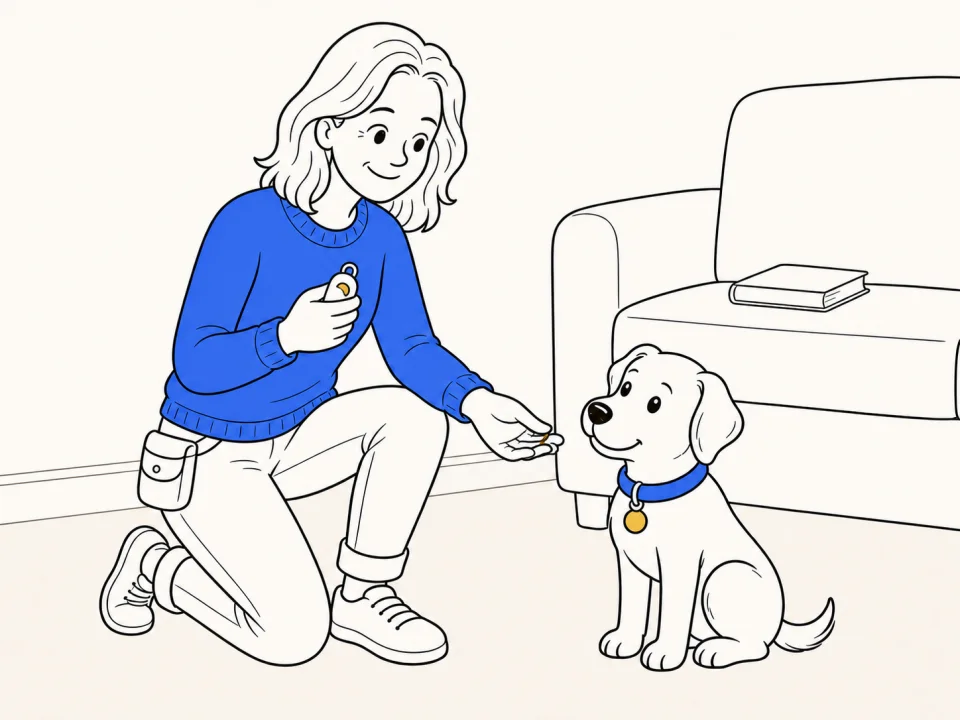
Stop paying the bark, and start paying quiet — every time, every person in the house. Once you start ignoring, you must persist until the behavior stops completely, and it often gets worse before it gets better. ASPCA attention-barking guidance is clear: a demanding, noisy dog has usually been taught that pattern, often by accident, and treatment means consistently not rewarding the bark. Dr. Stephanie Borns-Weil of Tufts’ Cummings School names that worse stretch as the expected part of unlearning — any petting, playing, reprimanding, or even eye contact can reinstate the payoff.
What does the ignore-and-pay loop look like?
- Zero response while the bark is on. No “shh,” no scolding, no shoving a toy at them mid-bark. Leave the room and close the door if you need a clean exit.
- Mark the first quiet. The moment there is a pause — even a second — mark it (a click or a calm “yes”) and give the attention, play, or access they were asking for.
- Install a polite ask. Sit, a hand target, or a settle on a mat becomes the way requests get answered. Quiet asks pay; noisy asks go invisible.
- Meet real needs on a schedule. If barking was how potty breaks or walks got booked, book them when your puppy is quiet so the need is met without the bark becoming the doorbell.
Household consistency is the whole game. If one person ignores and another answers, your puppy learns barking works sometimes — the most motivating schedule there is.
What if my puppy barks at the window, doorbell, or everything outside?
That is usually alert or territorial barking — and management beats a mid-bark argument. ASPCA separates the two: territorial barking targets people or animals approaching spaces your puppy treats as theirs (home, yard, car, familiar routes); alarm barking can fire at sights or sounds in any location, often with a stiff body and a small forward pounce on each bark. Either way, the rehearsal is the problem — every unanswered window show practices the same chain.
Cornell’s excessive-barking guidance recommends cutting that rehearsal: translucent window clings, blocking access to the window, white noise or a TV to mask outdoor sounds, and preventing fence-running by controlling when the yard is available. A puppy who can watch the trigger all day will practice the same bark all day.
How do I pay quiet once the view is managed?
- Call your puppy away from the window before the bark chain starts, when you can still win.
- Mark and reward looking at you, sitting, or settling on a mat away from the glass.
- Practice short “hear the trigger → get paid for quiet” reps at a distance your puppy can handle — not with the mailman already on the porch and everyone already yelling.
You are not training a mute dog. You are teaching that the window job has a new ending: notice, then return to you for something better than yelling at the sidewalk.
What if my puppy barks in greeting — or from boredom?
Greeting and boredom are different jobs from demand or alert barking, and they need different first moves.
How do I handle greeting and play barking?
ASPCA greeting barking is usually loose and excited — wagging, happy noise at people or dogs — not the stiff forward pounce of an alarm bark.
- Manage the arrival. Brief wait behind a gate, on a mat, or on leash before the hello starts.
- Mark calm contact. Four paws on the floor or a sit gets the marker before the fuss lands.
- Then greet. The hello is the payoff for quiet feet — not for leap-and-bark.
Excitement is fine; a rehearsed leap-and-bark greeting is optional.
How do I handle bored or frustrated barking?
Cornell names boredom and frustration as common drivers — under-stimulated, stuck behind a barrier, or watching something they cannot reach.
- Change the setup. Stuffed chew, two-minute training game, a walk, or access they can earn quietly.
- Do not answer with volume. More noise teaches the wrong lesson.
- Give a legal outlet. Remove the reason the bark started; the symptom usually follows.
Why does my puppy bark more when they are overtired?
Because an overtired puppy loses their brakes — and volume is one of the ways that shows up. The same boil-over owners call the puppy witching hour often pairs frantic barking with biting and zoomies. More fetch to “burn it off” usually piles stimulation onto a nervous system that needed a nap. This is arousal management, not a “bad dog” moment: sleep debt and overstimulation remove the puppy’s ability to stop, so the plan is naps and a calmer runway — not one more exciting game.
Three management moves do the work before training does:
- Protect daytime naps. Most loud evenings are sleep debt wearing a dog costume. If your puppy has been awake and “on” for most of the day, the bark spike is already booked.
- Wind down before the usual spike, not during it. Mat, slow low treats, a legal chew — started ahead of the predictable boil-over point, not argued through once the volume is already up.
- If they are already past settling, that is a nap, not a drill. Put them somewhere quiet and let the reset happen. An overtired puppy needs sleep more than one more cue.
If the bark is mostly teething-plus-chaos with teeth on hands, the sister plan in how to stop a puppy from biting is the same family of answers: redirect, reward the switch, guard naps.
How do I teach my puppy to settle so they bark less?
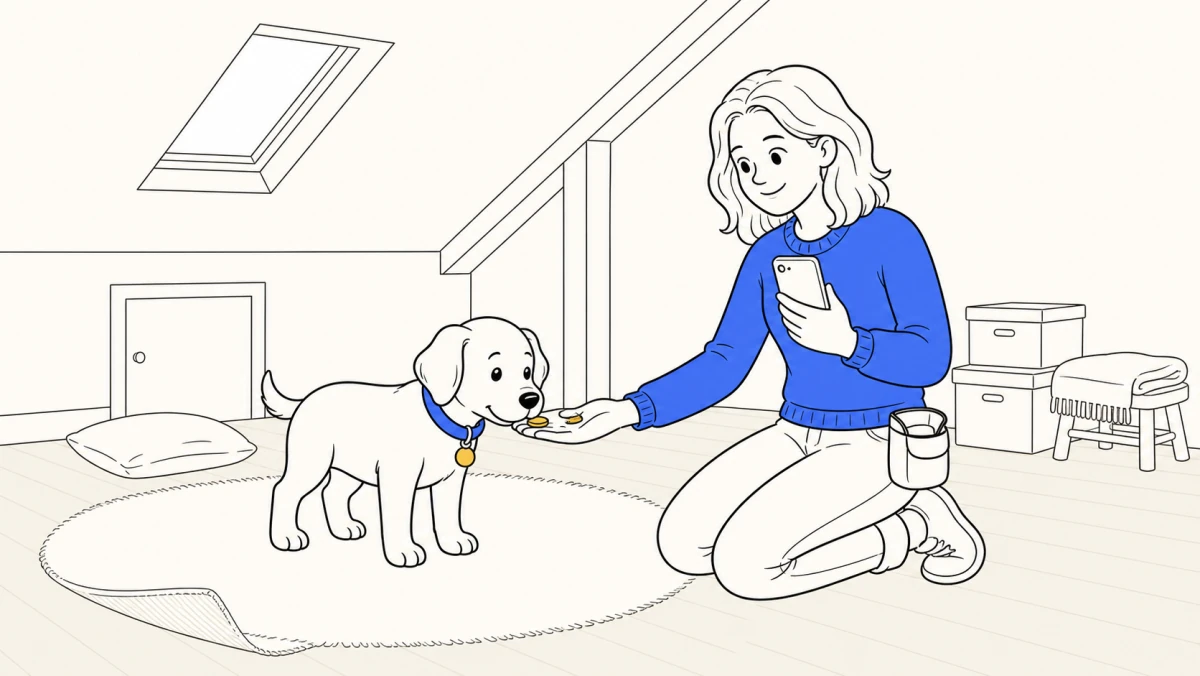
Settle is the durable skill under most everyday barking plans — a trained off-switch, not a frozen “down” held by tension. Put a mat or folded blanket down. Mark any interest — a sniff, a paw — and deliver the treat on the mat. Teach it in calm moments, then deploy it when life gets loud:
- Keep rewarding progressively calmer choices: stand → sit → lie down → a soft, relaxed body (a hip-roll or sigh beats a tense sphinx).
- Feed slowly and low, between the front paws. Fast, high treats create excitement — the opposite of the job.
- Skip the cue word at first. Capture the calm; name it later.
- Keep sessions to two or three quiet minutes, and end while your puppy is still relaxed.
Once the mat means calm, bring it out before predictable bark triggers — guests, the busy part of the day, the window that always starts a show — and pair it with a legal chew. Short sessions beat one long fight; the same two-minute rhythm that session-length research supports for puppies applies here.
Getting settle consistent when you are tired and the puppy is already loud is most of the battle — and it is exactly the kind of short, adaptive practice ClickerPup is being built to plan for you. More on that at the end.
Should I yell, use a bark collar, or punish barking?
No — and this is one place the standards and the hardware advice agree. AVSAB’s 2021 position statement on humane dog training recommends reward-based methods only. Cornell quotes Dr. Katherine Houpt on anti-bark hardware without soft-pedaling: shock is nasty, ultrasound only works a few times, and citronella is still punishment. In Vieira de Castro and colleagues’ 2020 study of 92 companion dogs, aversive-trained dogs showed far more stress-related behaviors during training — over 13 times more lip-licking and about 8 times more yawning — plus a real rise in cortisol afterward, while reward-trained dogs stayed flat.
Yelling has a simpler failure mode: to many puppies it sounds like you joined the bark-along. Quiet that you mark and pay is clearer than volume you add.
When is puppy barking a real problem?
Ordinary demand, alert, play, and overtired barking are management and training. Separation distress, fear barking that does not fade, a stiff frozen body with growling or snapping, or a sudden barking change alongside physical signs deserve a vet or a certified behavior professional — not a wait-and-see.
A few patterns to spot:
- Separation distress / panic when left alone — ASPCA separation-anxiety barking occurs when the caretaker is gone, usually with at least one other sign (pacing, destruction, elimination, depression, or other distress). That is not a “ignore it harder” homework assignment.
- Fear barking that does not fade, or barking paired with a stiff, frozen body, hard stare, or growling/snapping.
- Sudden barking changes alongside appetite, energy, or other physical shifts — vet first; pain often shows up as behavior (ASPCA notes illness or injury as a barking cause to rule out).
- Compulsive, broken-record barking with repetitive movement — get a certified behavior professional involved early.
For those, use the triage guide on what’s normal and when to get help. Look for IAABC-certified consultants (iaabc.org) or a veterinary behaviorist (ACVB) — not a shock collar sold as a shortcut.
From noisy puppy to a dog you can live with
Name the bark. Stop paying demands. Block the views that rehearse alert barking. Protect naps when volume is exhaustion. Teach settle so calm has a place to go. Skip the yell and the collar. Get help fast for fear, panic alone, or aggression — those are outside what a blog post (or an app) should coach through.
The hard part is not the plan on the page. It is running the ignore-and-pay loop, the window management, and the two-minute settle reps when you are already worn down. That consistency is the whole reason we are building ClickerPup: an honest, force-free coach that plans short sessions — including settle, the off-switch most barking plans need — and adapts to how the last one actually went.
The clicker stays free forever, with a plain reminder before anything ever charges. No quiet bill you did not agree to.
Claim your early spot and we will bring you in as we open up — with settle near the front of the plan for the weeks when the house is loud.