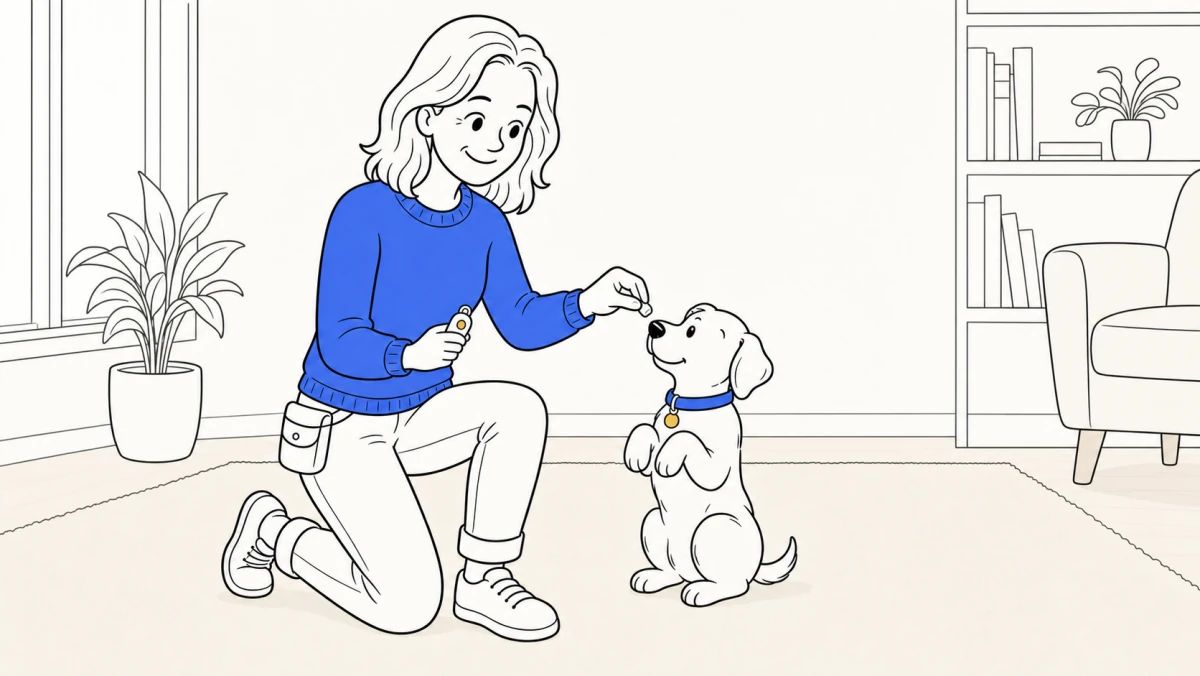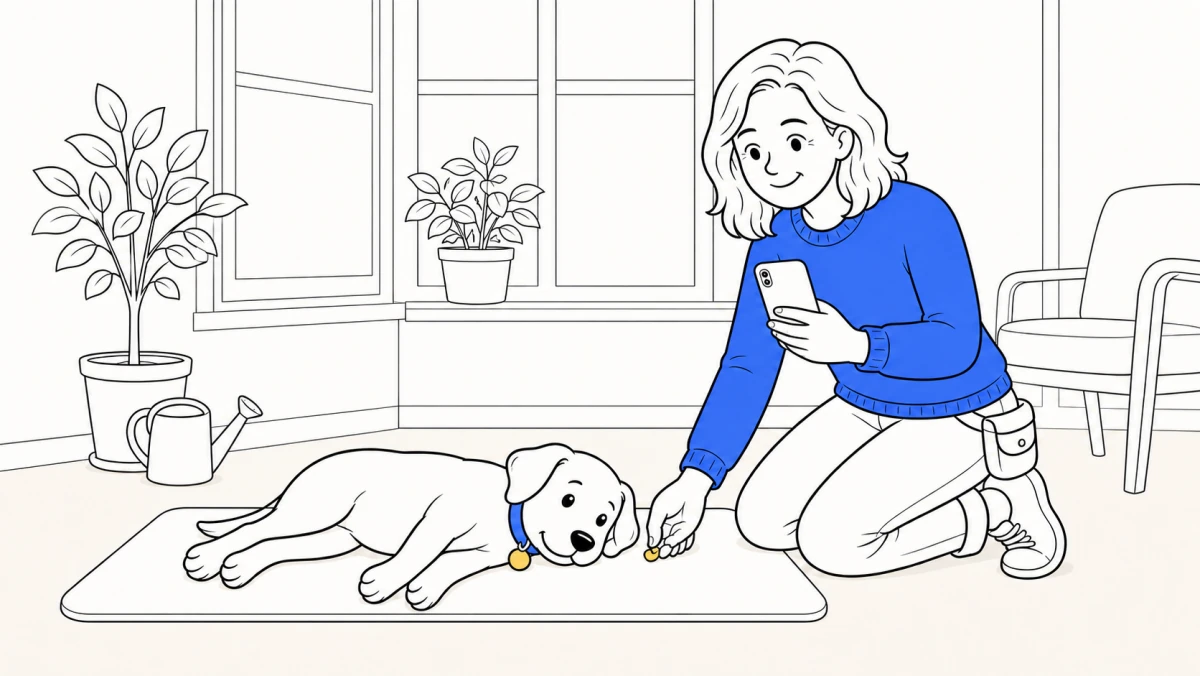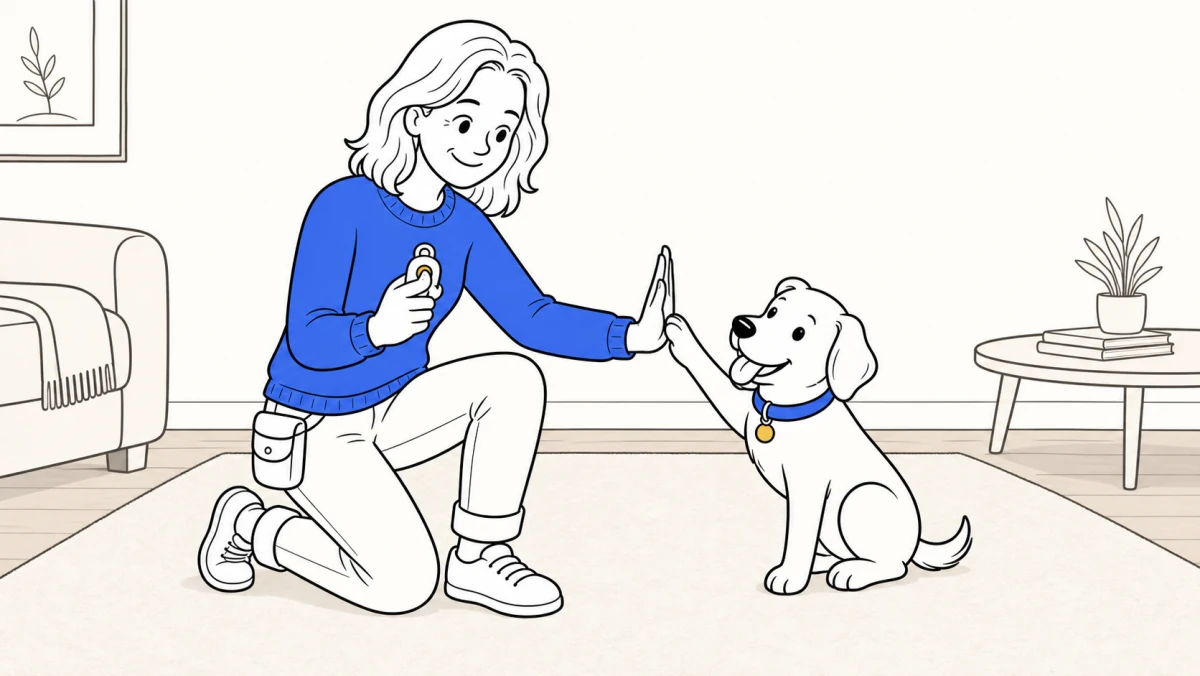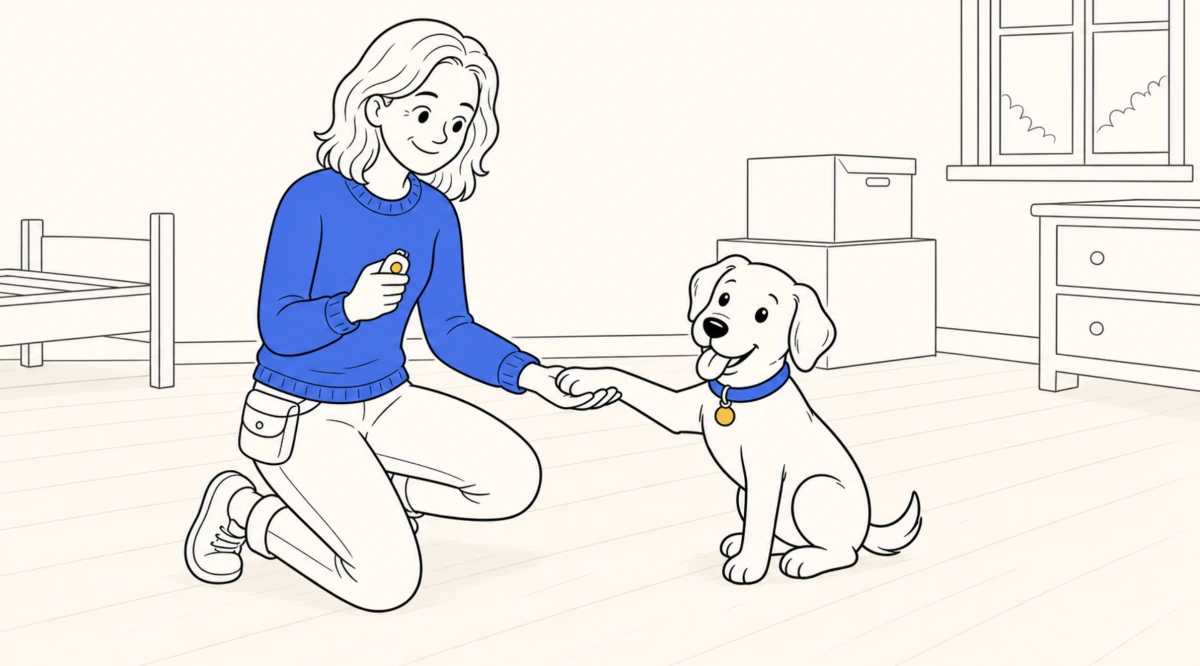
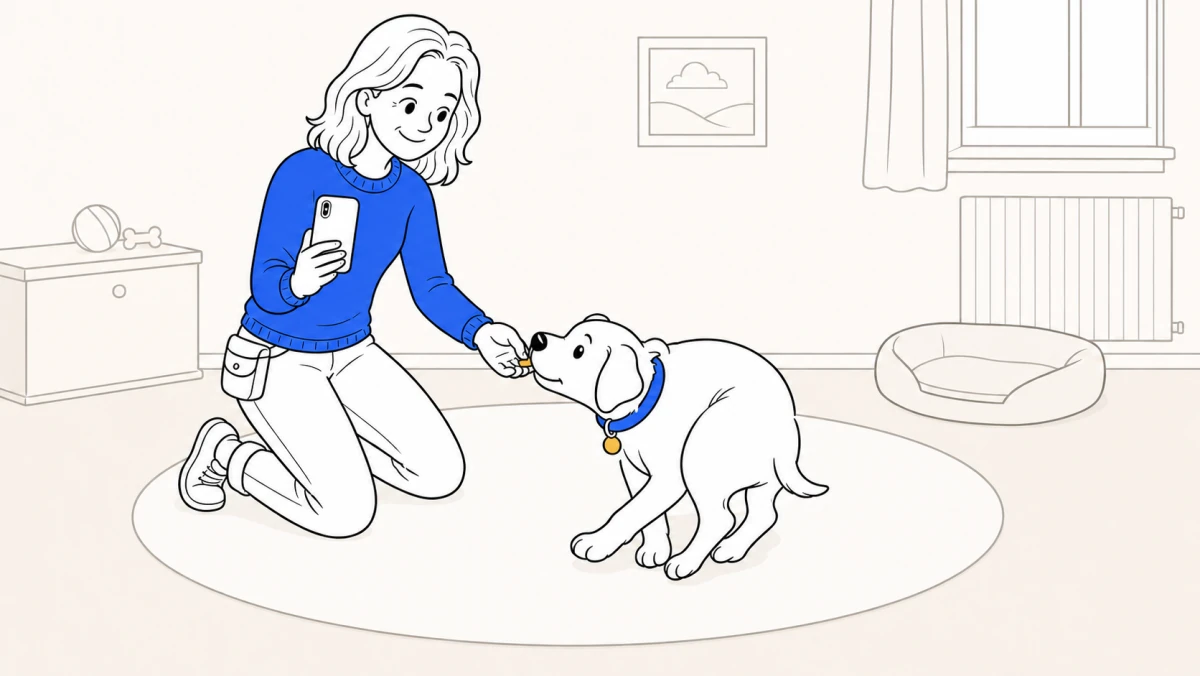
Teach spin by luring your puppy’s nose in a slow circle: draw a treat from their nose all the way around, click the half-turn first, then click the full spin, and treat. Keep the hand slow, sessions to a couple of minutes, and let it stay a silly game — no other skill required.
Spin is the trick to reach for after a rough week on sit, when someone on the sofa has asked “isn’t she supposed to know that by now?” It’s near-impossible to get wrong — pure lure, nothing else needed first — and it’s the one friends ask how you taught. Same click-and-treat loop as everything else: no class, no forcing, just a treat, a slow circle, and a click.
Does my puppy need to know any other skills before spin?
No — spin has no prerequisite, which is exactly why it’s such a good early win. Unlike roll over, which goes far more smoothly once your puppy already has a reliable “down,” spin starts from a stand with nothing else in place. If your puppy can follow a treat, they can learn to spin.
If sit or down is still a work in progress, don’t wait on them — teach spin as its own guaranteed win. That’s why ClickerPup treats spin as one of the two earliest-capable tricks, startable from scratch, the same slot as shake in the fun tricks hub. Confidence is what a handful of these early wins feels like.
How do you teach a dog to spin?
From a stand, hold a treat at your puppy’s nose and guide it slowly in a full circle so they turn to follow it — click the half-turn first and treat, then on later reps click only when they complete the whole circle. Keep the hand slow: a fast lure runs past their nose and they give up. That split is the whole method. The American Kennel Club’s spin instructions use the same lure — a treat drawn in a full circle so your dog turns to follow it, then a reward the moment they come all the way around. ClickerPup adds one thing on top: it clicks the half-turn as its own success before asking for the full circle, so a puppy who’d otherwise quit at the halfway point still gets paid for the try. That’s the first of Karen Pryor’s Ten Laws of Shaping in Don’t Shoot the Dog! — raise your criteria in steps small enough that your puppy always has a realistic shot at the treat.
What are the steps?
- Stand your puppy on a non-slip surface — a rug or carpet, not slick tile. Hold a treat right at their nose.
- Draw the treat slowly in a half-circle, around toward their shoulder and hip, so they turn to follow it. Click the moment they’ve followed a half-turn, then treat. Slow is everything — a fast hand runs the treat past their nose and they give up.
- On the next reps, carry that same arc all the way around into a full circle. Click as they complete the spin, then treat.
- Once the full spin is easy, shrink the big hand-swoop into a small hand-twirl at the same height, and pay from your other hand.
- Keep it to a handful of turns. One direction is plenty — whichever way they naturally lean is the spin.
Does the marker have to be a clicker?
No. This is reward-based work end to end. The American Veterinary Society of Animal Behavior (AVSAB) Position Statement on Humane Dog Training (2021) recommends reward-based methods only for dog training; a cheerful “yes” is a legitimate equal to a clicker if you prefer that sound. Either way, you’re using the clicker method — mark the moment, then pay it.
What if my puppy won’t follow the lure all the way around?
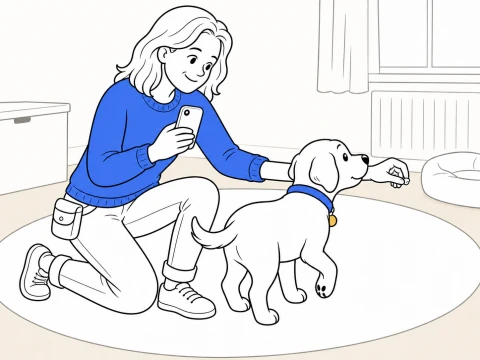
Almost every stuck spin is one of four fixable things, and not one of them is your puppy being difficult or stubborn. The fix is nearly always in the setup — the speed of your hand, the size of the ask, or the surface under their feet — rather than in the dog. So before you decide spin is just “too hard” for your puppy, run down this short list and change the setup first — the turn is usually hiding behind one small thing you can adjust in seconds. Here’s what each stuck moment usually means, and what to do:
- Luring too fast — the hand outruns their nose, they lose the treat, and they quit. Slow the circle right down and keep the treat glued to their nose.
- Following halfway, then stopping — you’ve lumped the whole circle into a single ask. Go back to clicking the half-turn on its own for a few reps, then extend it.
- Zoomies or looking dizzy — you’ve done too many in a row. A handful of slow turns, then a break, and one direction only.
- Still a big hand-swoop long after they’ve got it — the lure never shrank. Start shrinking the hand motion toward a simple twirl.
One direction forever is completely fine. Pick their easy side and stick with it.
Can you teach your puppy to spin both ways?
Yes — teach one direction until it’s solid and name it (“spin”), then lure the other way exactly the same, and give that direction its own separate cue, like “twist” or “turn.” Keep the two words clearly different so they don’t blur into one, and don’t rush it: one direction, cleanly, is already a complete trick. Lure the second direction with the same circle motion, and only add its new cue once your puppy follows that way consistently — the same “name it once it’s reliable” timing you used for the first spin. The other direction is a bonus for when the first is boring-easy.
When do you add the cue word for spin?
Add the word “spin” once your puppy is following the lure-circle reliably — about four clean spins out of five, across two separate short sessions — and say it just before you start the hand-twirl, not while they’re mid-turn. Cue too early and you pair “spin” with a half-finished turn; cue after the spin lands and you’re naming history, not teaching a signal.
After that, keep shrinking the food lure into an empty circular hand signal and pay from your other hand. Sassafras Patterdale, a Certified Professional Dog Trainer – Knowledge Assessed (CPDT-KA), writing on fading the lure for the AKC, says to begin fading once your dog performs the cue consistently, not on a fixed rep count — the same exit plan you’d use for sit. Generalize last, and only one change at a time: a spin in the kitchen is a different ask than a spin in the living room.
How long should a spin training session be?
About two minutes and three to five spins — then stop while it’s still silly and fun. Spinning is dizzying work for a growing puppy, so a handful of slow turns with a break beats one more rep every time. The same short-session logic that covers sit and settle applies here; see how long puppy training sessions should be for the age-by-age defaults. Ending early — while they’re still keen — is the win, not squeezing in extra turns after their body language has gone flat.
Is it safe to teach my puppy to spin?
For most puppies, yes — spin is one of the lowest-impact tricks there is, as long as you train on a non-slip surface and keep the reps few and slow. What’s genuinely different is spinning or tail-chasing your dog does on its own, off-cue and hard to interrupt — that can be a compulsive behavior and is a vet-and-behaviorist question, not a trick. A fast spin on slick tile or laminate can slide a puppy’s legs out from under them, so train on a rug or carpet where they’ve got grip. Because spinning is genuinely dizzying, a few slow turns with a rest is both safer and more effective than a run of fast ones. If your puppy has any diagnosed joint, spine, or balance problem, ask your vet whether this trick suits them before you start.
Is a taught spin the same as a dog spinning in circles on its own?
No — and the difference matters. A trick spin is something your puppy does on your cue, for a treat, and stops when the game ends. Spinning or tail-chasing that happens on its own — off-cue, over and over, often when a dog is excited, stressed, or bored — can be a compulsive behavior, and that’s a vet-and-behaviorist question, not a trick. Researchers at the University of Helsinki studying compulsive tail chasing (Tiira et al., 2012, in PLOS ONE) found it can begin young — as early as three to six months — and that nearly half of the dogs who did it showed lowered responsiveness during a bout: they were harder to interrupt or distract, and were more likely to show other compulsive habits too. The researchers treat canine tail chasing as an animal model for human obsessive-compulsive disorder.
Teaching a cued spin does not cause that — a behavior your puppy starts and stops on request is the opposite of a compulsion. But if your dog spins or chases their tail when no one asked, seems locked in, or can’t easily be called out of it, don’t train it as a trick and don’t punish it. That’s the point to step outside trick territory: use our when-to-get-help guide, talk to your vet, and for behavior work find an International Association of Animal Behavior Consultants (IAABC)-certified behavior consultant.
What should you do next?
Keep the hand slow, click the half-turn before the full circle, and let spin stay the silly, no-pressure end to a session — or claim an early spot on the waitlist if you’d like those short sessions planned for the puppy on your floor.
A slow circle, a click on the completion, and permission to stop after three good turns is the whole trick. If keeping the splits straight and knowing when a spin is actually “reliable” sounds like a lot to hold in your head alone, that’s what ClickerPup’s tricks module is for — spin alongside shake, roll over, and beg, sized into two-minute sessions and called “reliable” only after your dog has proven it twice. Claim an early spot on the waitlist. The clicker is free forever, with a plain reminder before anything ever charges.