Your dog hasn’t forgotten anything. Adolescence in dogs runs from roughly six months to somewhere between eighteen months and two years, and the study that measured the obedience drop found it was real, temporary, and aimed specifically at you — the same dogs got better at responding to a stranger.
If your seven-month-old is walking past a cue they nailed at four months, the fear underneath the frustration is usually one of two things: that you broke it, or that it never really worked. Neither matches what the research describes. What it describes is a phase with a shape — it shows up in the same short list of behaviors, it peaks at a fairly predictable age, and it passes. So: what’s changed, what to do while it’s happening, and which of the confident claims you’ll read on the way are actually backed by anything.
When does the teenage phase start in dogs?
Somewhere between six and eight months, depending on which source you ask — and the published start dates genuinely disagree, which is worth knowing before you decide you’re ahead or behind. Cornell University’s Riney Canine Health Center says “Most puppies hit adolescence around 6-months-old, but it can start later,” and that it “generally ends around 18 months of age, but can go until 2-years-old depending on the breed or dog.” The American Kennel Club puts the start later: “This period is individual to each dog, but it may begin when he’s about eight months old and continue until he’s two years old.”
The peer-reviewed developmental literature brackets it wider still. McEvoy and colleagues’ 2022 review in Animals lists six periods in canine development, the last of them “the pubertal period (7–24 months).”
Three respectable sources, three different start dates — and the spread runs both ways. Cornell’s end point is explicitly conditional, “depending on the breed or dog.” The Generation Pup researchers go tighter than any of them, putting it at “6 months and 1 year of age” for most dogs. So this isn’t sloppiness so much as a real range with breed and size moving it around inside. Take the behavior as your signal rather than the birthday.
What’s underneath it, per Cornell, is that “your puppy’s body and brain are making the transition from puppy to adult dog. Different hormones are turning on and off to control growth and sexual maturity.”
Why does my teenage dog suddenly ignore commands they knew?
Because adolescent dogs get measurably worse at responding — to you specifically. Asher and colleagues (Biology Letters, 2020) found dogs were roughly twice as likely to keep blanking a well-practiced “sit” at eight months as at five when the person asking was the one they lived with, while the same dogs got better at responding to a stranger over the same weeks. That the dip has a direction is the useful part, and it is the single most-skipped fact about this phase.
The study scored 93 golden retrievers, Labrador retrievers and crosses at five months and again at eight, 69 of them tested at both ages. “The odds of repeatedly not responding to the ‘sit’ command were higher at 8 months compared with 5 months” for the person the dog lived with — odds ratio 2.14 (95% CI 1.46–3.11, p = 0.044). For the stranger, the odds moved the other way (OR 0.40, 95% CI 0.25–0.63, p = 0.049).
Three caveats, because they matter. That was one cue, in one breed group, in dogs going through a guide-dog program rather than living ordinary pet lives. It sets an expectation; it doesn’t describe your particular dog. That test measured obedience and nothing else, though the same paper did find separation-related behavior scores rose at eight months and settled again by twelve. And the authors flag their own confound: in part of the study the stranger asking for the sit was a guide-dog trainer, who may simply have been better at getting a response — they report the pattern held with a non-trainer too, but it’s a caveat worth carrying.
Does a teenage dog forgetting their training mean it never worked?
No — and the same study contains the cleanest disproof of that fear you will find anywhere. Alongside the obedience test, Asher’s team collected trainability ratings on a larger group: 285 golden retrievers, Labrador retrievers, German shepherds and crosses, scored by the dog’s main caregiver and separately by a professional training supervisor who knew each dog less well. The caregivers’ scores fell between five and eight months. The professionals’ scores moved the other way: “By contrast, the dog’s trainers reported an increase in Trainability when adolescent.”
Same dogs. Same weeks. Two sets of graders, moving in opposite directions.
A skill a dog has genuinely lost cannot get better for somebody else at the same time. What changed isn’t your dog’s knowledge. It’s what your cue is worth against everything else in the room, and who happens to be asking — which is the whole of what “reliable” ever meant. A cue is reliable in the conditions you proved it in, and adolescence changes the conditions. In the caregivers’ own ratings, trainability had climbed back above its five-month starting point by twelve months.
Preventive Vet’s Cathy Madson (MA, FDM, CBCC-KA, CPDT-KA) puts the practical version plainly: “Dogs may experience regression in previously learned behaviors as their priorities shift temporarily during adolescence. This is totally normal and not your fault.”
When is the teenage phase at its worst?
Around twelve months, on a large UK and Irish cohort that asked owners the same questions month by month. Kinsman and colleagues (Animals, 2025) tracked the Generation Pup study at 6, 9, 12, 15 and 18 months — 1,718 responses at six months, tapering to 684 at eighteen. The share of dogs reported to show at least one behavior their owner considered undesirable peaked at the twelve-month survey: 42.1%, or 513 of 1,219. Barking, leash pulling, recall problems and jumping up all peaked at twelve months and declined after that.
Two precisions most write-ups drop. The change across time points was statistically significant for barking, leash pulling and recall problems, but not for jumping up. And it’s an owner-perceived measure in a self-selected UK and Irish cohort — a shape, not a forecast. The shape is the point, though: an obedience dip measured in a standardized test at eight months and a reported-problem peak collected from living rooms at twelve are two completely different instruments agreeing that this phase has a middle and an end. One small mercy from the same data — owners reporting a problem typically reported only one of them.
What behavior problems are common in teenage dogs?
Five, mostly: recall, leash pulling, jumping up, barking, and a second round of chewing. The first four are Generation Pup’s most-reported behaviors; the fifth is one the AKC flags that catches people out. That’s a narrow enough list to spend your effort on rather than worrying about everything at once.
| What gets reported | What it looks like at this age | Where to take it |
|---|---|---|
| Recall | Comes back perfectly in the yard, becomes selectively deaf anywhere interesting | Teaching a reliable recall |
| Leash pulling | A bigger, stronger dog who has worked out that pulling still gets them there | Leash training, from the start |
| Jumping up | The same greeting as at twelve weeks, now at chest height | Stopping a dog jumping on people |
| Barking | New things worth barking at, and a voice that carries further | Why puppies bark and what helps |
| Chewing, again | Furniture and shoes, months after you thought teething ended | Stopping a dog chewing furniture |
That last row surprises people, and it shouldn’t. The AKC flags it plainly: “There is a secondary chewing phase between 8-to-10 months that occurs as the adult teeth settle in the jaw.” So a dog who stopped destroying things at five months and started again at nine is on schedule, not backsliding.
What about the sleep and the accidents that came back?
Three separate things arrive around this age and get filed under one word, and only two of them are anything like a regression. Each has a different first move, so it’s worth naming which one you’re standing in before you change anything.
The nights. Broken sleep in an older puppy is more often arithmetic than regression — an adolescent needs several hours less sleep than a small puppy does, and the schedule usually hasn’t caught up. Why an older puppy stops sleeping through works through the six causes with the sleep research attached, and the medical one to rule out first.
The accidents. Call your vet before you change anything about the routine: VCA’s veterinary team treats a sudden break in house training as a red flag for the bladder, and a urinary tract infection is not something training reaches. Once that’s cleared, why a potty-trained puppy starts having accidents again has the order to check the rest in.
The clock. Seven months isn’t late, whatever you’ve read. How long house training actually takes has the real range and the separate milestones hiding inside the phrase.
Is there a second fear period at six months?
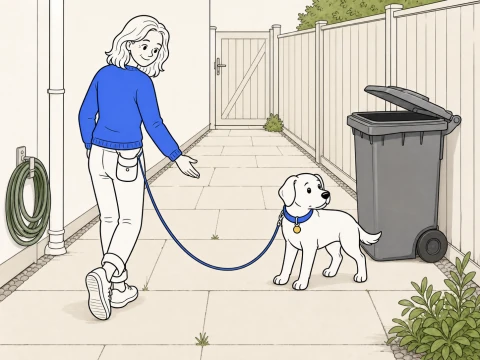
Maybe, but not as a defined stage. The wariness owners report is real and worth responding to; the tidy age bracket you’ll see attached to it isn’t pinned down anywhere. The developmental window with the strong evidence base is the early one — the socialization period at roughly three to twelve weeks, which is what the research actually supports. McEvoy and colleagues’ review lists six developmental periods, ending with “the pubertal period (7–24 months),” and doesn’t carve a separate fear stage out of that window. That’s why the brackets get quoted so differently from page to page.
Trainers describe one anyway, and their description is useful even without a bracket. Cathy Madson defines fear periods as “specific developmental stages in a young dog’s life when they may suddenly display heightened fear or anxiety towards certain things in the environment.” If your adolescent has gone wary of the trash can, the stairs, or a neighbor they used to greet, that’s a familiar enough pattern to take seriously without treating it as a crisis.
Take the boundary first, because it’s the part that matters. Fear that’s intense, that’s spreading to new things, or that isn’t fading is not a stage to sit out, and it isn’t something to work on from an article. That belongs with a certified behavior professional — IAABC-certified consultants work to standards that oppose “the intentional use of methods involving pain, fear, or intimidation,” which makes them a good first call — and the wider picture on where that line sits is in what’s normal and when to get help.
For an ordinary wobble, the move is management rather than a protocol: give your dog distance and end the encounter. Don’t march them up to the thing to prove it’s fine. That’s our position rather than a finding — nobody has run the trial — but it follows from everything else on this page, and it costs nothing to be wrong about.
Will neutering settle a teenage dog down?
That is a veterinary decision rather than a training one, and we are not going to make it for you. What you should know before the conversation is that the evidence does not promise a behavior fix.
WSAVA’s 2024 guidelines on reproduction control report that in some male and female dogs, “aggression against strangers and family members increased after gonadectomy,” and state plainly that the change afterward is “difficult to foresee and can only be estimated based on the individual dog and history.” Their recommendation is that owners get “a risk vs. benefit evaluation provided for both dog and owner in each individual case.”
The timing question is genuinely contested, and we’re deliberately not going to print an age here. AAHA’s 2019 Canine Life Stage Guidelines set different target ages depending on a dog’s projected adult size; WSAVA’s 2024 guidelines decline a single answer altogether and hand the decision back to the individual case. Two respected bodies, two different shapes of answer — which is exactly why it belongs with the vet who can see your dog, not with a training article. Take it to them with your dog’s breed, size, sex and household in front of you.
For balance, WSAVA does report that some testosterone-related unwanted behavior may improve after neutering — and, in the same breath, that plenty of it isn’t testosterone-related at all. Both halves of that belong in a consulting room rather than an article. The one thing we’ll say from the training side: nothing in the behavior research above describes the adolescent dip as a hormone problem you can operate on.
Should I just wait the teenage phase out?
It does pass — but “wait it out” is advice about time, and what changes things is what you do while the time passes. This is the stretch where habits set, in both directions.
It’s also the stretch the research keeps pointing at, which is why it gets studied at all. Kinsman’s team notes that the twelve-month problem peak “coincides with adolescence and has been reported as a peak age at which dogs are relinquished,” and the survey underneath that is Salman and colleagues (Journal of Applied Animal Welfare Science, 1998), who interviewed 3,772 people surrendering animals at twelve US shelters and found the largest single age band among surrendered dogs — 47.4% — was five months to three years. That band is far wider than adolescence and the data is thirty years old, so read it as why this age gets attention, not as a forecast about anybody’s dog.
What that means for you is small and practical, and it’s the next section.
What do you actually do when a cue stops working?
Make it easier, not stricter. The cue isn’t gone; the conditions got harder, so you drop back to a version your dog can win and rebuild from there. Six moves, in order:
- Rule out the physical first. A sudden behavior change, a break in house training, limping, drinking more, or any sign of pain is a call to your vet before it’s a training plan. That layer can only be cleared by someone who can examine your dog.
- Lower one criterion at a time. Distance, distraction and duration are the three dials; when one goes up, the others come down. A “sit” that’s solid in the kitchen is genuinely a new skill in a park, which is what reliable actually means — proved in the context you proved it in, not in general.
- Pay properly again. This is the age to start paying for things you’d quietly stopped paying for. Madson is blunt about the currency: “Kibble isn’t going to cut it around distractions with a teenage dog.” If you’re worried that means treats forever, that’s a different question with a good answer.
- Put the long line back on. Madson’s advice is to “use a long leash when practicing skills that require more distance, such as reliable recall or stay.” The way we’d put the reason: every off-leash cue your adolescent gets to ignore is a rep of ignoring it, and the line is simply what stops you practicing the version you don’t want.
- Manage the environment rather than testing it. “Managing the environment is an often-overlooked but very important part of training and behavior modification,” as Madson puts it. Baby gates, closed doors and a leash indoors aren’t failures of training; they’re what makes training possible.
- Spend the brain, not the miles. Cornell is direct about this: “Exercising your puppy’s mind will wear them out faster than any physical exercise.” Sniffing, chewing and two-minute training sessions do more for an adolescent than an extra walk.
Keep the sessions short and frequent rather than long and heroic — how long a training session should actually run doesn’t change because your dog got taller. The whole foundation this rolls back to is in the complete guide to training a puppy.
Should I be stricter with a teenage dog?
No — and reaching for something harsher is extremely common in this age group. The thing you’d be correcting isn’t defiance, so a harsher method has nothing to bite on. Brand and colleagues (Animals 14(2):336, 2024) surveyed the owners of 985 UK dogs at 21 months old. Across the whole cohort, 96.7% reported at least one problem behavior, with a median of five per dog (IQR 3–7) — and 82.3% reported using at least one aversive technique. The two travel together: owners reporting more problem behaviors were more likely to be the ones using aversive methods. Which way that runs, a survey taken at one moment cannot say.
AVSAB’s 2021 position statement is the short version of where the evidence sits: “AVSAB recommends that only reward-based training methods are used for all dog training,” and there is “no evidence that aversive training is necessary for dog training or behavior modification.”
Hold that next to the finding from earlier. A dog who performs better for a stranger than for you is not challenging your authority — the skill is present, the context has changed, and a firmer correction doesn’t touch the mechanism it’s aimed at. AVSAB’s view of what it does touch is blunt: aversive methods “have a damaging effect on both animal welfare and the human-animal bond,” which is a costly thing to spend at the exact age your dog is deciding how much you’re worth listening to.
That 82.3% comes from a UK, pandemic-era cohort, so treat it as context for how common the reach for harsher methods is at this age, not as a prediction about US owners.
When is teenage behavior a reason to get help?
When it stops looking like a phase and starts looking like fear or aggression. Growling, snapping or biting that isn’t play; lunging or barking at dogs or people on the leash; stiffening or guarding over food, toys or spaces; genuine panic when left alone; fear that’s spreading rather than fading — none of that is the teenage phase, and none of it is something to work through from an article, including this one.
That work belongs with a certified behavior professional. IAABC-certified consultants are a sound starting point: their standards of practice state that positive reinforcement “should be the primary training strategy” and that the IAABC “opposes the intentional use of methods involving pain, fear, or intimidation.” And what’s normal puppy behavior and when to get help covers where that line sits in more detail. Anything physical — a sudden change, pain, appetite or toileting shifts — goes to your vet first, always.
Is the teenage dog phase actually backed by evidence?
Partly, and it’s worth knowing which parts. Almost every claim on this topic sits in one of three buckets — measured, borrowed as an explanation, or repeated until it sounded measured — and the confident age brackets you’ll meet are mostly in the third.
| What you’ll read | What’s actually behind it |
|---|---|
| “Adolescent dogs stop listening” | Measured, narrowly. Asher 2020: one cue, 93 dogs in a guide-dog program, and the dip was specific to the dog’s own person |
| “It peaks around a year” | Measured. Kinsman 2025: owner-reported problems highest at the 12-month survey, 42.1% of 1,219 |
| “Their brain is still developing” | An explanation, by analogy. Cornell: “Just like in human adolescents, the prefrontal cortex in the brain is still developing.” Reasonable — but it’s a framing, not a scan of your dog |
| “It starts at six months” | Contested. Cornell says around six months, the AKC says about eight, the developmental literature brackets puberty at 7–24 months |
| “There’s a second fear period” | Widely described, not formally staged. No agreed age bracket, and it isn’t one of the six periods in the peer-reviewed developmental list |
| “Neutering will settle him down” | Not promised by the guidance. WSAVA (2024) calls the behavior change after neutering “difficult to foresee” |
None of that makes the trainers describing adolescence wrong. It means the numbers get repeated a long way past the evidence that produced them, and you’re allowed to hold them loosely.
How long does the teenage phase last?
Nobody can give you a date, and anyone who does is guessing. The outer edges are reasonably agreed: Cornell puts the end at “around 18 months of age, but can go until 2-years-old depending on the breed or dog,” and the AKC’s range runs to two years as well.
The training-side wobble tends to be shorter than the phase itself. In Asher’s cohort, caregivers rated their dogs less trainable at eight months and more trainable at twelve than they had at five. In Generation Pup, reported problems peaked at twelve months and declined after that — though that study stops at eighteen months, so it can’t tell you where the floor is.
Expect a wobble. Expect it to pass. And judge a rough patch on two weeks, not on an afternoon.
The honest short version
Your dog didn’t forget. Adolescence produces a real, measurable dip in how well a dog responds to their own person — and the same dogs respond better to someone else over the same weeks, which is as close to proof as you’ll get that the training is still in there. The problems cluster into a short list, they peak around a year, and they decline. Rule out the physical, lower the criteria, pay properly, put the line back on, and don’t let anyone talk you into getting harsher at the exact moment your dog can least make sense of it.
Here’s the honest bit: ClickerPup isn’t a teenage-dog program. It’s built around the foundation months, there’s no adolescence module in it, and it doesn’t potty train, house train or get a dog sleeping through the night — those are a vet, a schedule, and a body on its own timeline. We’re not going to pretend otherwise on a page you found because your seven-month-old just blanked you in a park.
What it does coach is the mechanic this whole page runs on: a skill counts as reliable only in the conditions you proved it in. When it slips, the plan steps back a rung and re-earns it instead of pushing on — two honest minutes at a time, on sit, leave-it, recall and the marker foundation underneath them. Knowing whether your dog has actually got something, or whether you raised the bar faster than they earned it, is the judgment that survives adolescence. The clicker stays free forever, with a plain reminder before anything ever charges.
Claim my early spot and we’ll bring you in as we open up.