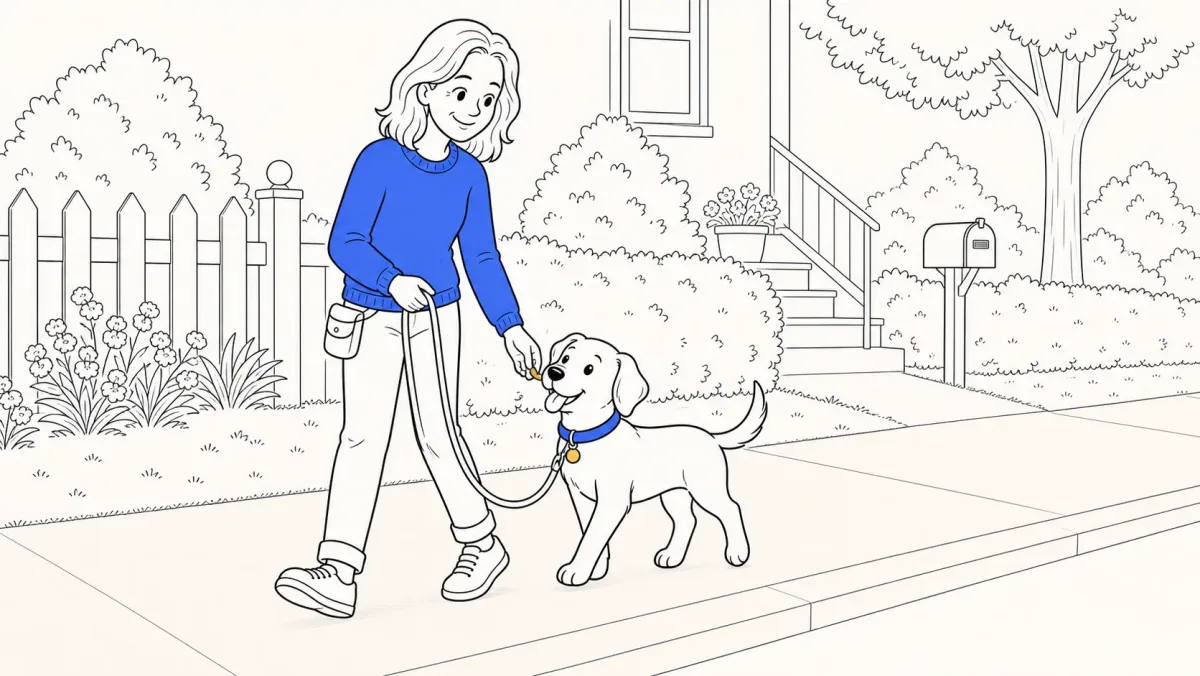
To stop a dog pulling on the leash, stop moving the instant it tightens — calm, no yank, no scolding — and walk on only when it slackens, paying the spot at your side. Forward motion is the reward, so pulling never once works. With a new puppy, you get to teach that rule before pulling ever becomes a habit.
Two people land on this page. One has a ten-week-old puppy and a leash still in its packaging. The other has a dog who has pulled for months, has learned that leaning into the collar makes the world arrive faster, and is now strong enough that the walk has quietly become the worst part of the day. The rule below is the same for both of you. The only difference is how much rehearsal you’re up against — and that difference changes the plan, not the method. If you’re here with a puppy and nothing has gone wrong yet, the starting-from-scratch sections are further down, from when to start onward; you’re building a habit rather than breaking one, which is the easier half of this page.
How do you stop a dog pulling on the leash?
Stop moving the instant the leash tightens — calm, no yank, no scolding. The moment it slackens or your dog checks back toward you, mark that, feed low at your side, and walk on. Forward motion is the reward, so pulling never once produces it.
That single rule is the whole fix, and it works because it removes the paycheck rather than adding a punishment. Every other decision on this page — gear, timing, session length, where you practice — exists to make that one rule easier to keep.
How common is leash pulling?
Common enough that it is the single most reported nuisance behavior in large owner surveys. In the Royal Veterinary College’s Pandemic Puppies cohort, 67.4% of owners (601 of 892) reported pulling on the leash as a problem behavior by 21 months (Brand et al., 2024). Dogs Trust’s National Dog Survey 2025 found 44% of owners named lead pulling among their behavior challenges in the past year — the first-listed and most frequently reported challenge in a survey where 90% of owners reported facing some behavior challenge. Those are UK surveys, so they say “lead”; the American word is leash. The pattern travels.
Why does my dog pull on the leash?
Because pulling works. Every step you take while the leash is tight pays for the pull, and outside is the most interesting thing in your dog’s day. It isn’t dominance or defiance — it’s a behavior that has been reinforced on almost every walk your dog has ever taken.
Look at it from the dog’s side of the leash. They lean, the sidewalk starts moving, the smells arrive. That happens on almost every walk, which means pulling is on a very generous reward schedule. Nothing about a collar tells a dog that the slack version gets them there too, because until you teach it, nobody has ever paid for slack.
Is leash pulling a dominance problem?
No. Pulling is a reinforcement history, not a bid for status, and treating it as defiance sends owners straight to the tools that make things worse. A dog leaning into a collar is not challenging you — they are doing the one thing that has ever reliably moved the walk along.
The American Kennel Club’s leash guide names the real gap precisely. Certified professional dog trainer Michele Miller says the big issue she sees is owners “not telling our dogs what we do want” — we know we don’t want pulling, but we never install the alternative. AVSAB’s 2021 position statement puts the same principle in one line: “Training methods are most effective when they focus on teaching the animal what to do, rather than punishing them for unwanted behaviors.” Pulling isn’t a character flaw to correct. It’s an empty slot where a paid behavior should be.
What is loose-leash walking?
Loose-leash walking means the leash hangs in a soft J instead of a straight wire — your dog somewhere near you, free to sniff and drift within the leash, just not towing you. It is not heel, which is a precise cued position you switch on for a few seconds.
That distinction saves people weeks. Loose-leash walking is the everyday skill: low precision, sniffing legal, the only rule being that the line stays slack. A formal heel asks for a matched pace, a held position, and attention up on you — it’s the thing you switch on to cross a road or thread through a crowd, then release. Trying to hold a heel for a whole walk is how owners burn out a young dog’s focus and conclude that “training doesn’t work on my dog.”
How do you teach loose-leash walking?
Teach it in three layers, in order: pay arrival at your pant seam with the leash off, keep paying slack steps with the leash on, then stop dead whenever it tightens and only walk on when it slackens. Skip a layer and you end up correcting a surge you never taught an alternative for. The three games below are the same rule at three difficulty settings.
What is the reward-zone game (leash off)?
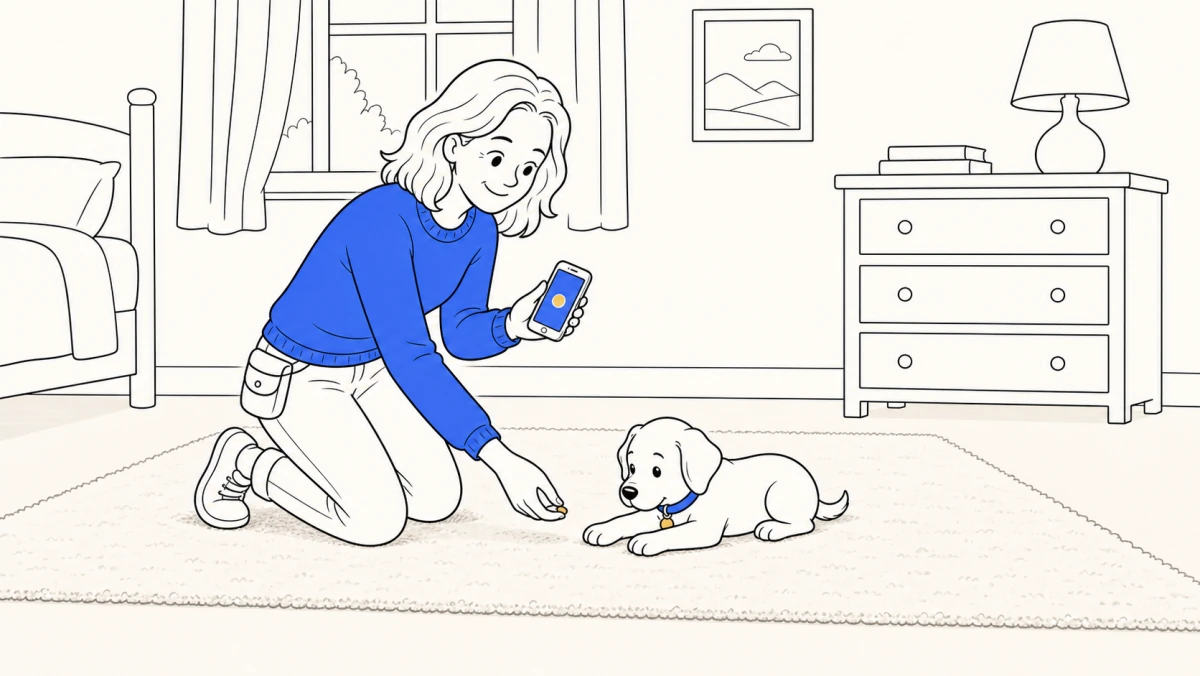
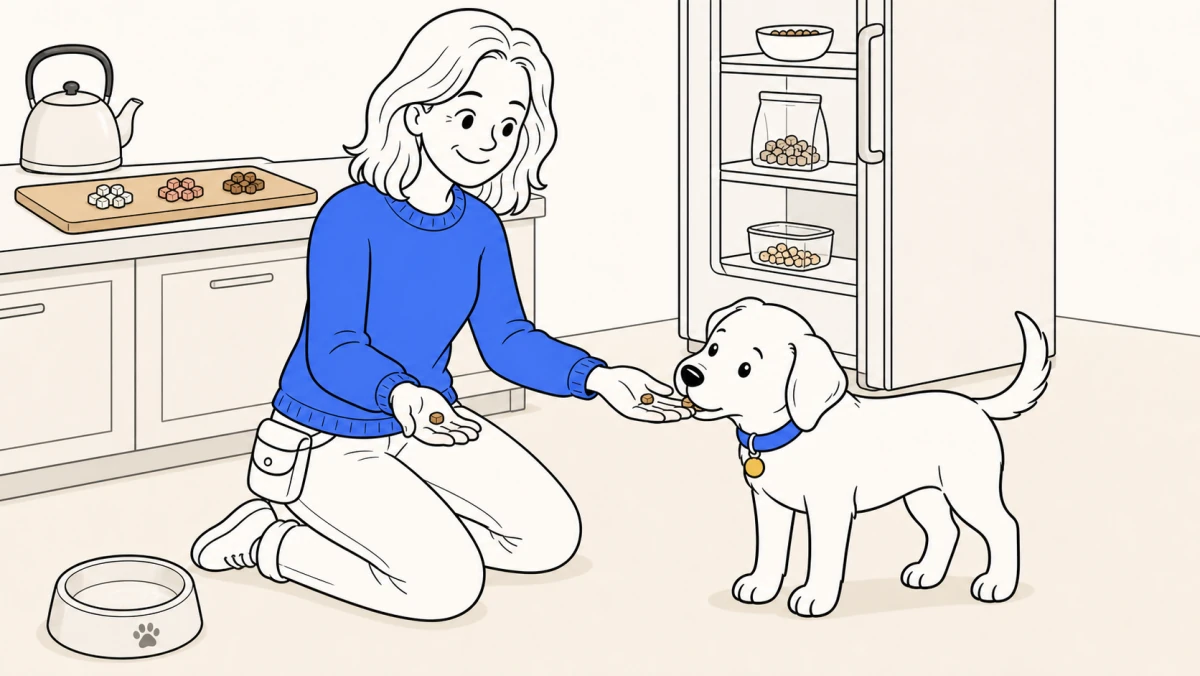
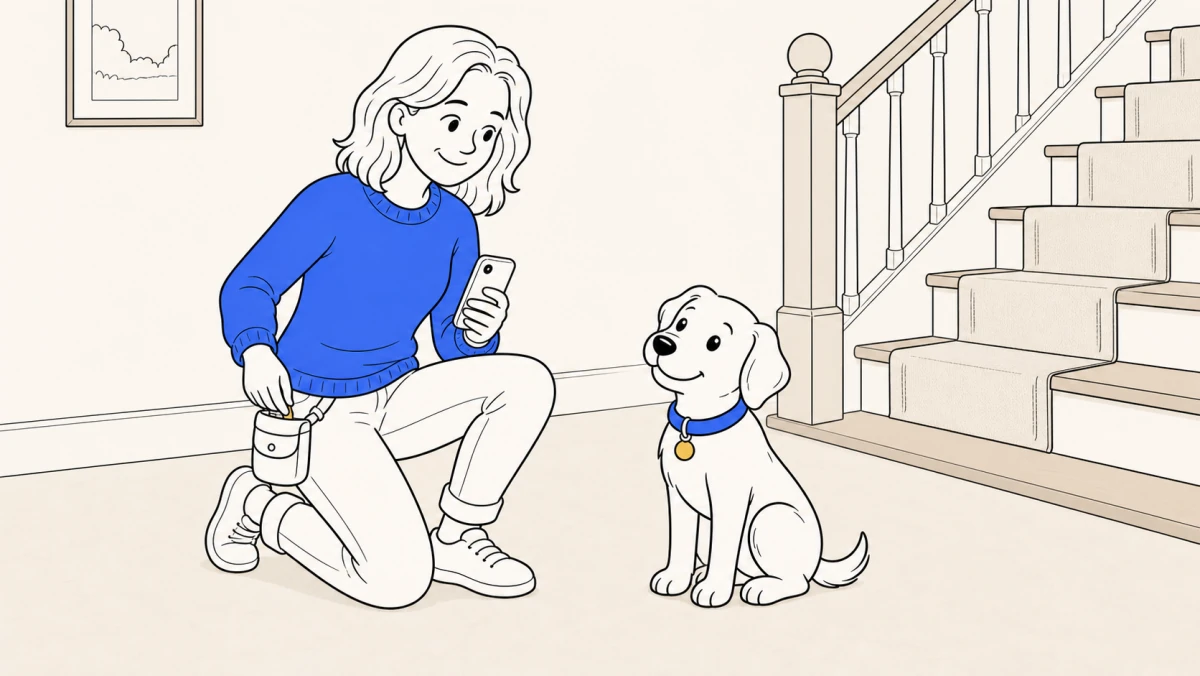
Click and treat whenever your dog arrives at or stays by your side, indoors, with the leash off. Deliver the treat low at your pant seam, always the same side. Take one step; click them coming with you. This is where “beside you pays” gets installed before hardware complicates it.
Deliver high or across your body and you’ll build the two most common side effects: a dog who jumps for the hand, or one who cuts in front of your feet on every step. Low, at the seam, same side, every time.
What changes when you clip the leash on?
Keep paying position every few steps while the leash stays slack. Change direction gently and click them catching up to your side. Same game, leash on — the line should hang in a soft J, not a straight wire. If the leash goes tight the moment you clip it, you’re moving too soon: go back to a few leash-off steps first.
How does stop-go finish the skill?
Stop-go is the rule that makes pulling stop paying. Run it as a short loop:
- Walk while the leash stays slack — soft J, not a straight line.
- The instant it tightens, stop moving — calm, no pull-back, no words.
- Wait for slack or a check-in toward you.
- Mark that moment (click or “yes”), treat low at the seam, then walk on.
Karen Pryor’s own starter tips put the same idea in one line: teach a dog to walk on a loose leash “by clicking and treating those moments when the leash happens to go slack.” The click-point is the slack, or the check-in — never a mark while the line is still tight. If the marker itself is new to your dog, spend one session pairing click and food first; that’s the same clicker method behind every other cue, and charging the clicker on day one takes about five minutes.
How do you retrain a dog who has already pulled for months?
Same rule, three changes: split the walk, shrink the distance, and expect the pulling to get briefly worse before it stops. A dog with a long pulling history isn’t harder to teach — they simply have far more successful repetitions to outweigh, so the plan has to protect the rule rather than hope for it.
| Starting (new puppy) | Fixing (a dog who already pulls) | |
|---|---|---|
| What you’re up against | An empty slot | Months of successful pulling |
| Where you practice | Indoors, then the yard | The doorway and ten yards of sidewalk |
| The walk | Training and walking are the same thing | Two separate outings: one to manage, one to train |
| What to expect early | Slow, uneventful progress | A few sessions of harder pulling first |
| The biggest risk | Taking the street on too soon | Walking on while the leash is tight |
- Split the walk in two. You cannot train a rule you break half the time, and needing to be somewhere is what breaks it. So separate the jobs: one outing is exercise and sniffing, where you manage the pulling and train nothing; a second, much shorter outing is the training walk, where stop-go is absolute. Five honest minutes beats thirty compromised ones.
- Start at the door. The front step is the highest-arousal moment of the walk and the one everybody skips. Clip on, open the door, and if the leash goes tight before the sidewalk, you’ve found your training ground for the week.
- Shrink the distance, don’t stretch it. Ten yards of slack leash beats a mile of stop-start yanking. Turn around at the end of your ten yards and do it again. Distance is the last dial you raise, not the first.
Will my dog pull harder before they stop?
Usually, yes — for a few sessions. When a behavior that has always worked suddenly stops working, dogs try it harder before they try something else. Trainers call that an extinction burst, and not knowing it’s coming is why most people quit in the first week.
Karen Pryor Clicker Training’s glossary describes it plainly: when a previously reinforced behavior isn’t reinforced, “the animal will increase the intensity or frequency of the behavior in an attempt to earn the reinforcement again,” and the behavior “will eventually diminish but often not until after an extinction burst.” So a walk that feels worse than last week is not evidence the method failed. It’s evidence your dog has noticed the rule changed — which is the necessary first step, not a setback.
How do you tell whether the retraining is working?
Count your stops. Note how many times you had to stand still in a five-minute stretch, and write the number down. Across a week that count should trend downward, and that trend is the only progress measure worth trusting — walks feel identical to us long after they have measurably changed.
The one thing that will flatten the graph is walking on while the leash is tight. Every one of those steps re-pays the pull and quietly refunds the work you just did. Stopped means stopped, every tighten you can train. And when a walk genuinely can’t be a training walk, that’s fine — keep the rule where you can and don’t pretend a yank is a shortcut.
Should you use a prong collar, choke chain, or shock collar to stop pulling?
No — and if your dog’s pulling has ever been discussed within earshot of another dog owner, someone has probably recommended one. We don’t use them, and the veterinary behavior position is unambiguous. The American Veterinary Society of Animal Behavior’s 2021 position statement opens with “Evidence supports the use of reward based methods for all canine training,” and states that “there is no evidence that aversive training is necessary for dog training or behavior modification.” Its guidance names the specific tools to avoid: choke chains, prong collars, electronic shock collars — and “physical correction techniques (leash jerking, physical force).”
Be honest about why they get recommended: they can suppress pulling quickly, and quick is seductive when your shoulder hurts. What they don’t do is teach your dog where to walk. Suppression leaves the empty slot exactly where it was.
What does aversive leash training actually cost?
More than most owners have been told, and the numbers are specific. In the Royal Veterinary College’s cohort, only 17.7% of owners (159 of 898) reported using no aversive training methods at all, and 40.2% (305 of 758) reported leash corrections — quickly yanking or jerking the leash when the dog pulls (Brand et al., 2024). It is the common path; that doesn’t make it the necessary one.
The physiological cost shows up in the dog. In a controlled study of 92 companion dogs, Vieira de Castro and colleagues (2020) found that dogs trained with aversive methods showed more stress-related behavior during training and a higher average post-training rise in cortisol (0.11 µg/dL) than reward-trained dogs (0.02 µg/dL). Karen Pryor’s own tip 13 is blunter still: “If you get mad, put the clicker away. Don’t mix scoldings, leash-jerking, and correction training with clicker training; you will lose the animal’s confidence in the clicker and perhaps in you.”
What gear do you actually need for leash training?
A flat collar or a well-fitted harness, a fixed-length lightweight leash of about six feet, and a pocket of tiny soft treats. That’s the list. Fit the collar or harness so two fingers slide under the strap and your dog can’t back out of it when they lean.
Soft, pea-sized treats matter more than they sound: you may pay every few steps at first, and crunchy biscuits slow the loop down and fill your dog up mid-session.
Do no-pull harnesses actually stop a dog pulling?
A front-clip harness changes the leverage, so less force reaches your arm — but it is management, not teaching. Nothing you clip on teaches a loose leash, and a dog who has only ever been managed will pull again the day the harness comes off. AKC’s Miller recommends one for large puppies because “this will make it easier to direct the puppy if they do start pulling” — useful, as long as you know what you bought.
One thing to skip outright: retractable leashes teach that constant tension is normal, which is precisely the opposite lesson. And anything that tightens, pinches, or corrects belongs in the section above.
When should you start leash training a puppy?
As soon as your puppy comes home — typically around 8 to 10 weeks. You can teach the skill indoors or in a secure yard before public walks; full vaccination timing for neighborhood sidewalks is a separate vet call, not a reason to delay the leash itself.
The American Kennel Club’s guidance matches that timing: CPDT-KA trainer Michele Miller starts leash work “before we even take a walk,” and the AKC notes you can begin the basics even if your puppy isn’t fully vaccinated or going out on walks yet. Early practice is habit-building. Everything in the retraining section above is habit-breaking — the same method, several times the work. If you’re reading this with a puppy rather than a puller, that’s the whole advantage, and it expires quietly.
How do you introduce the leash indoors?
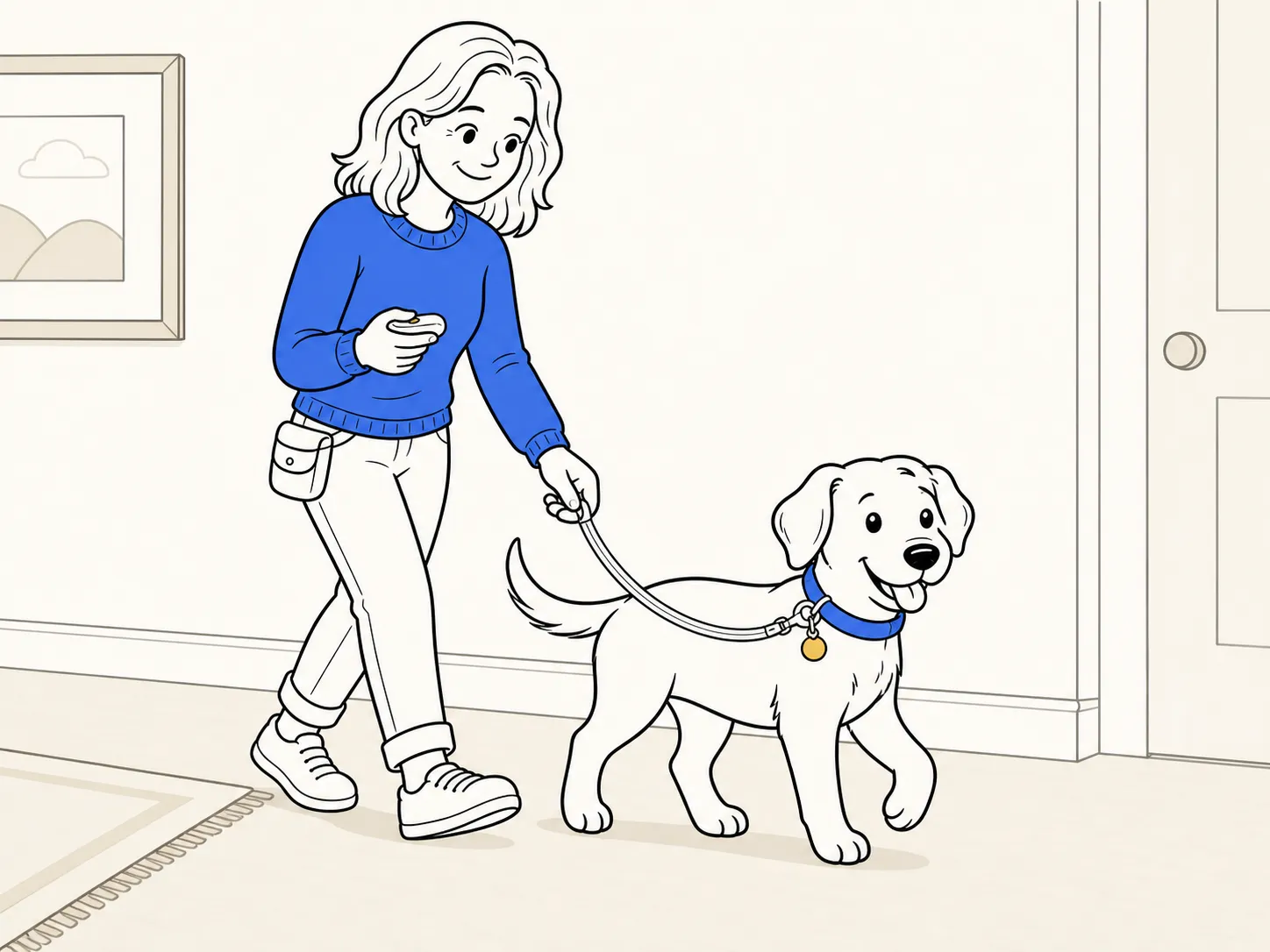
Indoors first: let the leash feel normal before you steer. Clip the leash on in a quiet room, let your puppy drag it under supervision for a minute, then pick up the end and follow them — no steering yet. The first job is “leash = normal,” not “walk politely.”
Pay any calm check-in toward you with a click (or a cheerful “yes”) and a treat. Miller frames this as its own skill: “Engagement is a skill, and we need to work on that. We work on that eye contact and those auto check-ins.” Keep sessions tiny — one to three minutes — matching the same short-session pattern that works for every other puppy skill. If the leash turns into a tug toy, redirect with a treat, ask for a drop, and keep a little less slack so the line is less interesting than you are.
What if my dog freezes and won’t walk on the leash?
That’s not stubbornness — it’s a dog who’s tired, unsure, or overwhelmed. Never drag the leash. Wait, invite with your voice, mark the first step, or simply end the session and try a shorter one in an easier place.
A puppy planted on the sidewalk is giving you information, not attitude. Drop the criteria: go back to the quiet hallway or yard, shorten the session, and pay the first willing step. Dragging teaches them that the leash is something to brace against — which is the same lesson pulling teaches, learned from the other end.
How long does it take to stop a dog pulling on the leash?
Expect the first genuinely slack steps within a few sessions in an easy place, and weeks to months before a real street is reliable. The longer a dog has practiced pulling, the longer the retraining — that’s arithmetic, not a judgment on you or your dog.
Nobody can give you a date, and any page that does is guessing. What you can control is the shape of the practice: two to three minutes of position games at home, plus short bursts of the same game on real walks before you let a walk just be a walk. Raise only one dial at a time — a few more steps between treats, or a slightly busier spot, or a gentle turn. Never all three. Progress here is measured one place at a time, not as a single global “trained” switch.
Why short and spaced, not one long drill?
Because over-drilling loses to shorter, spaced practice in the dog-learning research. In a controlled study, 44 laboratory Beagles were split into four groups learning an obedience-shaping task, each dog getting the same total of 18 sessions. Dogs trained in a single session per day did significantly better than dogs drilled in three sessions back-to-back, and dogs trained once or twice a week reached a higher training level than dogs trained daily (Demant et al., 2011). That’s a nudge against cramming — a lab-Beagle obedience task, not a rule that leash work must be weekly. Fuller session-length evidence: how long puppy training sessions should be.
When is my puppy ready for real outdoor walks?
When they can hold a slack leash for a stretch of steps in an easy place — indoors or the yard — about four times out of five across two separate sessions. Then add the street the way you’d add any new room: one change at a time, expectations dropped a notch, payment better for the harder context.
What should outdoor leash practice look like?
Cue the walk and mark check-ins rather than waiting to react. Miller teaches directional cues for turning left and right plus a general “let’s go,” so the dog isn’t “just getting dragged along” by a person who changes course without warning. Sniffing breaks stay legal — the walk is your dog’s newspaper, not a drill. A few dedicated sniffy outings each week, where your dog chooses the route, make polite walking easier the rest of the time because the enrichment need got met somewhere.
What other skills make outdoor walks safer?
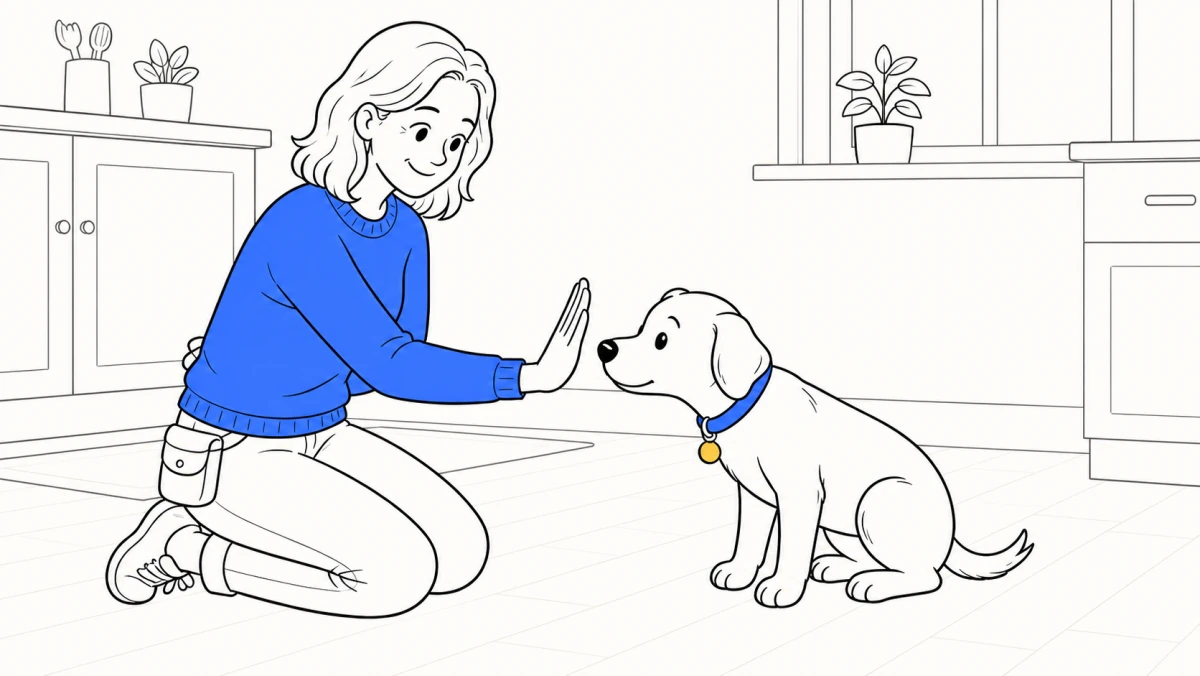
Name, hand-target, and a reliable come make outdoor leash work safer, because you can get attention and call your dog back before a surge turns into a yank. A simple pre-street sequence: say their name and mark a look, present your palm for a nose-touch, then take two slack steps and stop-go once. If you’re building those foundations, the basic puppy commands hub covers the first five, and leave it is the cue that saves you when something interesting appears on the sidewalk mid-stride.
Is a dog who pulls hard actually a safety problem?
Sometimes, yes — and it’s worth saying plainly rather than treating pulling as purely an etiquette issue. A large, strong dog who lunges into the leash can pull a person off balance, and the injury data that exists is not trivial.
The only large-scale figures come from older adults, so take them as the shape of the risk rather than your personal odds. In a JAMA Surgery analysis of US emergency-department data, fractures associated with walking a leashed dog among Americans aged 65 and over rose from an estimated 1,671 in 2004 to 4,396 in 2017, with roughly half involving the upper extremities and about 17% being hip fractures (Pirruccio, Yoon & Ahn, 2019). Younger handlers aren’t in that dataset; the physics of a 70-pound dog hitting the end of a leash are the same either way.
How do you manage a strong puller safely in the meantime?
Treat it as a management problem to solve now, while the training runs in parallel. A well-fitted front-clip harness, quieter routes at quieter times, shorter outings, and both hands on the leash — never a loop wrapped around your wrist, which is how a sudden lunge turns into a broken bone. It’s also a completely legitimate reason to bring in hands-on help sooner rather than later, and nothing to feel sheepish about.
When should leash problems mean you get help?
Normal pulling, freezing, or leash-chewing belongs in the plan above. Fear, panic, or reactivity on the leash does not. If your dog freezes and shakes, lunges and barks hard at dogs or people on walks, or the walks are getting more stressful week by week rather than easier, stop DIY-ing that piece and talk to a certified behavior professional.
That boundary is firm for a reason: leash reactivity is a fear and arousal problem wearing a leash-training costume. Stop-go doesn’t address it, and running the drill on a dog who is over threshold makes both of you feel worse. Sudden reluctance paired with limping, appetite change, or low energy is worth a vet visit first. Fear or aggression that isn’t fading is worth a certified behavior consultant — IAABC-certified consultants (iaabc.org) work to standards that rule out shock. Here’s a fuller guide to what’s normal and when to get help.
What is the one habit that makes a loose leash stick?
A loose leash is a habit, built one paid step at a time: pay the side, stop dead on a tight line, never let a yank do the teaching. With a puppy, you get the rare chance to build that habit before pulling becomes one. With a dog who already pulls, it’s the same job with more repetitions to outweigh — slower, not impossible, and measurably better from the week you stop letting a tight leash move the walk forward. Expect it to run slower than sit; that’s the skill, not a verdict on your dog.
If keeping the stop-go rule consistent across messy real walks is the hard part — and for most owners it is — that’s exactly the kind of short, adaptive session ClickerPup is built to coach: loose-leash walking as a real trainable skill, sized into two-minute bursts, with the clicker free forever and a plain reminder before anything ever charges.
Claim my early spot and we’ll bring you in as we open up.