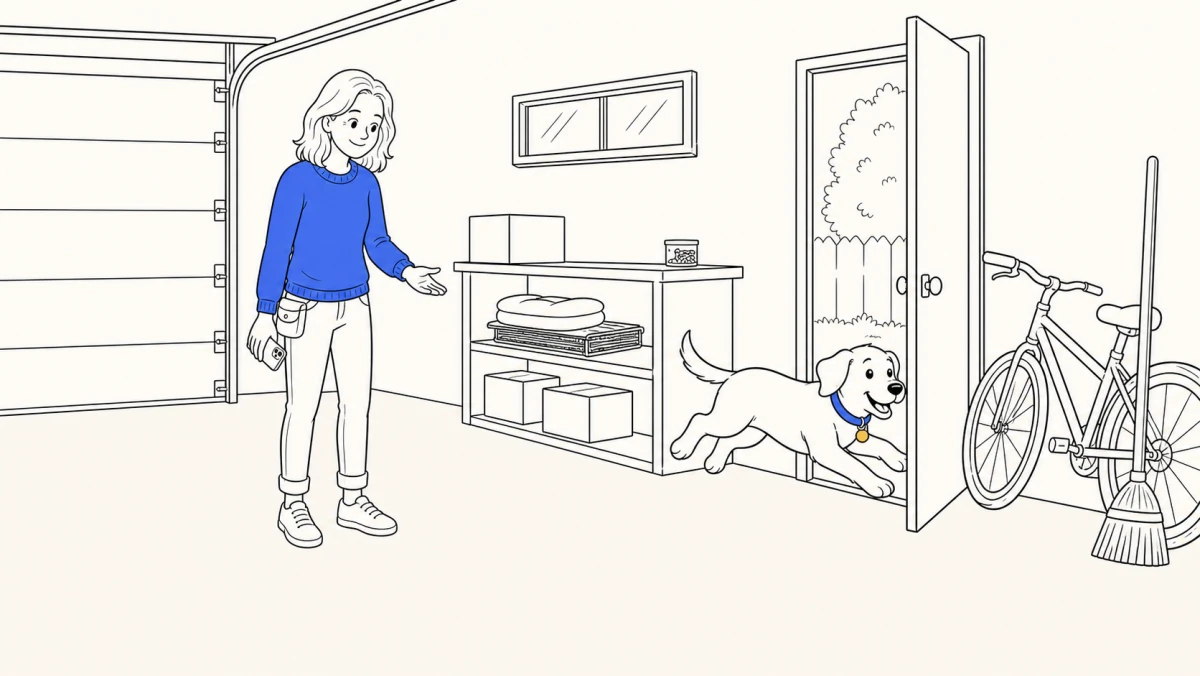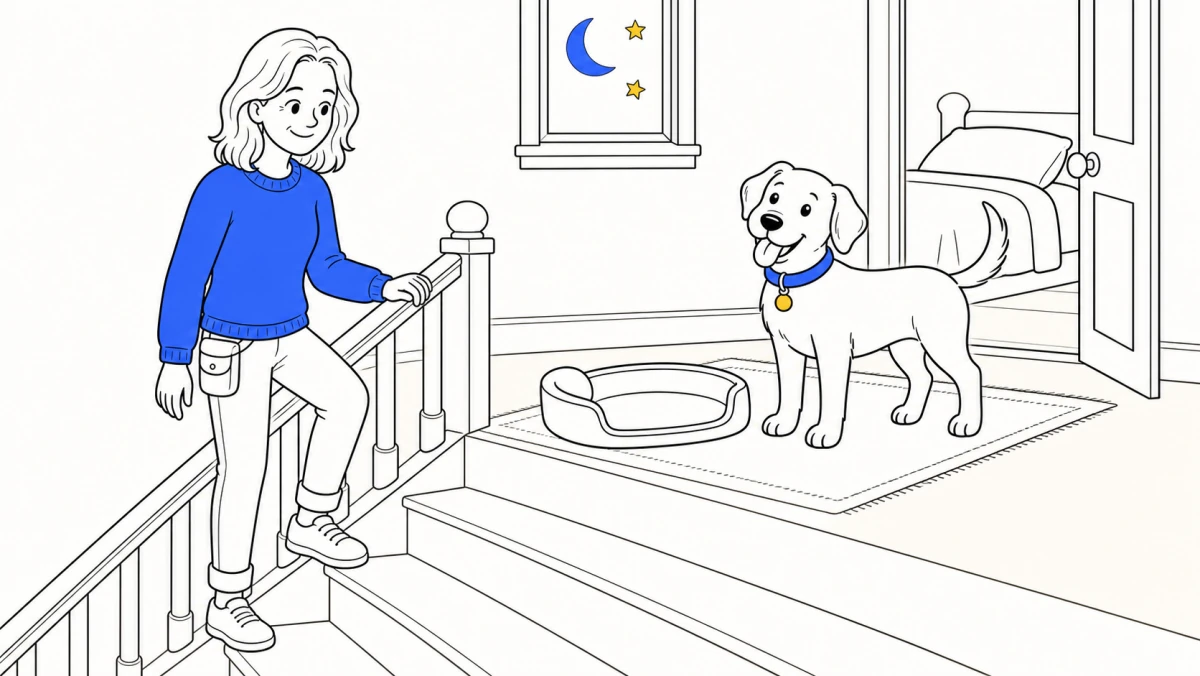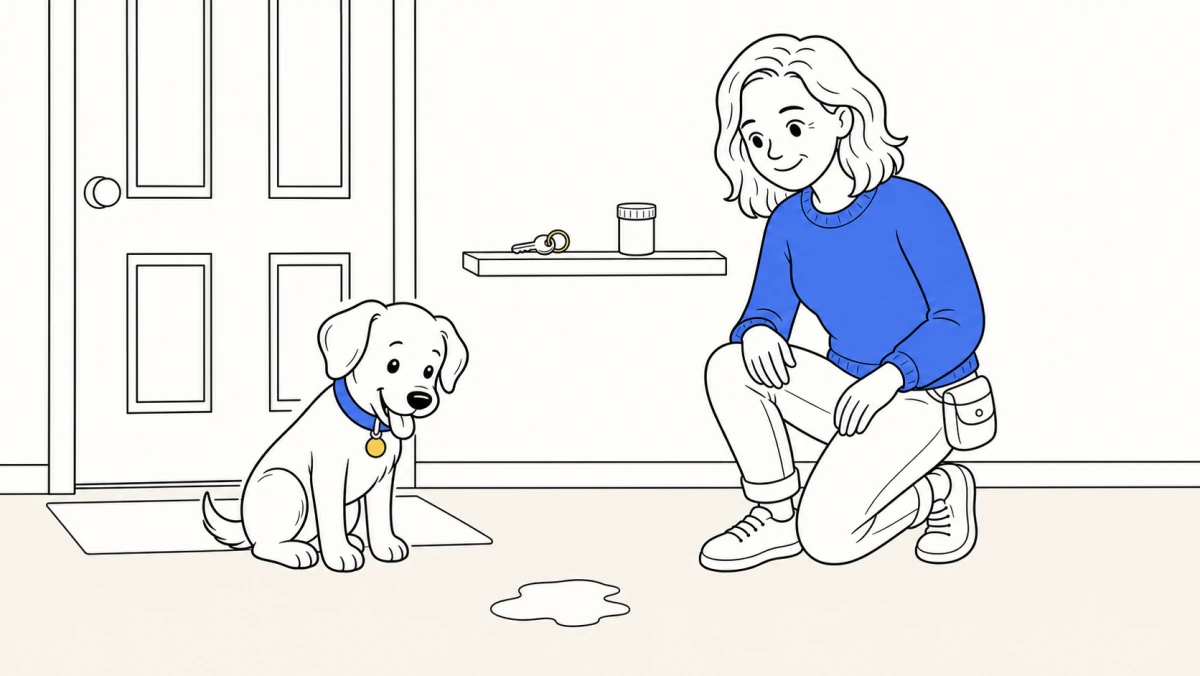
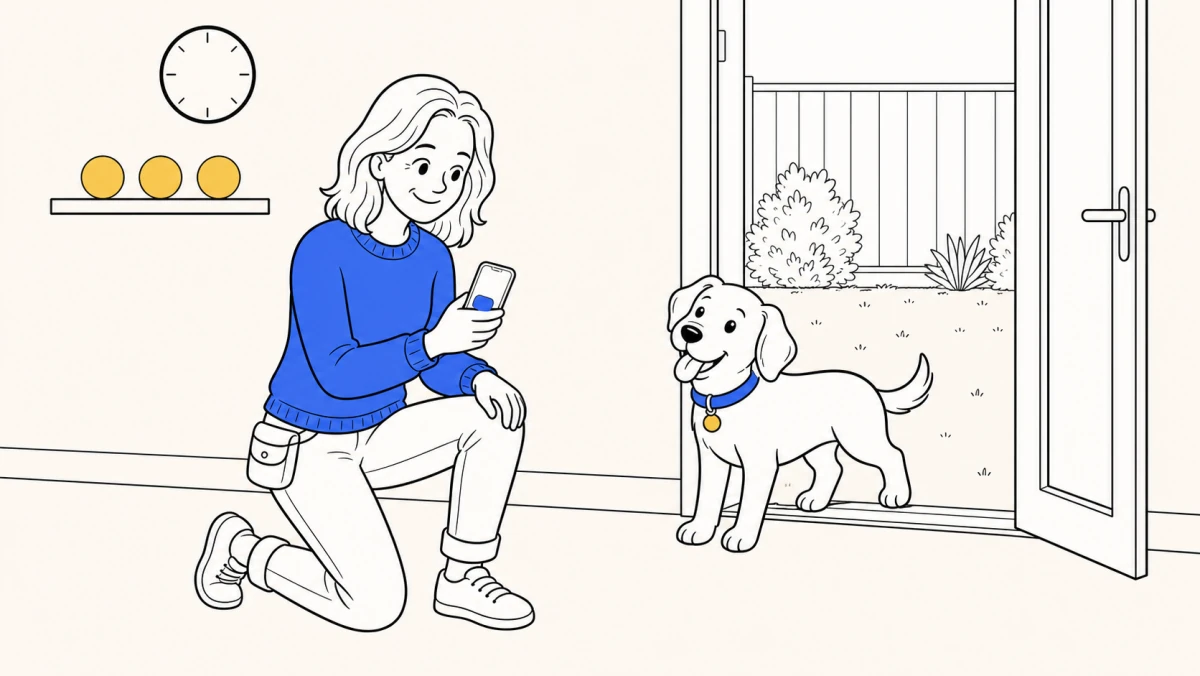
Teaching a dog where to go takes about two weeks. Getting to mostly reliable takes four to six months. And the Humane Society of Silicon Valley won’t call a dog house trained at all before eight to twelve months of age with six accident-free weeks behind it. All three are true; they measure different things.
Nobody says which one they mean, which is why you can search this question and get “7 days” from one result and “still working on it at ten months” from the next, then close the tab feeling further behind than when you opened it. So here’s the range with the sources attached, the three separate milestones hiding inside the word “house trained,” and how to work out which one you’re actually standing on. If you want the method itself — the schedule, the spot, the supervision — that’s the full potty training guide. This page is about the clock.
Why do the answers range from 7 days to a year?
Because “house trained” isn’t one event. Published guides measure at least three different finish lines, and almost none of them say which. Line up the numbers and the contradiction mostly dissolves:
| Source | The number it gives | What it’s measuring |
|---|---|---|
| Best Friends Animal Society | “days to weeks” | learning the routine |
| Riverbend Veterinary PetCare Hospital | 7 days (headline) | establishing habits — its own text says 2–4 weeks for daytime reliability |
| Humane World for Animals | 4–6 months | typical full house training |
| Rover (Kelsey Graham) | about six months | “no longer having accidents in the house” |
| K&H Pet Products | up to 12 months | 100 percent accident-free |
| Humane Society of Silicon Valley | 8–12 months, plus six accident-free weeks | reliable and unsupervised |
Notice that the fastest and slowest sources here aren’t actually arguing. The Humane Society of Silicon Valley says both in one breath: “To teach your dog WHERE to eliminate takes only a couple of weeks. But for a young dog or puppy to actually BE RELIABLE requires that the dog be mature enough physically to hold off eliminating until the appropriate time…” Two weeks and eight months, in the same paragraph, about the same dog.
Do the “7 days” guides really mean seven days?
No — not in the sense the headline implies, and the plan itself says so further down the page. Riverbend Veterinary PetCare Hospital’s vet-approved schedule is headlined “How to Potty Train a Puppy in 7 Days,” and then states plainly: “While full potty training can take a few weeks, 7 days is enough to establish strong habits that make the rest of the process much easier.” Its own summary breaks the job down as “2–4 weeks for daytime reliability” and “several months for overnight control.”
So the seven-day promise isn’t a lie. It’s a headline about the first milestone that gets read as a claim about the last one. If you followed a week-long plan and your puppy is still having accidents in week three, the plan worked exactly as its author described. You were measured against the wrong finish line.
What are the three milestones of house training?
Three different things arrive at three different times, and they are what everyone is arguing about without noticing:
- Going in the right place when you take them there — the one the fast guides measure.
- Telling you they need to go — the one nobody promises, because not every dog does it.
- Holding it loose in the house, unsupervised — the one people mean when they say “done.”
Almost all the misery in house training comes from hitting milestone one, being told that is what house trained means, and then reading the long gap before milestone three as a personal failure. It isn’t. It is the gap the sources are quietly disagreeing about. Timings for each are below.
When does a dog learn where to go?
Fast — usually inside a couple of weeks, and often quicker. Best Friends Animal Society describes the whole job as something that “can take days to weeks and will go more smoothly if you establish a predictable routine for them,” which is a fair description of milestone one. The Humane Society of Silicon Valley agrees on the timing and is more precise about the scope: “To teach your dog WHERE to eliminate takes only a couple of weeks.”
This is the easy part, because it is the part that is actually training. What follows is not more of the same teaching — it is waiting for a body to catch up with a rule the dog already understands. (The teaching itself is in the full potty training guide.)
When does a puppy start asking to go out?
Commonly around three to four months, though this varies more than the other two milestones and some dogs never develop an obvious signal at all. Rover’s timeline places it in the months three-to-four band, alongside the same period when a puppy “may also be able to go through the night without needing a potty break.” The American Kennel Club describes the pre-signal version — “sniffing the floor or carpet, wandering away from the family, becoming overexcited with zoomies, whimpering, or running to the door” — which is a dog telling you something without meaning to.
One caveat: a dog who never learns to ask can still be perfectly house trained. Plenty of dogs simply hold it and wait for the routine. A missing signal is a communication gap, not a training failure, and it is the milestone least worth measuring yourself against.
When can you trust a dog loose in the house?
Later than almost anyone expects — on the strictest published standard, not before eight to twelve months old with six clean weeks behind it. The Humane Society of Silicon Valley states it directly: “A dog cannot be called reliable or housetrained until he is at least eight to twelve months of age, AND has not had any accidents in the house for at least six weeks running.”
The same guide sets the practical bar first: a house trained dog “can remain inside your house for a reasonable amount of time (about eight hours) without eliminating in it.” Note that this is an age threshold plus a clean streak, not a countdown — a dog who came to you at ten months can clear it far sooner than a puppy who came to you at eight weeks.
How does a dog earn more freedom in the house?
In pieces, not all at once — which is why the answer to “when can I stop watching?” is a rate rather than a date. Best Friends Animal Society describes the phased version: “For the first couple of weeks, a new dog of any age should be supervised when they have full (or even partial) run of the house,” and then, “after a week or so of no accidents, you can begin allowing the dog freedom in the house after each successful trip outdoors.”
The Inland Valley Humane Society & S.P.C.A. frames it the same way — “as your puppy learns that he needs to go outside to do his business, you can gradually give him more freedom to roam about the house.” So the thing to watch is the trend: fewer accidents, across more rooms, for longer stretches, until the last six weeks are clean.
Why can’t a young puppy just hold it?
Because bladder control is developmental, not motivational. Your puppy is not choosing to fail; the plumbing isn’t finished. The Inland Valley Humane Society & S.P.C.A. puts the readiness point at “between 12 weeks and 16 weeks old,” when a puppy “has enough control of his bladder and bowel movements to learn to hold it.”
That start point is later than other sources give — Rover’s Brooke Greenberg, CPDT-KA, “says it’s safe to start potty training puppies at 8 weeks old, or once they’ve left their mom” — and IVHS is describing physical readiness to hold it rather than when to begin teaching. The underlying point holds either way: a nine-week-old having accidents isn’t behind schedule, they’re pre-schedule. There is no amount of consistency that installs a muscle.
How many hours can a puppy hold it?
Three or four hours for a three-month-old, depending on which published rule you follow — and the sources genuinely disagree about which. The American Kennel Club’s is age plus one: “Take the age of your puppy in months and add one, and that is the maximum number of hours that your puppy should be able to comfortably hold it between potty breaks.” Rover uses the same version, putting a puppy at “about one hour longer than its age in months.”
Humane World for Animals publishes the tighter one — “a puppy may be able to hold their bladder for about one hour for every month of age” — and the Humane Society of Silicon Valley agrees with it, putting a two-month-old at “up to two hours maximum during the day if he is not active.”
Plan your day on the shorter one. Nothing is lost by taking a puppy out sooner than they strictly needed, and a great deal is lost by finding out you guessed high. Two things hold either way:
- It’s a ceiling, not a schedule. While you’re teaching, trips outside are chances to reward the right thing, so more of them is better than fewer.
- It’s conditional. As Rover’s Brooke Greenberg, CPDT-KA, notes, “if your pup has been active outside and then guzzles down the entire contents of their water bowl, they will not be able to wait the full 3 hours.”
Can a puppy hold it overnight?
Often by around twelve weeks — earlier than the daytime rule would suggest, and the Humane Society of Silicon Valley explains why: “At night, most dogs can generally go longer. Most puppies by the time they are twelve weeks of age can sleep the entire night through without having to go out.” That sits alongside its own two-hour daytime figure for a two-month-old, and it isn’t a contradiction — a sleeping puppy isn’t eating, drinking, or running around. Rover places sleeping through in the same months three-to-four band. Riverbend Veterinary PetCare Hospital is the outlier, putting “several months for overnight control.”
The practical read: at eight or nine weeks, plan for a trip and treat it as plumbing rather than a setback. By around twelve weeks it often stops being necessary, and none of the sources treat a night trip before then as a training problem. (If the nights themselves are the hard part, here’s how to get a puppy to settle and sleep.)
What makes house training take longer?
Four things move this timeline more than effort does — which is why any single confident number is a guess with a citation attached:
| What moves it | What the source says |
|---|---|
| Body size | Rover: “since small breeds have smaller bladders, they need to be taken out more than larger dogs and can take longer to potty train” |
| The individual dog | Brooke Greenberg, CPDT-KA, on dogs who run past six months: “Sometimes, their little brains and bladders need some extra time to sync up” |
| What happened before you | Humane World for Animals names it as one of three variables — the 4–6-month estimate “can vary depending on the puppy’s size, age and previous housetraining habits” |
| How easy your outdoor access is | Not a cited finding — our own observation: a yard door makes frequent trips trivial, while a fourth-floor apartment turns each one into a project, and fewer trips means fewer chances to get it right |
Three of those four you don’t control at all, and one was decided before you ever met your dog. That isn’t a reason to give up on a timeline — it’s the reason the timeline is a range.
How long does it take to house train an adult or rescue dog?
Weeks rather than months, in most cases — a genuinely nicer answer than the puppy one. The Humane Society of Silicon Valley is specific: “For an older dog with bad potty habits, or one who has never been housebroken, you can expect to spend about six to eight weeks (following a strict housebreaking plan), before a new behavior pattern is established.” Rover’s estimate lands in the same territory: “anywhere from a few weeks to a few months.”
The reason is the same physiology that slows puppies down, running in your favor. An adult dog already has the bladder control; what’s missing is the rule, and rules are quick. The exception is the dog who was reliable and stopped — that one is a health question rather than a training question, and the vet section below has the red flags.
How do you tell whether you’re on track?
Judge the trend across a week rather than any single afternoon, and check yourself against the milestone you’re actually working on instead of the one in someone’s headline. Under six months old, on a consistent routine, with a shrinking number of accidents, is on track — even when it doesn’t feel like it.
The AKC’s Dr. Jerry Klein, its Chief Veterinarian, gives the most useful checkpoint on offer: “If training begins early, a 6-month-old puppy is usually able to be depended on most of the time to eliminate outside.” Note the hedge in “most of the time.” He also declines to give a firm number at all: “When it comes to how long potty training takes, it depends on the puppy and the schedule you keep.”
How long is too long for house training?
Around a year is the point to stop absorbing it and start investigating. Rover names the threshold: “if you’re approaching the one-year mark and your puppy is still having accidents in the house, it’s a good idea to talk to your vet to rule out any medical issues.” K&H Pet Products’ guide sets the same outer edge, noting that being “100 percent accident-free” can take up to 12 months.
So a year is the far end of normal rather than the middle of it — and past it, the next step is a vet appointment, not a stricter routine.
Does punishing accidents make house training take longer?
Yes — it’s the one response that reliably adds time. Scolding teaches a dog to go where you can’t see, which turns visible accidents into hidden ones and destroys the information you were using to fix your routine. AVSAB’s 2021 position statement on humane dog training recommends reward-based methods only.
The pull toward correction is real and well documented — the Royal Veterinary College’s Pandemic Puppies cohort, a UK study that followed puppies to 21 months old, found 82.3% of owners reported using aversive training methods to address their dog’s problem behaviors (Brand et al., 2024). Knowing the real timeline is part of the defense, because most people reach for a correction at the exact moment they decide their dog should have finished by now. A dog at seven months who still needs supervision isn’t behind. They’re inside the range every source on this page describes.
When is a house-training problem a reason to call the vet?
When a dog who was reliable stops being reliable. VCA Animal Hospitals put it directly: “A break in house training is a red flag that something is wrong in the bladder.” Urinary tract infections are common, treatable, and diagnosed by a vet rather than fixed by a tighter schedule.
Call sooner rather than later if the accidents come with any of these:
- Straining to urinate, or crying or whining while urinating (VCA lists both among UTI signs).
- Blood in the urine, or very strong-smelling urine (VCA).
- Frequent squatting that produces only small amounts — the AKC lists this among the signs of cystitis, an inflammation of the bladder.
- A jump in how much your dog is drinking — the AKC names “excessive thirst and increased urination” as symptoms of diabetes.
- An older dog who was fine for years and starts making mistakes — the Humane Society of Silicon Valley’s guidance is to have the dog “checked with your veterinarian first before going on a strict housebreaking program.”
Dr. Klein sets a low bar for checking: “Any change in urinary patterns for your dog should be reported to a veterinarian as soon as possible, as it may indicate an underlying medical issue.”
Soiling driven by genuine distress or panic — not a bladder that filled up, but a dog coming apart when left alone — is behavior modification and belongs with a certified professional. IAABC-certified consultants are a sound place to start: the association’s Standards of Practice state that it “opposes the intentional use of methods involving pain, fear, or intimidation and expects members to avoid shock and other punishment-based interventions.” If you’re not sure whether what you’re seeing is ordinary puppy chaos or something else, here’s what’s normal and when to get help.
The short version
Two weeks to learn the rule. Three or four months before many dogs start asking. Four to six months to mostly reliable, and — on the strictest standard — an eight-to-twelve-month-old dog with a clean six-week stretch behind it before anyone calls it finished. A year is the outer edge of normal, not evidence of failure. Small dogs take longer. Rescue dogs are usually faster. And nobody’s headline number was ever about your dog.
What ClickerPup does and doesn’t do here
The reason this question is so hard to answer is that “trained” is almost never defined, so nobody can tell whether they’re winning. That’s the problem ClickerPup publishes a definition of “reliable” to solve — an actual bar a skill has to clear on your dog, instead of a count of lessons you finished.
About what that does and doesn’t cover: ClickerPup doesn’t house train your dog. House training is a schedule and a body developing on its own timeline, not a skill a clicker shapes, and we’re not going to pretend an app changes that. What it does coach is the trainable half of a puppy — sit, settle, leave it, coming when called — measured to a published standard, two honest minutes at a time. The clicker is free forever, with a plain reminder before anything ever charges.
Claim my early spot and we’ll bring you in as we open up.