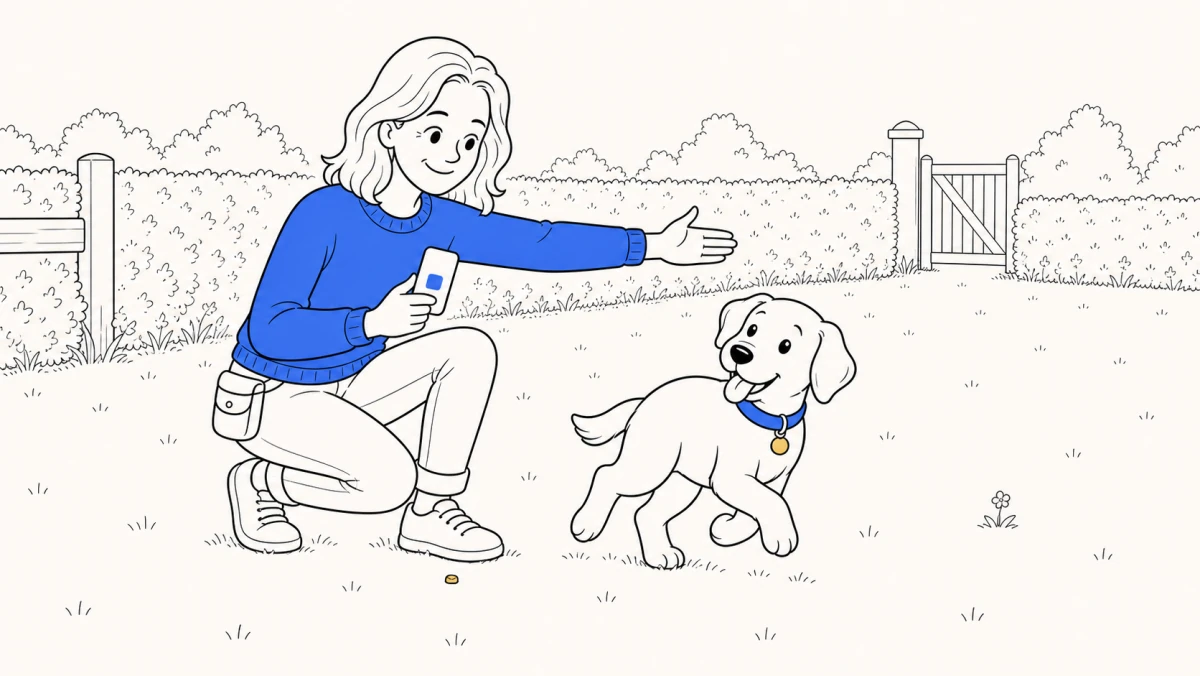
Teach a dog to come when called by saying the cue once, crouching low with your arms open, and finishing the recall on a nose-touch to your low open palm — then paying generously. Build it indoors from two skills first: your dog’s name, and a hand target. Outdoors, keep it on a long line until it’s genuinely reliable.
If you’re here because “come” has quietly become a suggestion — head down in the grass, tail going, ears very much switched off — that’s the most common version of this. In the Royal Veterinary College’s Pandemic Puppies cohort, followed to 21 months, 51.9% of owners (466 of 898) reported their dog not coming back when called, third only to pulling on the leash (67.4%) and jumping up at people (57.0%). Dogs Trust’s National Dog Survey 2025, with 342,974 respondents, put the same problem at 35%. Recall isn’t failing because your dog is stubborn. It’s failing because of a handful of very specific, very fixable habits.
What do you need to teach before recall?
Two things — and skipping them is why recall so often stalls. Your dog needs to know their name (an attention tap that means good things are coming) and a hand target (touching their nose to your open palm on cue). Recall is those two skills, run from further away.
That’s not a shortcut, it’s the actual structure. Laurie Luck, KPA CTP, writing on Karen Pryor’s clicker-training site, describes the target exactly the way you’ll use it here: present it “about ¼” in front of the animal’s nose,“ then “click and treat the instant your animal looks at the target.” Once your dog will cross a room to touch your palm, most of recall already exists — what’s left is distance.
It also answers the age question. As soon as your dog knows their name and will touch your palm — which for a puppy is often within the first few weeks home — recall can begin. There’s no separate age gate on it, because there’s no new physical skill involved; only distance.
If either piece is missing, start there: teach your dog their name first, and the hand target is one of the foundation skills behind the five basic commands. If the clicker itself is new, charging it takes one short session.
How do you teach a dog to come when called, step by step?
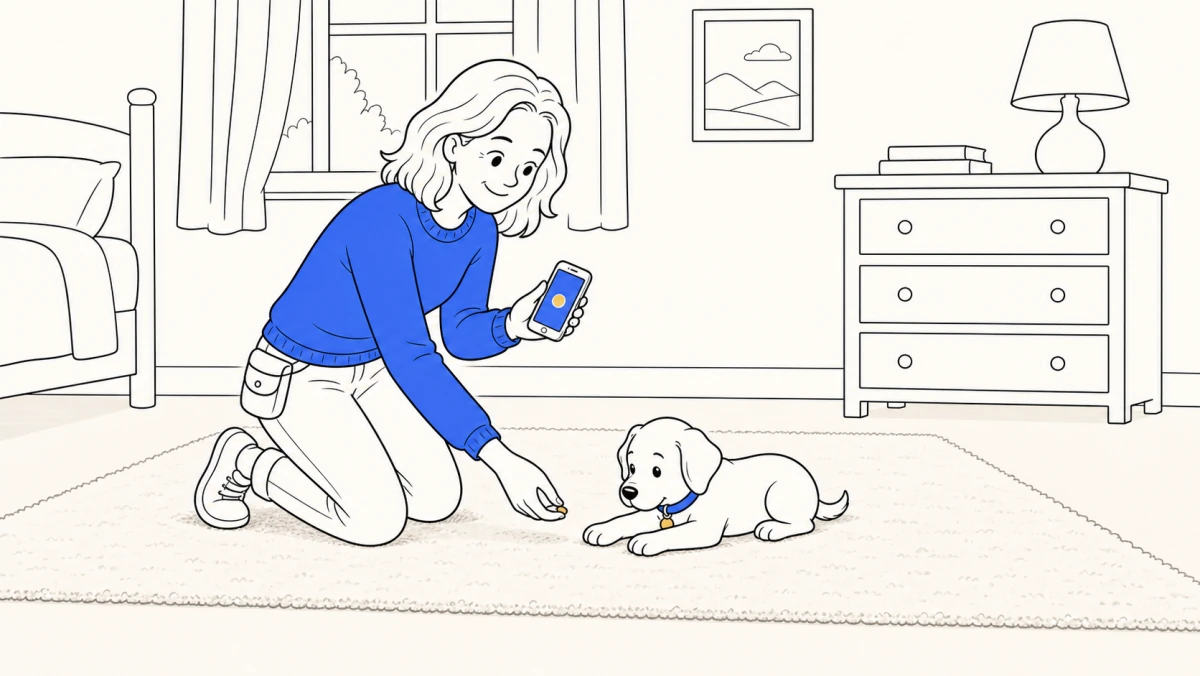
Start indoors, a few feet away, with nothing else going on. The whole rep is: cue once, get low, pay big at the palm.
- Say your dog’s name, then “come” — once. Bright and happy, not stern.
- Crouch and open up. Arms wide, low to the floor, genuinely pleased to see them.
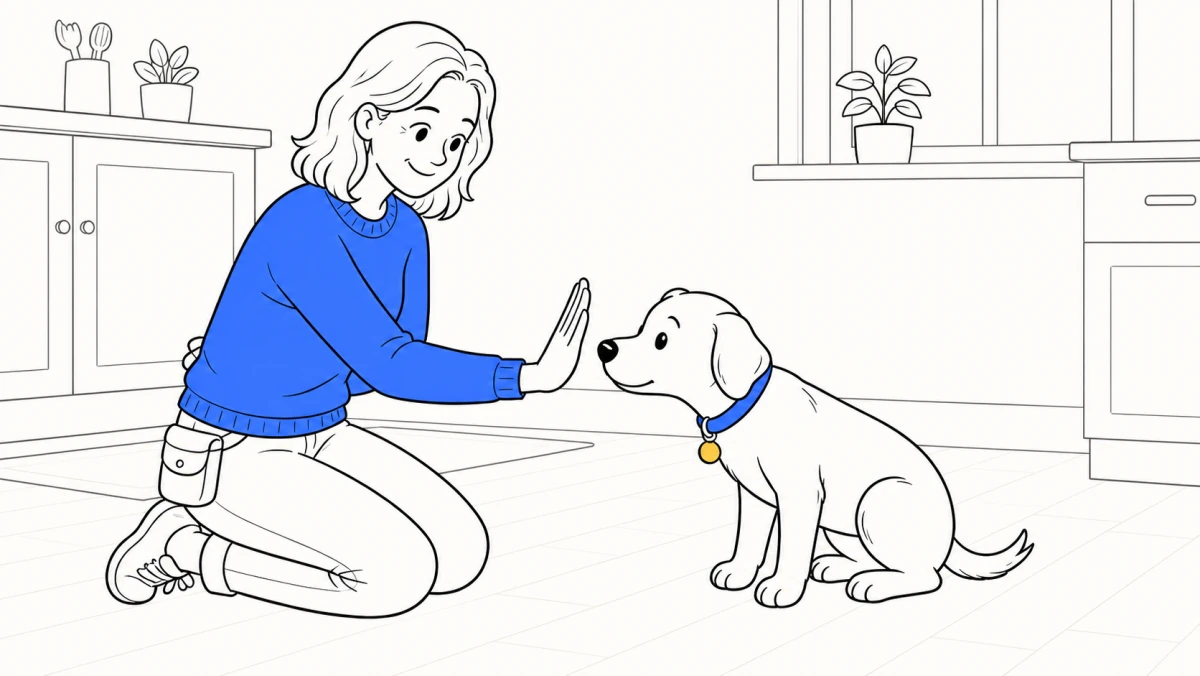
- Present your open palm low, at their nose height, as they arrive.
- Click the instant their nose touches your palm — that exact moment, not before, not after.
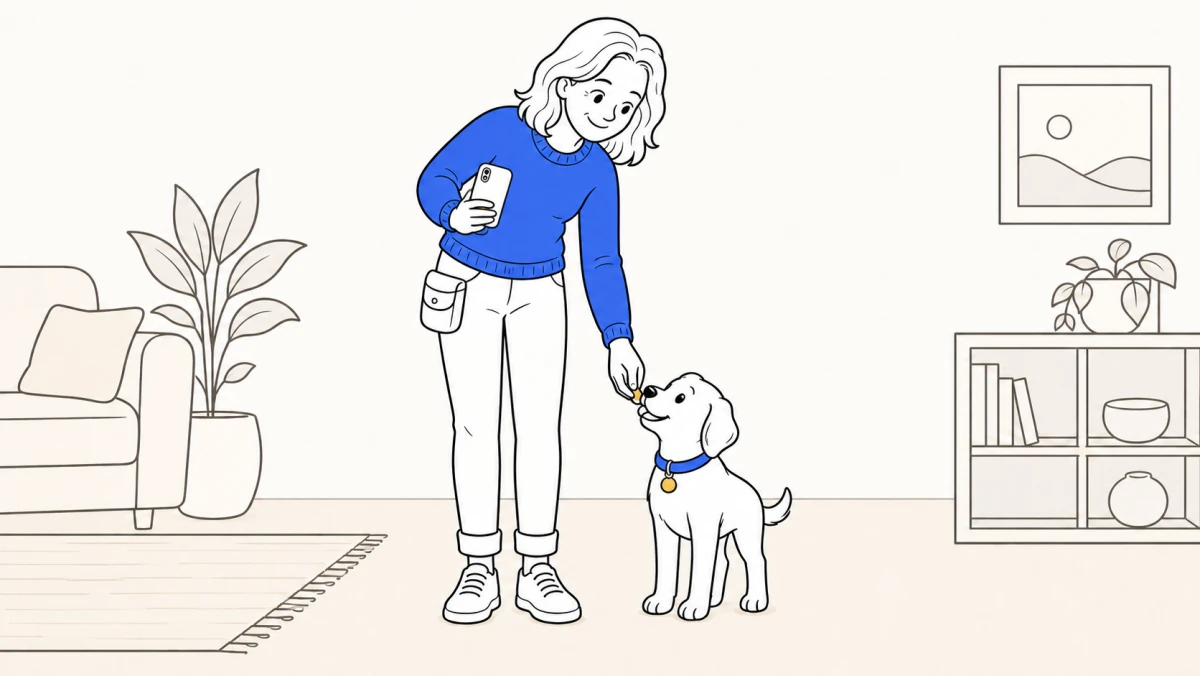
- Feed the treat down by your feet, so the good stuff happens at your feet.
- Every few reps, release them straight back to whatever they were doing.
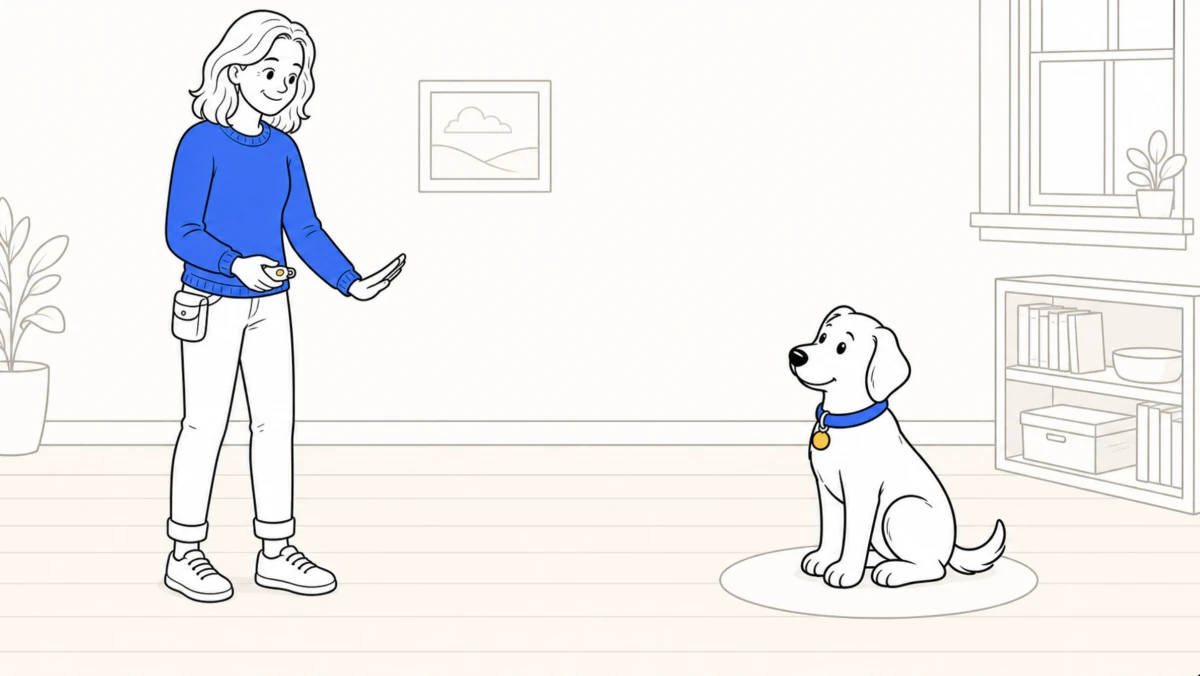
Keep it to about two minutes and three to five recalls, and stop on a great one — short sessions beat long ones for exactly this kind of skill. Then add distance a notch at a time: across the room, then from another room, then out of sight around a doorway.
Why click the palm touch instead of just “coming near you”?
Because “near me” isn’t something you can mark, and a nose-touch is. The palm gives your dog an unambiguous finish line and gives you an unambiguous click point — which is the entire mechanic a clicker exists to serve: the marker has to name one exact instant, or it names nothing.
It solves a second problem too. Melissa Alexander, writing on Karen Pryor’s site, recommends adding a collar hold before the reward every single time, because “it does you no good to have a recall if you can’t then catch your dog.” A palm finish puts your dog’s head right beside your hand, so the collar touch becomes an ordinary part of a happy arrival instead of a grab they learn to dodge.
It’s also unusual. The RSPCA, Best Friends and AKC guides cited throughout this article all describe getting your dog back to you, but none of them names a single markable finishing behavior — which leaves the click floating somewhere around “close enough.” A defined finish is the difference between a dog who drifts into your general vicinity and a dog who arrives.
Why won’t my dog come when called?
Usually because the cue got poisoned — used to call your dog for things they dislike, repeated until it became background noise, or always used to end the fun. The word stopped predicting good things, so your dog stopped answering it.
This isn’t folk wisdom. AVSAB’s 2021 position statement describes the mechanism plainly: after dogs learned a cue taught using aversive methods, “they continued to show stress-related behaviors when the cue was presented, suggesting the cue itself had become aversive.” Best Friends Animal Society puts the everyday version of it in one line: “If the cue ‘come’ always means that the fun stops, your dog will likely stop coming.” And the RSPCA is blunt about the most common way owners do it by accident — “don’t only call your dog to put them back on the lead - they’ll soon make the association and be reluctant.”
So the rule is absolute: never call your dog for anything they’d dislike. Bath, nail trim, going in the crate, the end of a walk — go and get them instead. Alexander’s version: “Don’t call your dog and then do something she doesn’t like.”
What’s the fix for a recall that’s already been poisoned?
Sometimes pay, then release them straight back to what they were doing. It’s the single most useful habit in this whole article, and it’s the one most people skip.
If every recall ends the good part of your dog’s day, “come” reliably predicts loss. If most recalls end with a treat and permission to go straight back to the sniffing, then coming to you costs nothing and pays every time. Alexander names it directly: “Balance the times when fun ends with several ‘practice’ recalls after which she is allowed to go back to what she was doing.”
Practically: for every recall that genuinely ends something, run three or four that don’t. And jackpot the brilliant ones — a scatter of treats, a favorite game — so the best responses get paid like the best responses.
Should you say “come” more than once?
No. Say it once, then make yourself worth coming to. Repeating the word teaches your dog that the cue is a countdown with several free passes before anything actually happens.
Alexander is unambiguous: “Call your dog one time. If she doesn’t respond, go and get her,” because “yelling ‘Missy, come!’ over and over as she runs around ignoring you only weakens your cue.” The practical version is a small discipline — if you can see your dog isn’t going to answer, don’t spend the cue. Walk over, get them, and set up an easier rep later. Every “come… come… COME” is a lesson that the first one was optional.
How do you make coming back the best thing on offer?
Be the one worth chasing. Crouch, turn, and move away from your dog rather than toward them — a person moving away is interesting, and a person advancing is a reason to hold position.
All three of the mainstream guides say a version of the same thing. The RSPCA’s method opens with running away while calling your dog excitedly. Best Friends says to “lightly jog backward so they need to catch up to you and get excited!” The AKC’s Stephanie Gibeault, MSc, CPDT, writes: “To encourage them to approach you, run backwards as you say ‘come.’”
Pair that with real pay. High-value food you don’t use for anything else, delivered fast, plus the occasional jackpot — and never a scolding on arrival, no matter how long it took. If you punish the return, you’ve punished the only part your dog got right.
When is it safe to practice recall off leash?
When the recall is already reliable in that kind of place — not as the way to find out whether it is. Outdoors is long-line territory until then, both because it’s safer and because every ignored recall rehearses the idea that the cue is optional.
The RSPCA notes that “long training leads can be helpful for practicing recall when outside as they allow your dog some freedom,” and the AKC’s guidance is to “graduate to a 20-foot longline training leash or 30-foot longline training leash” as distance grows. Clip it to a harness rather than a collar — a full-speed stop on a neck is a genuine injury risk — and let it drag or hold it loosely, never wrapped around your hand.
The long line is a safety net, not a steering wheel. Don’t reel your dog in; if a recall fails, go closer and make the next one easier. And be honest about context: a dog with an unreliable recall near roads or livestock is a management problem, not a training milestone. Leave the line on. The same “manage first, train second” logic applies to walks while leash skills are still being built.
What does a “reliable” recall actually mean?
It means your dog comes on the first ask, in that context, most times — and “that context” is doing a lot of work. A dog who is perfect in the kitchen and deaf in a field hasn’t failed; they’ve simply only been taught the kitchen.
That’s the difference between a dog who did it once and a dog who’s trained to reliable: first try, then practicing, then most times, then dependable in a real place with real distraction. Alexander gives the rule for climbing that ladder — “don’t increase your distance or distractions until your dog responds immediately and enthusiastically to the recall cue.” Raise one thing at a time, and when distance goes up, distraction comes down. Stacking both at once is how a good recall stops working overnight.
Do shock collars or e-collars work for recall?
There’s no good evidence they work better than reward-based training, and we’d never recommend one. AVSAB’s 2021 position statement is direct about both halves of that: “recall training is the most common reason dog owners use remote electronic shock collars,” and “even in the hands of experienced trainers, no difference in the effectiveness was found between remote electronic shock collars versus reward based methods for teaching recall/stop chasing.”
The head-to-head study behind that is China, Mills & Cooper (2020) in Frontiers in Veterinary Science, which trained 63 dogs with existing off-leash problems in three groups. The reward-focused group “achieved significantly better responses to both ‘Sit’ and ‘Come’ commands after a single instruction in the allocated time,” and those dogs also had shorter response latencies than the e-collar group. Being straight with you about its status: it’s one study, and it has been publicly disputed by other researchers over its design and statistical analysis, so it belongs inside AVSAB’s broader synthesis rather than standing alone as proof.
What does the welfare evidence say about aversive training?
It runs the same direction from a different angle: dogs trained with aversive methods show more stress during training and a bigger cortisol response afterward. Vieira de Castro et al. (2020), in PLOS ONE, compared 92 dog-owner pairs across seven training schools in Porto, Portugal, and found aversive-trained dogs showed more stress behaviors during training and a larger post-training rise in salivary cortisol. Its limits are worth stating: the authors call it “a quasi-experimental rather than an experimental study” that can’t establish a “true causal relationship,” owners chose their own schools, and the dogs averaged 11.9 months old — adolescents, not young puppies.
Put together, that’s why AVSAB’s conclusion is the one we follow: “there is no evidence that aversive training is necessary for dog training or behavior modification.” Which is also why there is no correction anywhere in the method above — there’s nothing left for one to do that a well-paid palm touch doesn’t do better.
When is not coming back something other than a training problem?
When the running is fear, not freedom. A dog who bolts in a panic, flees from specific triggers, or genuinely can’t hear you through their own stress isn’t ignoring a cue — they’re over threshold, and no amount of recall practice reaches that.
The guide to what’s normal and when to get help has the fuller picture, and IAABC-certified consultants (iaabc.org) are a solid place to start. Reactivity, real flight risk, and fear-based bolting are all outside what a training article — or a training app — should be coaching you through.
The part that’s genuinely hard
None of the mechanics above are difficult. Cue once. Crouch. Click the palm. Pay well. Release them back to the fun. Any one rep takes fifteen seconds.
What’s hard is holding it for weeks — through the walk where you’re late and you call them three times, through the vet trip where “come” is the fastest way to get the leash on, through the field where the distraction is a rabbit and you find out exactly how much you’ve banked. That consistency, not the technique, is what separates a dog who comes when called from a dog who mostly does.
That’s the part ClickerPup is built for. Recall is the skill the first plan is aimed at — built from your dog’s name and the hand target, finished on the palm touch, in two-minute sessions that adapt to how the last one actually went. The clicker stays free forever, with a plain reminder before anything ever charges.
Claim my early spot and we’ll bring you in as we open up.