A puppy who was reliable and suddenly isn’t is a medical question before it’s a training one. Call your vet first — a urinary tract infection is common, and no schedule fixes one. Then look at what changed in the house: supervision, scent, routine, stress. Most of what gets called regression is criteria raised too fast, not a rule forgotten.
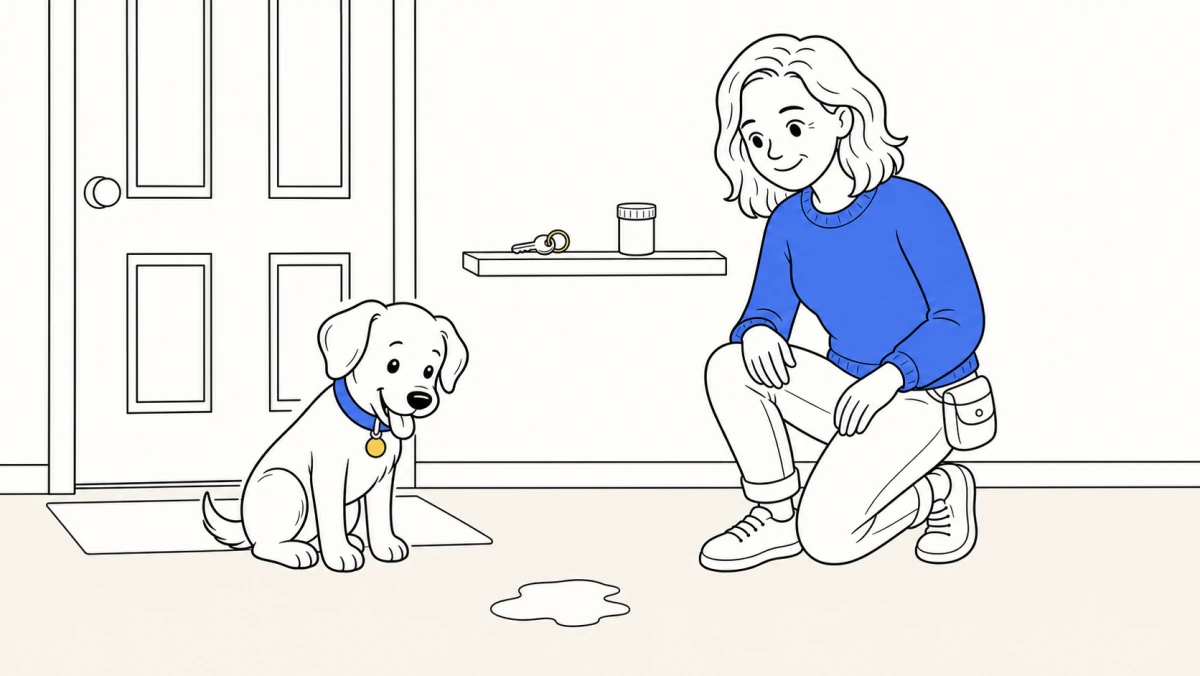
If you’re standing over a puddle in a room that hasn’t seen one in three weeks, the thought arriving right about now is what did I do wrong — and it’s the wrong question at exactly the wrong moment. A break in house training is information, not a verdict on you. What it needs is a diagnosis in the right order, because four completely different things produce the identical puddle, and three of them don’t respond to anything you’d change about training.
What actually causes puppy potty training regression?
Four things, and they need checking in a specific order — medical, environmental, developmental, training. That order matters more than the list does. Most articles hand you seven causes as a menu and let you pick the one that feels likeliest, which almost always means the training one, because it’s the only one you can act on immediately. It’s also the least likely to explain a puppy who was doing well and abruptly stopped.
| Check, in this order | What you’re ruling out | What it tends to look like |
|---|---|---|
| 1. Medical | Urinary tract infection, other urinary or GI illness, pain | Straining, blood, small amounts very often, drinking more, an off day generally |
| 2. Environmental | Supervision relaxed, schedule stretched, old scent still there, something changed at home | Accidents in one specific room, or in the exact stretch you stopped watching |
| 3. Developmental | Adolescence, urine marking, a body that’s changing | Dog is 6–12 months; small volumes, sometimes on vertical surfaces |
| 4. Training | The rule was less solid than it looked | Accidents in any new context — a friend’s house, a different floor surface |
Work down the table, not across it. Each layer you clear makes the next one easier to read.
Should I take my puppy to the vet for potty training regression?
Yes — before you change anything about your routine. VCA Animal Hospitals put it in a single sentence: “A break in house training is a red flag that something is wrong in the bladder.” Their house-soiling guidance is just as direct about sequence: “If your dog is house soiling, particularly if the behavior has started suddenly, it is important to ask your veterinarian to check for a physical illness.”
The reason this goes first isn’t caution for its own sake. It’s arithmetic. Bacterial urinary tract infection is, per the Merck Veterinary Manual, “the most common infectious disease of dogs, affecting 14% of all dogs” — and a dog with one physically cannot hold it, however well they understand the rule. Weeks of tightened supervision won’t touch it. A urinalysis and a course of antibiotics will.
Call your vet promptly if the accidents come with any of these, which VCA lists as signs of a UTI:
- Straining to urinate, or crying or whining while trying to go.
- Blood visible in the urine, or urine with a very strong odor.
- Frequent attempts that produce only small amounts.
- Dripping urine, or frequent licking of the genitals.
Diarrhea, vomiting, lethargy, or a jump in how much your puppy is drinking all deserve the same call. And a puppy straining but passing nothing at all is an emergency — go now, not in the morning. Nobody on the internet, including us, can diagnose your dog; a vet with a urine sample can.
How do I collect a urine sample from my puppy?
One practical thing that can save you a second trip: bring that sample with you. The AKC’s guidance is to “collect the urine, preferably mid-stream, in a clean container as your dog pees” — not to mop it up off the floor afterward, which contaminates it with everything else the floor had on it. A morning sample is best, because that’s when “your pet’s urine is at its most concentrated,” and you only need “a tablespoon or two for the urinalysis.” Get it in “as soon as possible, preferably within a few hours,” or refrigerate it until you can.
Did I give my puppy too much freedom too soon?
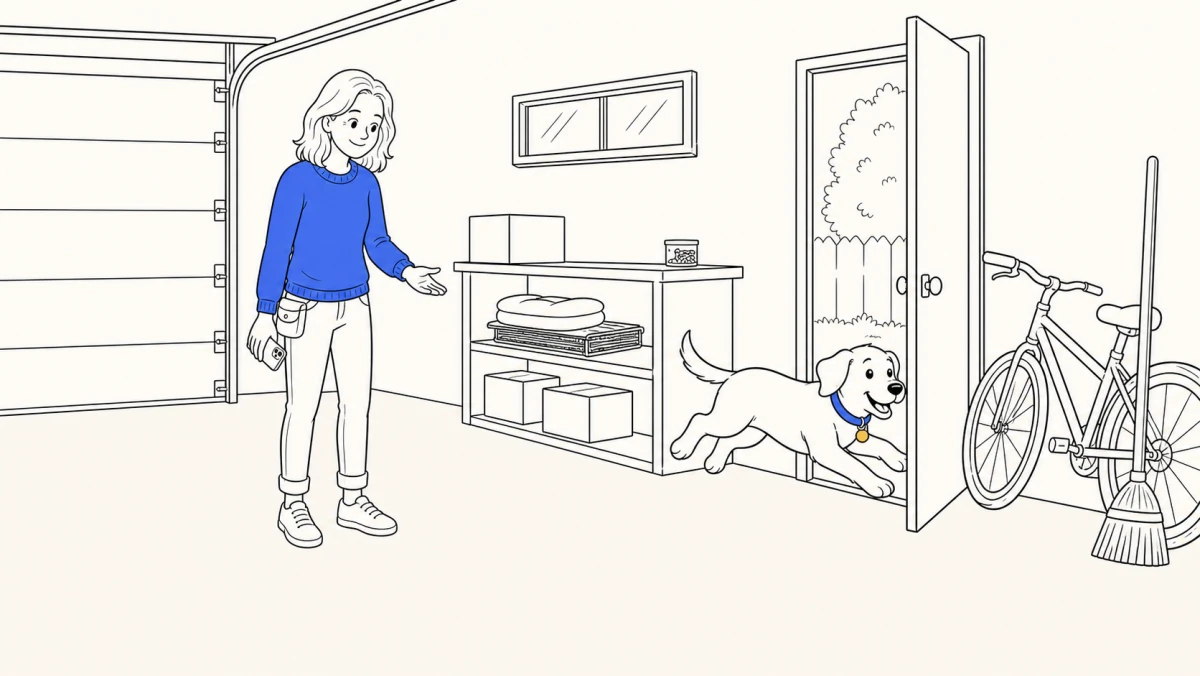
This is the most common non-medical answer, and it’s rarely the puppy’s doing. Somewhere in the last couple of weeks the criteria went up — a closed door got left open, the crate stayed unlatched, the every-two-hours trips drifted to every four, or your puppy simply started following you around the house instead of staying in the one puppy-proofed room you could see. None of that is a decision you’d remember making. All of it raises the difficulty.
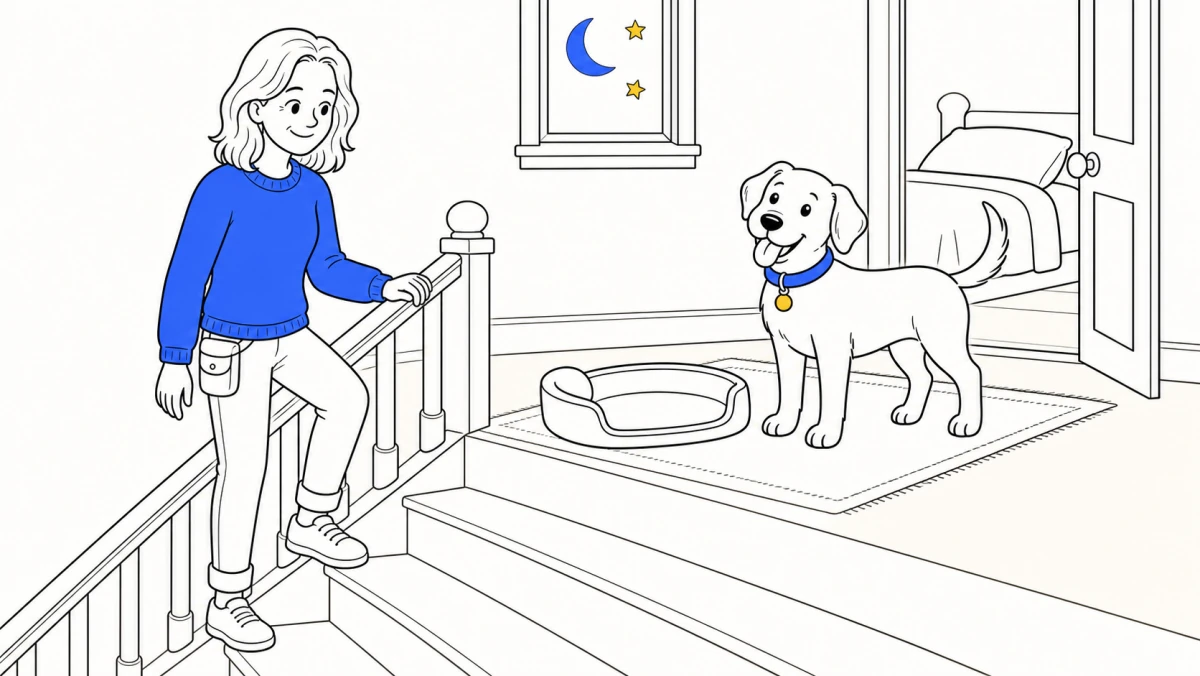
The AKC’s Stephanie Gibeault, MSc, CPDT, sets the bar plainly: “Until your puppy has learned to let you know when they need to go outside to potty, perhaps by barking or sitting at the door, they aren’t ready for unsupervised freedom.” Free run of the house is the final level of house training, not the default state you fell back from.
This is the same failure that stalls every other skill a puppy learns, and it has a name in force-free training: raising more than one criterion at a time. A sit that’s solid in the kitchen falls apart in the yard for exactly the reason house training falls apart in the hallway — the rule was learned under easier conditions than the ones it’s now being tested in. That’s why our whole approach to what “reliable” actually means is built around moving one variable at a time and checking the dog cleared it before moving the next.
So the fix isn’t to start over. It’s to drop back one rung — the supervision and confinement you had two weeks ago, for about a week — and then raise freedom again more slowly than you did the first time. The full house-training method is the foundation this rolls back to; you’re not re-teaching it, you’re re-running the level your puppy was last clean at.
Can old accident smells cause new accidents?
Yes, and this one is quietly responsible for a lot of “he keeps going in the same spot.” VCA is explicit: “Dogs are often attracted to previously soiled spots. To eliminate as much of the odor as possible, it is best to use a commercially available product that contains enzymes to degrade the urine or feces.”
Ordinary household cleaner is the trap here. It removes the smell for you and leaves it for your puppy, whose nose is doing a completely different job than yours. The AKC’s guidance is the same: use “an enzymatic cleaner that’s specifically designed to eliminate the scent of pet urine, poop, or even vomit, and follow the instructions on the package exactly.” That last clause is doing real work — most enzyme cleaners need a soak time, and a quick wipe doesn’t give the enzymes long enough to break anything down.
If accidents cluster in one particular spot, treat that spot as an unfinished cleaning job before you treat it as a training problem.
Can stress or a change at home cause potty regression?
It can, and this is the layer owners most often skip because it doesn’t feel like a training variable. VCA’s house-soiling guidance names four causes of indoor soiling: “incomplete house-training or house-training lapse,” “underlying physical illness,” “underlying behavioral illness” related to fear, anxiety or frustration, and “communication or marking behavior.”
The triggers VCA lists for that third and fourth category are ordinary domestic events, not disasters: “a new dog in the neighborhood, a new person in the home, a change in the relationship with another dog or person within the home, a new work schedule, or a remodeling project.” Add a house move, a new baby, or a long stretch of visitors and you’ve covered most of the cases. If the accidents started the same week something in the household changed, that’s not a coincidence to argue with — it’s the most useful clue you have, and the answer is usually to restore predictability and drop the freedom back a rung while things settle. A calm, predictable wind-down routine does more for this than any change to the potty schedule will.
One clear boundary: genuine panic when left alone — destruction, non-stop vocalizing, drooling, soiling that only ever happens in your absence — is separation anxiety, not a house-training lapse, and it’s behavior modification rather than something to coach through from an article. That belongs with a certified professional; IAABC-certified consultants at iaabc.org are a solid place to start.
Is potty training regression normal at 6 months?
Around six months you’re in adolescence, and two separate things start showing up that get filed under the same word. Only one of them is regression.
The first is real. Asher, England, Sommerville and Harvey’s 2020 study in Biology Letters tracked a cohort of young dogs — golden and Labrador retrievers and crosses — through puberty, and found that “the odds of repeatedly not responding to the ‘sit’ command were higher at 8 months compared with 5 months for the carer.” The detail that makes it worth knowing: responses to the same command improved for strangers over the same period. The dip was specific to the person the dog lived with. And it passed: the authors’ own conclusion is that adolescent-phase disobedience is real but, in most dogs, does not last.
Be honest about what that study measured, though: one command, in one cohort of guide-dog candidates. It is good evidence that the foundation cues you taught early can genuinely wobble through adolescence and recover. It is not evidence that house training specifically does, and we’re not going to stretch it into that.
Is my puppy having accidents, or marking?
The second thing that shows up around this age isn’t regression at all. It’s urine marking, and per the AKC’s Stephanie Gibeault, MSc, CPDT, it starts “when a dog hits adolescence, which is around 6 to 9 months of age, depending on the dog’s breed.” It looks different from a real accident, and the difference is easy to spot once you know it:
| Marking | Emptying a full bladder | |
|---|---|---|
| Volume | “small amounts of urine in multiple locations” | “more pee in a single spot” |
| Duration | “a few seconds” | “around 20 seconds” |
| Surface | often vertical — furniture legs, door frames | a puddle on the floor, wherever they were standing |
Marking is a communication behavior, not a lapse in house training — which means tightening the potty schedule won’t touch it. It also needs the same first step as everything else on this page: Gibeault’s advice is “first, rule out health issues that can mimic marking,” because kidney disease, diabetes and UTIs all produce urination that looks like it.
Why is my puppy suddenly soiling their crate?
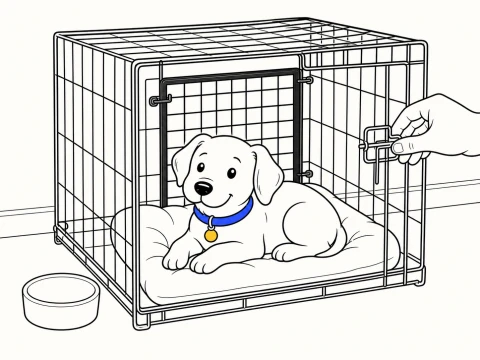
Crate accidents deserve their own look, because a puppy who soils where they sleep is telling you something specific. The AKC’s guidance is that “frequent crate soiling usually signals an underlying issue with your puppy’s health or environment, including their day-to-day routines,” and that “if accidents are frequent, sudden, or accompanied by other symptoms like diarrhea or lethargy, a veterinary visit is recommended.”
Two non-medical causes are worth checking before anything else. The crate may simply be too big: “a crate that’s too large may allow a puppy to soil one area and sleep in another. A properly sized crate discourages accidents.” And the crate may have stopped feeling safe — “if they find their crate stressful, they likely won’t relax enough to hold their bladder.” A puppy who has begun to dread the crate is not going to hold it in there out of tidiness.
Both of those are management fixes, not training ones. Neither responds to a stricter schedule.
Does early training make house-soiling more likely?
Almost certainly not — but there’s one genuinely counter-intuitive data point here, and it’s worth handling properly rather than leaving it to be repeated badly.
Dinwoodie, Zottola and Dodman’s 2021 retrospective survey in Animals covered 1,023 dogs across 641 owners. Dogs that attended training at six months or younger had lower owner-reported odds of aggression (OR 0.71), compulsive behavior (0.64), destructive behavior (0.60) and excessive barking (0.68) — and one result went the other way: “attending training at 6 months of age or younger was associated with 1.56 the odds of house soiling (95% CI: 1.08–2.27; p = 0.019).”
Read the authors’ own explanation before reading anything into that number. They note that 78% of the dogs in the study were reported to have had a house-soiling problem, which “makes this explanation most likely and indicates that the question may have been unclear and misinterpreted by owners” — the explanation being that house soiling “may well be best explained by house soiling being the reason for puppies being brought for training” in the first place. It’s a retrospective, owner-reported survey on a sample recruited through a canine behavior organization, so it can’t establish cause and effect in either direction, and its own authors don’t claim it does.
So the honest takeaway isn’t “training causes accidents.” It’s that accidents are common enough to be a leading reason people go looking for training help at all — which is very likely how you arrived here, and is a reason to feel less singled out, not more.
How long does a potty training regression take to fix?
Usually days to a couple of weeks once you’ve found the actual cause — and that’s the catch, because the timeline depends entirely on which of the four layers it was. A treated UTI resolves on the vet’s schedule, not yours. A freedom rollback typically shows in the first few clean days. A household upheaval settles as the household does. A marking habit is a different project altogether.
Judge it on the trend across a week rather than on any single afternoon, and count clean days rather than counting puddles — the two numbers tell very different stories about the same week. If you’re not seeing the line move at all after two weeks of a rolled-back routine, and the vet has cleared the medical layer, that’s the point to get a professional pair of eyes on it rather than repeating the same week again.
Never punish an accident, whatever the cause. This is the one point every source on this page and every force-free standard agrees on. AVSAB’s 2021 position statement on humane dog training concludes that “only reward-based training methods are used for all dog training,” and that aversive methods “should not be used in animal training or for the treatment of behavior disorders.” Scolding after the fact doesn’t teach a puppy where to go — it teaches them that puddles plus you is a bad combination, so the next one happens behind the sofa where you can’t see it. Clean it up without comment, and take the information.
When should potty accidents mean getting help?
Any sudden break in house training means a vet, first and always — that’s the medical layer, and it isn’t optional. Beyond that, get a certified behavior professional involved if the soiling only happens when your puppy is left alone and comes with genuine panic, if it comes alongside guarding or aggression around the accident, or if a rolled-back routine and a clean bill of health still leave you nowhere after a couple of weeks.
The guide to what’s normal puppy behavior and when to get help has the wider picture on where that line sits. IAABC-certified consultants (iaabc.org) are a good starting point.
The short version
A break in house training is a diagnosis, not a failure. Vet first, because a UTI is common and training can’t touch one. Then look at what changed in the house — supervision, scent, schedule, stress — before you look at what your puppy has forgotten, because they’ve almost certainly forgotten nothing. Freedom is the last level of house training, and it’s the one that quietly gets handed over early.
Here’s the honest bit: ClickerPup doesn’t potty train your dog. Potty training is a schedule and some laundry — management, not a behavior a clicker shapes — and we’re not going to pretend otherwise on a page you found because you’re already having a bad week.
What ClickerPup does coach is the part this article is really about: knowing whether your dog has actually got a skill before you make it harder. Clicker training gives you a precise marker, and the app checks whether your dog cleared the current level before raising it — two honest minutes at a time, on sit, settle, leave-it and the rest of the foundation. The same judgment that stops you handing back the run of the house too early. The clicker stays free forever, with a plain reminder before anything ever charges.
Claim my early spot and we’ll bring you in as we open up.