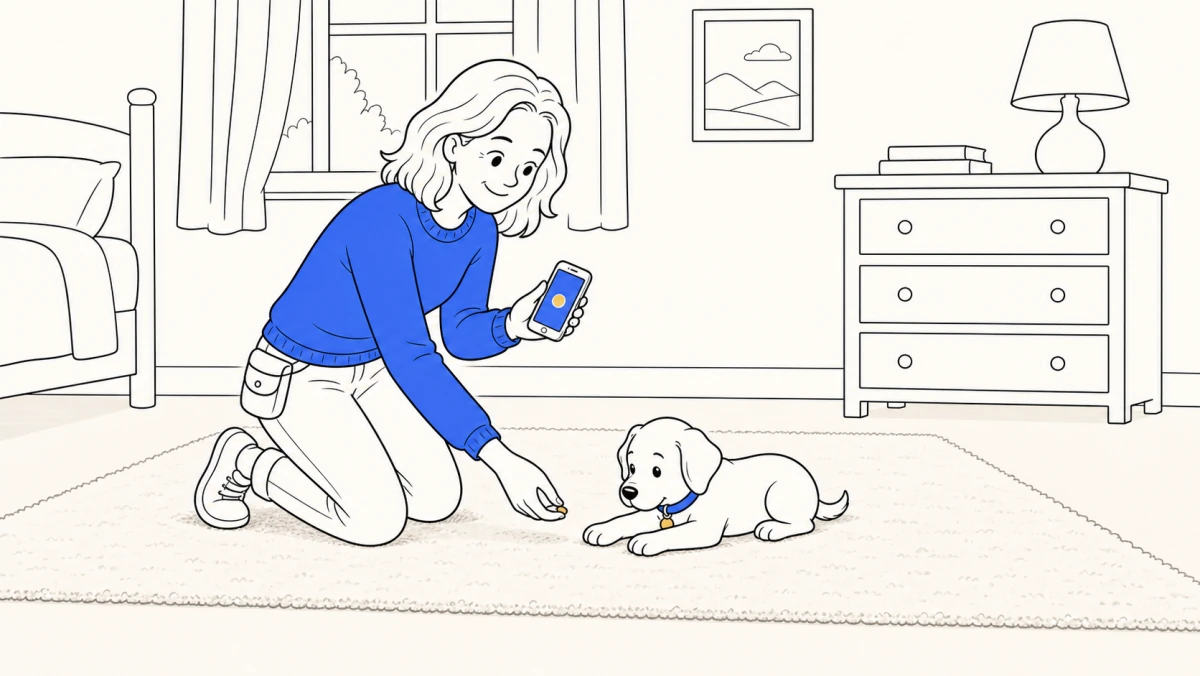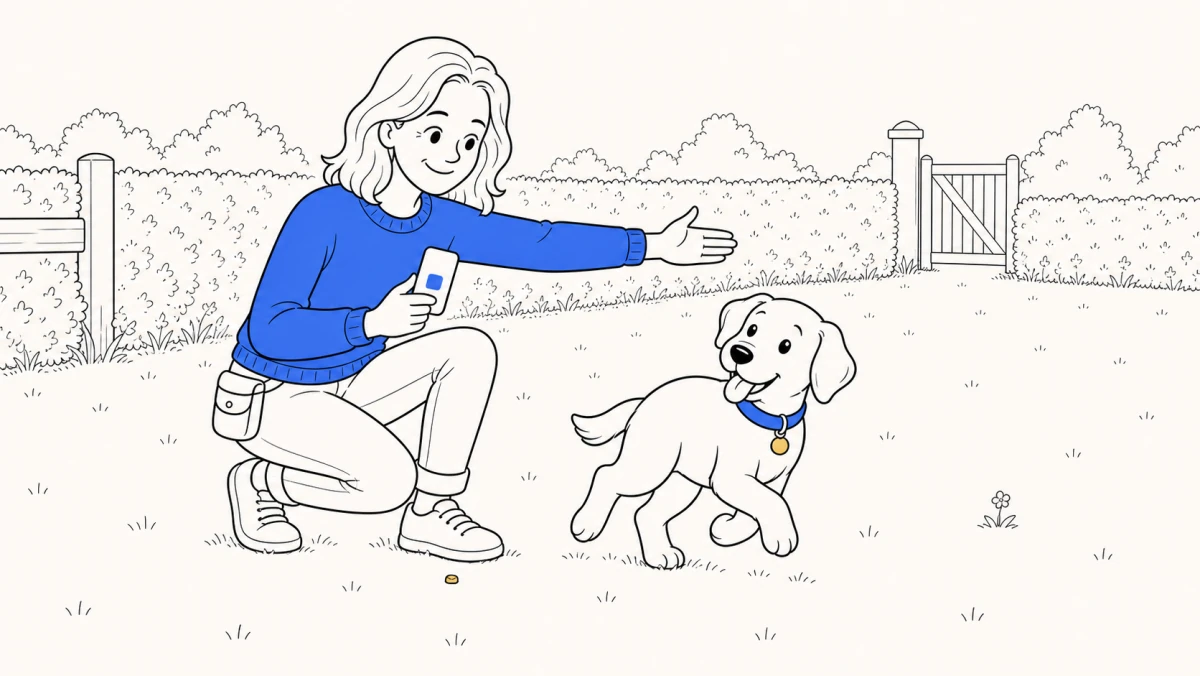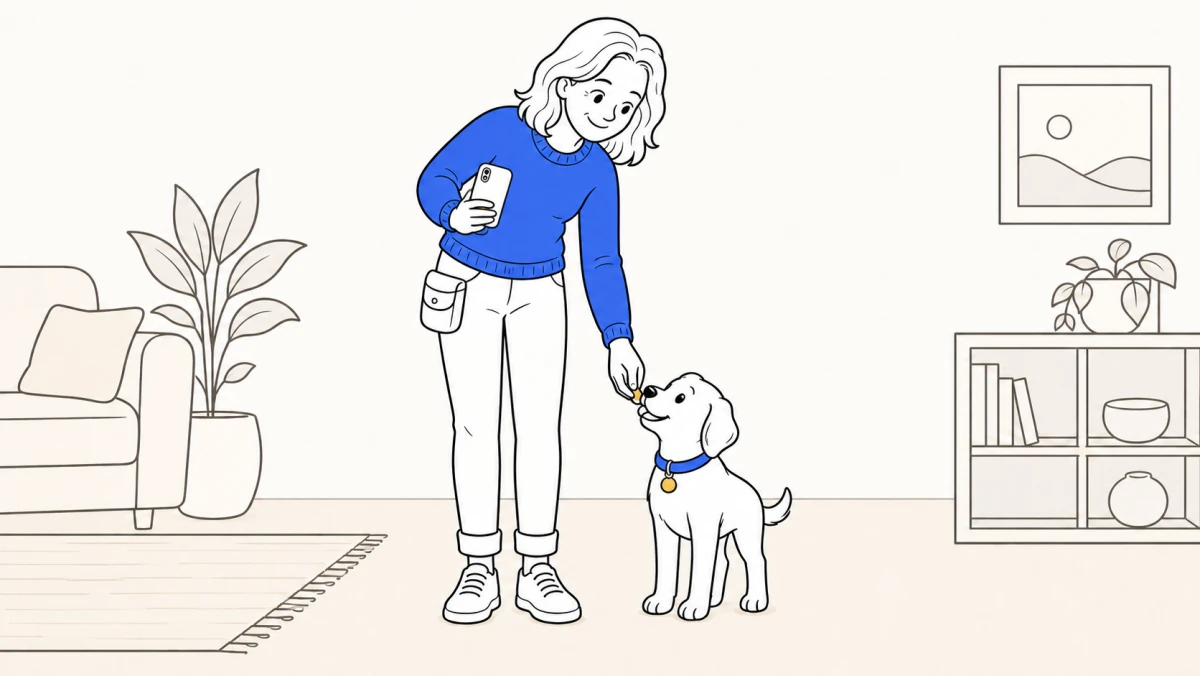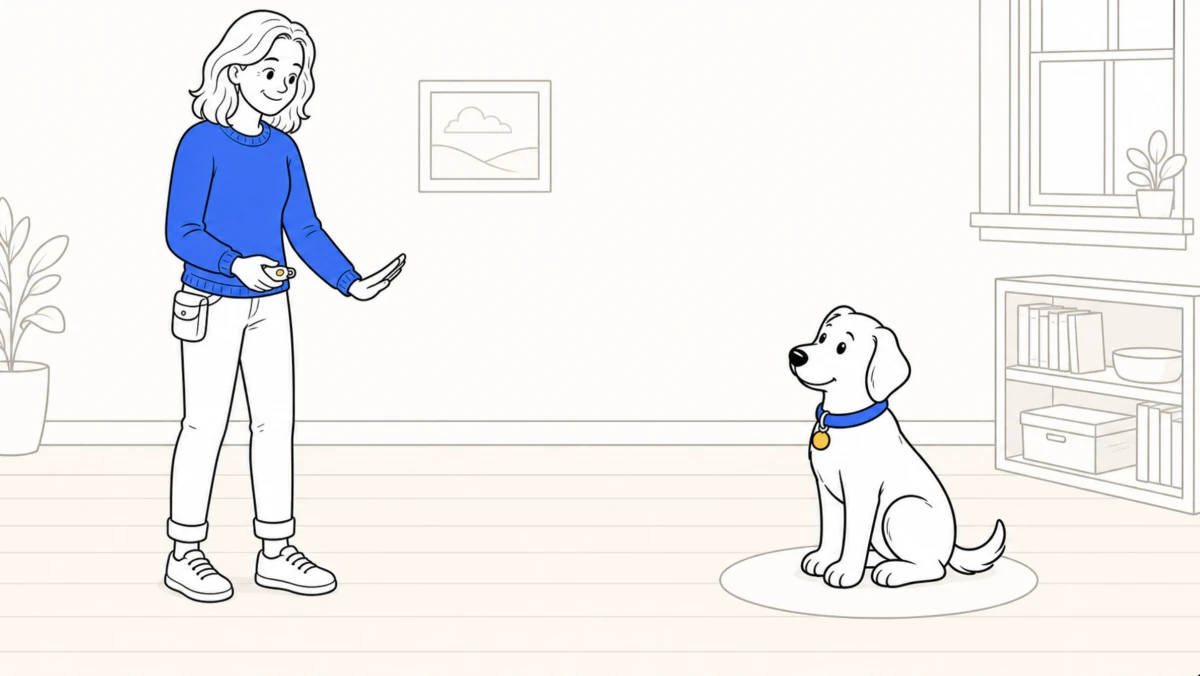
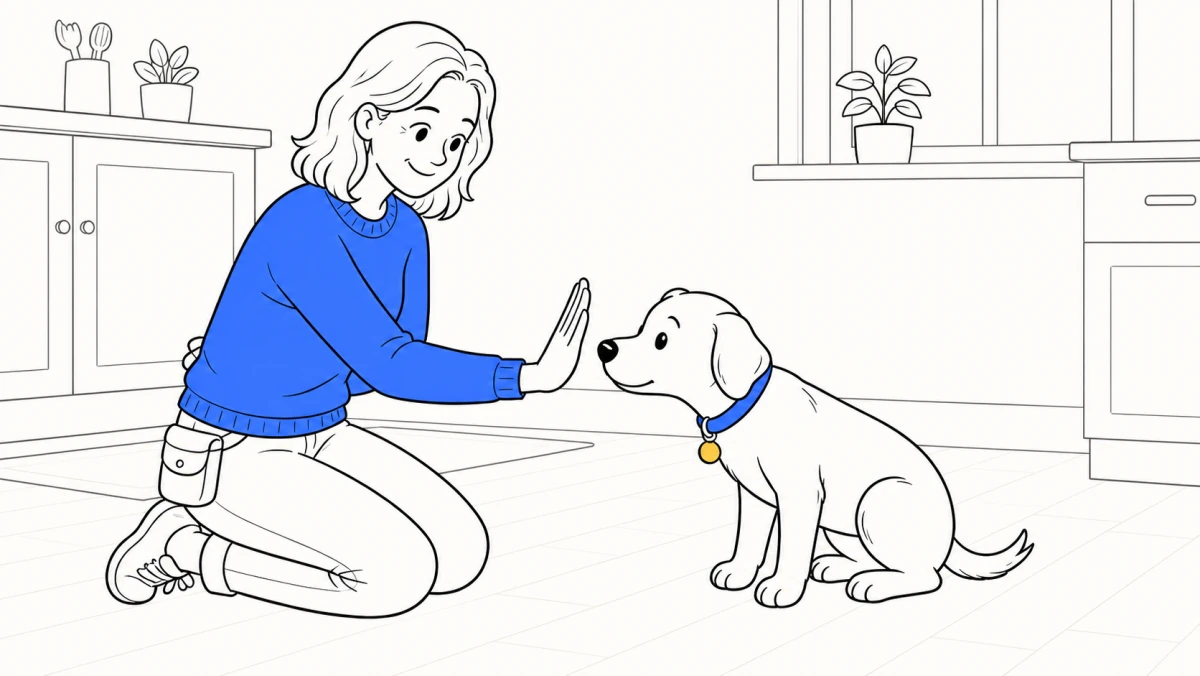
Teach a hand target by hiding a treat in one hand behind your back, presenting your other hand — open palm, flat and still — a couple of inches from your puppy’s nose, and clicking the instant the nose touches the palm. Treat from the hidden hand, then move your palm to a new spot and offer it again. Most puppies land a clean, repeatable touch inside one short session.
If you’ve read anywhere that this needs to be your puppy’s first trick, there’s a real reason for that — not just tradition. It’s nearly impossible to fail, which means it’s the fastest way for a brand-new team to bank a genuine win together, and — worth saying honestly — it isn’t a heavily searched topic on its own. Most owners find it folded into a first-day or basic-commands guide rather than looking it up by name. This page exists because it deserves its own room: what it is, why trainers reach for it first, the exact method, what goes wrong, and what it quietly becomes later.
What is a hand target, and why is it taught first?
A hand target — also called a nose target, or simply “touch” — is a dog deliberately pressing their nose to a chosen spot on cue, usually your open palm. It’s one of the three techniques (alongside capturing and shaping) that Karen Pryor Academy’s own trainer-certification course teaches as the foundation of force-free training, and it’s the specific skill KPA CTP trainer Julie Gordon calls “very easy for beginner clicker trainers to teach” precisely because the dog does most of the work — a hand a couple of inches from the nose is simply interesting, and most puppies investigate it without any luring at all.
Trainer Lori Chamberland, writing on Karen Pryor’s own clicker-training site, names a hand target as one of just three priorities for a puppy’s entire first week — alongside sit and going into the crate — ahead of anything else on a typical command list. The reason isn’t sentiment. A near-unfailable skill puts “cookies in the bank” fast: your puppy learns that trying things pays, and you get real practice on the piece that actually determines everything else — your click timing — before you’re trying to hold that timing on a harder, more failure-prone skill like a loose lure into a sit.
How do you teach a puppy to hand target, step by step?
- Hide a treat in one hand, behind your back.
- Present your other hand — open palm, flat and still — a couple of inches from your puppy’s nose. Don’t move it toward them; let them come to it.
- Most puppies lean in to investigate. The instant the nose touches the palm — click.
- Treat from the hidden hand. Then move your palm to a new spot (a little left, a little lower) and offer it again.
- Aim for about 5–8 touches over roughly two minutes, then stop while your puppy is still keen — there’s no fixed number to hit before you’re “done.”
The click-point is the entire skill: click at the moment of contact — not while they’re approaching, not after the head pulls back. AKC trainer Stephanie Gibeault’s guidance is the same shape from a different angle: present the flat palm, mark the instant of contact, then reward — building distance and hand position only once the first clean touches are reliable. Clicking a beat late is the single most common error here, and it’s the difference between teaching “touch the palm” and teaching “sniff, then wander off.”
If your clicker isn’t charged yet, that’s the one prerequisite: a handful of click-then-treat pairs with no behavior required, then a quick test (one click, hands still — does your puppy perk up looking for the treat?). How to charge a clicker covers the full method; the honest short version is Karen Pryor’s own instruction — “two or three” pairings, then test, not a fixed rep count.
What age can you start hand-target training?
As early as eight weeks — the week most puppies come home. It needs no collar pressure, no physical guidance, and no prerequisite skill, matching AVSAB’s 2021 position that puppies this young should learn through reward-based methods only. A brand-new puppy with zero training history can start the same day the leash goes on for the first time. It’s also genuinely low-stakes to get “wrong”: there’s no lure to fade badly and no position to force, so an eight-week-old puppy with a short attention span can still succeed inside a two-minute session.
What if the hand target isn’t working?
Almost always it’s one of five things, and every one of them has a fast, honest fix — none of them mean the method isn’t working or the puppy can’t learn it.
| Problem | Fix |
|---|---|
| Puppy bites the hand instead of nosing it | Click only clean nose contact; present the palm flat and briefly; calmly withdraw it if teeth arrive; lower the excitement and try again |
| Puppy won’t approach the hand at all | Rub a treat on your palm so there’s something to sniff for, click the sniff, then fade the scent over a few reps |
| You keep clicking a beat late | Click at the moment of contact, not after — decide where your criterion is before you present the palm |
| Puppy loses interest in a hovering hand | Present-and-remove rather than holding it out; keep it a quick game, not a standoff |
| Touch works close up but falls apart with any distance | Split it smaller — add three inches at a time rather than jumping straight to across the room |
If your puppy isn’t just uninterested but actively backing away or looking worried, stop, lower the energy, and try again from further away — never push a hand toward a puppy who’s retreating from it; that’s a different problem than a puppy who simply hasn’t noticed your palm yet.
And if there’s no visible “aha” moment for a session or two — that’s normal too, not a sign the method isn’t working. Very young puppies often don’t show an obvious lightbulb moment even while genuinely learning; persist rather than switching methods after one quiet session.
Worth knowing where “normal” ends: mouthing your hand during this game is ordinary teething and exploration, not aggression. That’s different from a stiff, frozen body, growling, guarding over food or toys, or a bite that breaks skin from a dog older than about six months — those deserve a professional’s eyes, not a training tweak. Here’s a fuller guide to what’s normal and when to get help.
What does a hand target become useful for later?
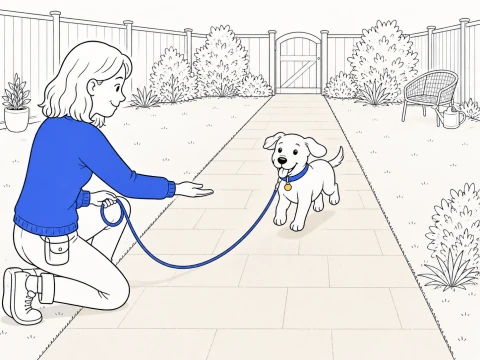
Recall, first. Trainers finish a “come” on a hand target because it turns a vague “get near me” into a clean, visible end-point: the nose-touch tells you — and your puppy — exactly when the job is done. How to teach a dog to come when called is built from exactly two pieces, name recognition and a hand target, run from further away.
Past recall, KPA’s Julie Gordon puts the wider case plainly: “Hand targeting is an excellent tool for teaching a reliable recall, and it is a way to maneuver your dog without pushing, pulling, or coaxing.” Chicagoland Veterinary Behavior Consultants, a specialty practice, lists the same skill as a way to guide a dog through doorways, into and out of the car, onto and off furniture, and onto a vet’s scale — plus a hand target held at your side to keep a dog with you past a distraction on a loose leash — all without touching the dog’s body or collar. AKC’s Gibeault sums up the mechanism in one line: “where your dog’s nose goes, their head and body follow” — which is why it also shows up as a confidence-builder for shy or unsure dogs approaching something new, and as a foundation for later tricks like spin, weave, and paw-touch light switches.
None of that needs to be built separately. It’s the same skill, asked from further away, in a new spot, or with a new distraction — which is exactly why trainers put it first.
Once the hand version is solid, some owners extend it to a target stick — the same touch, on a prop that reaches further than your arm. Karen Pryor Academy’s own guide to stick-targeting lists getting into a car, onto a grooming table, over a jump, or into position for gaiting or stacking among its common uses. It’s an optional next step, not a requirement — most of what a puppy needs from this skill, the palm alone already does.
What are the most common mistakes with hand-target training?
Beyond the click-point itself, three habits quietly slow this down:
- Luring instead of presenting. A hand target is a target — the dog moves to it — not a lure that drags the nose somewhere. If you’re moving your hand toward your puppy’s nose rather than holding it still and letting them come to you, you’re teaching a different (and weaker) skill. Present, then wait.
- Skipping straight to distance or distraction. A touch that’s rock-solid two inches from a still hand in a quiet kitchen can fall apart entirely across the room, or with the TV on. Build criteria one at a time — distance, then position, then distraction — never all three together.
- Treating the palm as a resting place instead of a game. If your hand hovers indefinitely, puppies lose interest fast. Present it, get the touch, remove it, re-present — the rhythm is what keeps a young puppy engaged for the full two minutes.
How many reps does hand-target training actually take?
There’s no honest fixed number, and any article that gives you one is guessing. What’s true across the sources above and ClickerPup’s own coached sessions: most puppies land a clean, repeatable nose-touch inside one short session — roughly 5–8 touches over about two minutes — because the behavior asks so little of a brand-new puppy. If yours takes a session or two longer, that’s still well within normal; the fix is shorter, calmer reps, not more of the same session pushed past the point your puppy is still keen.
Hand-target is the entry point to ClickerPup’s whole coached spine — it’s the very first skill in the app, with more built-in sessions than any other single skill as your puppy moves from a first touch to a reliable one on cue, at a distance, in a new room. If a coach that plans today’s two-minute session and adjusts when the last one went sideways sounds useful, that’s exactly the gap we’re building ClickerPup to fill.