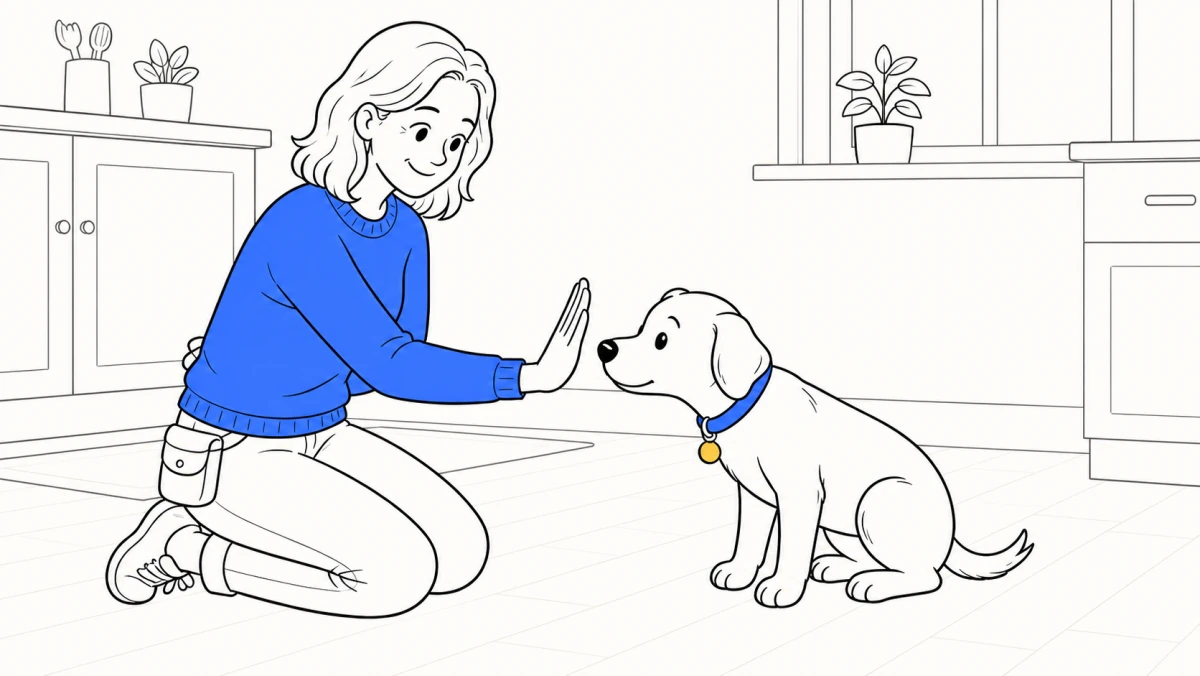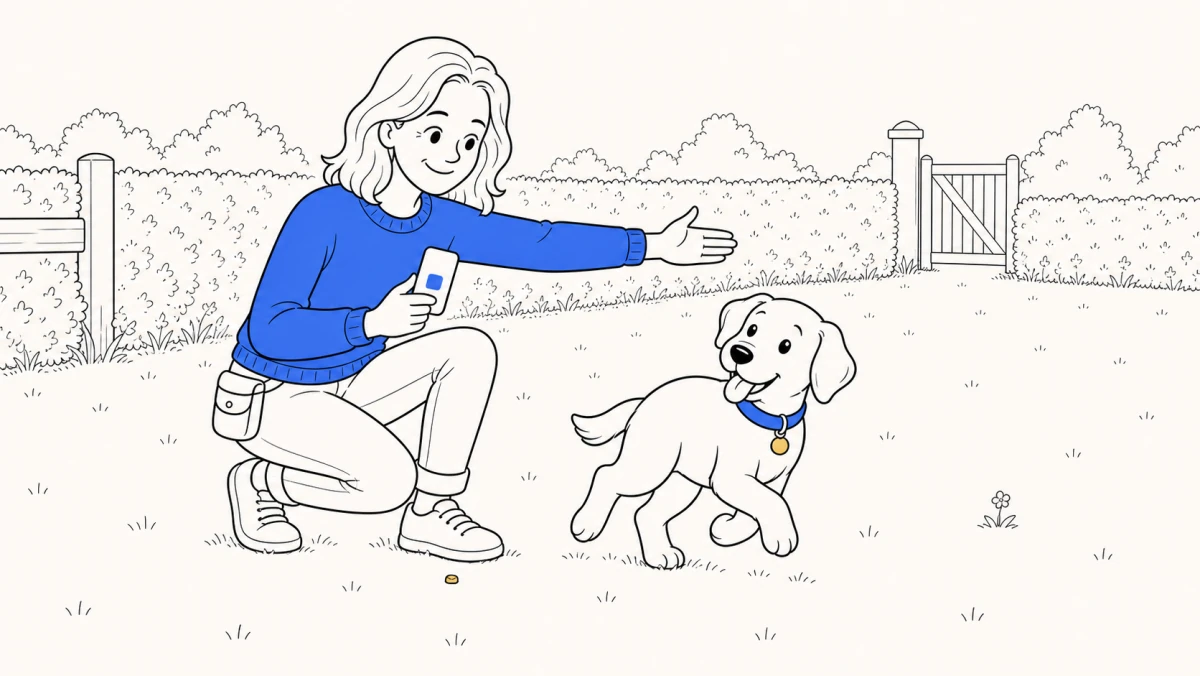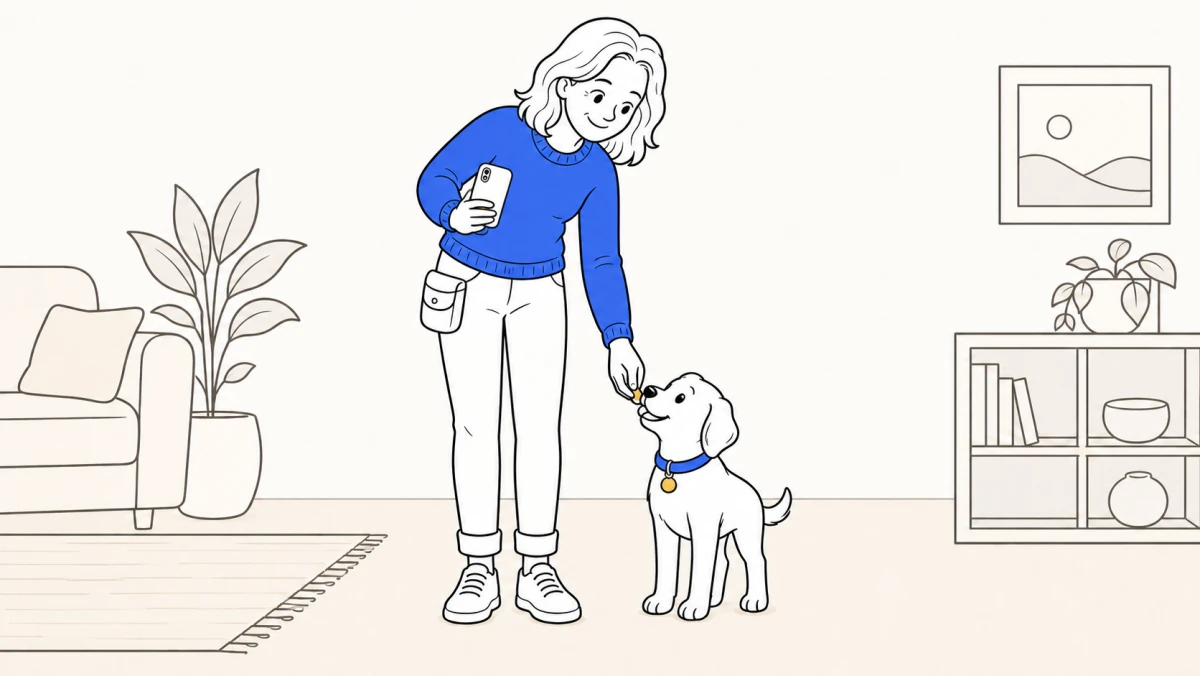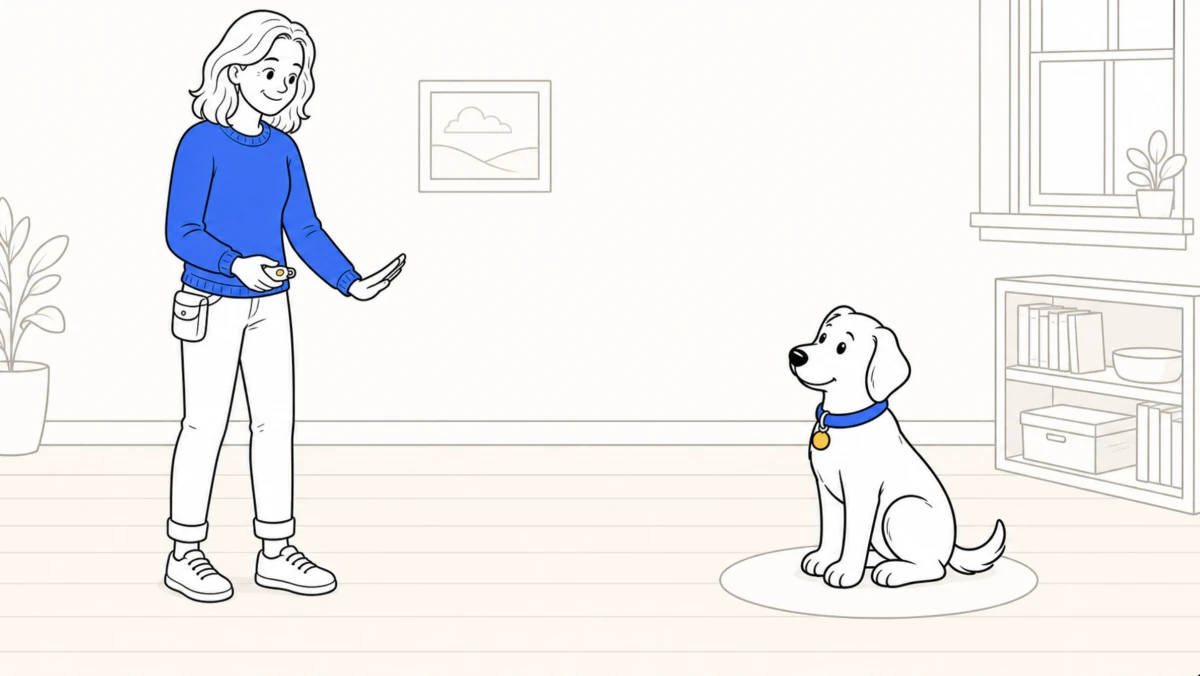
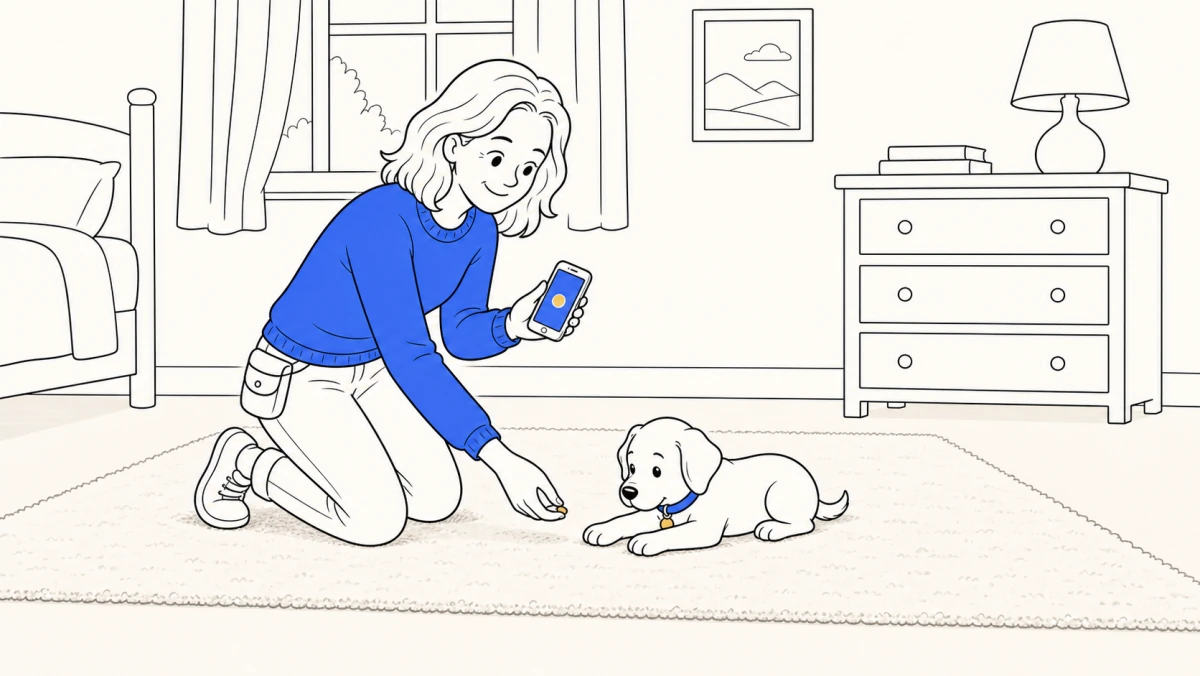
From a sit, lower a treat slowly straight down between your puppy’s front paws until both elbows touch the floor, click that instant, then treat on the floor, still in the down. Fade the lure once it’s reliable, and never push or press your puppy into position — most puppies learn it in a few short sessions.
If sit already went sideways once or twice, down can feel like the harder sequel — puppies often stall halfway, front end down and hips still up, or pop straight back up the moment the treat lands. That’s not your puppy being difficult; it’s almost always the lure moving too fast or stopping too soon. Here’s the exact method, why “down” asks more of a young body than sit does, and the honest answer on whether your puppy needs sit first.
How do you teach a puppy to lie down, step by step?
Lure the nose straight down between the front paws until the elbows touch, mark that instant, then treat in position — a method the AKC, the RSPCA, and ClickerPup’s own coaching all converge on, starting from an already-seated puppy.
- Ask for (or lure) a sit first. Down builds directly on it.
- Hold a treat right at your puppy’s nose, then lower it slowly, straight down, to the floor between their front paws.
- The instant both elbows touch the floor — click (or say “yes”) — then treat on the floor, delivered right there, still in the down.
- If only the front half folds and the hips stay up (a “sploot”), keep tracing the treat forward along the ground, away from the nose — the same continued-motion line the AKC’s own sequence uses to complete a full down in the first place, so it works just as well as a fix for a stuck one.
- Reset by inviting them back up, then repeat for a handful of easy reps. Once they follow the treat reliably, fade to an empty hand and add “down.”
Do I need to push my puppy into a down?
No. Never push or press on your puppy’s shoulders or back to force a down — lure only, and let the elbows fold on their own.
The American Kennel Club’s own instructions, written by Stephanie Gibeault, MSc, CPDT, are blunt: “Never force your puppy into a down. As tempting as it might be to ‘show’ your puppy what you want by pushing them into the position, that will likely have the opposite effect.” That matches AVSAB’s position that only reward-based methods — food and a marker, not physical pressure — belong in dog training. If your puppy resists the lure, the fix is a slower hand and a comfier surface, never a hand on their back.
What’s the exact moment to click when teaching down?
Click the instant both elbows touch the floor — not while the puppy is still lowering, and not after they’ve already stood back up. The AKC’s own guide agrees: “As soon as your puppy is in the down position, click and praise.”
Treat placement matters as much as timing. The AKC warns that “if you always give your dog their treat when they sit up again, you’re really rewarding sitting rather than lying down” — so the treat has to land on the floor, in the down, not at chest height once they’ve popped back up. The same timing stakes apply here as with any marker: in Browne’s 2015 University of Waikato research on delayed reinforcement, dogs learning a new behavior succeeded about 60% of the time when the reward arrived immediately, but only about 25% when it came a second late. A beginner’s hands are never as fast as a puppy; the click buys back the precision you don’t have yet.
Why won’t my puppy lie down?
Usually the lure moved too fast, stopped too soon, or the treat arrived after they’d already stood back up. Slow the lure down, trace it all the way to the floor, and pay while they’re still down.
| What you see | Likely cause | Fix |
|---|---|---|
| Stands up to follow the treat | Lure moved up or forward instead of straight down | Trace it straight down between the paws, low and slow |
| Front half folds, hips stay up | Lure stopped too soon | Keep tracing the treat forward along the ground until the hips settle |
| Lies down, then instantly stands | Treat delivered after they stood back up | Treat on the floor, in the down, immediately |
| Won’t fold on a hard or tile floor | Cold or hard surface is uncomfortable | Move to a mat or rug |
| Still hesitates, looks stiff, or is slow getting up even on a soft surface | May be discomfort, not stubbornness | Check with your vet before pushing more reps |
That last row is a real distinction, not a formality. Cathy Madson, CBCC-KA, CPDT-KA, writing for Preventive Vet: “Always consider if the action of lying down is uncomfortable or painful for your dog.” Stiffness or slow-motion getting up is her cue to see a vet, not add more reps.
Does my puppy need to know sit before down?
Yes, in practice. Every method that’s actually converged on here — the AKC’s, the RSPCA’s, and ClickerPup’s own — lures the down from an already-seated puppy, so a reliable sit makes down noticeably faster to teach.
That’s not a hard prerequisite in the sense of “impossible without it” — Madson’s Preventive Vet guide describes an alternative diagonal lure line for a standing puppy — but starting from sit gives the lure a much shorter, cleaner path (straight down, one motion) instead of asking a standing puppy to fold both ends at once. If your puppy doesn’t have a solid sit yet, teaching sit first will make this page faster to finish, not slower to start.
What age can you teach a puppy to lie down?
As early as 8 weeks. Down uses a food lure, not collar pressure, so a young puppy can start the week they come home. Keep sessions short — a couple of minutes is plenty.
The physical ask is the only real limiter, not age. A very young puppy folding onto a hard floor for the first time is exactly the case Madson’s comfort caution above is for — a soft mat removes most of the hesitation this early. Beyond that, down slots in alongside the other early cues; the first five commands worth teaching covers where it sits in the order.
Can you teach a puppy to lie down without treats?
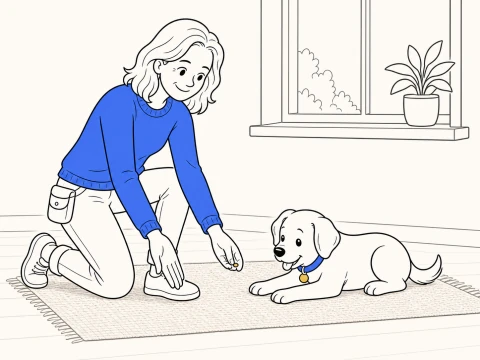
Not at first, and you shouldn’t try to skip straight there. The treat is what teaches the behavior; the click (or a crisp “yes”) marks the instant so the treat can land a beat later, once you’re both certain what earned it.
Once down is reliable on the lure, fade it the same way you’d fade any other cue: an empty hand doing the same straight-down motion first, then a smaller signal, then the word alone, paying from your other hand throughout. The AKC’s own guide to fading a lure — written by Sassafras Patterdale, CPDT-KA — is clear that this happens “as soon as your dog is performing the cue consistently with the lure,” not on a fixed rep count. If your puppy startles at a clicker, a verbal marker charged the same way works just as well; clicker training on day one covers charging a marker from scratch.
What comes after down?
Down is also the doorway to roll over — the AKC’s own instructions for that trick call it “helpful if your dog knows the ‘down’ cue before you start teaching this trick,” and in practice, luring a roll from a puppy who won’t settle into down usually means fighting the down, not teaching the roll. Once down is solid, roll over is the next short, low-stakes skill built from the same lure-and-click loop, just with the same never-force rule carried forward: no puppy should ever be rolled, pushed, or pressed into position by hand.
How long should a down training session be?
About two minutes and a handful of easy reps, then stop while your puppy is still winning — the same short-session culture that works for every early cue. Down is a bigger physical ask than sit, so don’t chase one more rep once the reps start looking effortful or the pace slows down. How long puppy training sessions should be covers the timing guidance behind every method on this page. For what the marker itself is doing, see what clicker training is and whether it works.
When is down trouble actually something else?
Mouthing at the lure or your fingers during down practice is ordinary teething under about six months — redirect gently, and click only the elbows-down moment, not teeth on your hand. Genuine physical hesitation — moving slowly into the down, stiffness getting up, or reluctance a softer surface doesn’t fix — is worth a vet visit before another session, per Madson’s guidance above.
What isn’t normal, physically or behaviorally: a stiff, frozen body, growling, guarding over food or toys, or a bite that breaks skin from a dog older than about six months. Those need a certified behavior professional — an IAABC-certified consultant (iaabc.org) or a veterinary behaviorist board-certified by the American College of Veterinary Behaviorists (ACVB) — not another lure adjustment. Here’s what’s normal and when to get help.
Down is one lure line, one click-point at the elbows, a handful of fixable stalls, and a planned exit from the food lure once it’s reliable — the last of the first five cues to get its own page, and arguably the one that rewards patience the most. If a coach that plans today’s two-minute down session — and knows when a stall is a lure problem versus a “check with the vet” problem — sounds useful, that’s the gap we’re building ClickerPup to fill.