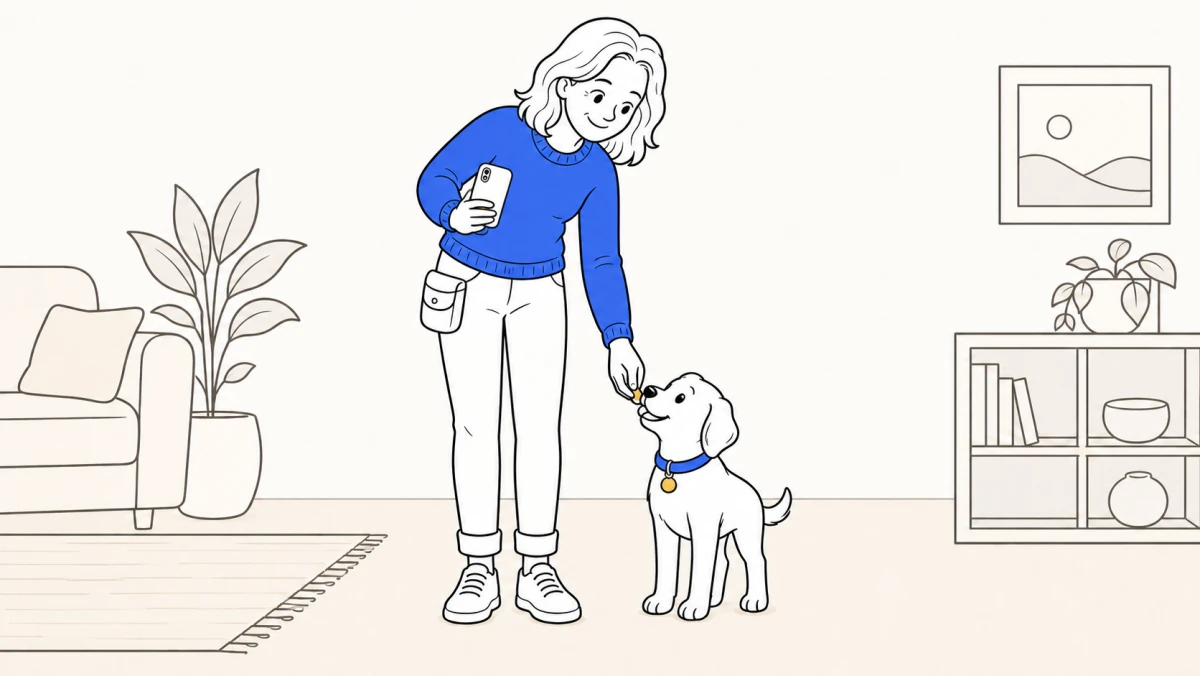
Teach a puppy to heel by paying the exact spot beside you. Lure your puppy to your side, mark the instant they’re in position with a clicker or a bright “yes,” and feed low at your leg. Add a single step, then the word “heel,” then slowly stretch distance, turns, and distractions. Heel is force-free position work — a marker and food, never a leash correction.
Here’s the honest part most heel guides skip: heel is not how you’ll walk your dog. It’s a cued position you switch on for a moment (crossing a road, passing a barking dog, threading through a crowd) and switch off again so they can sniff. Confusing heel with everyday walking is why owners drill it for weeks, get a tense dog who breaks the second the treats stop, and quietly give up. Get the difference right first, and the training gets much easier.
What is heeling — and how is it different from loose-leash walking?
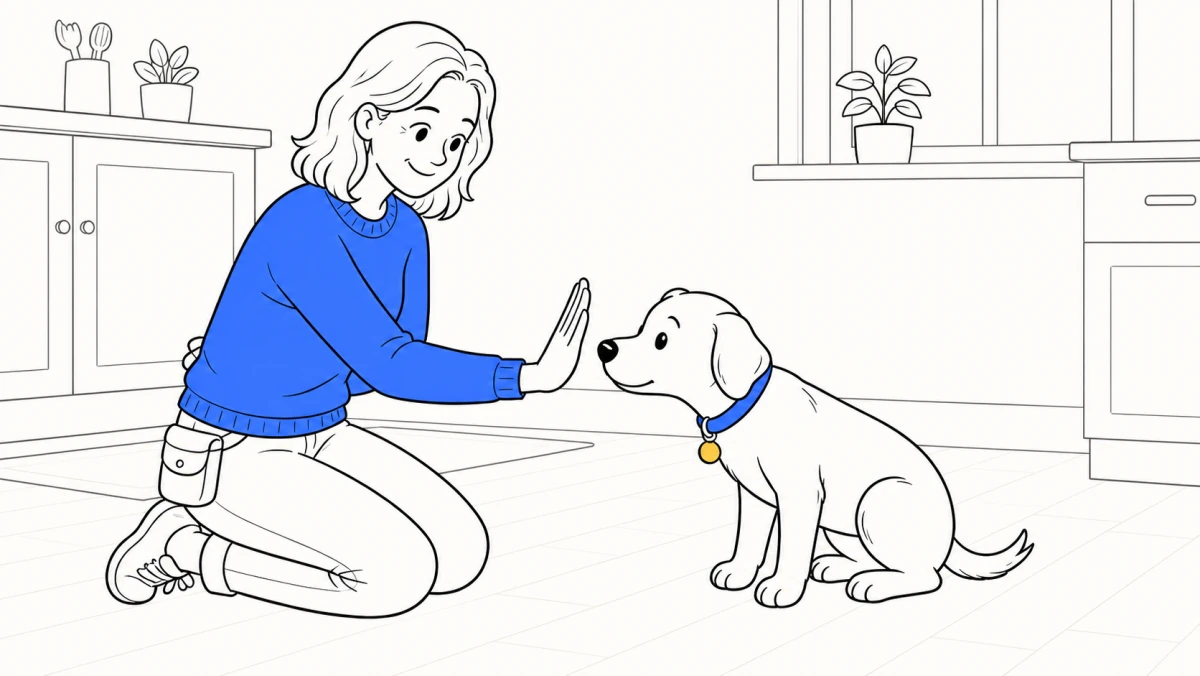
Heeling is a precise, cued position: your puppy walking at your side, shoulder roughly level with your leg, pace matched to yours, attention up on you. Loose-leash walking is different and lower-stakes — it just means no pulling, with the leash in a soft J and your puppy free to sniff and drift within its length. Loose-leash is the skill you want for the whole walk; heel is the one you switch on for a few seconds when you need precision.
That distinction matters because they’re taught, and used, differently. For everyday walks, teach loose-leash walking first — it’s the foundation, and for most dogs it’s the bulk of what a good walk needs. Reach for heel when the situation calls for your puppy tucked in close and locked onto you: a busy sidewalk, a road crossing, a narrow trail, or walking past something exciting. A real heel is as much about attention as position — the dog choosing to track you, not being held in place.
| Loose-leash walking | Heel | |
|---|---|---|
| What it is | No pulling; leash in a soft J | A precise, cued position at your side |
| Your puppy can | Sniff and drift within the leash | Stays tucked in, attention up on you |
| When you use it | The whole everyday walk | A moment: crossings, crowds, tight spaces |
| How long you hold it | The whole walk | Seconds to a minute, then release |
What age can you start teaching a puppy to heel?
Start the position foundation as soon as your puppy comes home, around 8 to 10 weeks. Luring your puppy to your side and paying the spot is gentle, treat-based work with zero leash pressure, so there’s nothing to wait for. What comes later is the polished heel (precise, held for distance, steady past distractions), because that version leans on focus and impulse control that only mature with age.
So early heel work is habit-building, not drilling a finished skill. You’re teaching a baby dog that the spot beside your leg is the best-paid place to be, long before the world gets loud and competitive. Treat it like every other early skill: tiny wins now, reliability much later. The way you teach a dog to heel doesn’t change with age — an 8-week puppy and a two-year-old learn it the same way; only the polish you can expect differs. Expecting a parade-ground heel from a 10-week-old is the fastest way to feel like you’re failing when you’re actually right on schedule.
What do you need to teach heel?
Not much: a flat collar or a well-fitted harness, a fixed-length leash of about six feet, a clicker or a consistent marker word, and a pocket of tiny soft treats. Skip anything that tightens, pinches, or “corrects” — no prong collars, no choke chains, no e-collars. Heel is built with a marker and food, and gear that does the correcting for you works against the very thing you’re teaching.
Soft, pea-sized treats matter because you’ll pay often at first, and crunchy biscuits slow the whole loop down. If the clicker itself is new to your puppy, spend one short session pairing the click with a treat so it clearly means “yes — that, exactly, and food’s coming.” That groundwork is covered in clicker training on day one; a charged marker is what lets you tell your puppy the precise instant they got it right — the same clicker method behind every other cue.
How do you teach a puppy to heel, step by step?
Build heel in layers, marking position before you ever add the word. Two independent reward-based sources teach essentially the same sequence: the American Kennel Club’s method, from GoodDog! Helpline trainer Christie Canfield, and Dogs Inc., a guide-dog organization whose volunteer puppy raisers treat heel as a dog’s “default position” — the place they focus, follow, and start other cues from. Both lure the puppy to your side, mark the instant they arrive, and raise difficulty gradually. Here’s the sequence:
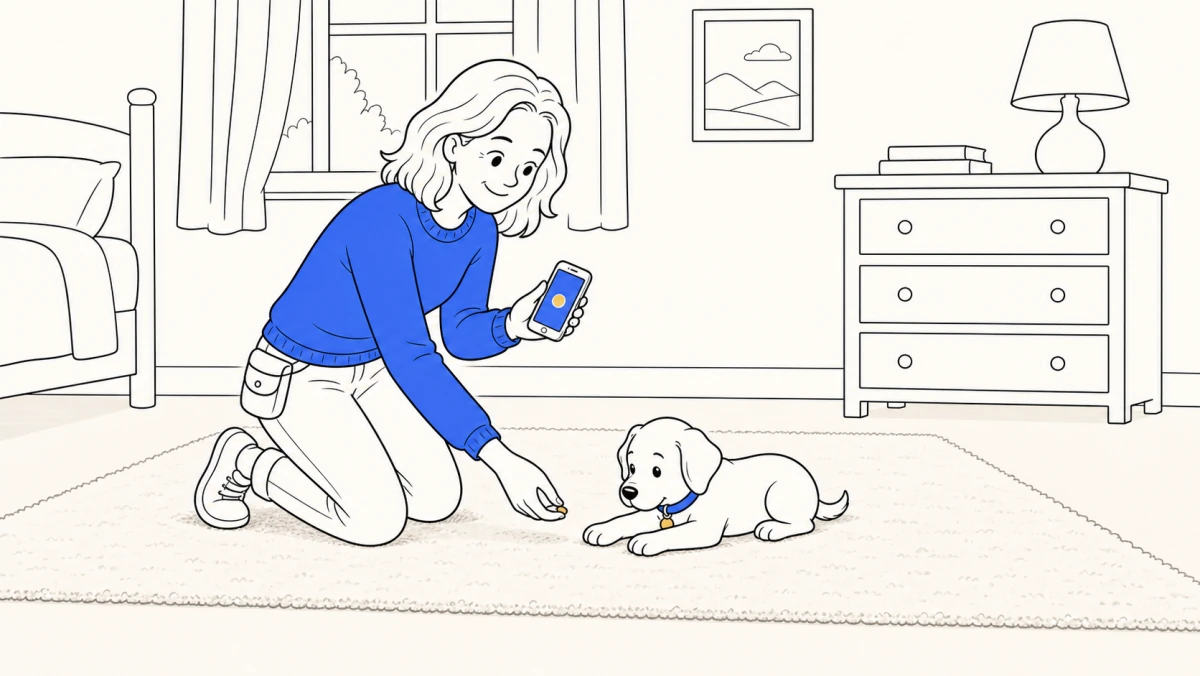
- Reward the position (“find heel”). Stand with your puppy loose beside you. The instant their shoulders line up with your leg, click (or say “yes”) and feed low, right at your pant seam, on the side you want them to walk. Feed with the hand nearest your puppy, not across your body — Canfield notes this keeps them from crossing in front of your feet. Her cue for getting them there in the first place: call the name and point to the side you want, then mark and pay the moment they arrive.
- Add one step, then a few. Take a single step and click your puppy for coming with you and holding the pocket; feed at the seam. Build to two steps, three, five — you’re marking staying in position now, not just arriving.
- Fade the lure. Stop holding food out in front. Keep your treat hand at your chest — Canfield notes this “will prevent luring… and jumping while walking” — and let your puppy choose the spot before you mark and pay. Food shows up after the click, not as a permanent bribe under the nose.
- Name it. Once your puppy reliably slots into position, add the word: say “heel” just as they take the spot, so the cue attaches to a behavior you already have. Name a wobbly, half-formed heel and all you’ve done is attach a word to the wobble.
- Add turns, pace, and duration — one at a time. Change your pace, zig-zag, make gentle turns, and add a “watch me” for eye contact (all in Canfield’s method). Stretch the steps between clicks. Raise one dial per session: more steps, or a turn, or a livelier spot, never all three.
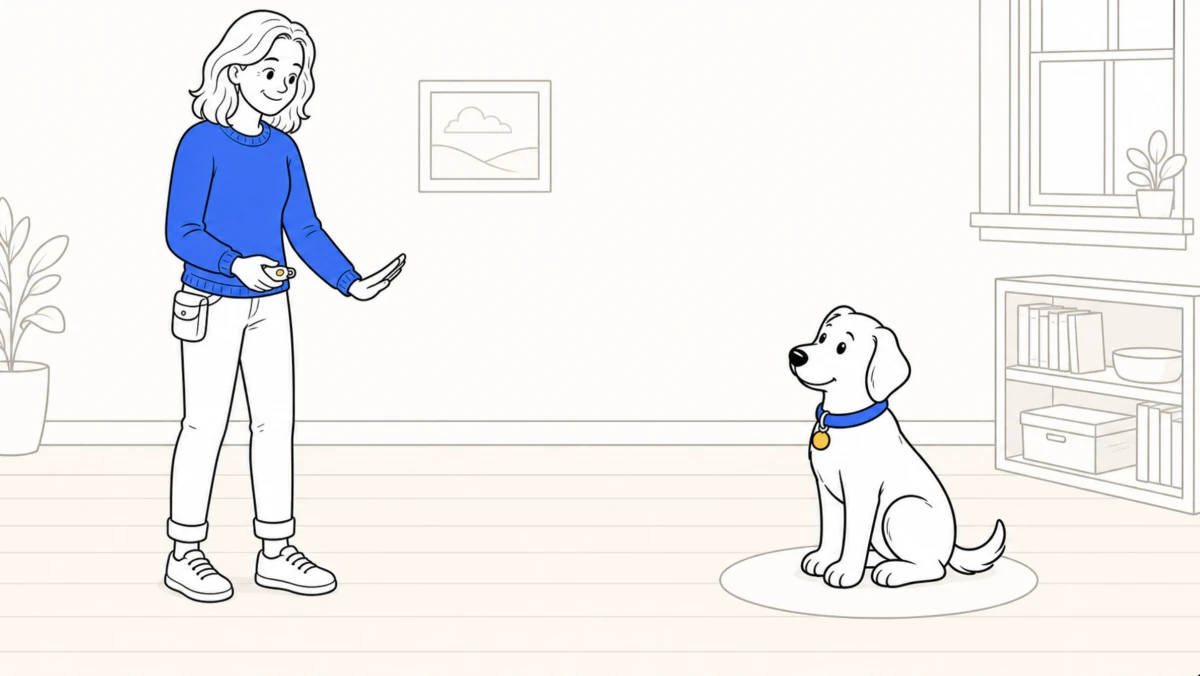
- Release cleanly. Teach an “all done” or “okay” that ends the heel, so your puppy knows when precision is off and sniffing is legal again. Heel is a moment you switch on and off, not a state you trap them in.
Which side should a puppy heel on?
Traditionally the left. Canfield notes heel “is traditionally on your left side for obedience and rally competitions,” so if you might ever try a class, left is the safe default. For a pet dog it honestly doesn’t matter which side you pick — what matters is that you pick one and stay consistent. Feeding and marking on the same side every time is what builds a clean, predictable position instead of a puppy who drifts back and forth across your feet.
How do you teach a puppy to heel without treats?
You don’t teach heel without rewards — you fade the treat from a lure into a paycheck. The clicker marks the exact instant your puppy is in position, and the food arrives a beat later, so you’re not steering with a treat held out in front of their nose. That’s the whole difference between a lure and a bribe: a lure is faded out in the first few sessions; a bribe never leaves your hand — and that is what the “no treats” guides miss.
Once heel is reliable, thin the food out and let other rewards start paying. Karen Pryor’s clicker guidance is blunt about keeping the marker clean — don’t mix in leash-jerking or scolding, or you lose your dog’s trust in the click. So instead of corrections, let real life do the paying: the walk continuing, a “go sniff” release, a favorite game. A dog who heels because the spot pays, sometimes in food and sometimes in freedom, is far steadier than one who only performs while a treat is visible.
How do you keep the heel when the world gets distracting?
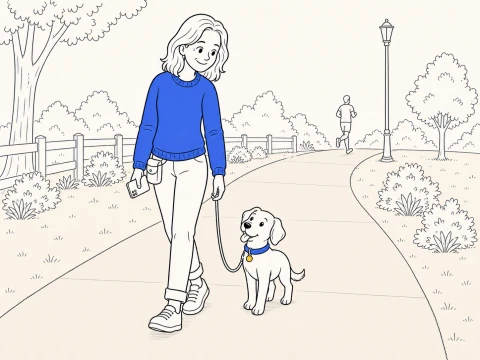
Add distractions one rung at a time, and drop your criteria the moment the world gets louder. A puppy who nails heel in the kitchen and “forgets” it on the sidewalk isn’t being stubborn — the street is simply a louder room than your cue. Dogs don’t generalize the way people do, so a skill that’s solid at home is genuinely new-ish outside. Expect the dip, and make the outside version easier: closer, shorter, better treats, fewer steps.
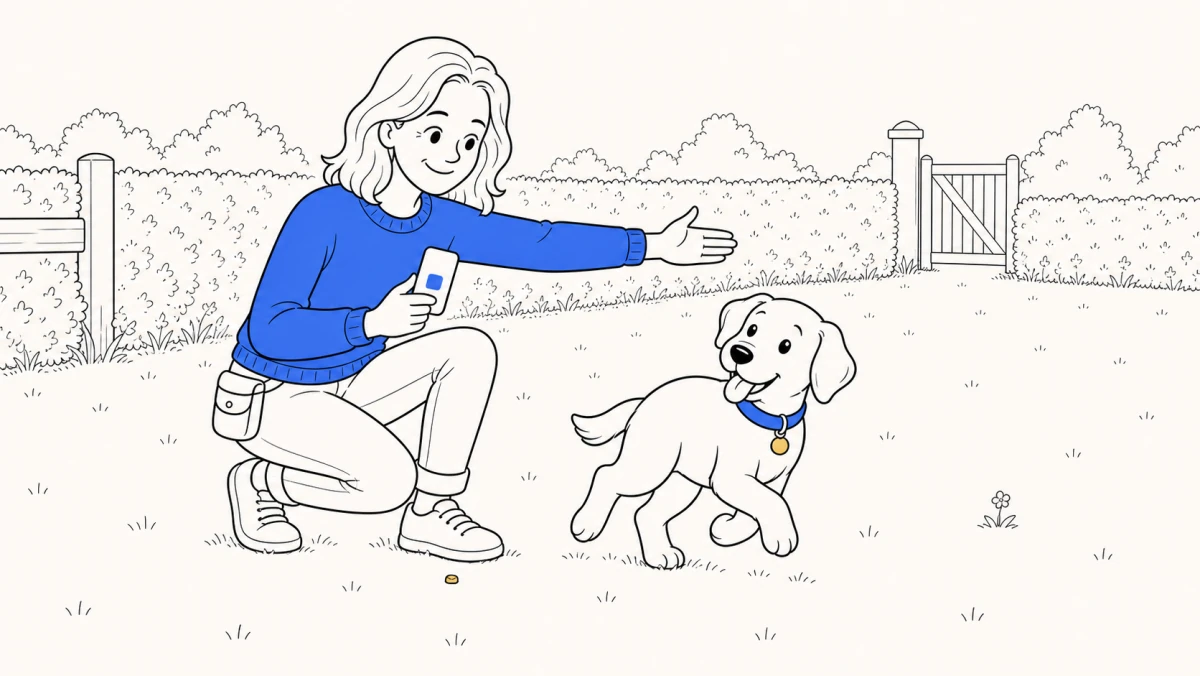
Practical proofing looks like this: quiet room → hallway → yard → quiet stretch of sidewalk → somewhere with mild distractions, re-earning a few good reps in each place before you move up. Keep the honest scoreboard per place: “reliable where you’ve trained, one spot at a time,” not “reliable everywhere.” And keep heel bursts short even on real walks: a few strides of tight, paid position past the distraction, then release back to a loose leash. Trying to hold a formal heel for a whole walk is how you burn out a young dog’s focus.
Should you teach heel with an e-collar or leash corrections?
No — you don’t need aversive tools to get a good pet heel, and we don’t use them. Heel is where you’ll see the most pressure to reach for e-collars, prong collars, and leash “corrections,” especially in competition and working-dog circles. ClickerPup’s whole approach is reward-based, and that’s a deliberate, evidence-aligned call. The American Veterinary Society of Animal Behavior’s 2021 position statement is explicit that reward-based methods should be the standard, and that aversive techniques carry real risks to welfare and to your relationship with your dog.
This isn’t a fringe worry. In the Royal Veterinary College’s Pandemic Puppies research, 82% of owners reported using at least one aversive method by 21 months, and 40% admitted to leash corrections — yanking the leash when the dog pulls (Brand et al., 2024). In that same survey, problem behaviors were more common among dogs trained with aversive methods, though a snapshot of owners can only show the link, not prove corrections caused it. Reaching for a correction is the common path; it just isn’t a necessary one.
The stronger evidence is what aversive training does to a dog directly. A full-speed jerk on a puppy’s neck is a genuine welfare risk, and the cost shows up in the dog’s body: in a controlled study of 92 companion dogs, Vieira de Castro and colleagues (2020) found those trained with aversive methods showed more stress-related behavior and higher cortisol than dogs trained with rewards. Punishment also tends to teach a dog what not to do without ever teaching the thing you actually want — the position, held, with attention. Marking and paying the right spot teaches that directly. If your puppy keeps breaking position, the answer is never a harder correction; it’s easier criteria — go closer, slower, and quieter until they can win again.
How long does it take to teach a puppy to heel?
Plan for weeks of short sessions, not a single weekend. Heel is slower to build than sit or touch because it asks for movement, a precise position, and attention all at once — and it competes with the most interesting thing in a puppy’s world, which is everything else. A young puppy picks up the foundation quickly; the reliable, distraction-proof version keeps maturing over months as they grow up.
Keep sessions to about two to three minutes, a few times a week, in easy places first. Short and spaced beats long and crammed: in controlled research on dogs learning a new task, animals trained in shorter, more spaced sessions reached a higher level than those drilled every day (Demant et al., 2011). That’s a nudge toward little-and-often, not a rule that heel must be rare — the fuller picture is in how long puppy training sessions should be.
When should a heel or leash problem mean you get help?
Normal wobble belongs in the plan above — a puppy who drifts, forgets the position outside, or loses focus is just a puppy learning. Fear and aggression do not. If your puppy freezes and shakes on the leash, or lunges and barks hard at dogs or people, that isn’t a heel problem and it won’t be fixed by drilling position. Stop the DIY on that piece and bring in a professional.
Leash-pulling is one of the most common things owners struggle with — 67.4% of owners in the Royal Veterinary College’s Pandemic Puppies study reported it by 21 months (Brand et al., 2024), and Dogs Trust’s National Dog Survey 2025 found 44% named it too — so you’re in very normal company if walks are hard. But sudden reluctance paired with limping or low energy is worth a vet visit first, and fear or reactivity that isn’t fading is worth a certified behavior consultant — IAABC-certified consultants (iaabc.org) work to standards that rule out shock. Here’s a fuller guide to what’s normal and when to get help.
The one thing that makes heel stick
Make the spot beside your leg the best-paid place your puppy can be, and let heel stay a moment you switch on and release. Teach loose-leash walking for the everyday walk, layer heel on top for the moments that need precision, mark the position, and never let a correction do the teaching. Build it in easy places, one dial at a time, and expect it to move slower than sit — that’s the skill, not a failure.
Keeping those short position sessions consistent across real, messy walks is the genuinely hard part. That’s exactly what ClickerPup is built to coach: the side-position skill heel is built on, sized into two-minute bursts that fit a real day. The clicker stays free forever, with a plain reminder before anything ever charges.
Claim my early spot and we’ll bring you in as we open up.