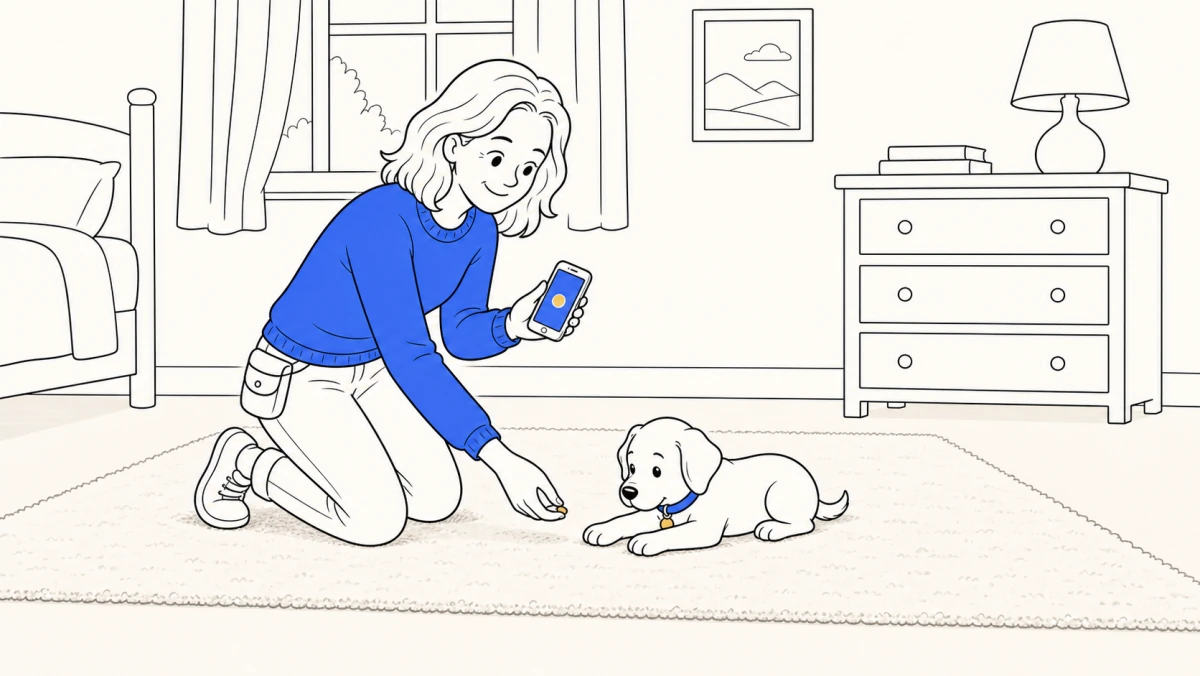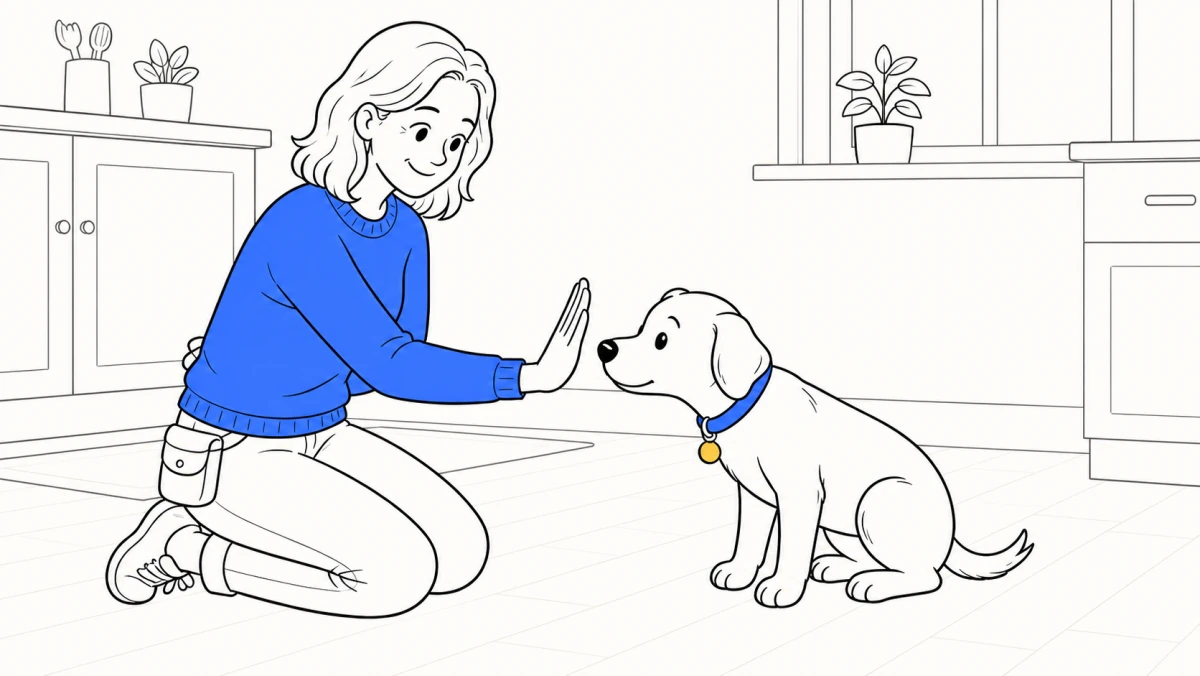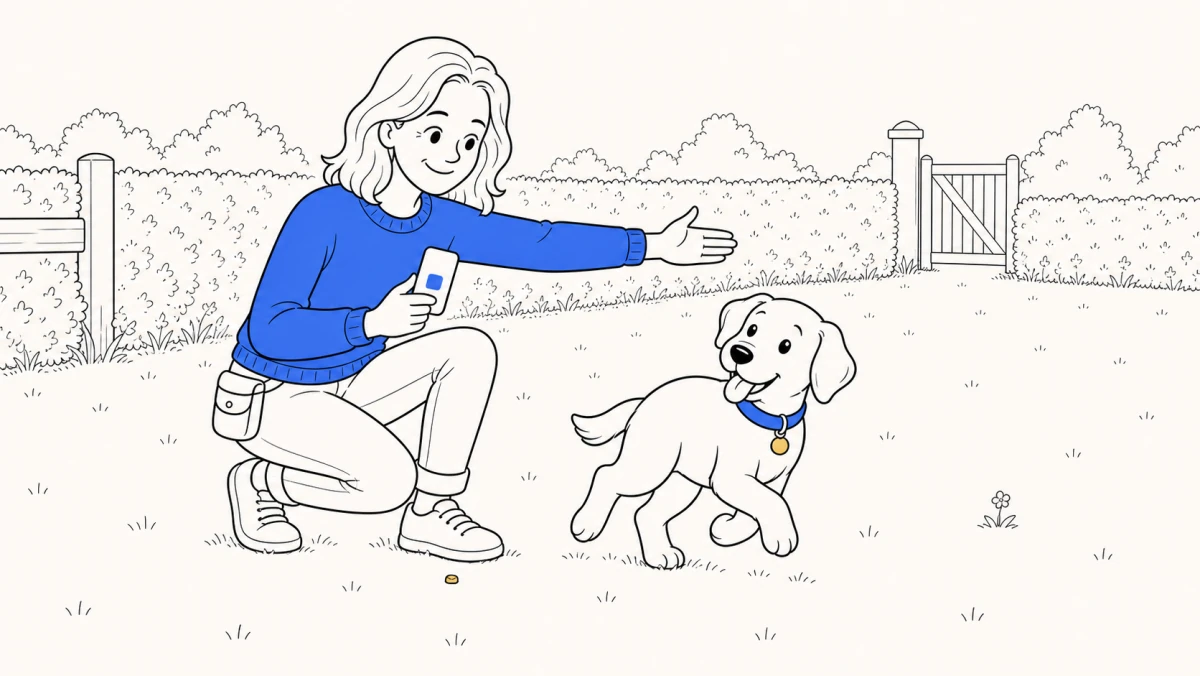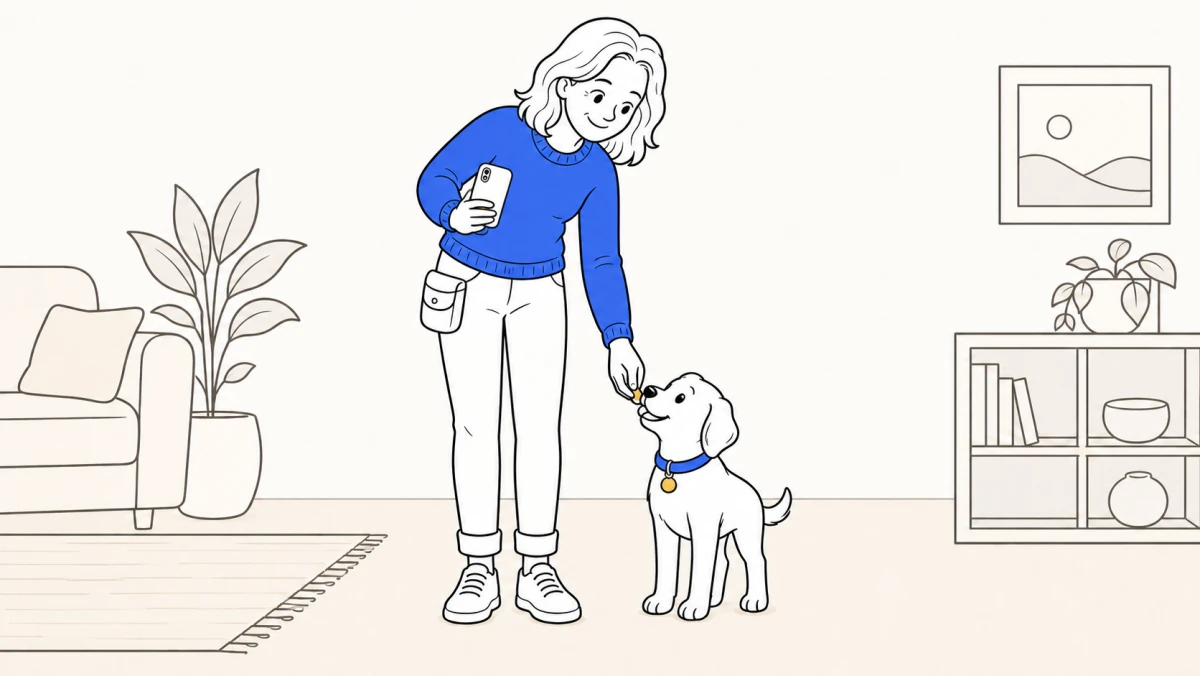
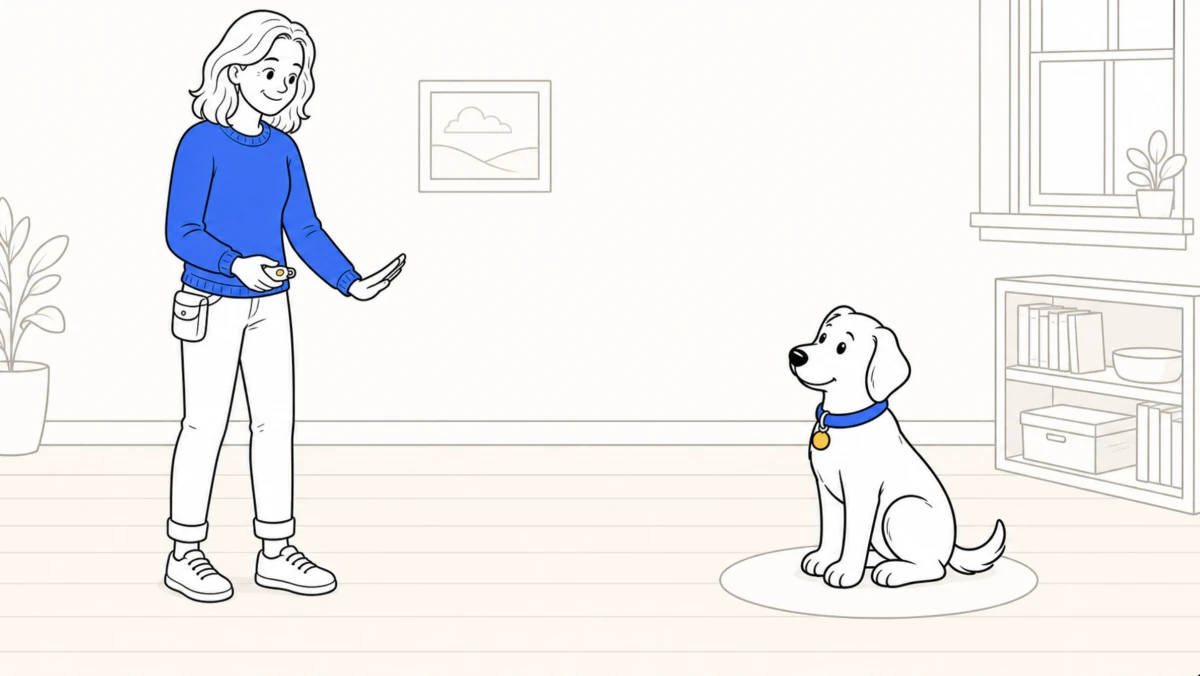
Once sit or down is reliable — usually a few weeks in, not day one — hold a beat, click, treat a step away so your puppy resets, then add a clear release word. Stay isn’t a day-one trick; it’s a duration upgrade on a cue your puppy already knows.
If you’ve already said “stay” three times, watched the puppy bounce up the second you leaned back, and felt the determination drain into quiet guilt, you’re not failing. You’re usually one mechanic away: a shorter beat, a release word used every time, and treats delivered out of position instead of fed in place. Here’s the exact method, the failure modes, and why stay comes after sit.
How do you teach a puppy to stay, step by step?
Start from a solid sit or down, mark a tiny hold, treat away from the spot, then chain a release word — build time in small steps before you ever add distance or distraction. That is the whole skill.
- Ask for a sit or a down your puppy already offers easily. Best Friends Animal Society prefers starting from a down when you can — it’s more comfortable for longer holds.
- For one quiet second, do nothing. The instant that beat is clean — click (or say a crisp “yes”).
- Deliver the treat a clear step away from the stay spot, or lightly toss it so your puppy must leave position to collect it and reset. Do not feed into the mouth while they are still holding.
- Add a release word (“okay,” “free,” or “release”) that ends the stay. Say it, then click the get-up and pay. Use that word every single time the stay ends.
- Raise the hold by a second or two at a time. Mix easy one-beat stays back in whenever your puppy struggles. Only after short stays are boringly reliable do you add one step of distance — then small distractions — never all three at once.
This is reward-based training in the AVSAB sense — “only reward-based training methods” — a marker and food, not a leash yank or a scolding “STAY.” For what the marker is doing under the hood, see what clicker training is and whether it works. If you haven’t charged a clicker (or “yes”) yet, clicker training on day one covers the five-minute charge test.
What’s the exact moment to click when teaching stay?
Click when the current duration criterion is met — then treat away so the loop can restart — and separately click the correct response to the release word. Those are two different marks, not one mushy “good dog.”
Fairweather’s clean loop is: criterion met → mark → treat where the next loop can begin → optional release cue chained as the end. Early on, permission to get up is the reinforcer (the Premack Principle: a likely behavior — jumping up — pays for an unlikely one — holding still).
Should I feed treats while my puppy holds a stay?
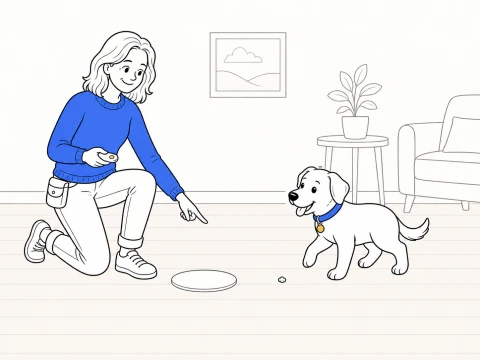
Not if you want a stay that gets longer — mark the duration, then treat away from the spot so the next loop can start. Clicker trainer Helix Fairweather names feeding in position as the classic trap: as Fairweather puts it, that teaches “This is a very nice place to be.”
That is classical conditioning instead of an operant offer of duration. Helix Fairweather recounts Karen Pryor calling intermittent treating during a stationary behavior “slovenly training”; the click carries the information, not a drip of cookies in place. Some popular guides eventually drip treats during a long hold — Fairweather’s line (and the one we use here) treats that as the ceiling on how long a stay ever gets.
Why does my puppy break a stay?
Usually the release was unclear, duration jumped too fast, distance or distraction got stacked on too soon, or treats were fed in place so the stay never had a clean end. Fix the mechanic — don’t raise your voice.
| What you see | Likely cause | Fix |
|---|---|---|
| Pops up the second you lean or step back | Body language became the cue; duration too long for the new move | Stay still; shrink the hold; add distance one step at a time |
| Holds until you dig for a treat, then breaks | Treated in position / unclear end | Click the beat, treat a step away, use the release word every time |
| Nails kitchen stays, fails in the hallway | Context never practiced | Drop expectations one notch; re-earn easy wins in the new spot |
| Breaks the moment anything interesting happens | Distraction added before duration was solid | Back to one-second holds; tiny distractions first |
| Creeps forward inch by inch | Criteria fuzzy; antsy moment marked by accident | Mark only calm stillness; if feet fidget, wait for stillness before you start the count |
Don’t punish a break — the AKC’s stay troubleshooting is blunt on that — and watch your body language: backing up invites a follow. Fairweather’s timing caution: if you release or click the instant your puppy gets antsy, you reinforce antsy, not stillness.
What age can you teach a puppy to stay?
Usually a few weeks after sit or down is already reliable — not day one. Stay is a duration upgrade on a cue your puppy already knows. Trainer Lori Chamberland, writing on Karen Pryor’s clicker-training site, is blunt that the first week is not the time for a down stay.
Sit, a hand target, and crate comfort earn early clicks because they are hard to fail. Stay asks for impulse control on top of a position that already works. That is why stay sits last on the first-five commands list and why the ClickerPup curriculum treats duration as a proficiency criterion inside sit and down — a beat of holding — rather than a separate day-zero skill. If sit is still wobbly, fix sit first; duration has nowhere to land.
What’s the difference between stay and wait?
Stay means hold this exact position until you hear a release word. Wait is a short pause — hold on a moment — without the same until-released rule. The AKC draws that line clearly; pick one release word (“okay,” “free,” or “release”) and use it the same way every time.
Be careful with “okay” in casual speech — the AKC notes it is easy to say by accident and accidentally end a stay. Whatever word you pick, exclusive use matters more than which synonym you chose. Some trainers build an automatic stay into sit or down (hold until released, no separate “stay” word); others add an explicit “stay” cue with a stop-hand signal. Either works if you are consistent. What fails is mixing them — sometimes “sit” means freeze, sometimes it means a quick perch for a treat.
How do you add duration, distance, and distraction without breaking the stay?
Raise one variable at a time. The AKC’s three Ds — duration, distance, distraction — match what Helix Fairweather’s stay work practices as tiny criteria changes (never lumped). When you add a new D, lower the others.
How do you build duration first?
Stay beside your puppy in a quiet room and lengthen the hold before you move. The AKC’s stay guide suggests getting to about 30 seconds of clean duration before you lean hard into distractions or distance. Best Friends builds the same way: treat quickly at first, then lengthen the wait — still next to them.
How do you add distance and distraction without breaking it?
Add one step of distance or one tiny distraction only after short stays are easy — and drop duration back down when you do. Always return to your puppy before you release so distance never becomes a secret “come” cue. When you add a clap, a toy flash, or a step toward the doorway, drop back to a one- or two-second hold and re-earn success. Stacking a long hold + leaving the room + the doorbell on day three is why stays feel impossible.
How long should a stay training session be?
About two minutes and a handful of short, successful holds, then stop while your puppy is still winning. Mix easy one-second stays in with the harder ones. Short sessions that end on a clean success beat one long drill that turns into guessing.
Fairweather’s session notes read the same: tiny criteria early (a count of “a-b”), plenty of easy reps mixed with stretches, and drop the plan the moment frustration shows — shorten the hold, simplify, recover. If you want the research behind short-and-spaced practice, how long puppy training sessions should be covers the timing evidence in one place.
When is stay trouble actually something else?
A puppy who stiffens, freezes, growls, or panics when you walk away is not “failing stay” — that can be fear or separation distress, and it needs a professional’s eyes, not harder reps behind a closed door.
Mouthing at your hand during early stay practice is usually normal exploration and teething under about six months — keep sessions short and end on a win. What isn’t normal: a stiff body, growling when you approach the stay spot, frantic distress when you step out of sight, or a bite that breaks skin from a dog older than about six months. Those deserve an IAABC-certified behavior consultant (iaabc.org), not another duration drill — here’s what’s normal and when to get help.
Stay is one short skill with a clear click-point, one non-negotiable mechanic (treat away, release every time), and a job that only starts after sit or down already works. If having a coach plan today’s two-minute stay session — and catch the moment you almost fed in place or stacked distance too soon — sounds useful, that’s exactly the gap we’re building ClickerPup to fill.