
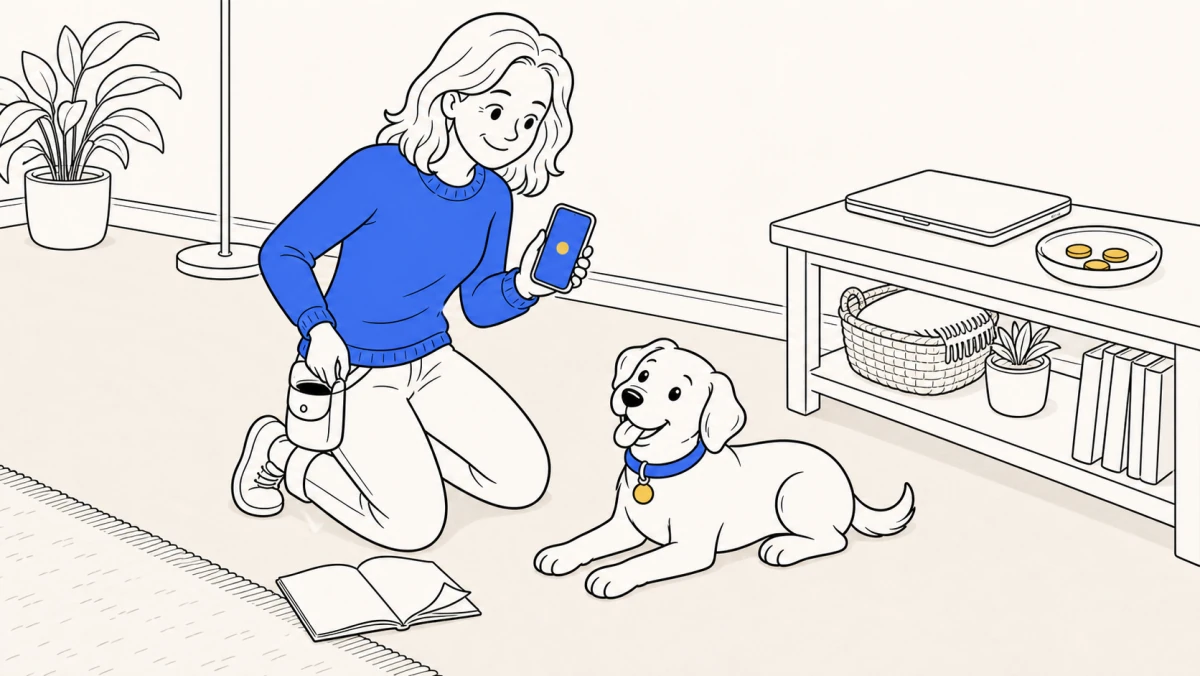
Yes — for a normal dog learning normal skills, almost entirely. The training method itself is public and free: the veterinary standard is a downloadable PDF, several complete puppy courses cost nothing, and a clicker costs a few dollars. What free doesn’t include, unless you go looking for it, is a schedule and someone watching to tell you when to make it harder.
That’s a real answer rather than a consolation prize. It’s also worth saying at the top that we sell dog training — or will, once our app launches — which is a reason to read this page with your guard up.
So here is the version we’d want if we were on your side of the screen. Search “free dog training” and you mostly get offers rather than answers: of the eighteen results we logged in July 2026, seventeen were either offering free training or listing free resources, and the eighteenth was a Reddit thread. Below is what free covers, what it costs that isn’t money, which resources are worth your time, how to tell a good one from a dangerous one, and why the free route collapses for people who could have made it work.
What can you actually train for free?
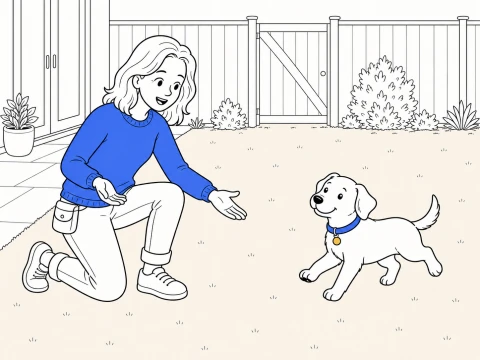
Everything a first-time owner normally needs. Sit, down, stay, recall, loose-leash walking, settling, leave it, and the manners that stop a puppy running your house are not proprietary knowledge. The mechanics of marker training — mark the exact instant the behavior happens, then pay for it — are public, and the marker itself can be a clicker costing a few dollars, or the word “yes” in your own voice, which costs nothing at all.
So the shopping list for a free route is short: a marker, something your dog will genuinely work for, and a plan for what to teach in what order. The plan is the part people skip, and it’s the part that’s free in the most abundant supply. Our own complete guide to training a puppy is free, and so is what clicker training is and whether it works — which is the least surprising sentence on this page, because that is how content sites work. The question worth asking isn’t whether free material exists. It’s which free material, and whether you’ll finish any of it.
What does free dog training cost you?
Three things: your time, usually an email address, and the work of deciding which advice to trust. The third one is the expensive one, and it’s expensive because the signals you’d normally use to sort good advice from bad mostly aren’t there.
That isn’t a hunch. Kuhl and colleagues, writing in Veterinary Record in 2022, ran Google searches using search terms taken from real dog owners and critically appraised what came back — 121 unique resources in 2014 and 102 in 2021. Their subject was dog care generally rather than training specifically, and the searches were UK-based, but the pattern is the one that bites here. On both occasions, the majority stated no author, offered no supporting evidence, made no reference to other resources and provided no reference list. Only 45.1% of the 2021 results were dated and just 34.3% named an author. Their conclusion is the one worth carrying around: “reliable indicators of quality were lacking, posing a barrier to owners’ identification of trustworthy information.”
The smallest cost is the one you’ll meet at signup. Free courses are usually free in exchange for your inbox, and the good ones say so plainly — Pupford answers its own FAQ, “Why do you need my email address if it is free?”, with “Having your email address allows us to send you relevant training tips, videos, and product recommendations to help your pup!” That’s a fair trade. It’s just worth knowing it is a trade, and it’s the same trade our own waitlist asks for at the bottom of this page.
And free doesn’t reduce the first cost at all. Training is repetitions, and the repetitions are yours either way — a few minutes at a time, most days, for months.
Which free dog training resources are worth using?
The short list below is six resources we opened and checked in July 2026, plus one phone call only you can make. Two are the current published method standard from veterinary bodies, three are courses or article libraries you can work through, and one is a problem-by-problem behavior reference. All six are free, and every one sits on the reward-based side of the line. The seventh is your local shelter, which is free but varies — and judging it is what the next section is for.
| Resource | What it is | Why it’s on this list |
|---|---|---|
| AVSAB Position Statement on Humane Dog Training (2021) | A short position-statement PDF from a veterinary behavior body | The published method standard, in writing, in plain language |
| AAHA 2015 Canine and Feline Behavior Management Guidelines | Free-to-read veterinary practice guidelines | Names the specific tools and techniques to walk away from |
| Dunbar Academy free course collection | Free courses plus three free eBooks by Dr. Ian Dunbar | A real curriculum, written by a veterinarian and behaviorist |
| Pupford’s 30-Day Perfect Pup, with Zak George | A day-by-day video course | Structure and an order of operations, “100% free forever! No credit card required!” |
| Karen Pryor Clicker Training’s resource library | A free online article library | Depth on the marker method itself, from the people who popularized it |
| ASPCA, Common Dog Behavior Issues | Free behavior articles | A problem-by-problem reference for when something specific goes wrong |
| Your local shelter or humane society | Free helpline, workshops, or low-cost classes | A trained human, for nothing, on your actual dog |
The one that’s easiest to overlook is the last one. Oregon Humane Society, for instance, publishes a free behavior line: “Call our free Pet Advice Help Line, leave a recorded message, and one of our knowledgeable behavior experts will return your call to offer suggestions.” Not every shelter runs one, the ones that do differ, and the person who calls back may be a trained staff member rather than a certified behavior consultant — so this is a phone call to find out rather than something anyone can promise you nationally. It is still the cheapest route to a trained person’s eyes on your specific dog.
We left apps off the list, for two reasons. The first is that a genuine free tier is a different product from a free trial that converts, and the difference isn’t visible from the App Store page. The second is that we’re building one, so we have an interest in the answer — we do publish a comparison of the best puppy training apps, with that stated on it, and you should read it with the same suspicion you’d bring to any of this. The free courses above cover the same ground with no billing question attached at all.
How can you tell if free training advice is safe to follow?
Check the method first, before you check anything else, because nothing about where a video sits in your search results tells you how it trains. The standard is published, short, and free: AVSAB’s 2021 position statement recommends “that only reward-based training methods are used for all dog training, including the treatment of behavior problems.”
The American Animal Hospital Association’s 2015 behavior guidelines are blunter about the hardware, and they’re free to read on AAHA’s own site: “Aversive techniques include prong (pinch) or choke collars, cattle prods, alpha rolls, dominance downs, electronic shock collars, lunge whips, starving or withholding food, entrapment, and beating. None of those tools and methods should be used to either teach or alter behavior.”
Here is how live that problem is, at the very top of the field. In 2025 AVSAB’s board published a statement because, in its own words, “an outdated and since-rescinded AVSAB document has been circulating recently, suggesting that the use of aversive tools may be appropriate in certain situations.” The clarification leaves no room: the 2021 statement is “the most current and authoritative expression of our views,” and aversive methods “should not be used under any circumstances.” If the leading veterinary behavior body in the country can have its own superseded guidance circulating as though it were current, a video you found in a search result has no chance of being filtered for you. Check the date on anything you’re about to follow, and check it against the current statement.
Run that check on everything, paid and free alike, and the reason is in the survey data. When Herron, Shofer and Reisner collected surveys from 140 owners arriving at a referral behavior service between April 2007 and May 2008, they asked where each technique the owner had already tried had come from — and the answer varies sharply by technique. Price was never in the picture — the survey didn’t record it — but the pattern is instructive anyway. These are small numbers from a referred, behavior-problem population, so nothing below is a general-population rate — but the shape is worth seeing. Of the 28 owners who had hit or kicked their dog, 22 (79%) had come to it on their own and not one named a trainer. Of the 53 who had used a choke or prong collar, 35 (66%) got it from a trainer, and of the 30 who had forced the dog down with the leash, 21 (70%) did. Television topped the list for exactly two of the thirty techniques — a “schhhtt” sound correction (34 of 77, 44%) and abruptly jabbing the dog in the neck (13 of 20, 65%) — both classed in the study as aversive confrontation, and neither belonging anywhere in a reward-based toolkit. Paying somebody is not the filter. The checklist is. And in the same survey several confrontational methods drew an aggressive response from at least a quarter of the dogs they were tried on: hitting or kicking 43%, growling at the dog 41%, alpha rolls 31%.
So four questions, aimed at a free video or article, where you have no trainer in front of you to ask:
- Does it name what it’s doing? Marking, rewarding, luring, capturing — if a source never says, you have nothing to check it against.
- Does it name an author, and is it dated? Kuhl’s review found most don’t. A missing byline isn’t proof the advice is bad; it’s proof you can’t tell, which is the same problem from your side of the screen.
- Does it reach for anything on AAHA’s list? Prong or choke collar, e-collar, alpha roll, dominance down. Those are named in the guidelines above, and they’re a full stop, not a preference.
- Does it make you feel bad? A source that frames your dog’s ordinary pace as a failure is telling you about its own standards, not about your dog. That’s a reason to close the tab, not to try harder.
The same four questions work on a person, with one addition a video can’t offer: ask to watch a session before you book, and watch the dogs rather than the instructor. What it costs to find out is covered in what puppy training actually costs.
Why does free dog training fail for some people?
Because “free” usually turns into “search results,” and search results are not a curriculum. The owners it works for pick one free program and finish it. The owners it fails for open a new tab per problem, skim a handful of contradictory threads, try the easiest-sounding one twice, and conclude the method doesn’t work — when what didn’t work was running several methods at once. That last part is our read rather than a research finding, but the finishing half of it has been measured.
Harris and colleagues, publishing in Animals in 2019, ran free dog-training classes in areas of high economic deprivation in the UK and tracked who completed them. Of the 32 people who started the free online course, not one finished — most didn’t complete a single module. The free face-to-face course lost 43%. A paid course of classes running in the same area lost 24%. Read that carefully, because the authors do: the free groups were recruited cold at community events and were not necessarily looking to sign up for training classes before they turned up, while the paying group had gone looking for classes themselves and had already handed over money, which the authors flag as a sunk-cost effect. So it is not a clean test of free against paid. What does transfer is their reading of the online collapse: the face-to-face course let people “ask the trainer questions, and receive feedback on their practical skills,” and the online course did not.
That’s the same gap Kuhl’s review implies from the other end. If the quality signals aren’t on the page, you can’t rank the advice by looking at it, so you sample instead. And when you are your own main source — one of the two most common categories in the Herron survey — nothing external ever interrupts the sampling.
Four questions tell you which side of that line you’re on. Each is something a class supplies at least partly by default, and a free route has to supply entirely for itself:
- Can you name the program you’re following? If the honest answer is “bits from a few places,” you have research, not a plan. Pick one of the free courses above and finish it before you add a second.
- Is there a time it happens? A class is an appointment you’ve already paid for. Free has none, so attach two minutes to something you already do every day and let the calendar make the decision instead of your energy levels.
- Do you know what “ready to make it harder” looks like? This is the judgment call a page can’t make for you, because a page says the same thing to every reader regardless of how your last session went. The usable rule falls out of how Karen Pryor describes shaping: raising a criterion is what makes the reward unpredictable for a while, and “when the dog is meeting the new criterion every time, the reinforcement becomes continuous again” — which is your signal that it’s solid enough to raise again. If a behavior stops happening altogether, her own recovery options are “reducing your criterion… or simply asking for some other well-learned behavior, or waiting an hour or a day and trying again.” There’s more on that in training a dog with treats.
- Would you notice if nothing changed for two weeks? A trainer would. On your own, most people don’t, because the dog is in front of you all day and there’s no baseline to compare against. Write down today what your dog can do, in which room, at what distance — one line — so that in two weeks you’re measuring against a record instead of a feeling.
Four yeses and the free route is genuinely enough for a normal dog learning normal skills. Two or more noes and the honest recommendation is a class — not because a class teaches a better method, but because it supplies some of that structure for you. That’s a perfectly good reason to pay, and it’s a completely different reason from the one the marketing gives you.
Does paying for dog training get better results?
No study we could find compares training outcomes by how much the owner paid, so nobody can honestly tell you that spending more produces a better-trained dog. What the research does cover is method and timing — and on those, the playbook that works is the same either way, because it is a public document. Which is not the same as saying everyone charging money follows it, as the survey above shows.
Dinwoodie, Zottola and Dodman’s 2021 survey of 641 owners covering 1,023 dogs found that dogs trained at six months or younger had lower odds of owner-reported aggression (odds ratio 0.71, 95% CI 0.53–0.97), compulsive behavior (0.64), destructive behavior (0.60) and excessive barking (0.68). Method showed up too, and it was the only method variable that did: dogs put through a reward-based program “had 0.52 the odds of developing aggressive behavior” (95% CI 0.28–0.96). The survey recorded no cost or price variable at all, so it says nothing either way about spending.
Three things stop that being read as evidence that a class adds nothing. It’s a retrospective owner survey, and the authors say plainly that “recollections can sometimes be unreliable.” It’s correlational, so it cannot establish that the training caused the difference rather than the difference prompting the training. And it isn’t uniformly flattering: early-trained dogs showed higher odds of reported house soiling (1.56), and for the equivalent finding the authors think the explanation runs the other way round — house soiling being the reason those puppies were taken for training in the first place, in a sample where 78% of the dogs were reported to have had a house-soiling problem. In that sample — self-selected, not national — 48% of the dogs had attended puppy training and 52% had not.
What money genuinely buys is worth naming rather than talking you out of: appointments you’ve already committed to, a second pair of eyes on your timing, and other puppies to practice around, which is the one ingredient a living room cannot supply. It is not a guarantee either — in the Harris study, roughly a quarter of the people who paid still didn’t finish the course. We’ve mapped what each format costs and what it buys in how much puppy training actually costs.
When is free dog training not enough?
When the problem is aggression, real fear, reactivity, or separation panic. Those aren’t budget problems, and they are the category where free isn’t just thin — it’s the wrong call. They need someone who can see your dog, and the published guidance is explicit that aversive handling makes fearful and aggressive dogs more dangerous, not less. AAHA’s guidelines put it directly: aversive techniques “are especially injurious to fearful and aggressive patients and often suppress signals of impending aggression, rendering any aggressive dog more dangerous.”
Our guide to what’s normal puppy behavior and when to get help covers the red flags in detail. If you’re seeing them, the International Association of Animal Behavior Consultants keeps a free consultant locator at iaabc.org — the directory costs nothing even though the consultant won’t, and this is the one line on this page we’d tell you to spend money on rather than around.
Even here, run the same check the rest of this page describes, because a credential is only as good as the standard behind it and the standards genuinely differ between bodies. Read the organization’s own published position rather than the acronym on the certificate. IAABC’s Standards of Practice say that “positive reinforcement should be the primary training strategy,” that the association “opposes the intentional use of methods involving pain, fear, or intimidation,” and — since February 2025 — that it “requires members to refrain from using shock in training or behavior modification.”
There’s another, much less alarming place free runs out: one specific skill that has genuinely stalled for weeks while everything else keeps moving. In our experience that is usually a timing problem someone else can spot quickly and you can’t spot at all, because you’re inside it. One paid session is a sensible purchase there. A whole program isn’t.
The honest bottom line
Free training works, and free is not a smaller version of paid — the method that works is the same either way, because the standard is a public document anyone can download. What a self-directed free route doesn’t include is an appointment and an outside pair of eyes. The first you can build with a calendar and a notebook. The second you can often get free, from a shelter helpline or a workshop, which is why it’s on the list above. And one thing neither a free course nor any app can give you is other puppies to practice around — for that, a class is the answer, and it is the best reason on this page to spend money.
Which leaves the thing we’re building, and its honest limit belongs in the same breath: an app can’t see your dog either. It reads what you tell it. What it can do that a page can’t is answer what you logged last time instead of saying the same thing to every reader. ClickerPup is a force-free, clicker-first coaching method for the first weeks with a puppy — short sessions, and a plan for the next one based on how the last one went. It isn’t launched, so there’s no price to quote and nothing to claim about results. What we can commit to is what our home page already says: the clicker stays free forever, there’s a plain reminder before anything charges, and canceling takes about 30 seconds.
Claim my early spot and we’ll bring you in as we open up.